Telemedicine App Development Company

Why Telehealth App Development Services Matter

Telemedicine application development services became a top priority for Topflight long before the COVID-19 outbreak. The case for virtual care has only grown since: patients expect it, payers reimburse it, and providers rely on it to extend capacity without adding clinic space. Here is what a well-built telehealth product does for patient care.

Remote-Care-Access

Remote Care Access

Patients connect with healthcare providers from wherever they are. Distance, mobility limits, and local specialist shortages stop deciding who gets seen. Virtual visits bring care to rural and underserved communities that would otherwise wait months for an appointment.

24:7-Patient-Support

24/7 Patient Support

Care does not end at closing time. Secure messaging, symptom checkers, and follow-up reminders keep patients supported between appointments, while on-call clinicians pick up urgent cases over video at any hour.

Lower-Cost-of-Care

Lower Cost of Care

Every consultation moved online cuts overhead for clinics and travel costs for patients. Fewer no-shows and reduced readmissions add up fast. For most medical organizations, telehealth pays for itself sooner than any other digital investment.

Faster-Care-Delivery

Faster Care Delivery

Video visits and asynchronous follow-ups replace weeks of waiting with same-day answers. Triage happens sooner, and treatment starts before a condition gets worse.

Better-Patient-Outcomes

Better Patient Outcomes

Continuous contact beats episodic care. Regular check-ins keep patient engagement high and catch complications early, which is exactly what value-based care models reward.

Reliable-Video-Consultations

Reliable Video Consultations

Secure video consultations are the core interaction of any telemedicine product, so they have to hold up on a weak rural connection as well as on hospital Wi-Fi. We engineer for low latency and stable quality even when the network is not.

Challenges We Solve With Our Telemedicine App Development Services

Founders and clinic operators rarely come to us out of curiosity. Something specific is broken or about to break. These are the six problems we get hired to fix most often.

Slow Time-To-Market

A telehealth product that ships in 18 months enters a different market than the one it was planned for. We compress timelines with proven module blueprints for video, chat, and scheduling, so your budget goes into what makes the product different rather than rebuilding table stakes.

Fragmented Systems

Video in one tool, notes in the EHR, labs in a third system, and staff copying data between all of them. We connect telemedicine apps with EHR systems, lab systems, and pharmacy software through FHIR and HL7, so clinical data lands where clinicians actually work.

Compliance Burden

HIPAA plus state-by-state telehealth rules: regulatory compliance can stall a release for months when it is treated as an afterthought. We bake data security and audit trails into the architecture from the first sprint and document everything your compliance officer will ask for.

Scaling Problems

A platform that works for 200 patients can fall over at 20,000. Our telehealth app developers design for elastic cloud infrastructure from day one, load-test before launch, and keep video quality stable when usage spikes on a Monday morning.

High Churn

Patients download a telehealth app, use it once, and disappear. We design onboarding that gets users to a first visit fast, then bring them back with reminders and patient engagement loops informed by analytics rather than guesswork.

Billing Friction

Telehealth visits that cannot be billed correctly bleed revenue. We integrate billing systems and payment gateways, map visit types to the right codes, and support both insurance claims and direct-pay flows so the money side keeps up with the care side.

Request a proposal for an app

Telemedicine App Development Solutions We Build

Specialty shapes the product: a dermatology consult and a dialysis check-in need different features, workflows, and integrations. As a telemedicine apps development company, we have shipped custom telemedicine app projects across the disciplines below.

Teledermatology

Store-and-forward consults where patients upload high-resolution skin photos for dermatologist review, plus live video for follow-ups. Image handling built to PHI storage requirements.

Teledentistry

Virtual triage saves chair time. Patients share photos or join a video call so dentists can assess urgency, give aftercare guidance, and book in-office visits only when drilling is actually required.

Teleneurology

Remote stroke assessment is time-critical. We integrate video exams with connected medical devices and standardized scoring tools like NIHSS for neurology teams.

Telemedicine in Obstetrics and Gynecology

Prenatal check-ins, postpartum support, and contraception consults from home. Apps we build pair video visits with home monitoring data like blood pressure and fetal heart rate.

Telepharmacy

Pharmacists counsel patients over video or chat while the system routes e-prescriptions and flags interactions automatically. Adherence check-ins keep refills on schedule.

Telesurgery

Pre-op education, surgical consults, and post-op wound checks over secure video. For the OR itself, we build the data and video infrastructure that supports remote proctoring.

Telecardiology

ECG and blood pressure data from wearables streams into clinician dashboards. Cardiologists review trends, run video consults, and escalate when readings cross thresholds.

Teleophthalmology

Remote vision screening and retinal image review for diabetic retinopathy programs. We connect fundus cameras and build the referral workflows around them.

Telenursing

One nurse can cover far more patients with the right tooling: triage queues, chronic care check-ins, and post-discharge follow-ups with protocols built in.

Telerehabilitation

Guided exercise programs with video form checks, progress tracking, and motion data from phone sensors. Patients stick with rehab when it does not require a commute.

Telepathology

Whole-slide image sharing and remote case review between labs and specialists. We solve the unglamorous parts: huge file transfers, viewers, and audit trails.

Telenephrology

Remote management for CKD and home dialysis patients: device data intake, lab result tracking, and scheduled video rounds with the care team.

Telepsychiatry

Therapy and medication management over video, with scheduling, intake forms, and outcome measures like PHQ-9 built into the flow. Privacy handled with extra care.

Doctor on-demand Software

On-demand consults: a patient requests a visit and the system matches an available licensed clinician in minutes. Routing, payments, and provider availability included.

Technologies We Use for Telemedicine App Development Solutions

No two builds use an identical technology stack, but the toolbox is stable. We pick advanced technologies with BAAs, documentation, and a production track record in healthcare, then wire them for secure data transmission end to end.

Video and real-time communication

WebRTC, Agora, Twilio Video, and Vonage for low-latency calls, group sessions, and in-visit chat that holds up on weak networks.

Cloud and compliance infrastructure

AWS, Google Cloud, and Microsoft Azure with HIPAA-eligible services under a BAA. Patient data encrypted at rest and in transit, with audit logging baked in.

Mobile and web

Swift, Kotlin, and React Native for mobile, React for web. HealthKit and Google Fit for device data on each platform.

Interoperability and AI

FHIR, HL7, and SMART on FHIR for EHR connectivity. On the AI side: symptom triage, ambient note-taking, and chat assistants under clinician control.

Our Telemedicine Clients

cedars sinai
cleveland clinic
stanford medicine
merck
medable

Our Web-Based Telemedicine App Development Services

Browser Access Across Devices

Web-based telemedicine applications connect clinicians and patients through nothing more than a browser. No app store, no installs, no IT tickets. We build responsive layouts that hold up on a phone in a parking lot as well as on a clinic workstation.

EHR Integration And Interoperability

A web telehealth product earns its keep when it talks to the rest of the stack. Our telehealth software development services cover FHIR and HL7 work, patient portals, and syncing visit notes back into electronic health records, so medical records stay complete.

Request a proposal for an app

Mobile Telemedicine App Features

Telemedicine mobile application development is where most patient interactions actually happen. As a telemedicine mobile app development company, we ship native and React Native apps for iOS and Android with this feature set as the baseline.

Video Visits

One-tap secure video consultations with waiting rooms, multi-party calls for caregivers or interpreters, and quality that adapts to the connection.

Secure Messaging

HIPAA compliant chat for follow-ups, photos, and care instructions. Messages sync across devices and land in the visit record.

Appointment Scheduling

Self-service booking against real provider availability, with reminders that cut no-shows and rescheduling that does not require a phone call.

E-Prescribing

Prescriptions route to the patient’s pharmacy during the visit. Refill requests and medication lists stay in the app.

Remote Patient Monitoring

Readings from wearables and connected medical devices flow into the chart between visits, with alerts when values drift.

We cover the full cycle of telehealth mobile app development services: HealthKit and Google Fit integration, push notifications, mobile payments, and app store submission.

Telemedicine App Integrations

A telemedicine app that stands alone creates double work for staff. As a telehealth app development company, we treat integrations as core scope, not an add-on phase.

EHR / EMR Integration

Visit notes, vitals, and prescriptions land in the patient’s chart automatically. We have integrated telehealth products with Epic, Oracle Health, athenahealth, and smaller EHR vendors, using native APIs where available and middleware where it saves months.

FHIR And HL7 Standards

Standards work is what keeps an integration alive after launch. We build on FHIR resources and HL7 v2 interfaces, and reach for SMART on FHIR when your product needs to run inside the EHR rather than next to it.

Payment Gateways

Stripe, Braintree, and healthcare-specific processors for copays, subscriptions, and superbills. We handle the awkward parts: split billing between insurance and patient, refunds for cancelled visits, and PCI scope kept away from your servers.

Wearables And Medical Devices

Apple Watch, Fitbit, glucometers, blood pressure cuffs, pulse oximeters: device data feeds remote patient monitoring and flags deterioration early. We work through HealthKit, Google Fit, and vendor APIs, then normalize readings so clinicians see one consistent stream.

Why Topflight Apps?

pharmacy app developers

Healthcare Product Experience

Topflight has been mastering healthcare apps development services since 2015. As a telemedicine app development company, we have shipped products for Medable, Stanford Medicine, Athcorp, ARA Genomics, and Cleveland Clinic. Our telemedicine app developers already know the difference between a consent flow and a clickwrap, so nobody learns healthcare on your dime.

Scalable And Secure Architecture

We build telemedicine solutions that absorb a surge in demand and scale as new users onboard. The stack leans on time-tested cloud platforms like AWS, Google Cloud, and Microsoft Azure, which provide HIPAA compliance as a service, paired with WebRTC technologies like the Agora SDK for ultra-low latency. Your users stay connected even when their network misbehaves.

healthcare and pharmacy app development
building telepharmacy application

Interoperability And Real-Time Care Delivery

A telemedicine platform earns clinician trust by moving data as fast as it moves video. We wire FHIR and HL7 connections so visit outcomes reach the EHR in real time, and we design around live clinical workflows: scheduling that respects provider calendars, alerts that find the on-call clinician, records that follow the patient.

AI And User-Centered Product Design

AI and Machine Learning are now baseline expectations in virtual care: smart symptom tracking, triage chatbots, preventive care nudges. We pair them with the user-centered design framework from our custom mobile app development process, verifying every assumption with real user testing. Whether built for clinicians or patients, the result is an interface people actually use.

build telepharmacy app

Although it would be great to start a project having every step completely mapped out, it’s rarely realistic. That’s why we have a process to start lean, iterate fast, and adapt to unexpected challenges to find and maintain market traction.

What Makes A Successful Telemedicine Platform

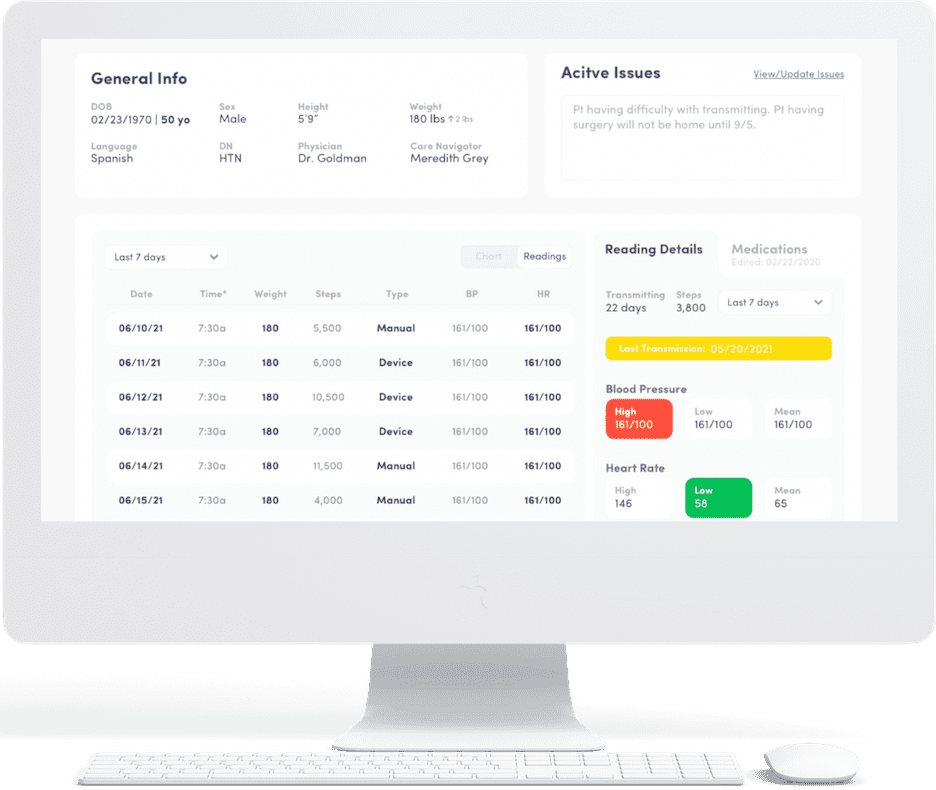
An example of telemedicine enabled software

On-demand teleconsultation app development can be tricky. It takes considerable business acumen to merge the patient’s and the provider’s user experience in a single solution.

A Teladoc-like app may look as simple as FaceTime. Yet the admin panel and data analytics on the provider’s side need to be just as straightforward, with an impeccable interface of their own.

To compete in the telemedicine market, your application must offer glitch-free video conferencing, handle big data, and cover the basics: online appointments, medical history, push notifications, patient monitoring.

In other words, a successful telemedicine platform amalgamates the patient’s and the provider’s experience into one.

Transparency in Our Process:

Telehealth App Development Process in Our Company

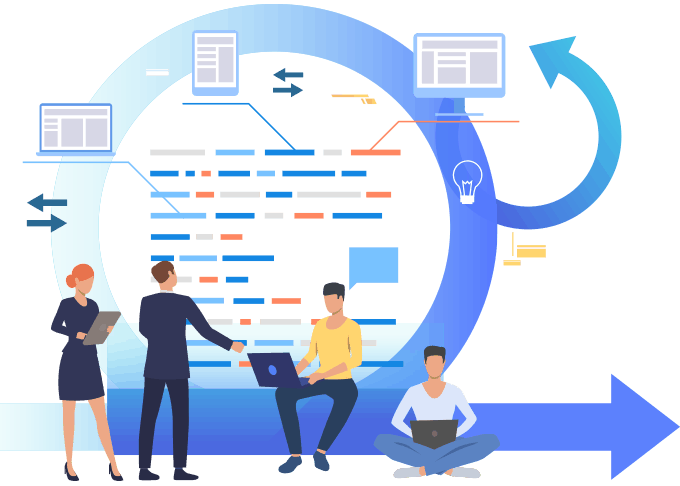
IT specialists working on requirements for a telemedicine app

Requirement Analysis

We start developing a telemedicine services app by aligning the specifications of the telehealth application with your business goals. As the very first step of telemedicine app development, we create low-fidelity mockups and use them as a visual reference to the product we’re developing. Our coding team provides technology recommendations applying the long-term product vision. We comb through available commercial and open-source APIs, SDKs, code libraries, and other components looking for development shortcuts. Finally, we evaluate potential Artificial Intelligence and ML enhancements for your telemedicine solution.

Deliverables: SRS, application estimate

UX Ideation

Unlike other software development agencies that start coding as soon as an SRS is ready, our telemedicine software development company goes into the prototyping mode. A prototype is a clickable app model made of wireframes: a skeleton of the future application. Its purpose is to ideate app features and user journeys. Our telemedicine services development team also reviews the prototype to ensure that it is architecturally consistent and can be realized with the existing tech stack.

Deliverables: Clickable application prototypes

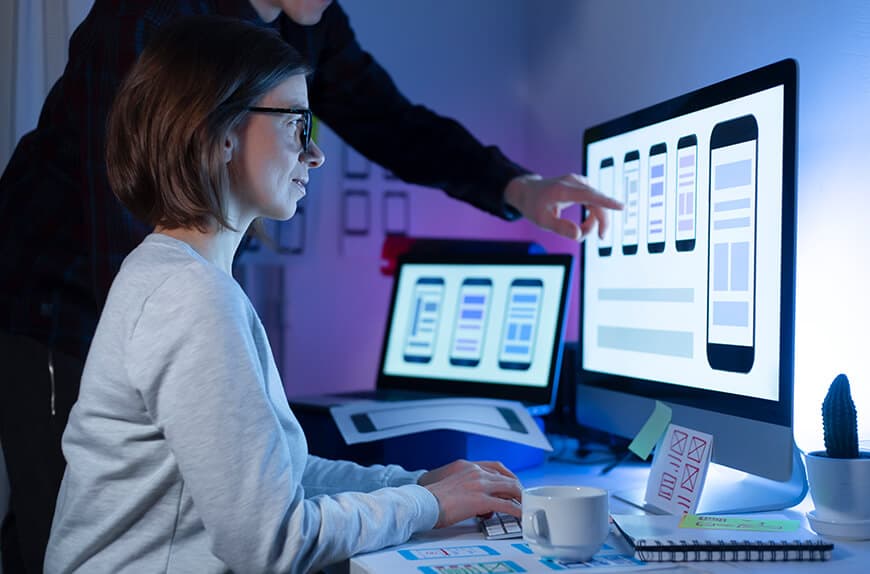
Designers working on the UX for telemedicine software
UI design in action; crafting high-fidelity designs for telehealth apps

High-Fidelity Design

Once the prototype is ready, our app design team steps in and creates an engaging high-fidelity UI. This phase of a telehealth project includes ideation of all visual elements of the solution: from menus to buttons to fonts to animations to static imagery. Our UI team works on iconography, color branding, and other application visuals that affect conversions. The end goal is to update the interactive prototype with high-fidelity designs and make sure users feel comfortable navigating “the app.”

Deliverables: design assets, high-fidelity prototypes.

App Development

This is a culminating phase of the project that combines the results of all previous steps. Our telemedicine services development team starts coding the application’s features using an Agile framework based on biweekly sprints. Throughout the development process, back-end developers maintain complete transparency giving you access to tools that monitor the progress of each feature development. A dedicated product manager/project manager updates you on the project pace after each sprint and demos the app’s beta versions.

Deliverables: application code, beta versions

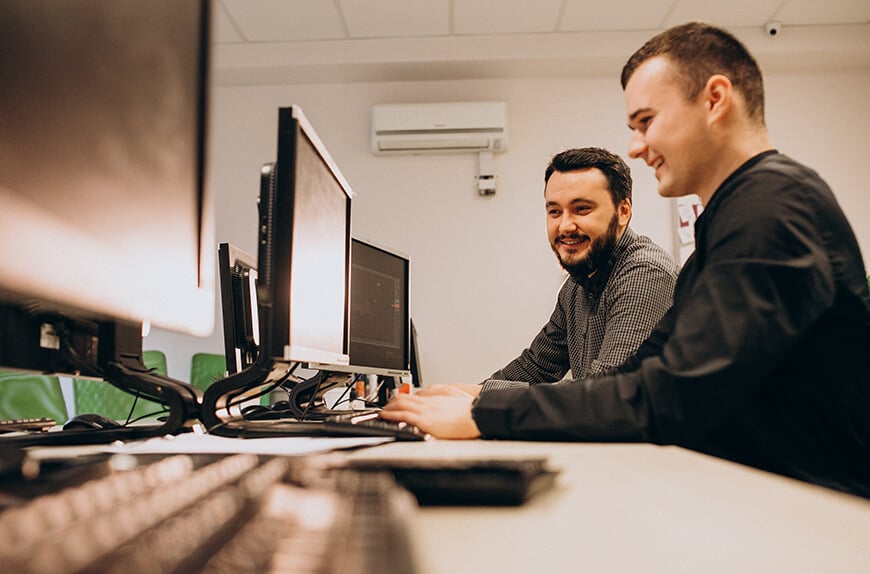
Telemedicine app developers at work
QA engineers testing a telemedicine app

Quality Assurance

Even though we test intermediate results during app development, once the telemedicine app has been built, we carry out another major QA round, including user acceptance testing with your team. Topflight telemedicine application developers program automated tests that test features at the code execution level. That’s also the step when we ask for as much feedback from the customer as possible, advising them to check all potential use cases. Besides that, our team QAs how fast the application loads, carries out stress tests, looks for typos, brand consistency, responsiveness, and a ton of other issues that might harm the UX.

Deliverables: source code, a ready-for-deployment application

Product Launch

We release the telemedicine app to the mobile stores and production cloud hosting as the final step. In addition, our telemedicine mobile application development firm supplies the app’s code so you can maintain complete control over its future, whether that means updates or fixes. Often, our customers prefer to continue working with our telehealth application development company long-term. Such collaboration allows us to seamlessly update the app to support the latest software and OS upgrades. Our corporate clients and healthcare startups don’t have to worry about app maintenance, and the software development process remains cost-effective.

Customers using a mobile telemedicine app on a tablet

Request a proposal for an app

Telemedicine App Development Case Studies

AlgoRX: Prescription E-Commerce Platform

A Shopify-like storefront for non-controlled medications. Patients browse, pass a smart eligibility questionnaire at checkout, and get provider approval without phone tag. We built multi-pharmacy order routing, pre-filled SOAP notes with one-click approvals, and a HIPAA compliant patient portal. The MVP shipped on time, and AlgoRX retained us for ongoing development.

E-commerce + e-prescribing · NextJS, Supabase, DoseSpot

Read the AlgoRX case study

Symptom Tracking Platform for a Telehealth Company

A San Francisco telehealth company hired us for product discovery, UX/UI design, and a web-based, mobile-responsive build in React Native. Patients log daily symptoms, medications, and diet, and clinicians read the trends on a dashboard. The first version got the product off the ground, and the engagement holds a 5.0 rating on Clutch.

$200K · 12 months · React Native

Mobile Telehealth App for iOS and Android

A Michigan-based telehealth founder came to us for native mobile design and development. We built the apps, wired AWS infrastructure and RevenueCat subscriptions, and shipped to both the App Store and Google Play. The client scored willingness to refer at 5.0 in a verified Clutch interview.

~$200K · iOS + Android · AWS, RevenueCat

Testimonials

Our Awards and Industry Recognition

Review platforms that interview real clients keep ranking Topflight among the top healthcare and telemedicine app developers. The recognition below comes from verified, analyst-checked client reviews.

good firms badge

Frequently Asked Questions


How much does it cost to develop a telemedicine app?

It may cost anywhere from US$59,000 to US$149,000, depending on how robust the app will be. That range covers a complete telehealth app built from scratch. HIPAA-compliant AI coding solutions can bring it down to US$10,000 to US$30,000 for run-of-the-mill telehealth apps.

How long does it take to build a telehealth application?

3 to 6 months, but mostly depends on whether you’re envisioning a web app and mobile apps, or a stand-alone responsive web telemedicine app.

Does my telehealth app need to adhere to the HIPAA regulations?

Yes, it will be holding and processing PHI, which needs to remain secure. So your telemedicine solution needs to be HIPAA compliant.

Should I choose an off-the-shelf telemedicine product and apply my branding or instead build a custom telehealth service?

If you need basic telemedicine functionality for your clinic without tight integrations with the existing systems, opt for a ready-made solution. If you want to introduce novel features, and integrate with other platforms, develop a custom telehealth solution.

Which platform is best for my telemedicine app: desktop, mobile, web, etc.?

We recommend you focus on the web and mobile. That way, you’ll be reaching 99 percent of your patients. Make sure you work with an experienced telemedicine application development company.

How does a telemedicine app integrate with EHR/EMR systems?

Through the EHR vendor’s API or interoperability standards like FHIR and HL7. We map which data moves each way (appointments, visit notes, prescriptions, vitals), authenticate via OAuth or SMART on FHIR, and test against the vendor’s sandbox before touching production. Middleware platforms can shortcut connecting to several EHR systems at once.

How do you ensure data security in a telemedicine app?

Encryption in transit and at rest, role-based access control, audit logs, and HIPAA-eligible cloud infrastructure under a BAA. We run security reviews during development rather than after it, and we document every safeguard so your compliance team can pass audits without archaeology.