

Your EHR won’t do this job, and your general CRM may not be legal to put patients in. That’s the wall, and by the time most teams start pricing healthcare CRM development they’ve already hit it. You’ve probably read forty vendor pages getting here. So: which vendor will actually sign, what the thing costs once the license price stops being the number, and what breaks when you wire it to the chart.
- Salesforce lists its healthcare edition at exactly twice the price of the general one.
- Epic sells its own CRM, only to organizations already running its EHR, and one health system ran a competitive process and chose it over Salesforce.
- Not one healthcare-native CRM vendor publishes a price.
Most teams should not build. The useful part is the test that tells you when you’re the exception, plus the two constraints that decide whether that build survives contact with reality: the compliance surface is wider than HIPAA, and the integration seam is narrower than the demo.
Should you build your own healthcare CRM or configure one?
Configure one, unless the relationship workflow is your product or integration depth is the whole point. The configure path publishes its numbers: HubSpot signs a BAA only on Enterprise tiers, and only for features designated as covered services. No healthcare-native vendor publishes a price at all. Whichever path you pick, the compliance surface is wider than HIPAA and the EHR seam is read-mostly, so budget for a data hub in the middle.
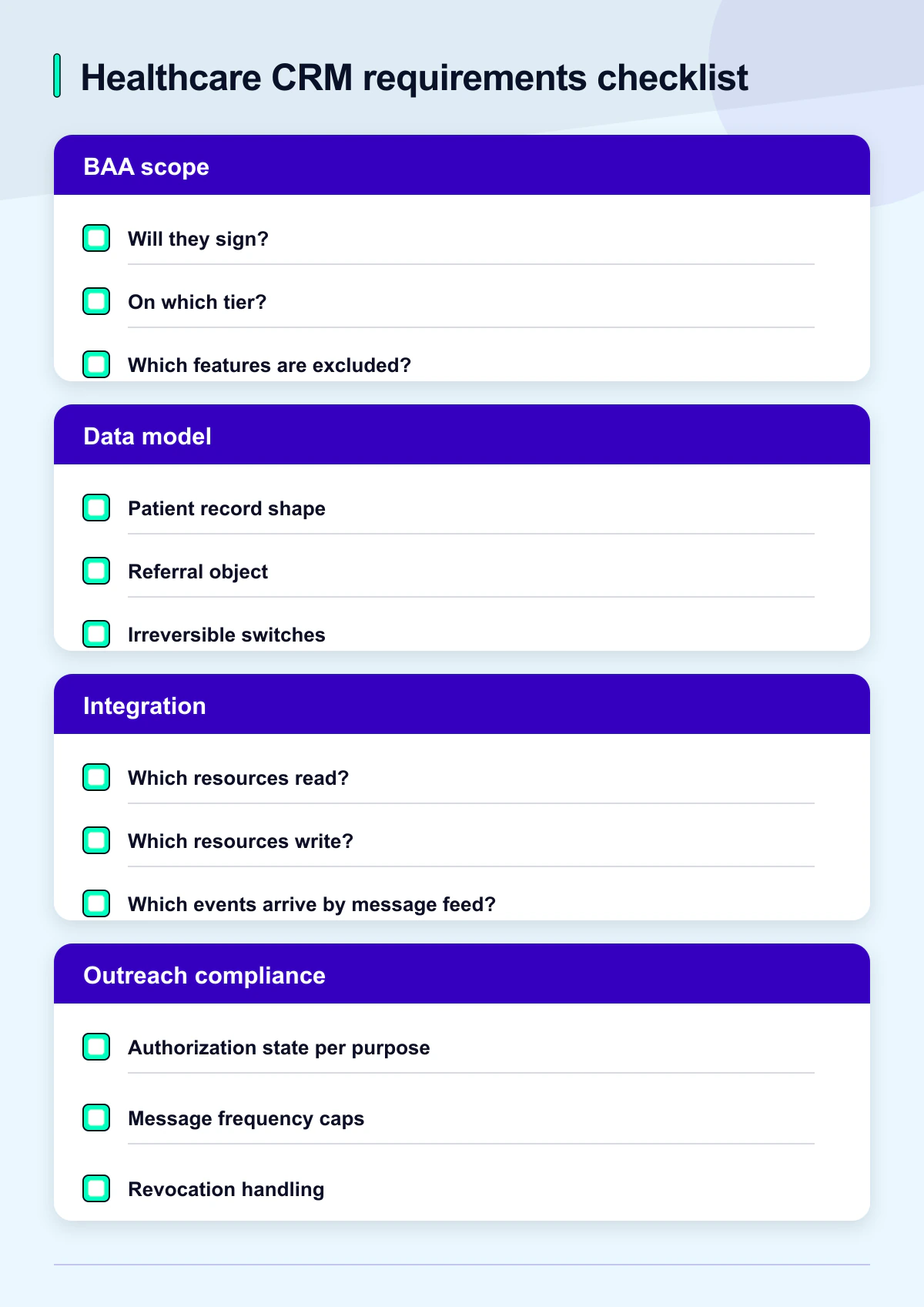
Key Takeaways:
- The system you assumed was unregulated carries patient rights. PHI a covered entity keeps in a CRM and acts on sits inside the designated record set, so access and amendment requests run on a 60-day clock.
- The first vendor gate is what the signature covers. Every general CRM will sign something, but coverage stops at designated features and the exclusions sit in a document outside the agreement. The healthcare-native path publishes no price at all.
- The seam is read-mostly, so the hub is a line item. The resources a CRM needs are read and search only, scheduling is absent, and no subscription resource exists, so events arrive over HL7 v2. Both regulators land in the schema for the same reason.
- Healthcare CRM vs EHR: your EHR is a certified record, your CRM is not
- What a healthcare CRM actually does: a sales object model bent around patients
- Provider CRM vs patient CRM vs pharma support: pick the flavor before the vendor
- Build vs buy: most teams should not build, and here is the test
- HIPAA, TCPA, and your CRM: the marketing line turns on who paid for the message
- EHR integration: FHIR R4, HL7 v2, and the data hub you still need
- Analytics that matter: instrument your own no-show and referral leakage numbers
- Why Topflight Apps for your healthcare CRM build
Healthcare CRM vs EHR: your EHR is a certified record, your CRM is not
An EHR is the clinical system of record, built for care delivery and the legal retention that follows it. A CRM is the relationship and revenue system, built for acquisition, intake, referrals, outreach and retention. They integrate; neither substitutes for the other.

The line between them is drawn in federal law, which defines one of these systems and has no definition at all for the other. That single asymmetry decides more about your build than any feature comparison will.
One system is certified, and the other has no certification to fail
Federal health IT rules define an EHR by certification. 45 CFR 170.102 sets out what a base EHR has to include to qualify, and a product either meets the criteria or doesn’t get certified. Run the same search for a CRM and nothing comes back. No federal rule contains certification criteria for customer relationship management at all, which is why no vendor can sell you a certified CRM even if it wanted to.
So the CRM vs EHR comparison is settled by category before anyone opens a feature matrix. Regulation sets the category, and no vendor gets a vote.
The retention clock runs on the chart. Medicare’s conditions of participation set a floor of at least 5 years for the medical record, while HIPAA sets no medical-record retention period of its own. The system carrying that legal duty is the one you can’t swap out.
One boundary while we’re here: what patients themselves touch is a portal, and patient portal development is a separate build with a different job. Patient portal integration is the seam where it meets both systems, and treating it as a CRM feature is how scope quietly doubles.
Your CRM data can still be part of the legal record
That asymmetry invites a comfortable conclusion: the CRM is the loose system where the rules relax. Here’s where it breaks.
PHI a covered entity keeps in a CRM and uses to make decisions about a patient sits inside the designated record set. Two rights come attached:
- the patient’s right of access
- the patient’s right to request an amendment
Both run on a 60-day clock, with one permitted 30-day extension. So a CRM holding decision-driving PHI needs an access and amendment path: a way to produce everything the system holds about one person, and a way to correct it when they ask. Almost no CRM implementation plans for either.
It surfaces the first time a patient asks for everything you hold on them and someone has to answer for the CRM too.
Your EHR vendor now sells a CRM
The 2026 wrinkle is that your EHR vendor sells one of these now.
Epic sells Cheers only to organizations already running its EHR. Tampa General Hospital ran a competitive CRM process and chose Cheers over Salesforce. Its chief transformation officer, Dr. Peter Chang, told Modern Healthcare in December 2024 that Epic delivered similar functionality at lower cost, with faster deployment and closer integration into existing workflows.
That’s one buyer’s account of his own selection, worth reading as exactly that. For anyone without an Epic contract, Cheers isn’t on the table at all.
KLAS now scores healthcare CRM software as its own segment in its 2026 rankings rather than as an EHR feature. What changes is who’s in the room when you go shopping. The clinical record stays the EHR’s territory either way, and wanting to build an EHR alternative is a different project entirely.
What a healthcare CRM actually does: a sales object model bent around patients
A healthcare CRM handles acquisition, intake, referrals, outreach, retention, care coordination, task management, workflow automation, omnichannel communication and AI lead scoring. Every vendor page carries that list of healthcare CRM features. Underneath it sits an object model, and that’s where medical CRM software earns the adjective: three bends in a general CRM’s data structures, and each one hands you a consequence in week one.
The patient is a person account, and that switch only flips once
Salesforce’s Health Cloud documentation models a patient as a person account: one record collapsing two objects into a single row. The household sits beside it as a business account, and family ties ride on relationship junction objects. So a family is an account membership plus a set of junction records, and every downstream count of your patients inherits that shape.
Enabling person accounts is documented as irreversible. So the sequencing matters more than the choice does. You decide how households and family relationships get modeled before you’ve onboarded a patient, or you decide it by default and live with it, because the switch has no off position and it outlasts whoever flipped it.
Intake is lead qualification wearing scrubs
In Health Cloud’s developer documentation, a prospective patient lives as a lead until conversion, which makes intake a lead management problem before it becomes a clinical one. The converted record is always a person account. Conversion ships in an unmanaged extensions package rather than as a managed feature, and it deduplicates on source system ID and medical record number.
Custom lead fields survive that conversion only if an admin mapped them first, which puts a data retention decision inside a form-building task, made by whoever sits closest to the form. Anything captured at the top of the pipeline and never mapped is gone by the time the record lands, which is where patient intake automation quietly loses its inputs. The gap shows up when someone asks a question the data can no longer answer.
The referral has no object of its own
Referrals are what healthcare relationship management is actually about, and they have no dedicated object anywhere in the model. Salesforce’s object reference puts referral management software on the standard sales funnel with fields bolted onto it:
- referral fields added to lead
- a narrower set on opportunity
- roll-ups on contact
Those roll-ups score the referring provider rather than the patient, which tells you who the object model thinks the customer is. It’s a sales system’s answer to a healthcare question, and you inherit that answer the day you sign. If referral performance is the reason you’re shopping for a CRM at all, the object you care most about is the one you’d be building yourself.

Provider CRM vs patient CRM vs pharma support: pick the flavor before the vendor
Three different systems get sold under the same two words. What separates them is whose relationship each one is built to manage.
The patient. Patient relationship management software works the acquisition-to-retention arc for the person receiving care.
The referring physician. A provider CRM works the referral network, and the physician’s details sit in a provider directory rather than in anyone’s chart.
The therapy-access program. This is the specialty pharmacy CRM aisle. Salesforce’s patient services documentation describes the shape: a pharma patient support platform running enrollment and intake, including referrals arriving from EHRs and portals, benefits verification, financial assistance and outcomes tracking. The drug maker pays for it, which makes the record a therapy-access file rather than a chart or a marketing list.
The provider CRM vs patient CRM split is the one the industry taxonomy erases. KLAS’s 2025 segment listing files healthcare CRM under patient engagement by default, which is how a buyer who needs referral-network management ends up shopping in a category that doesn’t contain it.
The provider-facing flavor also carries an obligation the patient-facing one has no version of. Everything a designated health services entity gives a referring physician across a calendar year, meals, tickets, gifts, all of it, has to stay under a limit CMS resets annually. For 2026 that’s $535, with medical staff incidental benefits capped below $46 per occurrence.
That’s an engineering requirement: a running per-physician accumulator, reset each calendar year, checked against a hard threshold before the next meal gets logged. No vendor puts it on a feature page.
Build vs buy: most teams should not build, and here is the test
Three paths out: configure a general CRM, buy something healthcare-native, or build. Two of them start with a vendor, and with a gate narrower than the vendor’s name suggests: will they sign a business associate agreement (BAA) at all, and what does that signature actually cover?
First gate: will they sign, and what does the signature cover
The four general CRMs a buyer usually shortlists answer it four different ways.
| Vendor | Will it sign a BAA? | The catch |
|---|---|---|
| HubSpot | Yes, on Enterprise tiers only, after an admin turns on Sensitive Data and attests to covered-entity status | Coverage reaches only the features designated as covered services, and Sensitive Data is unsupported in tools including chatbots, personalization tokens, playbooks and sandboxes |
| Salesforce | Yes, on request through an account representative | The covered-product list lives in a separate restrictions document outside the agreement you sign, so scope gets pinned down in procurement |
| Zoho | Yes, on request, and it names which applications are covered | Its HIPAA settings cap PHI marking at 10 modules with 25 fields each, a ceiling a spread-out data model hits |
| Creatio | Its public documentation doesn’t address executing one, so this is a question for contracting | What it publishes is that its data processing centers comply with standards including HIPAA, an infrastructure claim rather than a signature |
Read the second column as the product boundary. A signature is a scope statement, and the scope is narrower than the logo. Which makes the procurement question specific: name the features you’ll put PHI into, and get them listed in writing before anything closes.
Price the path that will actually quote you
HubSpot publishes its numbers, so this path can be priced before you talk to anyone. Enterprise lists Sales Hub and Service Hub at $150 per seat per month, each carrying its own required one-time onboarding fee of $3,500. Marketing Hub Enterprise runs $3,600 per month and includes 5 core seats, with a required $7,000 onboarding fee.
Run one shape you can redo with your own numbers. Take 10 seats on Sales Hub Enterprise plus Marketing Hub Enterprise:
- $18,000 of seats
- $43,200 of marketing
- $10,500 of combined onboarding
That’s $71,700 in year one, before an hour of integration work. The onboarding fees are the line buyers discount when they budget, and at this tier they’re mandatory.
Salesforce Health Cloud lists at $350 per user per month on Enterprise against $175 for Sales Cloud Enterprise. Exactly double, and that multiple is what the healthcare data model costs. A build has its own arithmetic, and healthcare app development cost is where that math lives.
The middle path will not give you a number
Healthcare-native means built for healthcare rather than a general CRM configured for it. And the category doesn’t publish. Welkin Health’s pricing page offers custom plans behind a quote request. Tellescope discloses only that it charges a small implementation fee and prices on the number of users or patients, an axis that scales with your panel rather than your headcount.
So that column of your comparison stays empty until procurement runs, and pricing this path means entering several separate sales cycles to fill it in.
The test
The third path is building it. You own the object model and the integration outright, plus the tenancy model, single tenant or multi-tenant as the product requires. A custom healthcare CRM earns its place under two conditions: the relationship workflow is the product, or integration depth is the whole point.
Northwell Health evaluates constantly, Joe Moscola told Becker’s in August 2024, always starting with the same question: “Is this part of our core business?” Its executive vice president of enterprise services put the reason plainly: “We’re not a technology company; we treat patients and try to keep patients healthy.”
Ask it about yourself before you price anything.
HIPAA, TCPA, and your CRM: the marketing line turns on who paid for the message
The general compliance stack, BAAs, role-based access control, audit trail, encryption in transit and at rest, is HIPAA compliant software development territory. The question a HIPAA compliant CRM raises on top of that one is narrower: authorization is required only for what the rule calls marketing, and most of what a patient-outreach program sends isn’t marketing at all. Which matters, because the outreach machinery is why you’re buying one: two-way SMS, email automation, campaign management, patient segmentation, and the marketing automation layer that fires all of it.
What actually counts as marketing
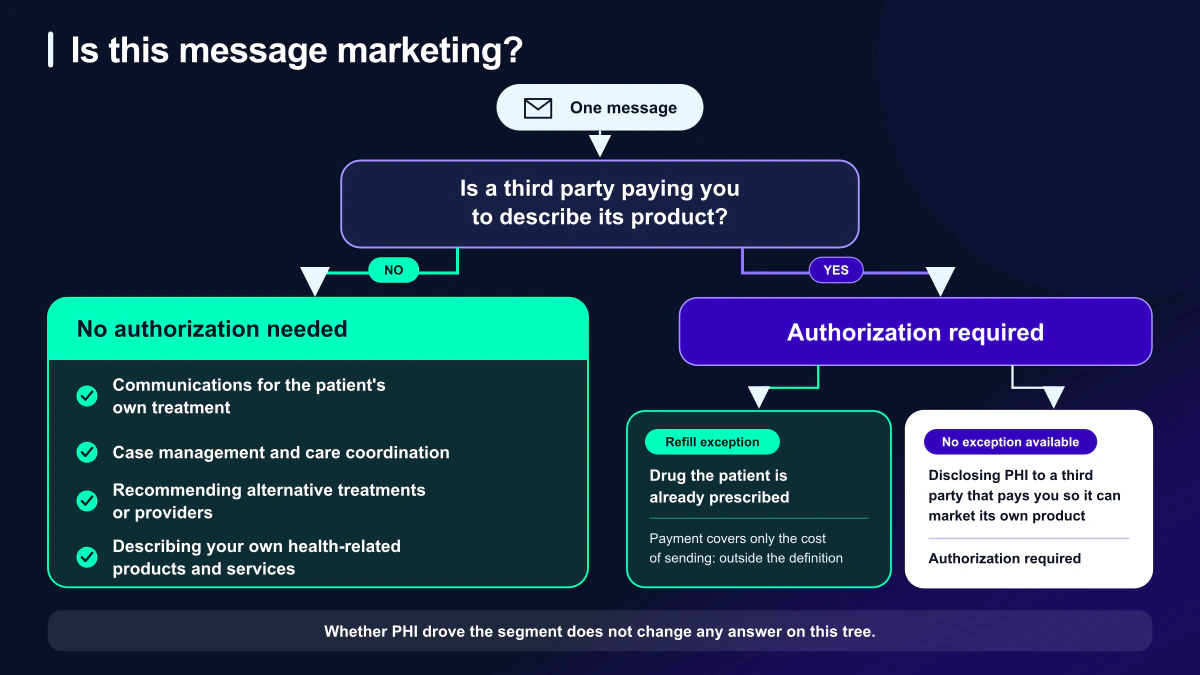
The HIPAA marketing rules are narrower than the word suggests. The Privacy Rule’s own marketing guidance names four things that sit outside the definition:
- communications for the patient’s own treatment
- case management and care coordination
- recommending alternative treatments or providers
- describing the covered entity’s own health-related products and services
None of those needs an authorization. The carve-out closes when the covered entity is paid by or on behalf of a third party whose product is being described. That’s the trigger: third-party money. Whether PHI drove the segment is a separate question with no bearing on it, which means the same message can be routine outreach at one organization and marketing at another, depending on who funded it.
One line has no exception on it. Disclose PHI to a third party that pays you so it can market its own product, and that’s marketing every time.
One narrow exception runs the other way, on messages you send your own patients. Refill messages about a drug a patient is already prescribed stay outside the marketing definition even when a third party pays for them, so long as that payment only covers the cost of sending them.
So the build question is about state: what do you have to keep, per person, to show that a given message was allowed?
Authorization is data, not a checkbox
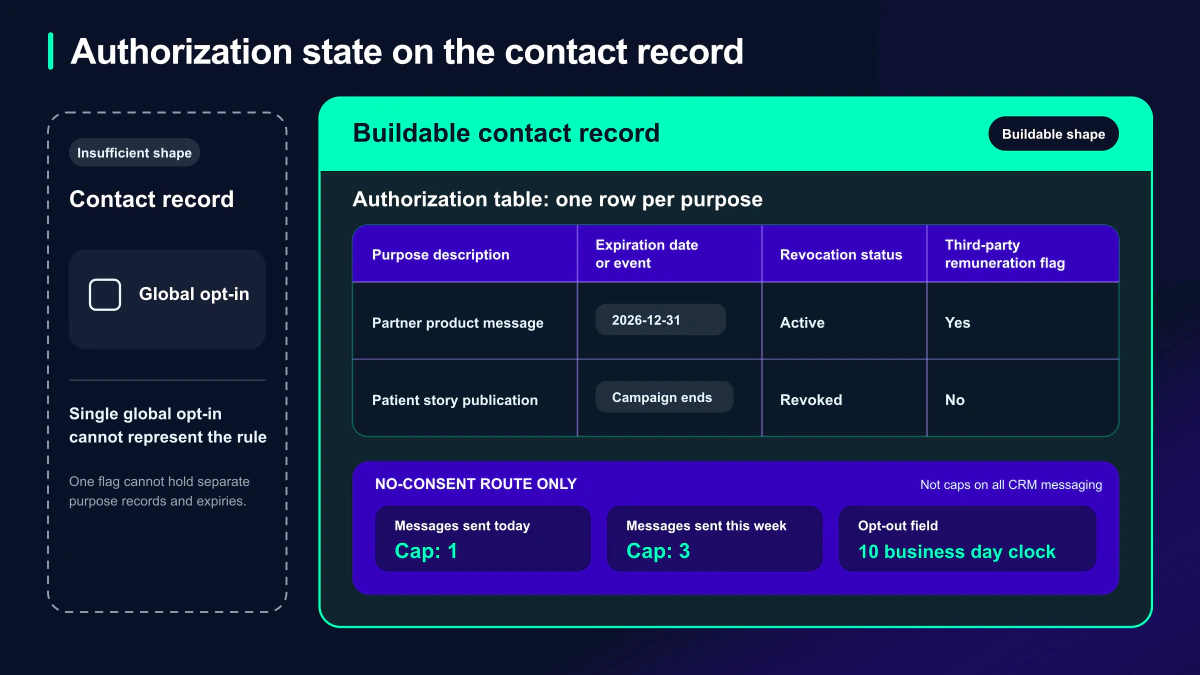
A valid authorization carries six core elements. Two of them decide your schema: a description of each purpose, and an expiration date or event. It also needs statements on revocation and redisclosure, and where third-party remuneration is involved, it has to say so.
Read that as a data model. Purpose-specific and separately expiring means authorization state belongs on the contact record per purpose, each with its own expiry. A single global opt-in flag can’t represent that, and consent management is where the build actually happens. Retrofitting it later means reconstructing, per patient and per purpose, what someone agreed to and when it lapsed, out of whatever your system happened to log.
A second regulator governs the same text message
This is a different statute, enforced by a different agency, and it covers calls and texts whatever the Privacy Rule says about the same message.
Rely on its healthcare carve-out to message a patient without prior express consent and the limits are hard: no more than one message a day and three a week, and no billing, collection or other financial content at all. Those caps scope to the no-consent route specifically.
The balance-reminder campaign a revenue-operations team builds first is exactly the one this excludes.
The revocation standard changed too. Since April 2025 a patient can opt out by any reasonable method, and you have ten business days to honor it. Any reasonable method means a reply to a text counts, which puts the opt-out path inside every channel you send on.
Both of those are counters and timestamps in your system. Which is the same lesson the authorization rules teach: this compliance surface lives in the schema, and a policy document has no way to enforce a frequency cap.
What it costs when this goes wrong
In September 2025, five Delaware providers settled with OCR for $182,000 and a two-year corrective action plan after posting patient success stories to a public website without authorization: names, photographs, and details of condition and treatment. Roughly 150 patients were affected and never notified, which put the breach notification rule in play alongside the privacy rule.
And the corrective action plan reached the marketing staff by name, which is where these programs actually live.
EHR integration: FHIR R4, HL7 v2, and the data hub you still need
EHR integration comes down to two channels: a standards API and a message feed. Which of the two carries a given piece of data decides most of the architecture in healthcare CRM software development.
The stack, with version numbers
FHIR R4, specifically 4.0.1, plus US Core. The current US Core implementation guide, published in May 2026, is still R4-based, and Epic’s developer portal exposes DSTU2, STU3 and R4 with no R5 anywhere on it. The US market has had no R5 migration to plan for.
Vagueness here is the tell. A vendor who answers “we support FHIR” without a version number is quoting a marketing position, and the version is what decides whether their connector matches what your EHR actually exposes.
You can read the appointment, you cannot book it
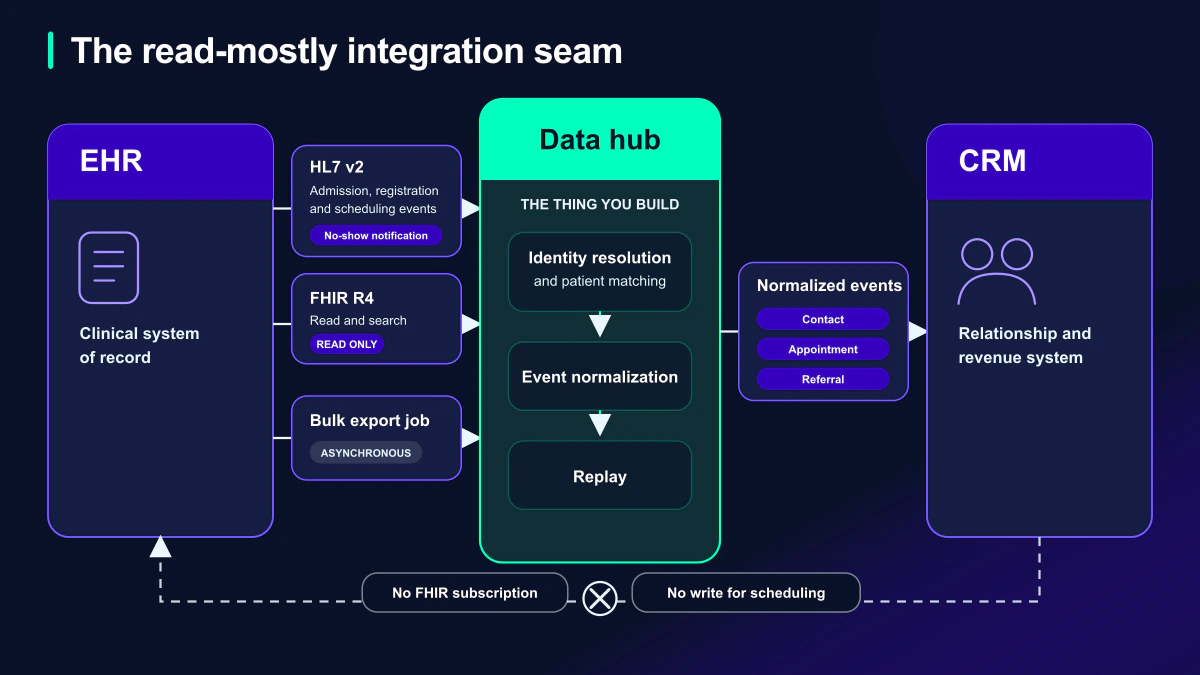
Epic’s R4 capability statement declares 60 resources. The ones a CRM actually cares about are read and search only:
- appointment
- encounter
- coverage
- related person
- practitioner
- location
- organization
Patient supports create but not update. Schedule and slot don’t appear at all.
So you can pull an appointment into the CRM and show it on a timeline. You can’t create one, move one, or offer a slot. The scheduling workflow a CRM buyer assumes is in the box is exactly the one FHIR doesn’t hand over, and that gap is where the demo stops matching the build.
Before any of that, you have to get access at all, and what it takes to integrate with Epic EHR runs on its own timeline.
Nothing pushes, which is why you need a hub
There’s no subscription resource in Epic’s R4 capability statement, so there’s nothing for a CRM to subscribe to. Two channels carry events instead: an acknowledged HL7 v2 store-and-forward message stream, and an asynchronous bulk job that returns a polling URL and delivers newline-delimited JSON. Both are shaped for an interface engine rather than a SaaS CRM.
The data hub follows from the channels. An interface engine is what they’re built for, and something has to stand in that position whether you call it a hub or not. Legacy system sync is the same job wearing an older name, and this shape shows up in every healthcare app development project that touches a chart.
What the hub terminates is the event traffic: admission and registration events, and scheduling events, including the notification that a patient didn’t show. That last one is the event any no-show measurement depends on, and it arrives as a message rather than over FHIR.
Epic ships these as two named catalog interfaces, one for patient administration and one for appointment scheduling. That’s the record-versus-relationship boundary, drawn in an interface spec.
The hub owns identity, because nobody else does
No national patient identifier exists. Federal appropriations language has barred adopting one every year since 1999, so every link between an EHR and a CRM is an algorithmic match.
Carry these numbers into your design review. In a 2022 JAMIA study, on a manually reviewed set of 30,000 record pairs drawn from an exchange holding over 47 million registrations, a probabilistic algorithm reached about 64% sensitivity against a referential algorithm’s 94%. Both stayed above 99.9% positive predictive value.
The failure mode follows from that gap. Matches get missed far more often than they get made wrongly, so build for duplicate reconciliation and skip the merge panic.
If the EHR side stonewalls, that got harder for them in September 2025. The enforcement alert landed on rules that had carried penalties since 2023 without being enforced, and investigations of health IT developers started in early 2026. The data access conversation has a regulator in it now, which changes how you escalate.
Analytics that matter: instrument your own no-show and referral leakage numbers
Referral leakage is care that a patient your organization referred receives somewhere outside your network. Worth pinning down before any figure attaches to it, because a sibling problem, the claims-side revenue leakage that shows up in denials and collections, wears almost the same label and belongs to medical billing software development instead.
Two of the numbers you’re probably carrying won’t survive a skeptical CFO with a search bar. Start with where they come from.
The rigorous leakage number is a share of visits
Peer-reviewed work on Medicare accountable care organizations computed the percentage of all outpatient specialty visits by attributed patients that weren’t delivered in the organization’s own network, and found 61% to 72%. Barnett and McWilliams published it in the American Journal of Managed Care in 2018.
The denominator is every specialty visit the patient made anywhere, which is visible only in claims data. So the study is worth citing and impossible to reproduce from your own records.
The two no-show figures everyone quotes have one source
The number for what missed appointments cost the country each year, and the number for what a single empty slot costs, both trace to a 2017 article by a scheduling software vendor. Check that before either one goes in a board deck.
One number does hold up
A 2026 systematic review and meta-analysis of 10 randomized trials covering 8,236 patients put appointment reminders at an 11% relative improvement in attendance. The text-message-only subgroup didn’t reach statistical significance.
Plan against 11%, then instrument your own:
- no-show rate, cut by cohort, channel, lead time and reminder sequence
- referral completion inside your own network
- patient acquisition cost, where the formula is settled and no defensible benchmark exists to measure yourself against
Every patient engagement platform ships an analytics dashboard. Whether the numbers in it are yours is the part you control, and reporting built on your own event stream is the kind that survives the next budget review. Referral tracking and patient retention fall out of that same stream, and no-show reduction stops being a vendor claim the moment you can measure it.
Why Topflight Apps for your healthcare CRM build
Most organizations that get this far need the same thing: the right CRM made HIPAA-safe and wired into the EHR. The deciding comes first.
Right now the healthcare CRM work coming through Topflight Apps looks like this. One team wants patient documentation loading with an AI report builder on top. Another wants clients, patients, tasks and leads living in a single system. A specialty clinic wants a revenue-operations control queue.
Each of those started with the same questions: which flavor of system the organization actually needs, whether to configure or build, and what to make a vendor put in writing before anyone signs. Answering them in that order is what keeps a procurement cycle from turning into a rebuild later. Most of the difficulty sits in the second and third questions, where the answer depends on things a vendor page won’t tell you.
Custom earns its place under two conditions: the relationship workflow is your product, or integration depth is the whole point.
The conversation worth having happens before anyone commits to build a healthcare CRM. Which path you’re on, and what would have to be true for the third one to make sense. Bring us the decision you’re stuck on and we’ll work it through with you.
Frequently Asked Questions
What is the difference between a healthcare CRM and an EHR?
The EHR is the certified clinical record; the CRM is the relationship and revenue system. They integrate rather than substitute, and federal rules certify one of them and say nothing about the other.
Does FERPA or HIPAA apply to school telehealth data?
Classify each maintained artifact by its holder and the holder’s capacity. After a copy changes hands, classify it again and apply the governing permission for that transfer direction.
Is Salesforce or HubSpot HIPAA compliant for healthcare?
Both will sign a BAA, on different terms. HubSpot only on Enterprise tiers, Salesforce on request with the covered-product list in a separate document. Scope is the real question.
Should I build a custom healthcare CRM or configure an existing one?
Configure, unless the relationship workflow is your product or integration depth is the whole point. Those two conditions are what make owning the object model and the tenancy model worth it.
Can a healthcare CRM integrate with my EHR?
It can, though read access and write access are different things. The resources a CRM needs are read-only, and no-shows arrive by message feed rather than over FHIR.
What are HIPAA marketing rules and how do they affect CRM outreach?
They gate communications a third party pays for. Treatment, care coordination, and describing your own health-related services sit outside the marketing definition, so most patient outreach needs no authorization.
How much does healthcare CRM development cost?
The configure path publishes list prices you can run against your own seat count. The healthcare-native path publishes none. Custom depends on scope, and the cost guide has that arithmetic.
Can a pharmacy or manufacturer pay us to send refill reminders?
That works within the refill and adherence exception, provided the payment is reasonably related to the cost of sending the communication.