

In the 2022 School-Based Health Alliance census, 90% of 1,518 responding school-based health centers offered at least 1 service through school-based telehealth; respondents represented about 40% of known centers, so keep that denominator attached.
You’re already past telehealth basics, but K-12 changes where the product has to hold together. The care line decides who presents the student, which exam data the remote clinician can use, and what has to happen before the student returns to class. A student leaves class, enters a physical care site, moves through a local handoff, and needs a documented disposition during the school day. Use the nurse’s office as the working model, because every fuzzy ownership decision surfaces there.
The build sequence follows those handoffs: define the encounter and exam, classify each record and consent path, then test school-day operations and rollout across the district. You’ll leave with a reviewable model your product, clinical, district, and provider teams can challenge together before a school goes live.
What makes a school telehealth platform ready for district rollout?
Begin with the care line and physical patient-site encounter, then classify every maintained record by holder and capacity. Assign each district-provider handoff to a named owner and prove one end-to-end mock visit at one school, covering exam capture, consent and record routing, clinician eligibility, connection failure, payer conditions, and documented disposition. Send each failed gate back to the owner who can supply the missing evidence.
Key Takeaways:
- Let the care line choose the product. It determines who presents the student, what findings the clinician needs, which equipment earns a place, and where the encounter at school escalates when evidence or connectivity fails.
- Make legal classification an artifact state. One program can produce both FERPA and HIPAA branches; holder and capacity decide the route, while the district-provider agreement assigns consent, access, release, emergency use, and every cross-boundary handoff.
- Turn rollout into a chain of pass/fail gates. Prove one complete visit on the managed school endpoint. Send every failure back to a named owner and hold launch or expansion until the missing evidence appears.
Table of contents
- School-based telehealth starts in the nurse’s office
- Telehealth exam devices turn video into a clinical exam
- FERPA vs HIPAA turns on who holds the student health record
- The district-provider boundary sets consent and access rules
- The operating model has to survive a real school day
- School telehealth platform development lives or dies at the handoffs
- Build for the nurse’s office with Topflight Apps
School-based telehealth starts in the nurse’s office
Presenting site telehealth begins before anyone joins the video call. The school gets the student into a real room, and a trained adult carries the local side of the visit through disposition. In the school-based health center (SBHC) model, adoption moved fast. Among School-Based Health Alliance census respondents, the share offering at least 1 telehealth service rose from 19% in 2016-17 to 90% in 2022. That jump puts the local workflow in the product core. That leaves one design question: who owns each handoff when the clinician is somewhere else?
The presenting site owns the local handoff
The Centers for Medicare & Medicaid Services uses originating site in payer language. Keep that label on the billing side. In the visit workflow, call the room the presenting site or patient site. Those names point to the work happening beside the student. Now give that work an owner. School-Based Health Alliance guidance names a school nurse, health-center employee, health technician, or another trained school employee as possible local presenters. The job title varies by program. In the workflow, that person is the telepresenter. Keep the program’s real job title in school nurse software. Underneath it, map that person to a stable telepresenter role so the visit states stay put. Before the request, the telepresenter confirms the need and consent status and gathers the parent’s history. The encounter then moves through 4 visible states:
- Requested. The telepresenter submits the visit request, and the designated scheduler owns the next move.
- Ready. The student is at the designated patient site, and the local handoff is complete.
- In visit. The remote clinician joins the synchronous visit and directs the telepresenter as they operate the equipment.
- Disposition complete. The care plan and billing paperwork have reached their owners, the caregiver has been notified, and the disposition is on record.
Show the current owner and allowed next move on every state. The video call can finish before the encounter does. Keep the encounter open until the care plan, family communication, paperwork, and disposition land where they belong.

A school-based telehealth encounter carries 5 people through 1 tracked visit and disposition.
Presenter readiness covers the whole encounter
Presenter readiness belongs inside the workflow, where the scheduler can see it before assigning a visit. School-Based Health Alliance guidance puts the whole job behind that status: consent, examination technique, documentation, care coordination, billing, and any point-of-care testing the program uses. It also calls for a school-level mock call before launch and annual refresher training. Track the presenter’s refresher status separately from the school’s mock-call result. The refresher follows the person. The mock call shows that the school has rehearsed its local workflow. Show both when someone assigns the visit. Readiness should answer one practical question in seconds: can this person run the next encounter at this school? If a requirement is missing, show who owns the fix before the student enters the room.
The actor-state map must be explicit
Keep 5 actors separate in the product:
- presenter
- clinician
- scheduler
- parent or caregiver
- student
The program decides who owns each transition. The platform stores that choice beside the state. A program can change the owner without rebuilding the lifecycle. If a trained employee takes over from the nurse, the scheduler still sees who receives the student and who closes the disposition. Our telehealth app development guide covers generic platform architecture. Pediatrics on-demand app development covers consumer pediatric flows. Here, keep the model on the physical school handoff. At any moment, you should be able to answer 2 questions: who owns the visit, and what happens next? When the remote clinician requests examination data, this role-and-state model hands off to the device layer.
Telehealth exam devices turn video into a clinical exam
Buy the exam kit after the care line defines the findings the remote clinician needs. Then prove the full setup can capture those findings at the school and move them into the provider workflow. Procurement ends there.
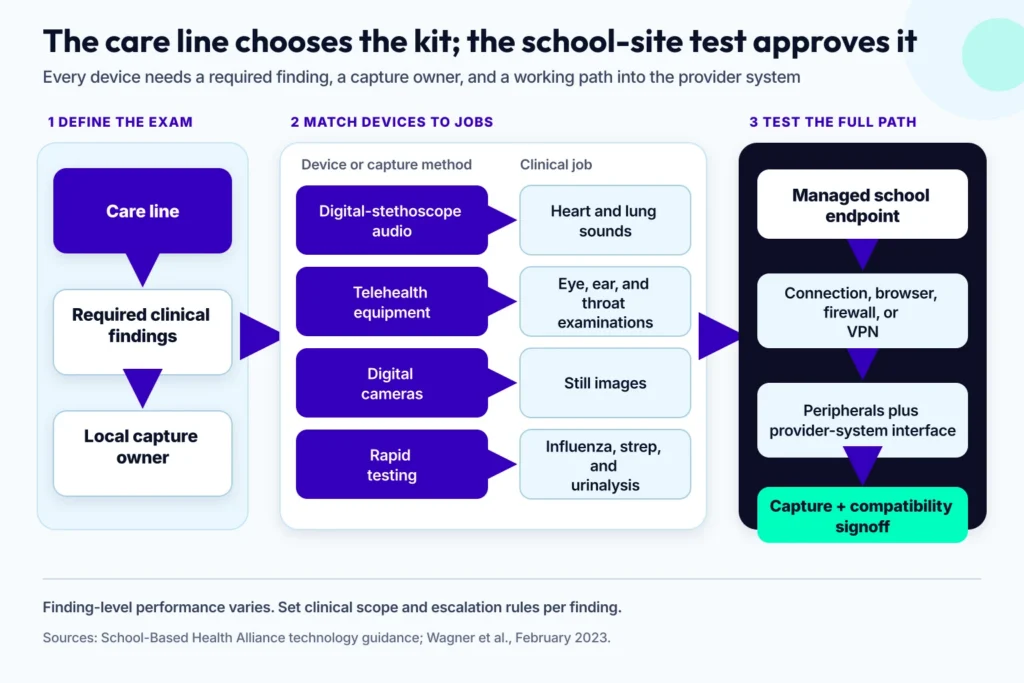
A device earns its place only when the finding it captures reaches the provider chart.
The care model chooses the equipment
In school health app development, the buying order starts with the care line and site readiness. Hardware comes next. Kathryn King, MD, MHS, and coauthors put it plainly in the Association of American Medical Colleges’ November 2023 guide: “Choices regarding technology needs are best made after considering all other aspects of the program.” Start with the visit scope and the school site. Name the findings required for the visit and the person responsible for capturing them. The hardware list comes last, once every device has a clinical job. Now product and clinical teams can review the same thing. Each device traces to a required finding and a local capture owner.
Each peripheral has to earn a clinical job
In one program example, the School-Based Health Alliance names a digital stethoscope and an otoscope alongside an exam camera. Its published toolkit maps the peripheral devices to work at this level:
- Digital-stethoscope audio carries heart and lung sounds.
- Telehealth equipment supports eye and ear examinations, plus throat examinations.
- Digital cameras capture still images.
- Rapid testing covers influenza and strep; the example also includes urinalysis.
Keep the requirements at the same level. Those examination examples belong to the equipment set; the guidance doesn’t tie every finding to a particular camera. The local kit follows the service menu and provider workflow. Staffing at the school and its testing permissions decide what the team can support. A device earns its place by helping the presenter capture a finding the remote clinician will use. Choose the kit per program. Two schools can share the platform while their service menus and testing permissions produce different hardware lists.
Diagnostic agreement changes by finding
Finding-level evidence should set the clinical scope. In a February 2023 prospective trial, Wagner and coauthors compared remote and in-person examinations for 690 clinically stable pediatric patients. Several skin findings and several heart or lung findings reached at least 90% concordance. Agreement was lower for ear-canal and tympanic-membrane findings, as well as throat and rhinoscopy findings. The study reported further limits in infant heart and lung examinations and abdominal auscultation. Clinical scope and escalation rules belong at the finding level. The same kit can support findings with very different agreement rates. For each finding, define when the remote encounter can continue and when it needs escalation.
The school-site test closes procurement
Run the complete kit on the managed school endpoint under the conditions expected at launch. Follow the full path through the connection type, operating system and browser, firewall or VPN, peripherals, and provider-system interface. Test the setup as one chain. The finding has to travel from the peripheral to the provider system across the school’s managed path. Procurement closes when the intended findings can be captured and moved through that setup at the school. Make capture and compatibility the signoff. Our medical device integration guide covers deeper interface work. After pre-launch signoff, the school-day operating model takes over failure detection, fallback, rescheduling, and referral.
FERPA vs HIPAA turns on who holds the student health record
The FERPA vs HIPAA decision starts with the artifact’s holder and the capacity in which it is maintained. One video visit can leave more than one legal record behind. For K-12 telehealth software, classify every school-held or provider-held artifact before assigning storage and sharing rules. Run the test again whenever a copy crosses the boundary. Attach the result to the artifact. A district-provider program can produce both branches, so one program-wide FERPA or HIPAA label is too coarse. Storage and sharing logic can then follow the artifact’s own route.
The holder and its capacity decide the regime
The December 2019 joint guidance from the U.S. Departments of Education and Health and Human Services gives the core test. If a FERPA-covered school maintains the student health record, it is a FERPA education record. The same applies when a party maintains it for the school under the school’s direct control. Those education records sit outside HIPAA’s definition of PHI. Give the direct-control relationship its own branch in the product model, because the contractor’s name on the file does not change the school’s capacity.
Make holder and capacity required when the artifact is created. The organization name alone can’t distinguish a party acting under school control from an independent provider. HHS’s provider-at-school FAQ covers the independent-provider branch. A provider can serve students on school grounds without acting for the school. Its records fall outside FERPA education records.
HIPAA applies only when the provider is a covered entity and the record contains PHI. A school-based health center still needs the holder and operating relationship attached to each artifact. The school address does not choose the regime.
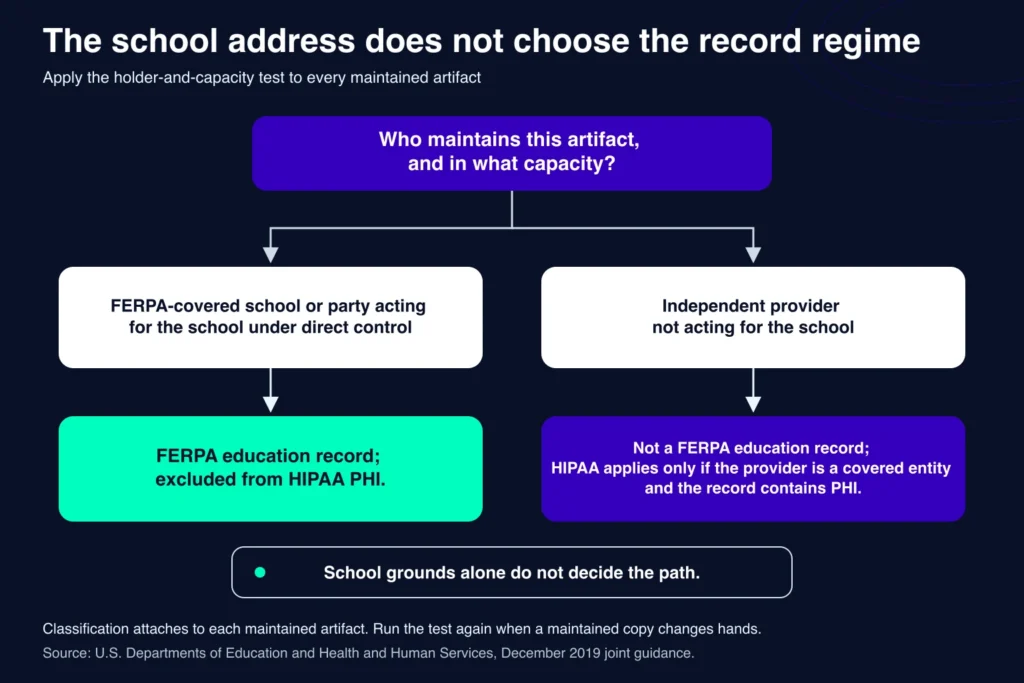
Start with the record holder and its capacity, then test the FERPA or HIPAA branch.
A transferred copy can enter a different regime
The federal joint guidance follows the artifact across a transfer. A source retained by a HIPAA-covered provider can remain PHI while the copy received and maintained by a FERPA-covered school becomes an education record. Treat copy creation as a new legal state. The content can match while the holder and governing regime differ. Model the source and received copy as 2 maintained artifacts, each with its own holder and legal classification.
At the data sharing boundary, the received copy gets a new classification decision. The source record keeps the classification attached to its own holder and capacity. Lineage and classification do different jobs. Lineage says the 2 artifacts are related; classification says which rules attach at each holder. Preserve both through transfer and disclosure review. Our HIPAA compliant software development guide covers general HIPAA engineering controls. This workflow owns the artifact-level classification that those controls act on.
Disclosure permission runs in two directions
In FERPA telehealth, direction and purpose belong in the permission model. Build 2 directional checks; they start from different rule sets and keep the disclosure purpose in the decision:
- School to provider. The U.S. Department of Education’s April 2023 guidance says FERPA generally requires parent or eligible-student consent unless an exception applies. Keep age and postsecondary status in the decision, along with state law, purpose, and recipient.
- Provider to school. HHS’s school-nurse FAQ says a covered provider may disclose PHI to a school nurse or physician for treatment without authorization. For immunization records, disclosure requires applicable law plus documented agreement from the authorized person or student.
Keep the treatment and immunization routes separate. The permission comes from the purpose of the disclosure, so one provider-to-school rule cannot cover both. At this stage, classify the artifact, holder, direction, purpose, and recipient. Those fields tell the next product layer which disclosure routes are legally available before the product handles consent and access or logs a release.
The district-provider boundary sets consent and access rules
Build the district-provider boundary as a control plane for consent, access, handoffs, and emergency use. A school telehealth app needs those decisions before you draw district and school scopes. The agreement assigns owners. Workflow states enforce their choices while the provider chart stays in the provider’s domain.
The agreement assigns each side’s operating duties
The memorandum of understanding (MOU) is the ownership map. Guidance from the School-Based Health Alliance and Virginia Department of Education uses it to assign consent-based eligibility and separate-record and sharing rules; it also assigns ownership of space, equipment, connectivity, maintenance, and technical support.
Those duties become an operating matrix for enrollment, record stewardship, access reviews, technical incidents, and record requests. Every row needs a district or provider owner and a named handoff. The same ownership discipline covers the provider network. Record program-specific exceptions in the agreement. The next incident should find an owner already named. In the product requirements, each duty shows the owner and receiving side, both tied to the relevant record boundary.
Consent needs separate instruments and branching rules
Enrollment carries 3 separately versioned instruments when they apply:
- consent to treatment
- HIPAA authorization
- FERPA disclosure consent
Each instrument keeps its own version and status. The eligibility check reads only the artifacts that apply to the requested service and disclosure. Consent management covers secure collection and storage, previsit availability, retrieval in the provider EHR, and chart creation. Relevant school health staff see only the minimum enrollment status they need. The operating agreement names the authoritative signed copy and custodian for each instrument. Parental consent branches inside the HIPAA workflow.
April 2025 guidance from the U.S. Department of Health and Human Services Office for Civil Rights says a parent is usually the minor patient’s personal representative. Exceptions apply when state law lets the minor consent or another person lawfully authorize care. They also apply when the parent agrees to a confidential provider relationship. State law also controls parental access to the resulting PHI. Branch the workflow by age, service, lawful authority, and jurisdiction. On the FERPA side, the U.S. Department of Education says disclosure consent must be signed and dated. It must identify the records and purpose, plus the receiving party or class.
School records and provider charts keep separate access domains
The U.S. Department of Education’s April 2023 guidance keeps the school-official exception inside school-maintained education records. Access without consent requires a legitimate educational interest. An outsourced party must perform an institutional service or function and remain under the school’s direct control. It may use personally identifiable information only for the disclosed purpose and may not redisclose it without authorization. Derive school-side roles from:
- job function
- student assignment
- purpose
- contractual control
School-Based Health Alliance implementation guidance keeps provider and district records separate and calls for a release process. A September 2024 guide from Health and Human Services and the Association of American Medical Colleges’ November 2023 guide require each record’s maintenance location to be explicit. Close the clinical encounter inside the provider-controlled EHR. On the student telehealth platform, model care coordination as a deliberate release of an authorized school-facing artifact.
Emergency access branches by governing law
Emergency access still follows the record regime. Under the U.S. Department of Education’s April 2023 guidance, FERPA’s health-or-safety exception is permissive and case-specific. Limit the disclosure to information necessary for an articulable and significant threat, then record the threat and recipients.
September 2017 guidance from the Office for Civil Rights gives the HIPAA branch. A covered entity may disclose information to people reasonably able to prevent or lessen a serious and imminent threat.
Build 2 break-glass paths. Each captures the governing regime, threat basis, decision-maker, recipient, released fields, and time. One emergency entry point can route both branches. The log still names the rule that authorized the release.
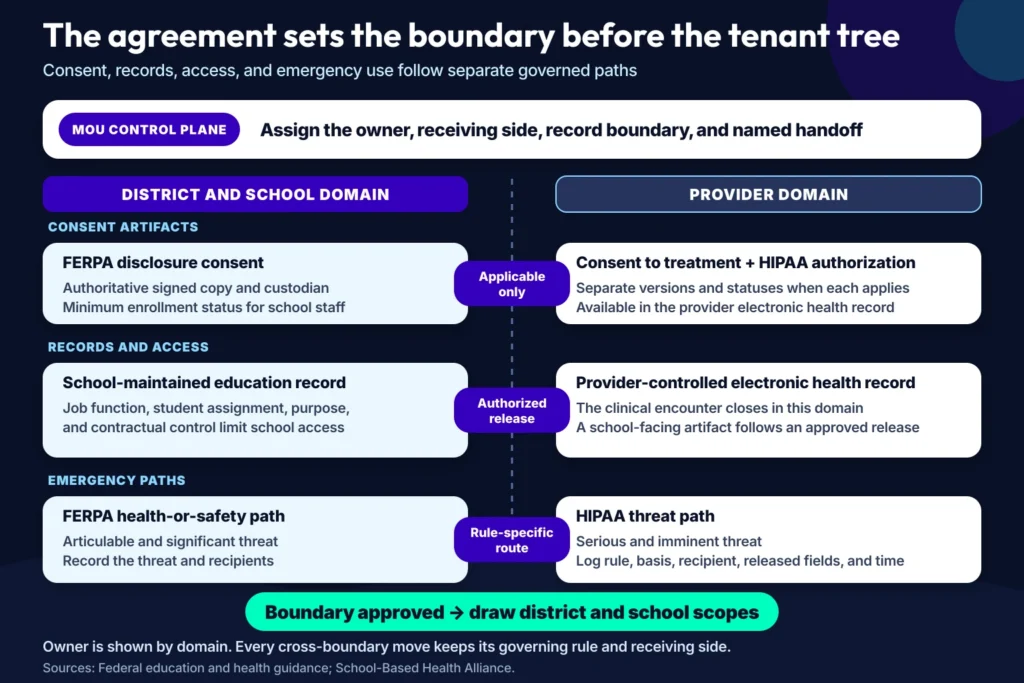
Name the owner and the receiving side before you draw a single tenant scope.
Once those boundaries exist, district administration can sit above school scopes while the provider chart remains provider-controlled. Build the multi-tenant hierarchy around those established lines.
The operating model has to survive a real school day
A school telehealth platform works only when each visit can move from class release through an eligible clinician to a documented return, escalation, reschedule, or referral inside the school day.
A booked visit is a chain of school-day states
Scheduling starts with a room and ends with disposition. Reserve the room, release the student from class, confirm the clinician, and leave a final status for return, escalation, reschedule, or referral. Virginia’s section 22.1-272.3 requires participating divisions to allow school-hour telehealth on the same basis as school counseling, provide a private internet-connected room, and impose no greater disciplinary consequence than for an equivalent in-person healthcare absence.
April 2025 guidance from the U.S. Department of Health and Human Services makes the clinician check location-specific. Cross-state authority may require a full license, temporary-practice permission, reciprocity, compact privilege, or telehealth registration. Verify the school’s state and consent before the visit.
A failed connection needs a safe next state
Oregon’s 2025 pilot put the failure branch in plain view. All 3 grantees hit secure-network or hardware failures. Two installed their own wireless networks. At the third, delays involving the lack of a HIPAA-compliant network and staff turnover resulted in zero visits. Detect the failure while the student and presenter are still in the room.
Route to an approved fallback when service and risk allow it. Otherwise, reschedule or document an in-person referral. Federal telehealth guidance keeps phone and secure messaging service-specific. Store-and-forward carries the same privacy, state, clinical, and payer constraints. See our RHTP build-fast-and-integrate playbook.
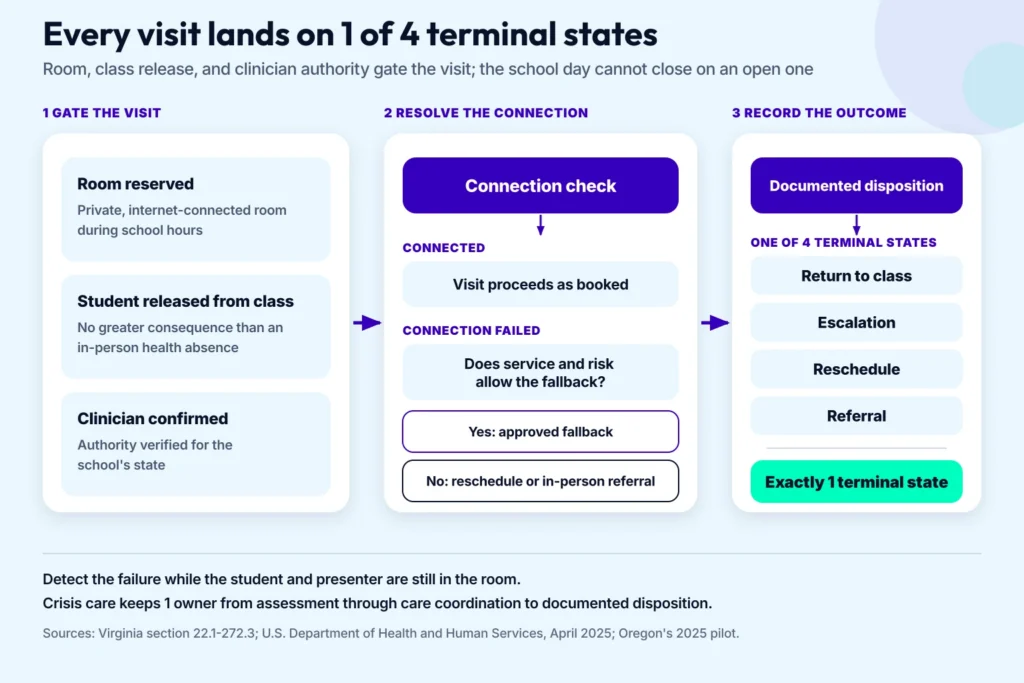
A failed connection is a routing decision, not a dead end.
Crisis care ends at a documented disposition
Austin’s 2020-21 telepartnership received 258 student-suicidality referrals. Shahidullah and coauthors reported in June 2024 that resulting actions included urgent same-day assessments for 24%, hospitalization referrals for 5%, and community-therapy referrals for 82%. Give assessment its own state. Do the same for care coordination and disposition. One owner holds that path until the destination is documented and the case closes. The broader build belongs in our behavioral health platform development guide.
Medicaid rules belong in the routing logic
The Centers for Medicare & Medicaid Services’ May 2023 guide permits covered school-based services for any Medicaid-enrolled student, including those outside an individualized education program (IEP) or Section 504 plan. That beyond-IEP posture is the free care rule. Build routing around:
- the state’s Medicaid plan
- provider enrollment
- coverage
- documentation
- non-duplication
Attendance evidence needs its uncertainty attached
Long et al.’s 2021 quasi-experimental evaluation of 4,203 students across 6 Howard County schools linked telehealth to 7.7% fewer absences (0.60 day per student-year); its $195,873 annual net-benefit estimate had a 95% interval crossing zero, and total utilization was unavailable. Put the caveat next to the number. The useful metrics in telehealth for schools sit inside the visit: room readiness, class release, clinician eligibility, connection state, and documented disposition.
School telehealth platform development lives or dies at the handoffs
A school telehealth build is ready when every handoff has a named owner, inspectable evidence or a test, and a defined action when that evidence fails. In school telehealth platform development, settle the care line and operating ownership before anyone turns the feature and device list into a roadmap.
Eight gates make readiness testable
School-Based Health Alliance guidance and Garber et al.’s 2021 account describe the Medical University of South Carolina model in 6 phases. Pipeline leads to strategy, then development and implementation, followed by operations and continual quality improvement. Each phase builds on the previous one. The 8 gates below are our synthesis, grouped by handoff evidence.
The 2 views slice the job differently, so the phase and gate numbers don’t line up 1-to-1. One rule applies to every row. A pass advances the site. A fail sends the decision back to the owning section and holds launch or expansion until the accountable owner supplies the missing evidence.
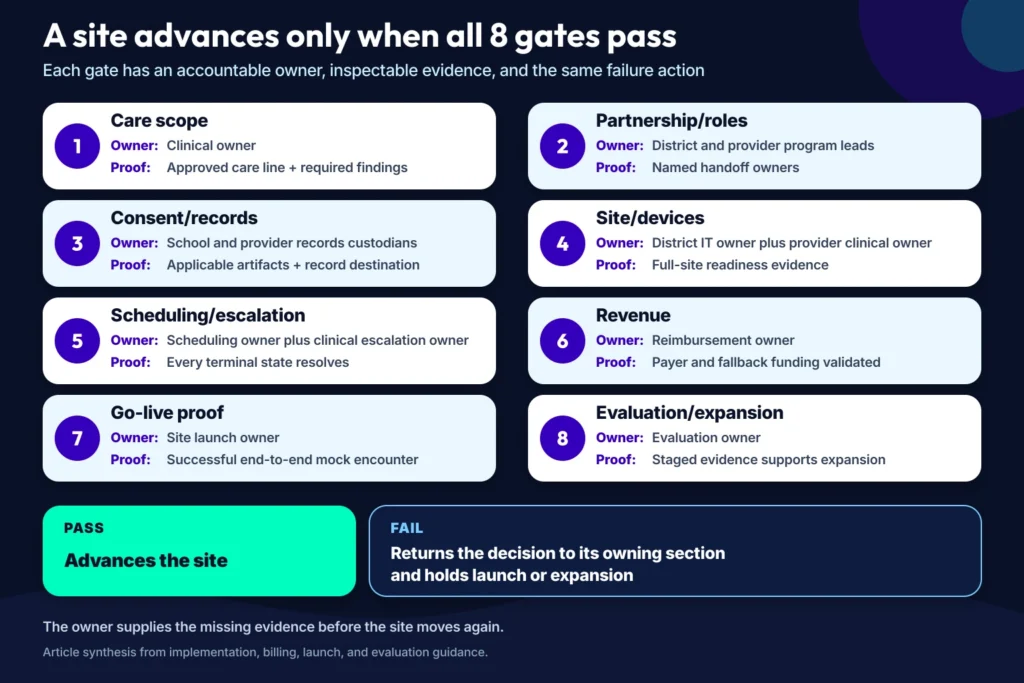
Every gate names who signs and what counts as proof, so a stalled launch always has an owner.
| Decision | Owning section | Accountable owner | Evidence or test | Pass/fail action |
|---|---|---|---|---|
| Care scope | Presenting site; exam devices | Clinical owner | Approved decision on each proposed care line: behavioral health, teletherapy, speech therapy, occupational therapy, or an asynchronous consult; required findings and validation evidence | Pass: advance. Fail: return the unsupported care line; hold launch. |
| Partnership/roles | Presenting site; district-provider boundary | District and provider program leads | Walk one visit across the approved district-provider responsibility split. Test every transition for a named owner and keep the handoff result as launch evidence. | Pass: advance. Fail: return the unowned transition; hold launch. |
| Consent/records | Record governance; district-provider boundary | School and provider records custodians | Applicable consent artifact; disclosure artifact; record destination; release-path test. Prove that the completed encounter closes in the assigned record destination and any release follows the approved path. | Pass: advance. Fail: return the unresolved artifact or record route; hold launch. |
| Site/devices | Exam devices; this readiness checklist | District IT owner plus provider clinical owner | Approved device and capture decisions. The School-Based Health Alliance site check can include a private room; dedicated data connection; low bandwidth and firewall-access tests; camera and peripheral placement; equipment ownership and support; school-location and visit-type setup in the electronic health record; applicable lab or point-of-care testing setup. Keep the combined result as full-site readiness evidence. | Pass: advance. Fail: return the failed site or device check; hold launch. |
| Scheduling/escalation | School-day operations | Scheduling owner plus clinical escalation owner | Scenario test covers booking, provider eligibility, connection failure, crisis disposition, and each terminal state. Every branch ends in a documented return, escalation, reschedule, or referral. | Pass: advance. Fail: return the unresolved terminal state; hold launch. |
| Revenue | This readiness checklist | Reimbursement owner | The U.S. Department of Health and Human Services’ January 2025 billing guide and School-Based Health Alliance business guidance put Medicaid school billing inside a launch review: startup and recurring costs; payer mix; covered services and provider types; originating-site eligibility and fees; documentation responsibilities; expected utilization; fallback funding. Medicaid and private-payer rules vary by state and plan. The test also carries forward the state’s Medicaid plan, provider enrollment, coverage, documentation, and non-duplication conditions. | Pass: advance. Fail: return the unsupported revenue assumption; hold launch. |
| Go-live proof | This readiness checklist | Site launch owner | Successful end-to-end mock encounter through room readiness, connection, local presentation, provider workflow, and documented disposition at the school | Pass: launch. Fail: return each failed step to its owning row; hold launch. |
| Evaluation/expansion | This readiness checklist | Evaluation owner | School-Based Health Alliance evaluation guidance and the Association of American Medical Colleges’ November 2023 guide stage the evidence: program definition; enrollment and utilization; experience plus technical and clinical quality; cost-effectiveness and population outcomes. Measures can include request-to-provider connection time, failed visits, workarounds, satisfaction, wait time, clinical outcomes, cost, and educational impact. | Pass: expand. Fail: return the unsupported expansion decision; hold expansion. |
Build for the nurse’s office with Topflight Apps
Start with 1 school and 1 provider. In a working session, Topflight Apps maps the care line and presenting-site encounter, then pins each record handoff to the district-provider boundary. The output is one reviewable operating model your clinical team can challenge with district counterparts before the product scope hardens. It also exposes where the district or provider still owes a decision.
From there, we turn the model into product boundaries, integration decisions, and a staged rollout scope. The first site test happens in the nurse’s office, where the local presenter and provider run the visit path the product is meant to support. That test turns assumptions about capture and record routing into a go-live decision at 1 site.
If you need broad budget context first, use our healthcare app development cost guide; the working session narrows that context to this program’s actual handoffs. If you’re ready to build a school telehealth platform, bring Topflight Apps your proposed school and provider model. We’ll trace one encounter from class release to its final record destination and leave you with the architecture decisions plus rollout gates that still need an owner.
Frequently Asked Questions
How does school-based telehealth work?
The student joins from a patient site, where a trained local presenter supports the encounter when needed. The remote clinician closes with caregiver coordination and a school disposition.
Does FERPA or HIPAA apply to school telehealth data?
Classify each maintained artifact by its holder and the holder’s capacity. After a copy changes hands, classify it again and apply the governing permission for that transfer direction.
What equipment does a school need for telehealth?
Start with the care line and required clinical findings. Validate the endpoint, peripherals, expected network path, and provider connection as one chain at the actual school.
Can school telehealth deliver mental health counseling?
U.S. Department of Health and Human Services guidance updated in August 2024 includes mental-health screening, counseling, and therapy, subject to local scope, clinical fit, consent, and coverage.
How do you handle parental consent for school telehealth?
Keep consent to treatment, HIPAA authorization, and FERPA disclosure consent as separate versioned artifacts. Apply relevant representative and jurisdiction rules, then let eligibility read only the applicable artifacts.
How is school-based telehealth funded?
Set payer mix and fallback funding at program level. The reimbursement owner validates each service’s state-plan, provider, documentation, and recurring-cost rules for its jurisdiction before launch.