

Most healthcare AI projects never make it past a pilot. Mayo Clinic runs AI across 3.9 million patient messages a month and saves 1,500 staff hours. Cleveland Clinic has 4,000 providers documenting 76% of visits with AI. The difference between those results and a stalled pilot comes down to compliance architecture, EHR integration, and workflow change, the parts teams budget last.
That work looks different at every size. A health system needs HITRUST certification, an FDA strategy, and infrastructure that survives 10,000 concurrent users. A small practice needs an off-the-shelf assistant with a signed BAA and one use case that pays for itself in a month.
This guide walks both paths, from scope to shipping, with the costs and timelines for each. No vendor promises. Just what it takes to build an AI medical assistant clinicians trust.
Should I buy an AI medical assistant for my practice or build a custom one?
Buy first. An off-the-shelf assistant on a HIPAA-eligible endpoint gets you live in weeks, with a signed BAA and per-provider pricing. Build custom only when a specialty workflow or a multi-location group outgrows the SaaS, and expect a scoped MVP to start around $60,000.
Key Takeaways
- Start with compliance, sized to your risk: health systems need HITRUST and an FDA strategy; a practice needs a signed BAA and a vendor security review. Skip HITRUST and FDA unless you sell to health systems or give clinical advice.
- Validate against real clinical data, because clean datasets hide the failures. Models degrade over time, so budget for retraining that starts around $10,000 a cycle.
- Start with one use case. A practice should begin with a single off-the-shelf assistant; a health system should buy a foundation model and customize the integration layer.
- Budget for the five-year operations tail. Every $1 of licensing tends to cost about $3 to implement and $6 to run over five years, and physician validation time is the line item that surprises people.
Table of Contents
- What is an AI medical assistant?
- Choosing the right scope for your organization
- AI medical assistants for small and independent practices
- Compliance and regulatory framework first
- Technical architecture for healthcare-grade AI assistants
- Data strategy for medical assistant development
- EHR integration and clinical workflow implementation in medical AI development
- Step-by-step AI healthcare assistant implementation process
- Critical features for medical-grade AI assistants
- How much does an AI medical assistant cost?
- How Topflight can accelerate your AI medical assistant development
What is an AI medical assistant?
An AI medical assistant is software that does a job a human would otherwise handle in a clinic: drafting a note, answering a call, triaging a portal message, or pulling up a protocol. The useful way to slice it is by what it touches, because that sets the compliance bar.
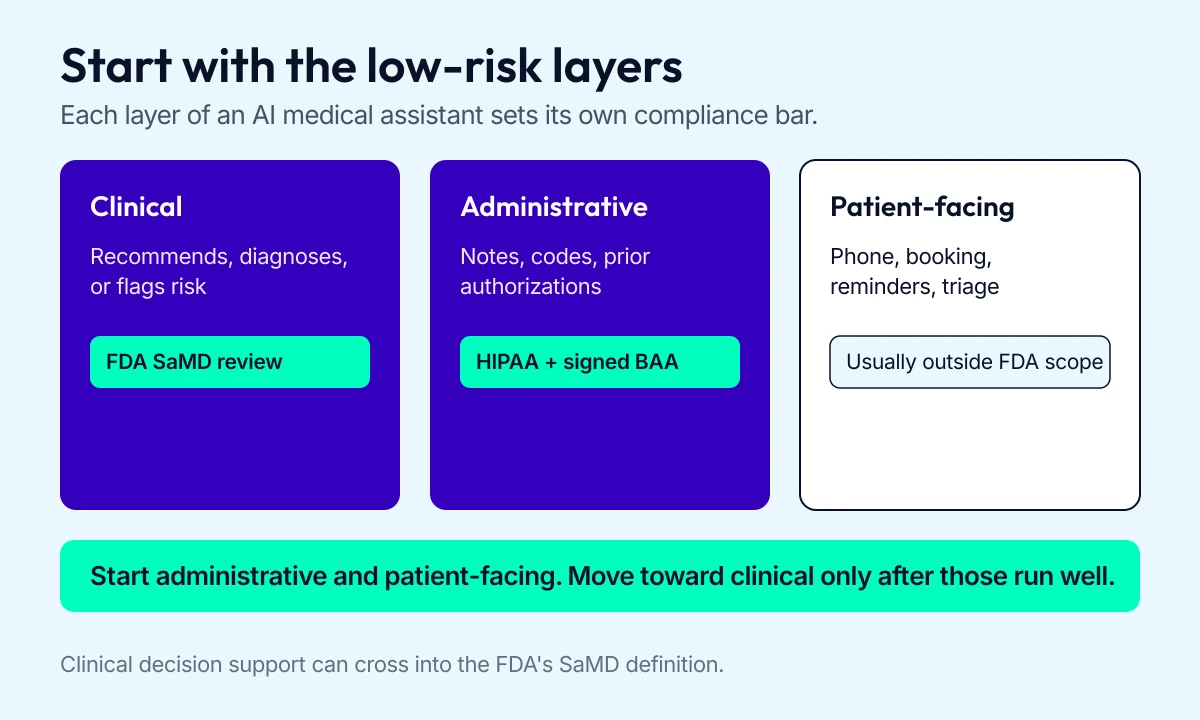
Administrative and patient-facing assistants carry the lighter compliance bar, so start there.
Clinical vs. administrative vs. patient-facing assistants
Three layers, each with a different risk profile.
- Clinical assistants recommend treatment, support a diagnosis, or flag risk. These can cross into the FDA’s SaMD definition and need explainability you can defend in an audit.
- Administrative assistants draft notes, assign codes, and fill prior authorizations. Lighter regulatory weight, but they still touch PHI, so HIPAA and a signed BAA apply.
- Patient-facing assistants are the virtual medical assistant AI most clinics start with: they answer the phone, book appointments, send reminders, and triage messages. Usually outside FDA scope, but they’re what a patient hears first, so escalation rules matter.
Start with the administrative and patient-facing layers. Move toward clinical only after those are running well.
Who this guide is for
|
Practice size |
Typical use case |
Budget |
Timeline |
Compliance level |
|---|---|---|---|---|
|
Solo or small practice (1–20 providers) |
Ambient scribing, AI front desk, refill and portal triage |
$99–$400 per provider per month off the shelf; $60K+ for a custom MVP |
4–12 weeks |
Signed BAA plus a vendor security review |
|
Specialty group or multi-location |
Custom assistant on your own protocols; multi-site scheduling |
$150K–$300K+ for a custom build |
3–6 months |
BAA plus SOC 2; FDA only for clinical use |
|
Health system |
Enterprise assistant across EHRs; clinical decision support |
$500K–$5M+ |
18–24 months |
HITRUST, SOC 2, FDA SaMD as needed |
Choosing the right scope for your organization
The gap between AI medical assistant development in theory and enterprise reality is massive. While vendors pitch magical AI that transforms healthcare overnight, you’re dealing with 47 different systems that barely talk to each other, physicians who’ve seen five “revolutionary” technologies fail in the last decade, and compliance requirements that could fill a library.

Let’s cut through the noise. An enterprise AI virtual assistant is a complex orchestration of clinical workflows, data systems, and human behaviors that must perform flawlessly when a patient’s health is on the line.
Clinical decision support vs. administrative automation
We covered the three layers above. The practical consequence: clinical support and administrative automation sit in different regulatory leagues.
Clinical decision support can trigger FDA’s SaMD pathway and needs explainability a provider can defend in court, with sub-200ms responses in critical moments. Administrative automation carries a lighter burden: HIPAA, a signed BAA, and a workflow people will follow. Pick the lane that matches your risk appetite, start with administrative, and expand into clinical once you’ve proven the value.
ROI expectations for healthcare organizations
Let’s ground this in real results. Based on our actual AI implementations in healthcare:
Administrative and Documentation AI: When we developed GaleAI’s medical coding system, it achieved a 97% reduction in coding time, dropping what took hours to mere seconds. More importantly, it identified 15% more revenue through accurate coding, discovering $1.14M in yearly lost revenue for one practice. The system paid for itself at less than 1% of the recovered revenue.
Clinical Support and Workflow AI: Our work with Allheartz on their AI-powered physical therapy platform delivered 80% reduction in clerical work time, allowing providers to focus on patient care. The computer vision system cut in-person visits by 50% while actually improving outcomes: athletes using the AI-guided system saw 70% reduction in injury rates.
What about areas without hard metrics? Not every AI medical assistant will have clean ROI numbers, especially in early implementations. Mi-Life’s deployment in disability care facilities focused on quality metrics: reducing medication errors and improving staff confidence. While we can’t put a simple percentage on “prevented errors,” the organization saw enough value to expand the system across their facilities.
The pattern is clear: healthcare AI solutions that succeed focus on specific, measurable problems. Documentation and coding? Quantifiable time and revenue gains. Clinical workflows? Measurable reduction in administrative burden. Patient safety? Harder to quantify but visible in quality metrics and staff satisfaction.
Build vs. buy vs. customize: a decision framework
This decision determines whether you’ll be in production in 6 months or still architecting in 2 years. Here’s the framework we use with enterprise clients:
Build when:
- Your use case is truly unique (rare in healthcare)
- You have 15+ ML engineers with healthcare experience
- You can afford 18-24 months to production
- You’re willing to maintain models indefinitely
- Competitive advantage justifies the investment
Buy and customize when:
- Established solutions exist for 70% of your needs
- You have 3-5 technical staff for integration
- You need production within 6-12 months
- You want vendor liability coverage
- Your advantage comes from implementation
Reality check: 90% of health systems should buy and customize. The fantasy of building your own AI medical assistant usually ends with a half-built system that never makes it past pilot. We’ve seen health systems burn $5M+ trying to build what they could have licensed for $500K annually.
The smart play? License a foundation model or platform that handles the base capabilities (natural language processing, medical knowledge base, HIPAA-compliant infrastructure), then customize the integration layers, clinical workflows, and specialty-specific features. This approach gets you to production in months, not years, while maintaining the flexibility to differentiate.
One more consideration that vendors won’t mention: talent retention. That team of ML engineers you hired? They’ll get poached by big tech within 18 months. When they leave, who maintains your custom-built AI? Vendor relationships provide continuity that internal teams rarely can.
The enterprises succeeding with AI medical assistants understand their core competency is delivering healthcare. They focus their technical resources on the last mile: the integration, workflow optimization, and change management that determines whether clinicians actually use the system.
Patient outcomes improve when healthcare providers spend less time fighting with technology and more time practicing medicine. Every architectural decision should be evaluated through that lens.
Related: a medical assistant is one pattern among several. See the wider view of gen AI in healthcare, including what it costs to run.
AI medical assistants for small and independent practices
An AI medical assistant for small practices doesn’t need the enterprise playbook. You need one assistant that removes hours of busywork, a signed BAA, and a rollout measured in weeks. This section is for practice owners and office managers, and it skips the health-system requirements until you actually need them.
Highest-ROI use cases for small practices
Start where the hours go. For an independent practice, the use cases that pay for themselves fastest:
- An ambient AI scribe during visits, so the note writes itself while you talk to the patient.
- An AI medical receptionist that answers calls, handles appointment scheduling, and sends reminders.
- Triage of prescription refill requests and portal messages, so a nurse isn’t sorting requests after hours.
- Prior authorization drafts and coding suggestions, which recover revenue on top of the time saved.
Patient intake and front desk automation are the quiet wins: they remove the busywork that eats a front desk’s afternoon, and they reduce administrative burden without changing how providers work.
The revenue side can out-earn the time side. Our GaleAI coding work found $1.14 million in missed revenue for a single practice. Related: medical billing automation
Off-the-shelf tools vs. a custom assistant
Most practices should buy. Per-provider SaaS handles scribing, front desk, and scheduling for $99 to $400 a provider per month, and you’re live in days. An AI medical assistant for clinics is usually off the shelf, and an AI assistant for doctors has to fit small clinic workflows from day one, so pick a tool that already lists your EHR.
Custom pays off when your workflow is the product: a specialty intake that follows your exact protocol, a multi-location group that wants one assistant across sites, or an organization that wants its own protocol library answerable by voice, like Mi-Life’s 1,300 pages. That’s a build starting around $60,000, and it only makes sense once SaaS stops fitting.
Minimum compliance checklist for small practices
Four items, and you can check all of them before you sign up:
- A signed business associate agreement (BAA) with every AI vendor, covering which subprocessors touch your PHI.
- No PHI in consumer chatbots. If the free tier won’t sign a BAA, it doesn’t belong in the workflow.
- Access controls and audit logs, so you can show who saw what and when.
- Patient AI-use disclosure where state law requires it, like Texas under TRAIGA, plus consent for ambient scribing where a state mandates it.
Related: HIPAA-compliant AI
Working with small-practice EHRs
athenahealth, eClinicalWorks, DrChrono, NextGen, and ModMed all expose APIs and marketplaces, so an off-the-shelf assistant usually connects without custom work. Pick a tool that already lists your EHR as an integration, and keep a copy-paste fallback for the workflows that don’t sync yet. Start with one bidirectional flow, notes in and schedule out, before you wire the rest.
Small practice budget and timeline
Off the shelf, budget $99 to $400 per provider per month and expect to be live in a week. A custom MVP on a hosted model starts around $60,000 and lands in 4 to 12 weeks. Staff time is the real cost on both paths: one champion who owns the rollout, plus a few hours a week for the first month to correct the assistant. Related: Healthcare MVP development
30-60-90 day rollout plan for a small practice
Pick one use case and one champion.
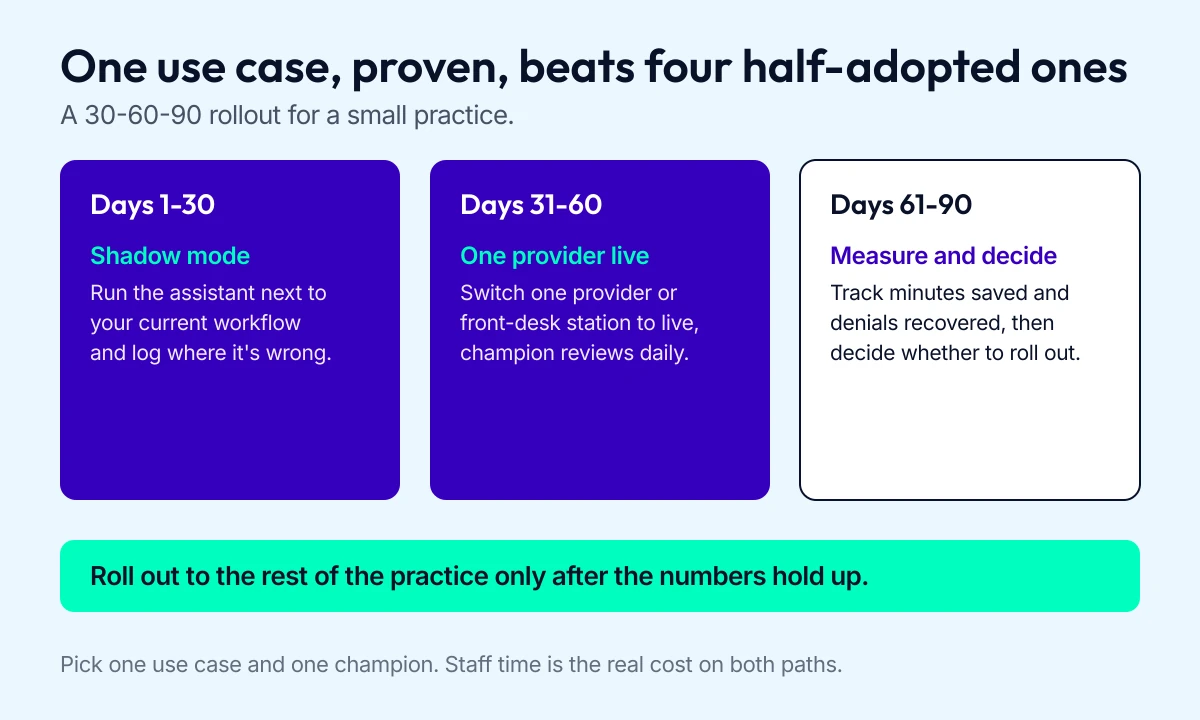
Run one use case in shadow mode, then scale it only after the numbers hold.
- Days 1-30: run the assistant in shadow mode next to your current workflow, and log where it’s wrong.
- Days 31-60: switch one provider or one front-desk station to live, with the champion reviewing a sample of outputs daily.
- Days 61-90: measure minutes saved and denials recovered, then decide whether to roll out to the rest of the practice.
One use case, proven, beats four half-adopted ones.
Get a scoped estimate for your clinic’s AI assistant. Tell us about your workflow and we’ll put a number on it.
Compliance and regulatory framework first
Most organizations approach medical AI assistant software backwards. They build first, then scramble to meet compliance requirements when they’re 80% done and realize they’ve architected themselves into a corner. Start with regulatory compliance as your foundation, not your finishing touch.

Here’s the reality: your medical AI implementation will touch every major compliance framework: FDA’s SaMD requirements, HIPAA, HITRUST, SOC 2, and state-specific AI regulations. Miss one, and you’re looking at deployment delays measured in quarters.
HIPAA, HITRUST, and SOC 2 requirements
HIPAA compliance is table stakes, but thinking it’s sufficient for enterprise deployment is like bringing a knife to a gunfight. Major health systems won’t even look at your medical AI implementation without HITRUST certification. HITRUST and SOC 2 matter when you sell into health systems; a small practice buying a tool needs a signed BAA and a vendor security review.
Key compliance requirements for enterprise AI
- HITRUST r2 certification costs $60,000-$200,000 but provides a two-year certification covering 19 control domains, and it’s becoming mandatory for major health system partnerships
- SOC 2 Type II attestation ($20,000-$100,000) is a stepping stone, with evidence reusable for 60-90% of HITRUST requirements
- Control inheritance strategy using HITRUST-certified cloud platforms (AWS, Azure) can reduce certification timeline by 40% and save six figures in documentation costs
- Architectural decisions must be made upfront. You cannot retrofit encryption standards (AES-256 at rest, TLS 1.3 in transit), audit logging, or access controls after development
Related: HIPAA Compliant App Development Guide
HITRUST is no longer optional for enterprise healthcare
The University of Pittsburgh Medical Center (UPMC) changed the game when they mandated HITRUST certification for all technology vendors. This was strategic risk management. Now, any vendor without HITRUST faces months of additional security reviews and often loses deals to certified competitors.
When Mi-Life built their AI assistant on Azure’s HITRUST-certified infrastructure, they inherited foundational controls for physical security, network infrastructure, and virtualization. This cut their certification timeline dramatically and let them focus resources on application-specific controls where they add unique value.
FDA software as medical device (SaMD) classification
The FDA’s approach to AI medical devices is evolving rapidly, and the January 2025 draft guidance signals a fundamental shift. They’re moving from point-in-time approval to Total Product Life Cycle (TPLC) management. This means your regulatory compliance extends through the entire deployed life of your AI assistant. In January 2026 the agency finalized its clinical decision support guidance, which trims oversight for some CDS and digital health tools.
Critical FDA considerations for medical AI assistant software
- Predetermined Change Control Plans (PCCPs) define what post-deployment changes you can make without new regulatory submissions. Get this wrong and every model update costs $24,335 in FDA fees plus $20,000-30,000 in consultant costs
- Data representativeness requirements are now mandatory: only 3.6% of 692 reviewed AI approvals reported race/ethnicity data, creating massive liability for biased outcomes in diverse populations
The 510(k) trap: understanding validation debt
The numbers tell the story. As of September 2026, the FDA has authorized over 1,600 AI-enabled medical devices. But here’s what vendors don’t advertise: over 95% of these approvals came through the 510(k) pathway, which relies on “substantial equivalence” rather than new clinical trials. This creates what we call “validation debt”: the burden of proving the AI works for your specific population falls on you.
For enterprise buyers, the conversation must evolve beyond “Are you FDA cleared?” to
- Show me your PCCP.
- What are your defined boundaries for algorithm modification?
- How do you handle post-market performance monitoring?
- What are the contractual triggers for model updates?
These questions are essential for managing liability when the AI makes an error and lawyers come knocking.
Clinical validation protocols for enterprise deployment
Regulatory compliance gets you permission to deploy; clinical validation determines whether you should. The gap between these two is where lawsuits are born.
Essential clinical validation requirements
- Prospective randomized controlled trials (RCTs) are becoming the evidence standard: JAMA’s RECTIFIER study showed 60% improvement in trial eligibility rates through rigorous validation
- Algorithm vigilance programs (continuous AI performance monitoring) with detection for data drift and concept drift are now regulatory expectations from FDA, MHRA, and Health Canada
- AI Governance Committees need teeth: clinical leadership, risk management, and legal representation with authority to pull underperforming models offline when thresholds are breached
Recent studies are setting new evidence standards beyond vendor whitepapers. Microsoft’s AI Diagnostic Orchestrator achieved diagnostic accuracy four times higher than experienced physicians in research settings, but responsibly noted it requires extensive safety testing and clinical validation before real-world deployment.
We’ve seen enterprises deploy AI assistants that performed beautifully in pilots, then degraded to sub-clinical standards within six months due to seasonal variations in patient populations. Without continuous monitoring and defined intervention thresholds, you’re running an uncontrolled experiment on your patients.
Define your thresholds upfront: at what accuracy degradation do you retrain? At what bias detection do you halt operations? These are enterprise risk decisions requiring cross-functional governance.
Multi-state compliance and emerging U.S. regulations
While federal AI regulation remains fragmented, states are rapidly filling the void with their own requirements, creating a complex patchwork for multi-state healthcare organizations. This regulatory maze demands strategic planning for any medical AI implementation spanning multiple jurisdictions.
- Illinois leads with the strictest requirements, banning AI systems from delivering mental health treatment independently through their WOPR Act.
- Colorado repealed its AI Act and replaced it with SB 26-189, effective January 1, 2027. The revision drops impact assessments and risk-management duties in favor of transparency for automated decisions.
- Texas and Louisiana require patient disclosure when AI touches care. Texas TRAIGA has been in force since January 1, 2026, and ambient scribing without patient consent is already drawing lawsuits.
- California’s evolving data privacy laws increasingly mirror GDPR’s strict requirements, including rights to explanation and algorithmic transparency.
The strategic play for multi-state operations is adopting a “highest common denominator” approach. Build to the strictest standard nationally. This means:
- Implementing explainable AI architectures even where not yet required
- Building comprehensive audit trails for all algorithmic decisions
- Ensuring human-in-the-loop workflows for critical medical decisions
- Creating data privacy controls that exceed current requirements
This approach also protects your investment. U.S. courts increasingly reference international standards like GDPR when establishing precedents. The organizations building explainable systems today won’t be scrambling when federal regulation inevitably arrives.
For scope-of-practice considerations, your AI must be intelligent enough to understand jurisdictional boundaries. A medical AI assistant that’s legal for nurse practitioners in California might exceed scope in Texas. Build in role-based access controls and state-specific limitations from the start, or face liability when a provider inadvertently operates outside their legal scope due to your AI’s recommendations.
Remember: medical AI implementation is entering healthcare at a unique moment. Regulators are writing rules in real-time, courts are establishing precedents with every case, and public scrutiny is intense. The organizations succeeding build explainable systems that can weather any regulatory storm.
Technical architecture for healthcare-grade AI assistants
When you build AI medical assistant platforms, the temptation is to start with the shiniest model. That’s backwards. Start with your constraints: sub-200ms response times, 10,000 concurrent users, and zero tolerance for hallucinations. Your AI powered medical assistant architecture must prioritize reliability and explainability over raw capability.

Choosing an LLM: foundation vs. medical-specific models
The model selection debate usually goes like this: “Should we use a frontier LLM or build our own?” Wrong question. The right question is: “What combination of models delivers clinical accuracy with acceptable latency and cost?”
Foundation models (the frontier LLMs from OpenAI, Anthropic, and Google) excel at natural language processing and general medical knowledge. They’re pretrained on massive datasets and handle conversation flow naturally, but they weren’t trained exclusively on medical literature and can hallucinate convincingly. Medical-specific models like Med-PaLM or BioBERT understand clinical terminology better but often struggle with conversational interfaces.
The winning architecture uses ensemble approaches:
- Foundation models for conversation management
- Medical-specific machine learning algorithms for clinical decision support AI
- Guardrail models to catch hallucinations
When GaleAI built their medical coding system, they didn’t rely on a single model. They orchestrated multiple specialized models, achieving 97% reduction in coding time while maintaining accuracy that caught $1.14M in missed revenue.
For PHI, use a HIPAA-eligible endpoint with a signed BAA: Azure OpenAI, AWS Bedrock, or Google Vertex. The model is the same. The endpoint and the BAA are what let you use it in a clinic.
Retrieval-augmented generation (RAG) for practice protocols
Most practices don’t need custom training data. You need your documents. RAG grounds the model in your own protocols, formularies, and policies, so every answer traces to a source you control.
Mi-Life did this for disability care: an assistant over 1,300 pages of protocols, answering by voice or text about medication schedules, behavioral interventions, and emergency procedures. Caregivers got accurate answers with a source attached, and medication errors dropped.
Multi-modal processing: voice, text, and image integration
Your medical AI assistant will face voice commands from hurried physicians, typed questions from nurses, and uploaded images from radiologists. Each modality requires different processing pipelines that connect through healthcare APIs, but they must converge into a unified response system.
Voice processing adds 50-100ms latency for transcription (Whisper or Azure Speech), text requires tokenization and embedding (another 20-30ms), while image processing can take 200-500ms depending on complexity. Stack these serially and you’ve blown your latency budget.
The solution: parallel processing pipelines that converge at the inference layer, with modality-specific caching to avoid reprocessing.
Scaling infrastructure: from one clinic to 10,000+ users
Enterprise scale breaks most AI architectures. That demo running smoothly for 10 users will melt at 10,000. Your cloud infrastructure needs horizontal scaling at every layer: load balancers distributing across multiple API gateways, containerized inference servers with auto-scaling, and distributed caching for common queries.
Cost reality check: GPU-enabled cloud infrastructure for 10,000-user deployment runs $40,000-$120,000 annually just for compute. Add data transfer, storage, and redundancy, and you’re looking at $200,000+ annually.
Real-time response architecture with <200ms latency
Achieving sub-200ms responses requires obsessive optimization of your machine learning algorithms:
- Cache everything cacheable: user contexts, common queries, recent inferences
- Implement edge computing for voice processing
- Use model quantization to trade marginal accuracy for 2-3x speed improvements
The secret weapon is intelligent query routing. Not every question needs your most powerful model. Route simple queries to lightweight models, complex clinical questions to specialized models, and only use expensive foundation models when necessary. This can cut costs by 60% while maintaining quality.
Data strategy for medical assistant development
A small practice rarely needs the full pipeline below. Start with RAG over your own documents and add the rest as your data volume grows. To develop AI medical assistant platforms that actually work, you need a data strategy that acknowledges reality: healthcare organizations generate 50 petabytes annually per hospital, with medical data growing at 47% yearly. Your medical knowledge base is a living system requiring continuous investment and curation.

Aggregating clinical data from multiple sources
Enterprise health systems average 16 different EHR vendors when including affiliated providers. Patient mismatch rates reach 50% even within same-vendor implementations due to customizations. Epic’s Care Everywhere achieves only 12.6% patient match rates between institutions despite dominating 37% of providers.
The solution is intelligent aggregation layers. FHIR R4 provides the backbone, with 22 of 38 surveyed organizations using it primarily. CommonWell and Carequality networks cover 90%+ of acute and 60%+ of ambulatory EHR markets through TEFCA-designated QHINs processing 8.5+ billion records. But here’s the catch: 35% of claim denials stem from inaccurate patient identification, making Master Data Management solutions from IBM or InterSystems essential for ML-powered matching.
When GaleAI approached medical records aggregation, they didn’t try to boil the ocean. They focused on structured data first (CPT codes, diagnoses, medications), then expanded to unstructured clinical notes, using AI medical record review to turn long-form charts into concise, actionable summaries. This phased approach let them achieve 97% accuracy in medical coding while building their knowledge base incrementally.
Building UMLS-compliant medical ontologies
UMLS provides 3.45 million concepts integrating 190 vocabularies, but requires 2-4 weeks for basic implementation and 35GB+ storage. Only 44% of clinical outcome concepts map fully in UMLS, with 67% requiring multi-term combinations. This takes real work to set up.
Smart organizations implement phased approaches: LOINC for laboratories (months 0-6), SNOMED CT for clinical findings (months 6-18), and UMLS for advanced analytics (months 18-36). Access everything through FHIR terminology services to protect the investment while managing complexity.
Continuous learning from clinical interactions
Here’s the brutal truth: 91% of deployed ML models degrade over time. Your AI diagnosis assistant needs continuous retraining, minimum $10,000 per cycle for basic models, significantly more for complex LLMs.
Mayo Clinic’s approach shows what works: their GPT-based system processed 3.9 million patient messages in 11 months, saving 1,500 organizational hours monthly. But they didn’t deploy and forget. They continuously refined based on clinical feedback, expanding from pilots to all nurses.
De-identification and privacy-preserving training
Traditional Safe Harbor de-identification causes 5-15% accuracy drops in AI model training. Modern approaches do better: Expert Determination achieves only 2-5% performance degradation, while neural de-identification systems like NeuroNER achieve 97.21% F1 scores on clinical documents.
The standout is synthetic data generation using GANs, actually improving downstream task performance by 2.5-4.5% when used for augmentation. Federated learning delivers 5-10% performance improvements over single-site training without centralizing patient data.
EHR integration and clinical workflow implementation in medical AI development
Building medical AI assistant capabilities without proper EHR integration is like buying a Ferrari and keeping it in the garage. The real value emerges when your AI fits into existing clinical workflows.

FHIR and HL7 integration strategies
Stop treating FHIR and HL7 as competing standards. Use both strategically.
- HL7v2 still handles 95% of hospital ADT feeds and lab results.
- FHIR excels at modern RESTful APIs and mobile access.
Your EHR integration strategy needs both.
The winning approach: HL7v2 for real-time event streams (admissions, discharges, lab results), FHIR for on-demand data queries and clinical decision support interfaces. Use integration engines like Mirth Connect or Redox to normalize between formats. This hybrid strategy lets you connect to legacy systems while building for the future.
Epic, Oracle Health, and Veradigm integration patterns
Each major EHR requires different integration approaches. Epic’s Showroom and Vendor Services program provides SMART on FHIR apps but demands 8-12 weeks for security review. Budget $30,000-$50,000 just for the integration, plus $10,000-$50,000 annual maintenance. Read our Epic EHR integration guide for the full workflow.
Oracle Health (formerly Cerner) has FHIR APIs that are more open but less standardized across implementations. Every site has unique customizations requiring 2-3 weeks of discovery.
Veradigm (formerly Allscripts) offers both FHIR and its own APIs, but the TouchWorks platform often requires direct database access for real-time clinical workflows.
Kaiser Permanente’s deployment of Abridge’s ambient AI across 24,000+ physicians shows what’s possible: medical documentation that doesn’t disrupt patient interactions. But they didn’t achieve this overnight. It required custom Epic integrations at each of their 40 hospitals.
Workflow disruption mitigation strategies
The fastest way to kill your AI implementation? Force physicians to change their workflows. Johns Hopkins’ Command Center succeeded because it improved existing processes, delivering 30% faster emergency room bed assignments by integrating with current systems, not replacing them.
Start with shadow mode: run your healthcare automation tools parallel to existing workflows for 30-60 days. Measure accuracy without impacting clinical care. Once physicians see the AI matching their decisions 90%+ of the time, adoption becomes voluntary, not mandated.
Provider change management and training
Forget traditional training sessions. Physicians don’t have four hours to learn your system. Cleveland Clinic’s Microsoft Healthcare Agent Service succeeded through micro-learning: 5-minute modules dropped into daily huddles, with superusers providing elbow support during the first two weeks.
The key metric is voluntary adoption after mandates expire. Target 60% voluntary usage within 90 days. If you’re not hitting this, your telemedicine integration or clinical workflows need redesign, not more training.
Step-by-step AI healthcare assistant implementation process
The path to create AI medical assistant capabilities at enterprise scale is littered with failed pilots. An alarming 80% of healthcare AI projects stall in “pilot purgatory,” never scaling beyond initial testing. The difference between success and failure is execution strategy. Here’s the proven roadmap based on real enterprise deployments.

Phase 1: clinical requirements and stakeholder alignment
Before writing a single line of code for your AI healthcare assistant development, spend 8-12 weeks building consensus. This is risk management. Cleveland Clinic’s successful AI scribe deployment began with engaging physicians from 80+ specialties before selecting a vendor. They understood that healthcare professionals, not IT, determine adoption success.
Start by forming a multidisciplinary governance committee: CMO, CNO, CIO, legal, compliance, and critically, frontline clinical champions. Define your primary pain point with surgical precision. “Improve documentation” is too vague. “Reduce primary care documentation time by 2 minutes per appointment” gives you a measurable target.
Map your current-state workflows obsessively. Where do clinicians spend unnecessary time? What tasks could AI handle without compromising patient engagement? Document everything. You’ll need this baseline to prove ROI later.
Small practice version: 1-2 weeks, owner plus office manager plus one physician champion.
Phase 2: pilot program design and success metrics
Your pilot determines whether you get funding for enterprise scale. Design it for success. Cleveland Clinic ran a competitive 3-5 month evaluation with five AI scribe vendors, testing across diverse specialties to ensure broad applicability.
Define success metrics across four pillars:
- Operational: Time saved per note (target: 2+ minutes), appointment capacity increase (7% for high utilizers)
- Financial: Case Mix Index improvement, reduction in denial appeals
- Experiential: 90% provider willingness to continue, measurable burnout reduction
- Clinical: Increased complication capture, maintained or improved diagnostic accuracy
Choose 50-100 pilot users representing both tech enthusiasts and skeptics. Include multiple departments to test versatility. Run for 3-6 months, enough time for the novelty to wear off and real usage patterns to emerge.
Small practice version: run one assistant in shadow mode for a month and track minutes saved per note.
Phase 3: model development and clinical validation
Whether building or buying your healthcare medical chatbot development platform, clinical validation is existential. The FDA’s approval is your starting line. Models trained on academic medical center data often fail in community hospitals.
Follow the three-stage validation framework:
- Technical Validity: Test raw accuracy on curated datasets (2-4 weeks)
- Clinical Validity: Evaluate performance with real-world, messy data (4-8 weeks)
- Clinical Utility: Measure actual impact on treatment recommendations and patient outcomes through randomized controlled trials (3-6 months)
Allheartz validated their AI-guided physical therapy platform against real patient outcomes: the computer vision system cut in-person visits by 50% and reduced injury rates by 70%. That is the bar. Prove the AI works on your population, on the outcome you care about, before you scale it.
Small practice version: skip the RCT and validate against a month of your own real charts.
Phase 4: phased rollout across departments
Never attempt a “big bang” enterprise launch. Cleveland Clinic’s timeline is instructive: pilot in 2024, vendor selection in February 2025, spring rollout to ambulatory clinicians, and by late 2025, 4,000 providers using it for 76% of office visits, 18-24 months total.
Months 7-12: Department Expansion Expand to 2-3 adjacent departments. Use pilot champions as peer trainers. Target 70% adoption in new departments while maintaining pilot KPIs.
Months 13-24: Facility-Wide Implementation Standardize workflows across all departments. Deepen EHR integration. Launch comprehensive training programs. Intermountain Health’s approach of building a centralized Azure platform first enabled them to deploy new AI models in weeks rather than months.
Year 3+: Enterprise Scaling Establish an AI Center of Excellence. Replicate successful models across facilities. Centralize monitoring and governance. Intermountain’s conversational AI reduced call center volume by 30%, demonstrating clear enterprise value.
Small practice version: roll out to one provider, then the rest of the practice over a month.
Phase 5: production monitoring and optimization
Your AI medical assistant isn’t static. Deployed ML models degrade over time. Establish continuous monitoring for model drift, with defined thresholds for intervention.
Build feedback loops directly into clinical workflows. When diagnostic accuracy drops below 95%, when patient engagement metrics decline, or when healthcare professionals report increased errors, these trigger immediate review and potential model retraining.
The organizations succeeding with enterprise AI treat implementation as a product launch. They budget for permanent teams, continuous improvement, and evolving clinical needs. This operational mindset separates the 20% who scale successfully from the 80% stuck in pilot purgatory.
Small practice version: one champion reviews a sample of outputs weekly.
Critical features for medical-grade AI assistants
When you build an AI medical assistant for enterprise deployment, five features separate medical-grade systems from consumer apps. Skip any of these, and you’re building a liability.

Emergency escalation and red flag detection
Your symptom checker must recognize critical patterns (chest pain with shortness of breath, sudden vision loss, suicidal ideation) and immediately escalate. Build hard-coded triggers that bypass AI processing entirely, connecting patients to emergency services within seconds.
Multi-language medical terminology support
Medical terms vary dramatically across languages and regions. “Myocardial infarction” becomes “infarto” in Spanish, but colloquially it’s “ataque al corazón.” Your system needs clinical terminology in 5+ languages minimum, with regional variations mapped.
Audit trail and explainable AI requirements
Every decision needs a defensible paper trail. Log:
- Inputs
- model confidence scores
- decision pathways
- clinician overrides
When lawyers ask why your AI recommended a specific treatment, you need the exact reasoning.
Human-in-the-loop review and override
Every output that touches care needs a human who can catch it and override it. Build the override first: one click to reject a suggestion, a logged reason, and an escalation path when the model and the clinician disagree. A clinician always has the last word, and the disagreement gets recorded for the next retraining cycle.
Offline functionality and failover systems
Hospital networks fail. Cloud services crash. Build local caching for critical functions, automatic failover to backup models, and graceful degradation that maintains core symptom assessment even offline. Your 99.99% uptime requirement isn’t negotiable.
How much does an AI medical assistant cost?
Enterprise AI requires brutal financial honesty. For every $1 spent on AI software licenses, budget $3 for implementation and $6 for long-term operations over five years. Most organizations underestimate costs by 3-5x.

Cost by organization size
Costs fall into three bands by organization size.
|
Organization size |
Off-the-shelf (year one) |
Custom (year one) |
Typical payback |
|---|---|---|---|
|
Solo or small practice (1–20 providers) |
$1,200–$4,800 per provider |
$60K+ for a scoped MVP |
1–3 months |
|
Specialty group or multi-location |
Per-provider SaaS plus light customization |
$150K–$300K+ |
6–12 months |
|
Health system |
Enterprise licenses |
$500K–$5M+ |
8–24 months |
Enterprise development costs breakdown
Initial implementation breaks down predictably:
- Software licensing: $200K-$800K annually
- EHR integration: $100K-$700K (Epic alone requires $30K-$50K)
- Data preparation: $50K-$500K (20-40% of total budget)
- Clinical validation: $100K-$1M for FDA compliance
- Infrastructure setup: $50K-$1M+ for enterprise scale
Infrastructure and operational expenses
Annual recurring costs kill unprepared budgets:
- Cloud infrastructure: $40K-$120K for 10,000 users
- Model maintenance/retraining: $50K-$150K yearly
- Specialized talent: $250K-$1.2M for dedicated AI team
- Ongoing compliance: $25K-$80K for regulatory updates
Hidden cost: clinical staff time for validation costs $32,500 per physician annually.
ROI through efficiency gains: real metrics
Real implementations deliver measurable returns:
- Mayo Clinic: 1,500 hours saved monthly from 3.9M patient messages
- Cleveland Clinic: 4,000 providers documenting 76% of visits via AI
- Intermountain: 30% call center volume reduction
- Kaiser: 24,000+ physicians using ambient AI across 40 hospitals
A small practice clears the bar faster. A $200-per-month scribe that saves two minutes a note covers its own cost inside the first week, and our GaleAI work recovered $1.14M for a single practice.
Typical payback: 8-14 months for administrative AI, 18-24 months for clinical support.
The organizations achieving these returns share one trait: they treat AI investment as permanent operational transformation. Success comes from accepting the true costs upfront and building sustainable funding models that support continuous improvement rather than chasing quick wins.
How Topflight can accelerate your AI medical assistant development
After 7+ years building healthcare AI systems that actually reach production, we’ve learned what separates the 20% that scale from the 80% stuck in pilot purgatory. Our approach focuses on three critical success factors most vendors miss.
First, we start with compliance architecture. When we built Mi-Life’s RAG-powered assistant for disability care facilities, HIPAA compliance and Azure’s security framework came before the first line of functional code. The result? A system processing 1,300 pages of protocols with dramatic medication error reduction, deployed in months.
Second, we validate with real clinical data. GaleAI’s medical coding system achieved 97% time reduction and uncovered $1.14M in missed revenue because we tested against actual medical records. We understand the difference between demo success and production reliability.
Third, we build for enterprise scale from day one. Our implementations handle 10,000+ concurrent users, integrate with Epic, Oracle Health, and Veradigm, and include the monitoring infrastructure to catch model drift before it impacts patient care.
We’ve navigated FDA clearances, HITRUST certifications, and multi-state compliance frameworks. Our AI medical assistant development expertise comes from sitting through 3 AM emergency calls when systems fail and learning how to build redundancy that actually works. We deliver systems that healthcare professionals trust with patient lives.
For practices and digital-health startups, we build scoped MVPs the same way: one use case on a hosted model, shipped in 4-12 weeks, with EHR integrations added only where the workflow needs them. You get a real assistant in front of patients fast, with the BAA and security review baked in from day one.
Ready to move beyond pilot purgatory? Explore our AI consulting and development services to build medical AI assistants that scale.
Frequently Asked Questions
How long does it take to deploy an AI medical assistant at enterprise scale?
Realistically, 18-24 months from pilot to substantial adoption. Cleveland Clinic’s timeline shows the pattern: vendor evaluation (3-5 months), pilot (3-6 months), departmental expansion (6 months), then facility-wide rollout. Trying to compress it usually lands you in the 80% of healthcare AI projects that never scale.
What's the biggest hidden cost in AI medical assistant implementation?
Clinical staff time for validation and training, at $32,500 per physician per year. It rarely appears in the first budget, but it is the biggest ongoing line item. Model retraining starts at $10,000 per cycle for basic models and climbs for complex LLMs.
Should we build our own AI medical assistant or license existing solutions?
Unless you have 15+ ML engineers and can wait 18-24 months, buy and customize. Ninety percent of health systems should license a foundation model and spend their effort on integration and workflow. Custom builds usually end up half-built and never reaching production.
How do we ensure physician adoption of AI medical assistants?
Start with administrative automation, where the ROI is clear and resistance is low. Run shadow mode for 30-60 days so physicians watch the AI match their decisions before anyone mandates it. Target 60% voluntary adoption within 90 days; if you miss, redesign the workflow instead of adding training.
What compliance certifications are mandatory for enterprise healthcare AI?
HIPAA is the floor. Health systems require HITRUST r2 before a partnership, and FDA clearance through 510(k) or De Novo applies to clinical decision support. Administrative-only assistants often need neither. State law is the newest layer: Colorado replaced its AI Act with SB 26-189, effective January 1, 2027, and Texas and Louisiana patient-disclosure rules are already in force.
Can a small practice afford an AI medical assistant?
Yes. Off-the-shelf scribes and AI front-desk tools run about $99 to $400 per provider per month, and you can start with a single provider. A custom assistant built on hosted models starts around $60,000, so most practices should begin with SaaS and customize only when a workflow demands it.
Is it HIPAA compliant to use ChatGPT in a medical practice?
No, unless you’re on a HIPAA-eligible endpoint with a signed BAA. The consumer ChatGPT (free and Plus) doesn’t sign a BAA and can use your input for training. Azure OpenAI, AWS Bedrock, and Google Vertex offer BAAs, as do healthcare-specific assistant tools.
What can an AI medical assistant do for a small clinic?
The highest-ROI jobs are ambient scribing during visits, answering the phone and booking appointments, sending reminders, triaging refill and portal requests, and drafting prior authorizations. Start with one of these. The compliance bar is lower than a clinical tool, and the time savings show up in the first month.
How long does it take to build a custom AI medical assistant?
A scoped MVP on a hosted model takes 4 to 12 weeks. A full enterprise deployment with EHR integration and clinical validation runs 18-24 months. Compliance and integration work eat the extra time.
Do I need FDA clearance for an AI medical assistant?
Only if it gives clinical advice or a diagnosis. Administrative and patient-facing assistants (scheduling, scribing, refill triage) usually fall outside the FDA’s device definition, especially under the January 2026 CDS guidance. Anything that recommends treatment or diagnoses a condition needs a SaMD review.