

Let’s be honest: in dtx app development, the code is the easy part. The hard part starts the minute your demo ends—when Epic needs more than a slide, your model drifts on real patients, and a security officer asks, “Who touched the PHI, exactly?” SMART on FHIR is the starting line, not the victory lap; payer pilots don’t care about your sandbox screenshots; and “zero-retention” isn’t a BAA no matter how many times the vendor smiles.
This guide is the shortcut we wish someone handed us before our first DTx pilot: opinionated architecture that won’t buckle at go-live, AI that earns trust with lineage and guardrails, and integrations that don’t take six months of emails to move a medication list. If your goal is prescribable, not just downloadable, we’ll show you how to build for audits, clinicians, and outcomes from day one—so you can ship, survive contact with reality, and scale without rewriting the plane mid-flight.
Key Takeaways
- Integration-first or bust: creating digital therapeutics solutions that survive go-live means EHR variability, identity/consent, device QC, and an evidence engine (validated instruments → reproducible RWE) are designed in from day one—not bolted on after the demo.
- Govern the AI: to develop dtx software for real therapeutic apps, keep models assistive by default, pin data/feature/model versions, set drift/rollback triggers, and treat every update like a clinical event with audit-ready lineage.
- Execution beats hype: costs/timelines hold when you pick an archetype (e.g., CBT in behavioral health), stage integrations, and avoid the seven failure modes (FHIR-only fantasies, unmanaged AI, misaligned outcomes) that blow up coverage math.
Table of Contents
- The Uncomfortable Truth about DTx in 2025
- Reference Architecture for DTx (What We Actually Ship)
- AI in DTx: Where It Works—and Where It’s a Liability
- EHR Integration Realities: SMART on FHIR is the Starting Line, Not the Finish
- Device and RPM Data: Designing Ingestion That Won’t Poison Your Evidence
- Evidence Engine by Design
- Safety, Quality, and Change Control (What Auditors Ask First)
- Security and Compliance Foundations That Don’t Choke Velocity
- Build Strategy: Custom DTx, Step-by-Step (No Shortcuts)
- Cost and Timeline Scenarios That Reflect Reality
- Seven Avoidable Failure Modes We See All the Time
- How Topflight Helps You Build DTx Apps
The Uncomfortable Truth about DTx in 2025
If DTx had a post-demo sobriety test, most teams would fail on the walk-the-line part: integration, evidence, and ops. The headlines already told us what happens when coverage and proof lag the hype—Pear and Better Therapeutics didn’t fold for lack of code; they ran out of payer belief. That belief is earned with clear outcomes and cost offsets, not glossy sandboxes.

Here’s the pattern that repeatedly kills momentum:
- Coverage without evidence is fantasy. Commercial and Medicare plans keep asking for head-to-head data and real world evidence; there’s no universal “DTx lane” to reimbursement yet. If you can’t show outcomes that matter to payers, the conversation stalls.
- “We’re on SMART on FHIR” is not a deployment plan. Hospital APIs exist and are improving, but production access still means app registration, security reviews, identity matching, and filling HL7 v2 gaps FHIR doesn’t cover well—especially for bulk data and orders/results. Translation layers (and people) still do heavy lifting.
- Evidence needs plumbing, not PDFs. If your app can’t emit auditable outcomes and telemetry mapped to clinical endpoints, you’ll rewrite it mid-pilot. Build the real-world evidence (RWE) pipeline into v1: outcome instruments, data lineage, and monitoring designed for payer scrutiny.
The riskiest work in digital therapeutics isn’t feature velocity—it’s proving value inside real provider workflows and payer reviews. Treat digital therapeutics app development as integration-first engineering: EHR realities, identity and consent, AI guardrails, and an “evidence engine” by design.
Reference Architecture for DTx (What We Actually Ship)
If you want prescribable DTx—not just a shiny pilot—design the architecture around audits, integrations, and evidence from day one. Features are easy to add; provenance is not. Here’s the pragmatic stack we ship for digital therapeutics platform development.
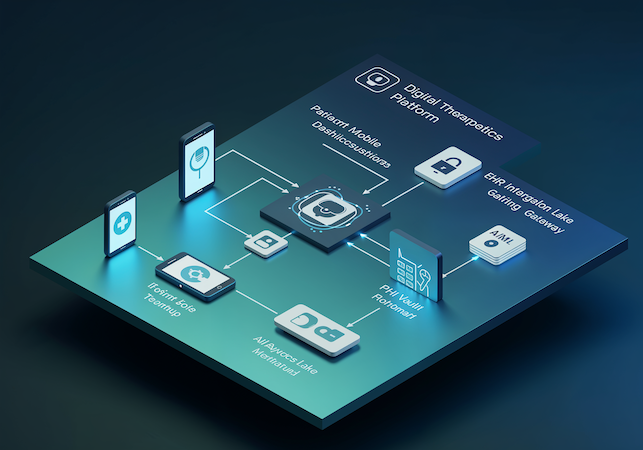
The High-Level Map
- Clients: Patient iOS/Android + web, clinician console, admin ops.
- Edge capture SDK: Offline queue, dedupe, timestamp normalization, device signals (BLE/RPM) pre-QC.
- API gateway (zero-trust): OAuth2/OIDC, mTLS, WAF, rate limits, scoped service tokens.
- Domain services: Patient, identity, consent, intervention engine, outcomes, device ingestion, notifications.
- Event bus: Kafka/NATS/Pub/Sub; every clinically relevant change is an event.
- Data tier:
- PHI Vault: “minimum necessary,” field-level encryption, tokenization.
- Analytics Lake: de-identified/pseudonymized (vault keys never leave).
- Feature Store: PHI-minimized features for models.
- ML workbench: Model registry + lineage, dataset/version pinning, drift monitors, human-in-the-loop review.
- Interop layer: SMART on FHIR auth, FHIR facade, HL7 v2 bridges, Bulk FHIR jobs, payer endpoints.
- Ops and compliance: Immutable audit logs (WORM/S3 Object Lock), SIEM, secrets via KMS/HSM, backup/DR, release governance.
PHI Boundaries (Vault ≠ Lake)
Your data lake is not your PHI vault. Put identifiers in the vault, analytics in the lake, and force all re-identification through a tokenization service with strict policy checks. Result: analysts move fast; auditors sleep at night.
Consent as a First-Class Service
Store consent artifacts (who/what/why/expiry) in a consent registry; enforce via API scopes at the gateway and attribute-level filters downstream. Support revocation that actually propagates (event to bus → cache purge → model access rules).
Evidence Engine, Not Just Analytics
Bake outcomes into the product: versioned instruments (PHQ-9, GAD-7, ISI, custom composites), event-sourced scoring, and audit-ready exports that map to payer/IRB expectations. If it’s not reproducible, it’s not evidence.
Device/RPM Ingestion That Won’t Poison Results
Normalize timestamps, dedupe bursts, sanity-check ranges, and tag provenance (firmware, sensor, transport). Quarantine questionable readings; never let dirty data sneak into clinician views or model features.
EHR Integration You Can Actually Deploy
Wrap variability behind a FHIR facade and background queues. Handle identity resolution (MRN ↔ MPI), orders/results gaps, and retries with dead-lettering. Expose a clinician-friendly “what changed in the chart” view—trust is a UX issue as much as an API issue.
Release Governance for Clinical Software
Pin datasets and models per release, require dual sign-off for PHI schema changes, and keep immutable release notes that explain patient risk, mitigations, and rollback. If your AI or mapping changes, it’s a release—treat it like one.
Where Custom Work Pays Off
- Consent registry and policy engine
- Identity resolution and FHIR normalization
- Outcomes catalog + rules engine (your “evidence OS”)
- Device QC pipeline and observability
- AI guardrails: lineage, review queues, drift alarms
- Clinician workflow UX (explainability, reconciliation, exceptions)
Want to see how we split this across workstreams? Our AI team hardens the ML workbench and guardrails; our EHR Integration team handles the facade, identity, and deployment choreography. The glue is the event bus and a ruthless respect for PHI boundaries.
AI in DTx: Where It Works—and Where It’s a Liability
If you want to create a dtx app clinicians will actually use, keep AI assistive by default. The quickest way to lose trust is letting an opaque model make care decisions while you’re still wiring up audits.

Where AI Pulls Its Weight
- Summarization, triage hints, and care-plan nudges with human sign-off. Great for scaling therapeutic interventions without pretending the model is a clinician.
- Ops automation (charting drafts, coding hints, message templates) flowing through review queues. Treat AI as a force multiplier, not a self-driving doctor.
Where It Becomes a Liability
- Autonomous claims without a change-control story. If the model, data, or prompt changes, you need versioned provenance and rollback—every time.
- PHI in prompts/logs with vendors that won’t sign BAAs. “Zero-retention” ≠ a contract.
- EU rollouts that ignore risk classification and logging obligations. Paperwork is a feature.
Guardrails We Ship
- Lineage and versioning: pin datasets/features/models per release; every inference is traceable.
- Drift SLOs: measurable drift → review queue → rollback path.
- PHI-minimal features: identifiers live in a vault; the feature store stays de-identified.
- Human-in-the-loop: high-risk actions always require clinician confirmation; explanations visible in the workflow.
- Evidence by design: instrument outcomes so clinical validation doesn’t require a rewrite later.
Case Snapshot: Assistive AI in the Wild
In Allheartz, computer vision measures joint angles from patient videos to support Remote Therapeutic Monitoring. AI drafts insights; clinicians own the decisions. Reported results: up to 50% fewer in-person visits, ~80% less clerical time, and up to 70% injury reduction for athlete screenings—evidence that assistive AI can move the needle without overclaiming autonomy.
When developing dtx software, ship explainable assistance, not automated diagnosis. Make the audit trail boring, the handoffs obvious, and the rollback painless—then scale what works.
EHR Integration Realities: SMART on FHIR is the Starting Line, Not the Finish
If you’re wondering how to create a digital therapeutics platform that actually deploys inside hospital networks, treat SMART on FHIR like the on-ramp—not the highway. Real life is app registration, security reviews, identity matching, HL7 v2 pockets, payer hooks, and relentless proof you’re not breaking regulatory compliance along the way.

Onboarding Isn’t One-Size-Fits-All
- Epic: you’ll touch Epic’s FHIR sandbox and client registration, then surface in Connection Hub for customers—helpful, but not a golden ticket to production.
- Oracle Health (Cerner): build on Millennium SMART/FHIR; DSTU2 is being sunset—R4 is the path forward.
- athenahealth: SMART R4 across patient and provider launches, with evolving capability statements and site-specific base URLs that complicate multi-tenant routing.
- eClinicalWorks: FHIR and SMART access via its developer portal and on-demand activation—details still vary by customer.
Bulk FHIR = RWE at Scale—When It Exists
Population analytics and payer pilots usually need Bulk (Flat) FHIR; check each vendor’s maturity before you promise exports. Epic documents Bulk FHIR; the HL7 implementation guide defines the contract your app should expect.
Orders/Results Still Have HL7 v2 Seams
Labs and imaging aren’t magically “all FHIR now.” You’ll often mix FHIR (ServiceRequest, Observation, DiagnosticReport) with legacy HL7 v2 order/result feeds—plan the bridges.
Payer and Formulary Hooks Matter for Adoption
If your workflow touches benefits or step therapy, align to Da Vinci PDex US Drug Formulary so your app can surface plan-accurate options, not guesses. CMS points to these IGs for consumer-facing formulary access.
eRx Is Its Own Beast
Don’t promise prescribing without an intermediary. Surescripts dominates the network and EPCS requires certified software, identity proofing, and two-factor authentication.
Identity Resolution Is Where Projects Go to Die
You’ll reconcile local medical record numbers (MRNs) to an enterprise master patient index (MPI)—and sometimes payer member IDs. ONC is clear: cross-system patient matching is nontrivial; design for it.
Compliance Is Moving—Keep Receipts
ONC’s certification program is shifting to SMART 2.0 by 2026; build for token scopes, auditable launches, and least-privilege data flows now. That’s how you stay friends with security and healthcare providers’ IT.
Device and RPM Data: Designing Ingestion That Won’t Poison Your Evidence
If “data is the new oil,” BLE is the leaky tanker. In building dtx applications, your ingestion layer either earns trust—or quietly corrupts it.

BLE isn’t HTTP
Expect pairing churn, background throttling, and firmware surprises. Cache locally, tag every packet with device_id/firmware/build, and reconnect opportunistically. Don’t trust device clocks; stamp at capture and again at ingest.
Related: BLE App Development Guide
Time Is a Liability, Not a Field
Record three clocks per sample: device_time, phone_time, server_received. Maintain a rolling offset (NTP-based) and correct drift on write. DST is not a clinical event—normalize to UTC and store the user’s timezone separately.
Dedupe Like Your Trial Depends on It (it does)
Idempotency keys = hash(device_id + rounded_timestamp + value_bucket). Use sliding windows, sequence numbers, and gap detection to kill burst duplicates without erasing legitimate physiologic spikes. Keep the raw; present the normalized.
QC Pipelines > Dashboards
Quarantine first, visualize later. Automated checks: physiologic bounds, rate-of-change, flatlines, sensor posture/body-site (when provided), battery/firmware anomalies. Tag everything with QC flags; only “green” data flows to outcomes and models.
IEEE 11073 Hints That Actually Help
Normalize units and concepts to standard nomenclatures (11073/LOINC where available). Store measurement context (position, hand, cuff size) as first-class fields; auditors will ask, clinicians will care.
Reconcile Device vs Patient-reported Truth
Design a “golden record” policy: deterministic rules + clinician override. Weight sources by reliability, show provenance in the UI, and log reconciliation events. Transparency beats mystery math.
Make Adherence Observable (quietly)
For treatment adherence, detect missing sessions early (no more “oops, two weeks of silence”). Offer grace: offline capture, gentle nudges, and recovery flows that don’t punish the user for a dead battery.
Outcome Math That Holds Up
Map cleaned streams to validated endpoints and keep a reproducible trail from raw → feature → metric. That’s how you defend patient outcomes without rewriting your pipeline mid-study.
Evidence Engine by Design
If you want to build a digital therapeutics app that survives payer and clinician scrutiny, design measurement before features. Dashboards impress demos; engineered measurement produces clinical evidence you can defend.

Your goal: define “what good looks like,” then make every release calculate it the same way—across cohorts, locales, and time.
Define Outcomes before Features
Decide what you’ll claim, then hard-code how it’s measured. Start with validated instruments and lock versions at release so clinical efficacy isn’t a moving target.
- Outcome Catalog mapping claims → endpoints → scoring recipes
- Versioned instruments (PHQ-9, GAD-7, ISI): text, locales, skip logic, cutoffs
- Digital biomarker specs: sampling, smoothing, imputation, minimum days-to-confidence
- Lineage from raw → transform → endpoint, with reversible steps
Variant Safely, Not Recklessly
Experimentation is good science until it quietly invalidates your evidence. Treat variants like protocols, not vibes.
Use protocol-safe feature flags with pre-registered exposure rules and balanced assignment. When a rule changes, that’s a new version on purpose—not a silent edit. Monitor sample-ratio mismatch and freeze variant definitions at analysis time so you can compare apples to apples.
Make Clinical Trials a Runtime Mode
Trials shouldn’t require a new schema every quarter; they should flip on like a configuration.
- First-class fields for arm, inclusion/exclusion, visit windows, and time-zero snapshots
- Automatic intent-to-treat exposure logs and locked cohorts
Then let the same rails power observational studies so randomized controlled trials (RCT) outputs flow into RWE without rewrites.
Telemetry You’ll Thank Yourself for at Payer Reviews
Pre-bake effect sizes over time, adherence distributions, time-to-benefit curves, adverse-event funnels, and utilization offsets. Always show denominators, attrition, and missingness reasons so a reviewer can re-calc your headline in a notebook.
Reproducibility and Clinician-visible Provenance
Freeze datasets and code per release (dataset_id + analysis_commit + parameter hashes). One click should reproduce any endpoint. In the product, surface instrument version, observation window, and data completeness at the point of care—trust is as much UX as statistics.
Safety, Quality, and Change Control (What Auditors Ask First)
If your demo screams speed but your release notes whisper “we’ll fix it later,” payers and hospital IT will hear the whisper. Safety isn’t a binder; it’s how you ship. When your digital therapeutics software makes risk boring and rollback obvious, you stop looking risky and start looking ready for regulatory approval.

Make Risk a Feature, Not a Spreadsheet
Bake hazard thinking into the backlog—every story ties to a risk and a mitigation you can test.
- Link hazards → user stories → tests → residual risk
- Capture pre/post-mitigation severity/occurrence and why it changed
- Verify mitigations with executable checks (negative tests, fault injection)
- Track SOUP/third-party components with known-issue notes and update policy
Traceability or It Didn’t Happen
Requirements must click through to code, tests, and evidence. Your “requirements → design → verification → validation” chain should be navigable, not archaeological.
- One artifact ID per requirement and per test
- Rigor matches risk class; no cargo-cult paperwork
- Same gated pipeline from dev → staging → prod
Change Control for AI (updates are clinical events)
Models, prompts, and datasets are code with consequences.
- Version datasets, features, models, and prompts together
- Define drift/bias triggers for retraining and rollback
- Dual sign-off for any change that can affect recommendations
- Ship model cards and two-minute change summaries clinicians can read
Evidence, Not Vibes
Make release decisions evidence based: effect deltas, safety signals, and usability findings feed a go/no-go template. Keep WORM/append-only audit logs, parameter hashes for endpoints, and signed notes stating risk impact and mitigations. If numbers move, you know exactly why.
Human Factors Is the Shortest Path to Trust
Usability failures are safety failures. Run formative studies on the workflows that matter (ordering, reconciliation, exceptions), log confusion points, and fix them like defects. In product, show provenance—what data, which instrument/model version, over what window. When clinicians can explain it to a patient, you’ve done it right.
Security and Compliance Foundations That Don’t Choke Velocity
Security shouldn’t slow a digital therapeutics application; it should make shipping safer by default. Build guardrails into the pipeline so engineers move fast without creating tomorrow’s breach memo—or undermining health outcomes with data you can’t trust.
- Least-privilege data paths
Design deny-by-default flows. ABAC over RBAC for PHI; private networking and egress allow-lists; no PHI in logs or crash reports (mask at source). “Break-glass” access with time-boxed tokens and auto-revoke.
- Scoped environments
Isolate dev/stage/prod; no production PHI in non-prod. Ephemeral preview environments pull only synthetic fixtures. Dataset whitelists, not wildcards.
- Secrets management
Short-TTL credentials, workload identities (no long-lived keys), automatic rotation as code, and per-service KMS policies. Secrets never in env vars or CI logs.
- Tamper-evident logs
Structured, signed, append-only audit streams; hash chains per request; immutable storage tier; deterministic redaction rules verified in CI.
- Ops runbooks
Tabletop-tested IR playbooks (breach, bad deploy, model rollback), on-call who/when/what, and single-command containment (revoke, rotate, quarantine). Drill quarterly; measure MTTR, not vibes.
Build Strategy: Custom DTx, Step-by-Step (No Shortcuts)
If you’re going to build your own dtx platform, treat it like a regulated product with moving parts—not a feature sprint. Here’s the lean, opinionated path that avoids rewrites and “we’ll fix it in post.”
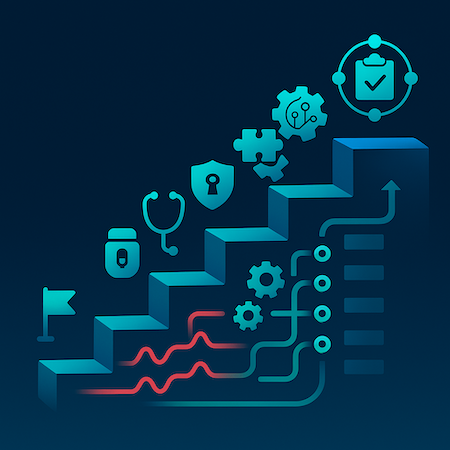
1) Claims before code
Decide what you’ll prove, to whom, and by when. Lock success metrics early.
- Deliverables: Evidence charter (target population, endpoints, effect size), risk class, preliminary pathway to regulatory and payer acceptance.
- Exit criteria: Everyone agrees what “works” means and how it’s measured.
2) Workflow design with clinicians (the 10 hard screens)
Design the decisions, not just the UI. Build for reconciliation, exceptions, and explainability.
- Deliverables: Storyboards for ordering/review/escalation, “why this recommendation” spec, failure-mode notes.
- Exit criteria: Clinicians can narrate a patient encounter end-to-end.
3) Data, identity, consent (the boring stuff that saves you)
Map PHI boundaries and patient matching before you touch an API.
- Deliverables: Data-flow DFDs, consent model (capture/propagate/revoke), identity plan (MRN↔MPI, member IDs).
- Exit criteria: Minimum-necessary data paths signed off by security.
4) Platform architecture and slice plan
Choose your service boundaries and ship a vertical slice that exercises them.
- Deliverables: ADRs, service SLOs, event model, release policy; thin slice: capture → transform → outcome.
- Exit criteria: One patient journey produces a real, versioned endpoint.
5) Integration choreography (EHR, devices, payers)
Plan reality, not hope. List each dependency, its IG, and test path.
- Deliverables: IG checklist per system, mapping tables, sandbox→prod steps, payer/formulary hooks.
- Exit criteria: Contracts, test accounts, and a migration plan exist on paper.
6) AI workstream gates (assistive first)
AI is assistive until evidence says otherwise.
- Deliverables: Model card template, review queues, drift/bias SLOs, rollback triggers, PCCP outline.
- Exit criteria: A model update is a release, not a hotfix.
7) MVP pilot with measurement baked in
Pilot design is a spec, not an email thread.
- Deliverables: Inclusion/exclusion, visit windows, ITT logging, pre-registered analyses, training/runbooks.
- Exit criteria: You can rerun outcomes from raw data in one click.
8) Launch ops and change control
Make operations boring and auditable.
- Deliverables: On-call matrix, incident playbooks, immutable logs, signed release notes with risk impact.
- Exit criteria: A dry-run proves you can roll back safely.
9) Scale and the payer packet
Turn proof into coverage math.
- Deliverables: Effect sizes over time, utilization offsets, adherence distributions, attrition accounting, budget impact sketch.
- Exit criteria: A payer can verify numbers from your artifacts without meeting you.
Bottom line: sequence decisions, freeze the right artifacts, and keep every change explainable. That’s how custom builds ship on time—and survive contact with clinicians, security, and payers.
Cost and Timeline Scenarios That Reflect Reality
The bands below are planning ranges we see on custom DTx builds. Your mileage will vary with scope, sites, and vendors—but the drivers don’t change.

Archetype A — Adjunctive CBT (PDT-ready)
A mobile cognitive behavioral therapy (CBT) companion with clinician console; start adjunctive, aim for prescription digital therapeutics later.
- Key drivers: validated instruments, outcomes packaging, light EHR read (notes/problems), assistive coaching (no autonomous claims).
- Indicative timeline: MVP pilot 12–20 weeks; payer-ready 6–9 months (1–2 sites, one EHR).
- Indicative budget: $0.6M–$1.2M.
- Risk multipliers: multi-EHR from day one; multilingual content; Class II ambitions without a PCCP.
- De-risk moves: lock claims early; one health system; pre-registered analyses; “assistive by default.”
- Patient engagement: session streaks, human touchpoints, relapse-prevention nudges that clinicians can tune.
Archetype B — RPM-Heavy Chronic Care
Device ingestion + rules engine + care team workflow; think hypertension, diabetes, HF.
- Key drivers: device QC and timestamp sanity, HL7 v2 seams around orders/results, MPI matching, payer codes.
- Indicative timeline: MVP 6–9 months; scale 9–15 months (device family + one EHR → multi-device, multi-payer).
- Indicative budget: $0.9M–$2.5M.
- Risk multipliers: “all devices” promise; Bulk FHIR that isn’t real in prod; unmanaged model updates.
- De-risk moves: one device family; one EHR; golden-record policy; quarantine pipelines before dashboards.
- Patient engagement: adherence detection, recovery flows after drop-offs, proactive outreach keyed to risk.
Archetype C — VR/AR-Based DTx
Immersive protocols with motion/biometrics; clinic + at-home hardware.
- Key drivers: human-factors studies, kinematics validation, hardware logistics, FDA pathway clarity.
- Indicative timeline: MVP 8–12 months; formal trials 12–24 months.
- Indicative budget: $1.5M–$4.0M.
- Risk multipliers: custom engines, bespoke peripherals, late usability testing.
- De-risk moves: off-the-shelf engines, content reuse, standard clinic kits, early formative studies.
- Patient engagement: session comfort, motion-sickness mitigation, short loops with visible progress.
Takeaway: budgets don’t blow up because engineers can’t code; they blow up when claims, integrations, and evidence sequencing are fuzzy. Choose the archetype, lock the claims, and stage your integrations—your timelines (and sanity) will thank you.
Related: App Development Costs Breakdown
Seven Avoidable Failure Modes We See All the Time
If you want to make a digital therapeutics app that survives contact with clinicians, payers, and auditors, dodge these seven traps. They’re boring. They’re expensive. And they’re fixable.

- Onboarding without an identity strategy
“MRN equals identity” is how data gets orphaned and patients get mislinked. Mis-ID already burns billions and drives denials. Fix: implement/partner for an EMPI, use hybrid (deterministic + probabilistic) matching, and measure duplicate and false-match rates from day one. - “FHIR-only” fantasies
R4 doesn’t delete HL7 v2, site quirks, or missing Bulk FHIR. Plan for a hybrid of FHIR + v2 + proprietary endpoints; budget an interop layer and validate every resource/operation in production, not just sandboxes. Track time-to-first-successful transaction per connection. - Unmanaged AI updates (aka clinical events masquerading as hotfixes)
Models, prompts, and datasets need a PCCP, governance, and rollback triggers. Adopt NIST AI RMF; pin datasets/models; monitor drift; require dual sign-off for changes that can touch care. No PCCP = regulatory purgatory. - Evidence that doesn’t map to claims
An elegant p-value on a bespoke endpoint won’t unlock coverage. Work backward from payer policies (e.g., Aetna’s PDT policy) and bake accepted endpoints + utilization offsets into your protocol and product. Package an economics story, not just efficacy. - Corrupting clinical signal with sloppy device/RPM ingestion
For remote monitoring, timestamps drift, retries duplicate, and units vary. Treat device data as untrusted: NTP-corrected stamps, idempotent dedupe, quarantine + QC flags, and map to IEEE 11073/LOINC before it touches outcomes or models. Measure duplicate rates and mapping coverage. - Consent that doesn’t propagate (and other HIPAA traps)
“Zero-retention” marketing ≠ a BAA. Model consent as a queryable state, automate revocation propagation across every system/vendor, and enforce “No BAA, No PHI.” Also minimize PHI in logs/telemetry by design. - Blind spots in formulary/eRx and payer workflows
PDTs stall when prescribing and benefits checks are an afterthought. Wire in eRx networks and Da Vinci Formulary/Prior Auth flows so you know coverage, tier, and step therapy in workflow. Secure codes early to avoid post-launch reimbursement face-plants.
How Topflight Helps You Build DTx Apps
We don’t sell shortcuts—we ship systems that survive clinics, audits, and scale. Typical deliverable: a dtx mobile app + clinician console + an interop spine that plays nice with the real world.
Case Beats: Allheartz (Computer Vision RTM)
- What we built: iOS/Android app + web console for AI-assisted remote monitoring (pose detection, joint-angle measurement) using TensorFlow + MoveNet. More here.
- Speed: MVP delivered in ~6 months.
- Impact: up to 50% fewer in-person visits, ~80% less clerical work, and up to 70% injury reduction for athlete screenings.
Our Engagement Model (opinionated, fast)
- Claims first: lock target outcomes and adoption math before code.
- Architecture + thin slice: one patient journey from capture → transform → outcome.
- Integration + AI guardrails: EHR facade, device QC, model lineage with rollback.
- Pilot to proof: payer-grade telemetry, clinician training, and a “rerun this result” pack.
When to Bring Us in
- Pre-IRB or payer pilot and you need evidence paths that won’t break later.
- EHR onboarding stuck in “SMART on FHIR purgatory.”
- RPM ingestion degrading signal (timestamps, duplicates, unit chaos).
- AI touching care without change control.
If you’re mapping how to develop a digital therapeutics app that clinicians actually adopt—and you need remote monitoring plus explainable AI to hold up under scrutiny—bring us the mess. We’ll turn it into a roadmap, a pilot, and a platform your team can run. Book a consult and let’s scope the slice that proves it.
Frequently Asked Questions
What does a ready-to-pilot DTx stack actually include?
Patient app, clinician console, an event bus, a PHI vault separate from an analytics lake, a consent registry, a FHIR facade with HL7 v2 bridges, device/QC pipelines, and an ML workbench with lineage and release governance so evidence is reproducible.
How should we scope AI features for V1 without creating audit debt?
Keep AI assistive by default, require human-in-the-loop on high-risk actions, pin datasets/features/models per release, monitor drift with rollback triggers, and never send PHI to vendors without BAAs; treat any model or prompt change as a release.
What are the biggest EHR integration glitches we should plan for?
SMART on FHIR is just the on-ramp; you still need app registration, security reviews, MRN-to-MPI matching, HL7 v2 seams for orders/results, uneven Bulk FHIR support, formulary/prior-auth hooks, and EPCS constraints for prescribing.
How do we stop RPM/device data from corrupting our outcomes?
Stamp multiple clocks, correct drift, dedupe bursts with idempotency keys, quarantine and QC data before use, and normalize to IEEE 11073/LOINC with provenance tags; only “green” data should reach outcomes or models.
What actually drives cost and timeline more than coding speed?
Clarity of claims and endpoints, sequencing integrations, building the evidence engine up front, and dodging the seven failure modes (FHIR-only fantasies, unmanaged AI, misaligned outcomes, identity gaps) determine whether you hit dates and budgets.