

Updated November 2026
Apps make money through eight app monetization strategies: subscriptions, in-app purchases, freemium, advertising, paid downloads, hybrid models, usage-based plans, and B2B or sponsored access. Mobile app monetization usually starts with subscriptions and in-app purchases; games lean on ads, and B2B tools sell company licenses.
Quick answer: the eight app monetization strategies
- Subscriptions: recurring revenue, best for content and services people use weekly.
- In-app purchases: consumables and one-time purchases inside a free or paid app.
- Freemium: a free app with paid upgrades, usually subscriptions or in-app purchases.
- In-app advertising: rewarded video, interstitial, and native ads.
- Paid apps: a one-time download price, best for niche professional tools.
- Hybrid: two or three of the models above in one app.
- Usage-based and credit pricing: credits and tiers for apps whose AI features cost real inference.
- B2B and sponsored access: employers, schools, or partners pay for their users.
For a new app, subscriptions plus in-app purchases bring revenue faster than ads do, because they need a few hundred paying users, while ads need millions of viewers. That’s the short version of how to monetize an app; the rest of this guide covers fees, store rules, and how to pick.
Key Takeaways:
- Subscriptions and in-app purchases are the most reliable revenue, and store fees shrink after the first year or the first million.
- US web checkout changed in 2025: Apple collects no commission on US link-outs, and Google charges per-program service fees from October 1, 2026.
- Ads still fund most free apps, but App Tracking Transparency cut iOS ad revenue, so hybrid models are the safe default.
- Health and wellness apps have cleaner routes: employer and payer contracts, provider licensing, reimbursement, and consumer plans.
Table of Contents:
- 1. What is mobile app monetization?
- 2. App monetization in 2026: what changed
- 3. How do apps make money? 8 app monetization models
- 4. How do free apps make money?
- 5. Web checkout and external payments: what Apple and Google allow in 2026
- 6. App Store vs. Google Play: fees and what works on each
- 7. How to monetize a healthcare or wellness app
- 8. App monetization platforms and tools
- 9. How to choose a monetization model for your app
- 10. App monetization best practices
- 11. Monetization metrics to track
- 12. How Topflight helps you pick and build a monetization model
What is mobile app monetization?
App monetization is how an app turns its users into revenue: paid downloads, subscriptions, in-app purchases, advertising, or licensing, alone or combined. When your app is your business, the model you pick sets your pricing, your onboarding, and your retention strategy.
If you already run a business and the app is another channel for your goods or services, monetization mostly means subscriptions or purchases inside the app, and the model matters less than the delivery.
App monetization in 2026: what changed
Four shifts since 2020 reset how apps make money. Each one is dated because store rules moved fast.
App Tracking Transparency reset iOS ad revenue
Apple shipped App Tracking Transparency with iOS 14.5 in April 2021, and within weeks only a single-digit share of US users had opted into tracking (Flurry’s daily opt-in updates, May 2021). Advertisers moved budget to Android and first-party data, and every ad network rebuilt around contextual signals.

Every monetization decision in this guide traces back to one of these four shifts.
US courts opened web checkout on both stores
A district court order on April 30, 2025 made Apple let US apps link out to external purchases, and the Ninth Circuit ruling on December 11, 2025 kept that door open while a cost-based fee gets decided. Google opened its billing alternatives for US users on October 29, 2025. The full sequence, with fees, sits in the web checkout section below.
Hybrid monetization became the default
By 2026, large consumer apps commonly run two or three models at once: Duolingo pairs ads with Super Duolingo, Spotify pairs ads with Premium, and YouTube runs ads beside Premium. The hybrid pattern spreads revenue across segments that no single model reaches.
AI features pushed usage-based plans
AI features changed the pricing math because every message, edit, or generation costs real inference. Apps responded with credits and usage caps on top of recurring plans, so heavy users pay for the compute they consume.
How do apps make money? 8 app monetization models
The eight app monetization models break into two camps: direct revenue (subscriptions, in-app purchases, paid downloads) and indirect revenue (ads, licensing, sponsorships). Here’s how they compare:
| Model | How it works | Best for | Store fee | Example |
|---|---|---|---|---|
| Subscriptions | Recurring billing for ongoing content or service | Content, productivity, health, dating | Apple 30%, 15% after year one; Google 10% service (+5% Play billing) | Spotify, Calm, Duolingo |
| In-app purchases | Consumable and non-consumable purchases sold inside the app | Games, utilities, social | Apple 30% (15% small business); Google 20% or 25% service (+5%) | Candy Crush, Bumble |
| Freemium | Free download, paid upgrades | Broad consumer apps | Fees follow the model you combine it with | Dropbox, Evernote |
| In-app advertising | Rewarded video, interstitial, native ads | Games, social, utility | No store fee on ad revenue | Pinterest, Subway Surfers |
| Paid apps | A one-time download price | Niche professional tools | Apple 30% (15% small business); Google 20% or 25% service (+5%) | Procreate, LumaFusion |
| Hybrid | Two or three models in one app | Most consumer apps | Combined, per model | Duolingo, Spotify |
| Usage-based pricing | Credits or tiers capped by usage | AI features, APIs | Store fees apply when users buy credit packs | ChatGPT, AI photo apps |
| B2B and sponsored access | Employers, schools, or sponsors pay | B2B tools, wellness, health | Negotiated outside the store or via in-app purchases | Headspace for Work, Calm Business |
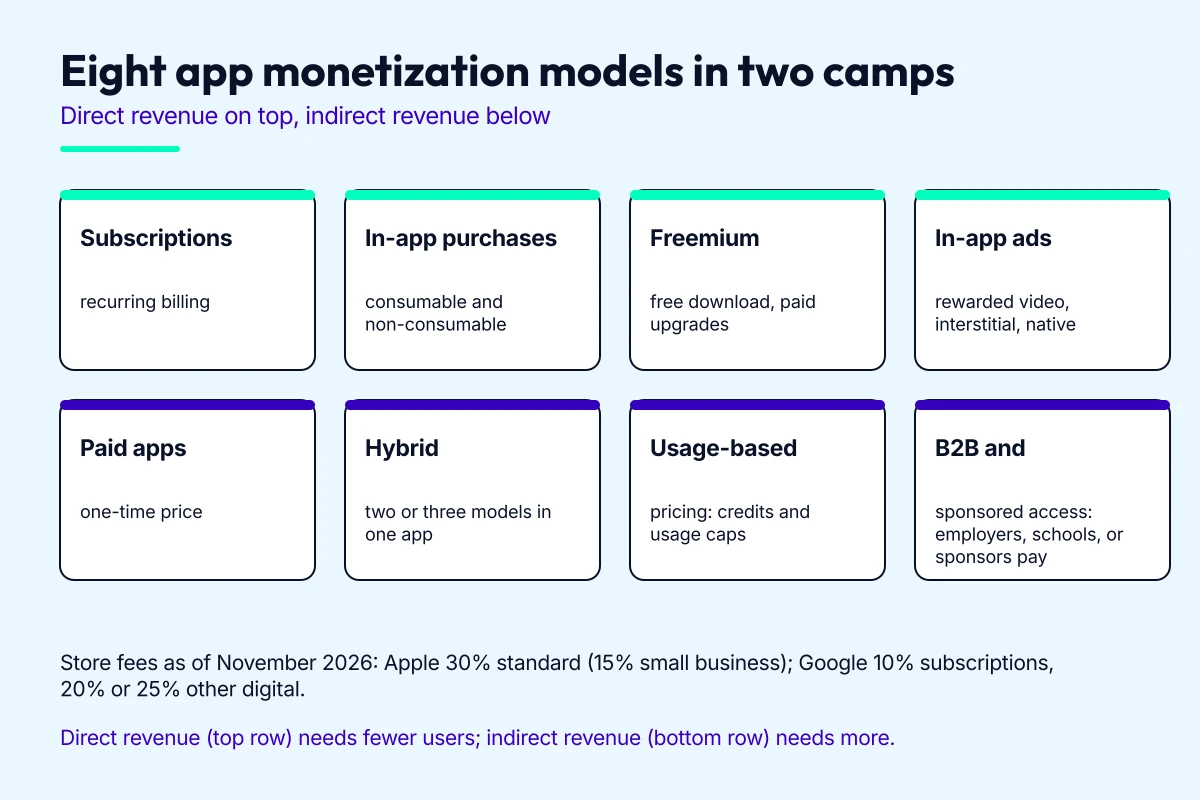
Direct revenue needs fewer users; indirect revenue needs more, and the fee column decides which wins.
Subscriptions
The model bills users monthly or yearly for ongoing value: content and storage. As of November 2026, Apple takes 30% in year one and 15% once a subscriber passes a year of paid service, and the App Store Small Business Program cuts that to 15% from the start for developers under $1 million in proceeds. Google Play charges 10% service on an auto-renewable subscription, plus a 5% billing fee when the purchase runs through Play Billing.
Apple’s tools have grown past the 2020 set: win-back offers, offer codes, and a monthly plan with a 12-month commitment. The current rules live on Apple’s subscriptions page. US rules on selling recurring plans outside the store sit two sections down.
- Family Sharing covers your plans, which widens the funnel without extra acquisition cost.
- Tiers convert better than one price: free, plus, and pro.
Recurring revenue only keeps arriving if the value does, or churn eats the model.
In-app purchases
In-app purchases do most of the heavy lifting in app monetization. A consumable sells again and again: gems and boosts. One-time purchases sell once and stay tied to the account: a pro upgrade, a filter pack.
Apple’s sandbox lets you test purchases before release. Refunds remain the main cost, so design the purchase flow so accidental buys are hard to make.
Freemium
Freemium is the funnel around the two models above: the app is free to download, and revenue comes from the share of users who upgrade through a subscription or an in-app purchase. The free tier is marketing, so it has to show real value before the paywall appears.
In-app advertising
Advertising funds most free apps. ATT weakened iOS ad targeting, and the networks rebuilt around mediation: AppLovin MAX, Google AdMob, and Unity LevelPlay auction each impression across demand sources. Facebook’s old Audience Network inventory runs today as Meta Audience Network.
The formats worth using:
- Rewarded video: users watch for a life or a boost.
- Interstitial ads: full-screen between flows, keep them rare.
- Native ads: styled like the feed they sit in.
Ads pay off only at scale. Duolingo and Spotify run them alongside premium tiers, which tells you the real answer is usually both.
You may also be interested: how to create a game app.
Paid apps
Paid apps charge once at download. The model fits niche professional tools where a free tier would cannibalize sales, and you can combine it with in-app purchases, which Apple calls paymium.
- Works when the app targets a premium segment with few direct substitutes.
- Costs you acquisition speed: every download is a purchase decision.
- Examples: Procreate, LumaFusion, Threema, HotSchedules.
Weighing a paid product? Our custom mobile app development guide walks through the build.
Hybrid monetization
The model runs two or three revenue streams in one app. By 2026 it’s the default for anything with a large free audience: paid tiers pay for content, ads fund the free tier, and in-app purchases catch the rest.
Combining helps when the models serve different user groups, so free users see ads and subscribers don’t. It hurts when ads reach paying users, which is the fastest way to burn a subscription base.
Usage-based and credit pricing for AI features
A flat subscription loses money when every message a user sends costs you inference. Usage-based pricing charges for what people actually use, and most AI products settled on two mechanisms in 2025 and 2026:
- Credits that refill monthly, with packs for heavy use.
- Tiers with usage caps and an overage price past the cap.
B2B and sponsored access
Some apps make money before a single user pays: employers license the app for their staff, schools buy seats for students, or a partner sponsors access for a specific audience. Sponsorship and affiliate deals work the same way, and the product experience stays clean.
Move-to-earn apps are a cousin here: Sweatcoin-style products pay users in sponsor-funded currency and sell the underlying technology to insurers that bundle it with policies. Read our move-to-earn app development guide to see whether the model fits.
How do free apps make money?
How do free apps make money? Through ads, upgrades from free to paid, in-app purchases, and sponsorships. Ads monetize app traffic, and the other three monetize users directly. The download is the funnel; the revenue comes later.
Duolingo shows ads on the free tier and sells Super Duolingo. Spotify pairs ads with Premium. Pinterest sells promoted pins. None of them charges at download.
Web checkout and external payments: what Apple and Google allow in 2026
US payment rules changed in 2025, and the two stores now diverge. As of November 2026, here’s where things stand.
Apple. Since the district court’s April 30, 2025 contempt order, Apple must let US apps link out to external purchases, and it has collected no commission on them. On December 11, 2025 the Ninth Circuit affirmed the contempt finding, vacated the complete commission ban, and told the district court to set a fee tied to Apple’s actual costs. The Supreme Court agreed on June 30, 2026 to hear Apple’s appeal, with a ruling expected by June 2027. Apple has proposed 15%, 10%, and 5% tiers in an August 2026 court filing, but no schedule is in force. Outside the US, external purchase links run through Apple’s entitlement programs, with their own commissions. Coverage: The Next Web.
Google. Google has allowed alternative billing and external links for US users since October 29, 2025, under programs announced December 9, 2025. Developers in those programs must report transactions and pay service fees starting October 1, 2026: 10% for auto-renewing subscriptions, 20% for other digital purchases through external purchase links, and 25% for other purchases through in-app alternative billing. The 5% billing fee applies only when a purchase runs through Play Billing, not the alternatives. These rates come from Google’s March 2026 Epic settlement, effective June 30, 2026 in the US, the UK and the EEA. Announcement: A new era for choice and openness. Details: Google Play Console Help.

The US is the outlier: Apple charges nothing on link-outs today, while Google’s service fees started October 1.
App Store vs. Google Play: fees and what works on each
Fees set the ceiling on every model above. As of November 2026:
| Fee | Apple App Store | Google Play (US) |
|---|---|---|
| Standard rate | 30% on apps and in-app purchases | 20% service on other digital purchases from new installs, 25% from existing installs, plus a 5% billing fee via Play Billing; 10% service for renewals |
| Small business / first-year rate | 15% under the App Store Small Business Program (under $1M in proceeds) | 10% service on the first $1M of annual earnings |
| Subscriptions after year one | 15% | 10% service, unchanged |
| US external links | 0% commission since the April 30, 2025 court order; proposed fees are not in force | 10% for renewals, 20% for other digital purchases through external purchase links |
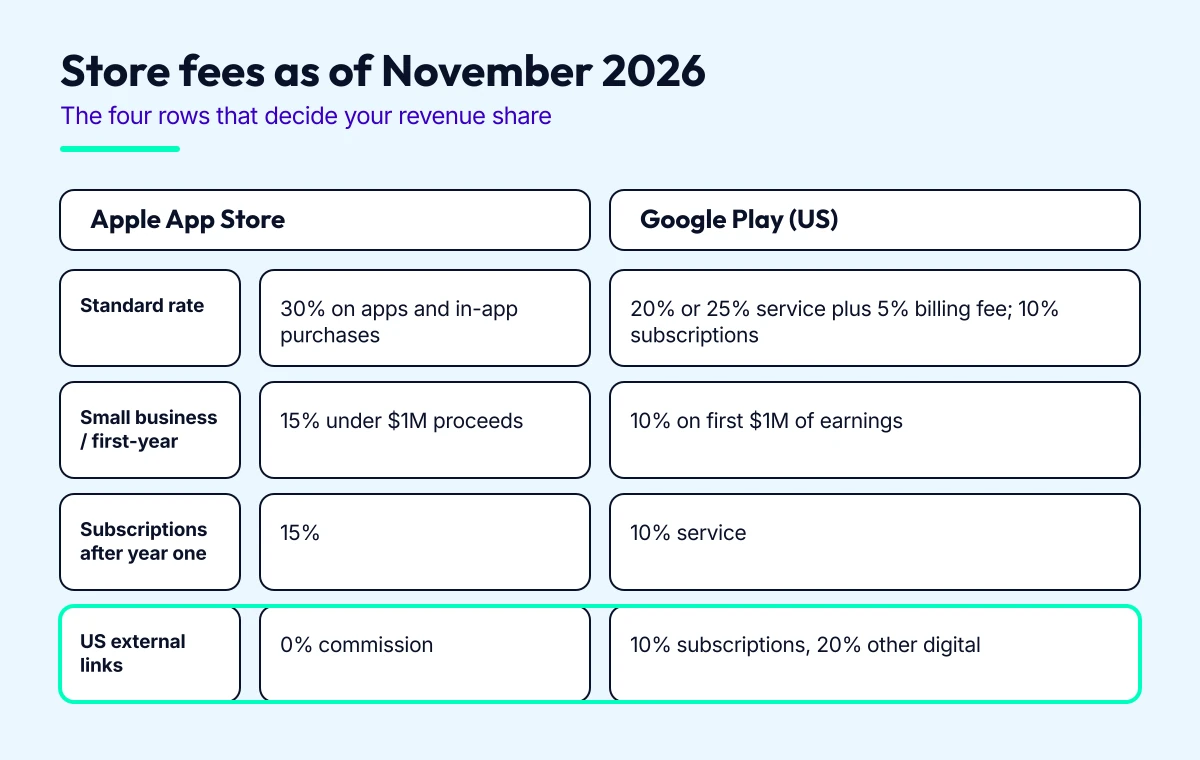
Read the row that matches your app: the store split is biggest on standard in-app purchases.
Best monetization options for iOS apps
Recurring revenue and in-app purchases stay the strongest models on iOS, and Apple’s tooling (offer codes, win-back offers) is built around them.
If you do run ads on iOS, placement and frequency matter more than the network, because iOS users expect a premium feel. Related: Understand App Development Costs
Best monetization options for Android apps
Android’s reach makes ads and alternative billing natural fits. Video and playable ads engage best on the platform, and since October 29, 2025 US developers can route purchases through Google’s alternative billing programs and skip Play Billing for those transactions, with the service fees from the table applying from October 1, 2026.
How to monetize a healthcare or wellness app
Health app monetization runs on different rails than consumer apps, because ad tracking and data sales carry legal risk that most health apps shouldn’t take. Four routes work better:
- Employer and payer contracts (B2B2C): companies or insurers pay for their members to use the app. This is how employer-sponsored wellness programs run.
- Provider software licensing: clinics pay per seat or per site for a tool their staff uses daily.
- Remote patient monitoring reimbursement and therapeutic monitoring: billable codes turn the app into a revenue line for practices.
- Consumer subscriptions: a direct-to-patient tier, with the compliance work done properly.

The money in health apps sits with employers, payers, and practices more often than with consumers.
Selling user data is the trap. In February 2023 the FTC fined GoodRx $1.5 million, and in March 2023 it made BetterHelp hand back $7.8 million, after both shared health data with ad platforms; both settled rather than going to court. The FTC Health Breach Notification Rule, updated in April 2024, covers health apps, and Washington’s My Health My Data Act took effect on March 31, 2024. The health apps that keep paying for this are the ones that attach health data to ad targeting.
We’ve watched the cleaner models work: Dedica Health signed a $300K-a-year SaaS customer right after its MVP, and AlgoRx reached seven-figure ARR in six months. Read our healthcare app development cost guide, the wellness app development guide, and the HIPAA compliant app development guide, plus the Dedica Health and AlgoRx case studies.
App monetization platforms and tools
One platform handles billing, another mediation, a third measurement. Pick one app monetization platform per job from this shortlist:
- Paywall and billing: RevenueCat, Adapty, Superwall.
- Ad mediation: AppLovin MAX, Google AdMob, Unity LevelPlay.
- Attribution and analytics: AppsFlyer, Adjust, Branch, and Sensor Tower, which absorbed data.ai in March 2024.
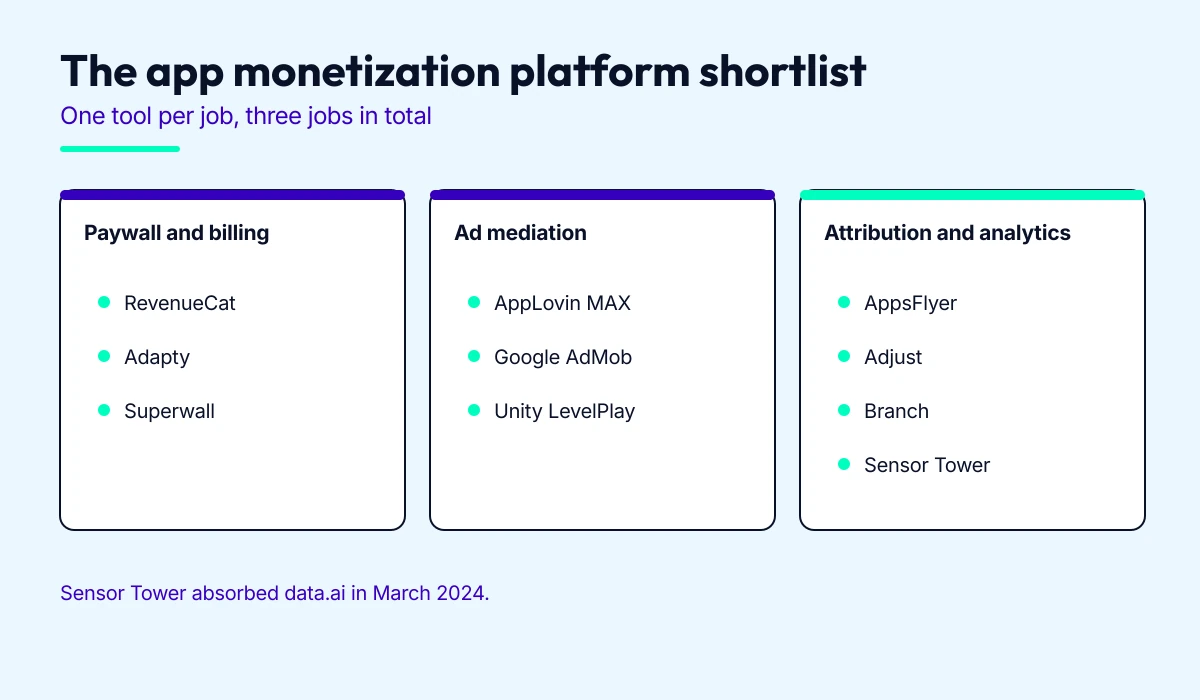
Wire the three together instead of buying an all-in-one.
We’ve run RevenueCat in production, most recently on SoberBuddy, and the SDK went in during an afternoon. Its dashboards cover MRR, LTV, trials, and churn in one place, which beats stitching reports together from the stores.
How to choose a monetization model for your app
Six app types, six mobile app monetization strategies. Start with the row that matches your product and adjust from there:
| App type | Model that usually fits |
|---|---|
| Utility | A free app with a one-time upgrade |
| Content | Subscriptions |
| Games | In-app purchases plus video ads |
| Fitness and wellness | Recurring plans or employer-sponsored access |
| B2B tools | Paid apps or B2B licensing |
| Healthcare | B2B2C contracts or consumer plans |
App monetization best practices
Five practices hold across every model above:
- Combine models. Paid tiers and ads fund different user groups in the same app.
- A/B test paywalls and pricing before you scale either.
- Offer a free trial. It’s the cheapest way to move skeptics.
- Price by country. $4.99 means different things in the US and in Vietnam.
- Show the paywall after the user has seen value; a first-launch paywall adds friction.
Monetization metrics to track
Track five numbers from day one: ARPU, LTV, trial conversion (trial-to-paid), churn, and ad eCPM. Each answers one question: what a user is worth, how long they pay, whether the trial converts, how many leave, and what each impression earns.
Benchmarks for each live in our mobile app metrics guide.
How Topflight helps you pick and build a monetization model
Pick the wrong model and you’ll spend a year rebuilding pricing while the product stalls. We’ve run this exercise across healthcare and consumer apps: Dedica Health’s MVP led to a $300K-a-year SaaS customer, and AlgoRx hit seven-figure ARR in six months.
Tell us about your app and your audience, and we’ll map the models that fit, then build the one you pick. Book a call.
Related Articles:
- Top Mobile App Metrics to Track for Growing Your App
- On Demand App Development Guide
- How to Develop an MVP
- App Store Optimization Guide
Frequently Asked Questions
How do free apps make money?
Free apps make money through ads, in-app purchases, subscriptions, and sponsorships. Duolingo runs ads on the free tier and sells Super Duolingo, and Pinterest sells promoted pins. The download is free because one of those models pays for it.
How do you make money from an app?
Pick a model that fits the app: paid tiers for content, in-app purchases for games, ads for scale. In practice, how to make money from an app is to launch free, show value first, and put a paywall in front of the parts worth paying for. Tell us about your product and we’ll shortlist the models that fit.
How much money can you make owning an app?
It depends on the model and the reach. A niche B2B tool can pass $100K in annual revenue with a few hundred customers, while an ad-funded game needs millions of downloads to match it. An app with 1,000 paying users at $10 a month grosses $120K a year before store fees. No model pays without retention.
How much is an app with 100,000 users worth?
It depends on what those users do. Revenue, retention, and ARPU set the value: 100,000 active users paying $5 a month is a different company than 100,000 dormant installs. Buyers and investors price the recurring revenue first, then the growth rate.
What is the best monetization model for a new app?
Subscriptions plus in-app purchases, unless the app is a game (ads and in-game items) or a B2B tool (licensing). New apps need revenue per user before they have the traffic that makes ads work.
Can I sell subscriptions outside the App Store?
In the US, yes. Since the April 30, 2025 court order, Apple lets you link out to outside payments and collects no commission on them, though the courts are still deciding what fee Apple may charge later. Outside the US the rules differ. Google allows out-of-store billing in the US, with service fees applying from October 1, 2026.
Can I have subscriptions and in-app purchases in a paid app?
Yes. Neither Apple nor Google prevents a paid app from selling paid upgrades on top of the download price. Apple calls the combination paymium.
Should a health app show ads?
Usually not. Ads work when they match the context, and health apps sit on sensitive data where ad targeting produced the FTC’s 2023 actions against GoodRx and BetterHelp. Employer contracts and reimbursement pay better for health apps.