

You’re in the budget meeting again. Epic AI now covers notes, patient messages, and denial appeals, so the room is asking why you’d fund anything else. It’s a fair question.
Our answer: Epic’s built-in AI is the right default for generic work inside Epic. Custom AI earns its place where the workflow, the data, or the product is yours. Anything else is a build decision.
More than 85% of Epic’s customers now use Epic’s AI.
Ochsner Health moved a planned system upgrade forward by 3 weeks to start using Ergo Visit sooner.
Fewer than 25% of clinicians who adopted Epic’s AI tools say they got adequate training on validating AI output.
This post is the map. You get the portfolio of what Epic ships. Then the 7 places its AI stops. Then the 5-question framework for deciding what to build. Walk back into that budget meeting and close the line item.
Should you use Epic’s built-in AI or build your own?
Use Epic’s AI for the work that lives entirely inside Epic: ambient notes, patient messages, and denial appeals, where the built-in features win on integration and one contract. Build and connect through SMART on FHIR, CDS Hooks, and FHIR write-back with clinician sign-off the moment a workflow needs outside data, specialty rules, or a product sold across EHRs. The five questions, asked in order, land every workflow on one side of the line.
Key Takeaways:
- Epic’s built-in AI wins the generic middle, and saying so out loud buys the rest of the argument its bluntness. Credit Epic where the work lives entirely inside Epic. The boundaries that follow are sharper because the concession came first.
- Three answers flip a workflow from use to build: outside data, specialty rules, or a product to sell. Any one of them sends the project out of the built-in AI and into the build side, where SMART on FHIR and CDS Hooks do the connecting.
- The write-back step separates safe builds from records you cannot defend in an audit. AI output lands in preliminary status, a clinician signs, and only then does the note become final. Skip the checkpoint and an unsigned draft reads like a signed one.
Table of contents
- What is Epic AI?
- Epic’s AI portfolio at a glance
- What Epic’s AI does well
- Where Epic’s AI stops
- Agent Factory vs. building outside Epic
- Build or use Epic? A decision framework
- How custom AI connects to Epic
- If you sell to Epic customers, will Epic replace you?
- Governance, HIPAA, and cost
- Why choose Topflight Apps for Epic AI development
What is Epic AI?
Epic generative AI lives inside the EHR itself, in the same record your clinicians work in. The features Epic builds in are generative and predictive, organized around three assistants: Art for clinicians, Emmie for patients, and Penny for revenue cycle. Agent Factory sits alongside them for the agents an organization builds itself. Every piece runs grounded in the chart. That constraint drives the whole decision: the strengths come from it, and the stops begin with it.
Epic’s own taxonomy names the three assistants by audience: Emmie for Patients, Art for Clinicians, and Penny for Revenue Cycle and Operations, embedded throughout Epic’s software for everyone in between. That in-between covers the front desk, scheduling, the billing office, anyone who touches the chart without holding a stethoscope.
Every one of those roles gets an assistant pitched at them, which is how one portfolio becomes coverage for the whole health system. The split tracks the budgets you defend, clinical and revenue cycle first among them. Ask Art is the clinicians’ entry point, answering natural-language chart questions with concise, cited answers and visualizations. The assistants live inside the chart, which is why they need no integration project.
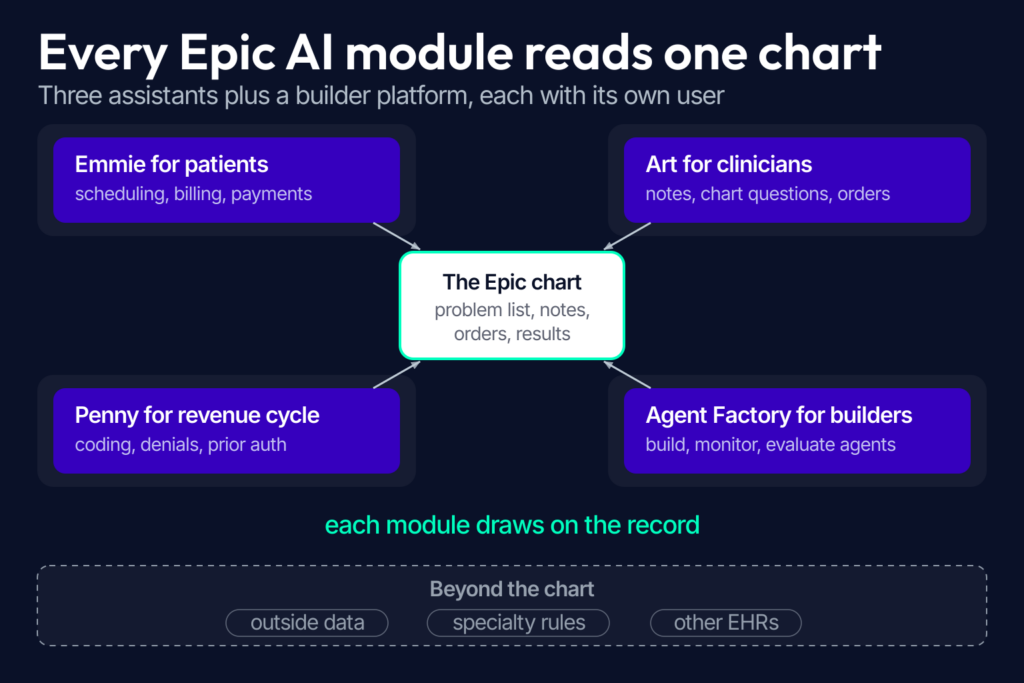
Epic’s AI portfolio is organized around three assistants plus a builder platform, all grounded in the chart.
More than 85% of Epic’s customers now use the AI in Epic EHR, Epic’s own March 10, 2026 figure from its Real Results, Right Now post. The number measures spread, and only spread: it counts who has switched the features on, and it says nothing about whether the features fit. Still, spread at that scale settles the first question in the room. For most Epic shops, the built-in AI is the default, and the live question is where it stops.
Epic itself has published exactly one Ergo name: Ergo Visit, a redesigned outpatient visit. The broader Epic Ergo umbrella, spanning Art, Emmie, Penny, and Cosmos, exists only in UGM 2026 keynote reporting, never in an Epic post. Both matter, and they matter differently: a keynote signals direction, while a post means shipped. Your roadmap slides should say which one they’re built on.
Built in and grounded in the chart: exactly why the build-or-use question exists. A tool that already reads the chart skips the integration project and the second contract. A tool that needs something the chart does not hold is a build decision. Our AI in EHR guide covers the generic blueprint; this post is its vendor-specific sibling. Here it’s Epic’s story, and it starts with the portfolio.
Epic’s AI portfolio at a glance
Six rows cover the portfolio: Art and Chart with Art for clinicians, Emmie and Ask Emmie for MyChart patients, Penny for revenue cycle, Agent Factory for builders, Cosmos and Curiosity for analysts, and Ergo Visit for the redesigned visit. Each row carries what Epic reports, dated.
| Product | User | What it does | Reported result | Availability |
|---|---|---|---|---|
| Art for Clinicians and Chart with Art | Clinicians | Ambient documentation that drafts notes and queues orders | Discharge summaries 20-30% faster; OLVG note time down 31% | Launched February 2026, outpatient first, then nursing, home care planned |
| Emmie and Ask Emmie | Patients in MyChart | Scheduling, billing questions, and payments | Rush: sustained 58% fewer billing messages | Live at Sutter first; Reid Health and Community Health Network adopted 2026 |
| Penny | Revenue cycle staff | Coding support, denial appeals, prior auth, claim edits | 200+ organizations; denials down 20%+ (Feb 2026); 33% across 160 (UGM, Aug 2026) | Autonomous coding and appeals within each organization’s guardrails, per Epic |
| Agent Factory | Health system builders | Build, monitor, and evaluate agents | ECU Health: 20 staff hours a week saved | Early-adopter training October 2026, broader 2027 |
| Cosmos and Curiosity | Analysts, researchers | Outcome prediction on de-identified Cosmos data | Curiosity: simulates future patient outcomes | Research community since March 2026 |
| Ergo Visit | Clinicians, patients | AI-supported redesigned outpatient visit | Pilot at Ochsner, 4 clinicians | First use August 3, 2026 |
What the table shows
Epic ambient AI arrived with the February 4, 2026 launch. AI Charting listens during visits, drafts the clinician’s note, queues orders from the conversation, and takes voice commands to restructure notes; the same launch post reports Art Insights at 16M+ uses a month and 200+ organizations on Penny, all built directly into Epic.
Launched as AI Charting in February 2026, Epic renamed it Chart with Art. Outpatient first, then bedside nursing in March, with home care planned for April. Discharge summary completion runs 20% to 30% faster with Art’s draft hospital course notes (Fierce Healthcare, March 2026), and OLVG pediatricians cut note-writing time 31% and time in chart 27% (Epic, September 2, 2026).
Epic Emmie provides conversational assistance in MyChart and over text, and Sutter Health was first live with Ask Emmie. Rush has held a sustained 58% reduction in billing-related customer service messages (Fierce Healthcare, March 2026).
Epic Penny is the revenue-cycle assistant: 200+ organizations on professional billing coding per Epic’s February 2026 reporting, with 20%+ fewer coding-related denials. UGM 2026 keynote reporting puts the coding assistant at 33% fewer denials across 160 organizations. Summit Health cut prior auth submission time 42%, with 92% of responses accepted without edits (Fierce Healthcare, March 2026).
Agent Factory is Epic’s platform to build, monitor, and evaluate AI agents. Early-adopter training begins October 2026, with broader availability planned for 2027.
Epic Cosmos AI runs Curiosity: generative models on 300M+ de-identified Cosmos records, open to researchers since March 2026.
Ergo Visit rounds out the table: Ochsner Health first used it on August 3, 2026, with 4 clinicians.
Which numbers to trust
Every figure above carries a date, and the dates matter because the results are early. The origins split three ways:
- Epic’s own newsroom posts, Epic-reported and mostly early
- press reporting of Epic’s claims, like Fierce Healthcare’s March 2026 coverage
- UGM keynote reporting, Epic’s conference numbers in a journalist’s words
Keep the origins separate when the numbers reach your board deck. If the Art row’s ambient documentation is the part you’d rather build than use, our ambient AI scribe guide walks through the build. These numbers are the use-Epic evidence; the stops section marks where they stop.
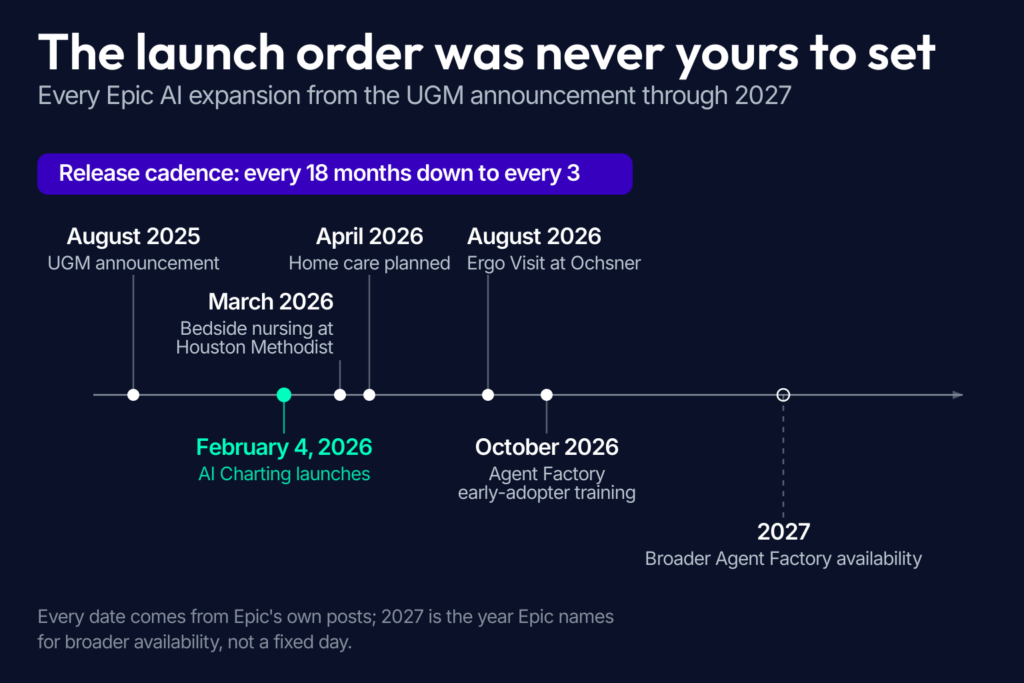
Epic’s AI shipped on Epic’s calendar: every expansion date is Epic’s call.
What Epic’s AI does well
Start with the least glamorous strength: there is no integration project. Epic calls Emmie a built-in AI assistant, and built-in is the operative word. The features ship inside the chart your clinicians already open, so day one is a configuration question. Your integration team keeps its backlog, and the budget line you feared never opens.
The data is already in context, so there is no handoff to mess up. The models read the chart directly, and the output arrives shaped for this patient, this encounter. That context is what makes the output safe to act on. Epic Art AI results hold up at the hospital level: Riverside cut documentation and communication time 32%, and Christ Hospital’s lung detection sits at 69% versus 46%, the diagnosis support number.
One contract covers it. The AI ships under the Epic agreement you already signed, so onboarding means turning features on. Your security review has one familiar system to look at, and the procurement meeting that usually kills AI pilots comes back with nothing to do.
Rollout reaches people you already have. Ochsner Health moved a planned system upgrade forward by 3 weeks to start using Ergo Visit, which saw first use on August 3, 2026. When a health system rushes its own upgrade calendar for a feature, the adoption cost is already low. That’s why “use Epic” is the framework’s default. Now the other side, where the same chart runs out.
Where Epic’s AI stops
Epic’s AI covers work that lives inside Epic. Seven boundaries mark where it stops, and each boundary is a build signal. Learn the list once, and every vendor pitch sorts itself into one of the seven.
1. Data outside Epic
Epic states the boundary itself: because the AI is built directly into Epic, it draws from information captured throughout the medical record and is grounded in a comprehensive understanding of the patient. What that grounding leaves out: device and remote monitoring data, pharmacy and payer data, records from non-Epic partners. The outside already moves real volume: 9.3 billion records exchanged in 2026, half of them between Epic and non-Epic organizations.
2. Specialty rules Epic does not model
Chart summarization goes generic exactly where specialists need it sharp. KLAS, May 21, 2026: specialists may find the summarization output too generic when they need focused, specialty-specific context. Chart with Art covers 70+ specialties live, per UGM 2026 keynote reporting, and coverage that wide is breadth. The depth a single specialty needs still has to be built.
3. Workflows that cross systems
Prior authorization is the cleanest example. Epic’s own admission: it used to mean phone calls, faxes, or retyping into separate insurance portals, and the CRD API fixes it only where payers build their end. Interoperability is a two-sided build, and Epic only controls one side.
4. Your own model and hosting choices
Epic builds and ships the models. Customers get a validation suite and Agent Factory’s policy and knowledge-base knobs, and no model substitution. If your team wants its own model or its own hosting, that work happens outside Epic, where total cost of ownership and vendor lock-in become your line items to manage.
5. Products sold to many health systems
Epic builds for Epic. Cheers CRM’s whole value is full integration into Epic’s one unified code base, which is exactly the quality you cannot take to a shop running another EHR. A product you sell across many EHRs lives outside Epic.
6. Patient experiences outside MyChart
Emmie is informed by the chart and connected devices, and Michael Millenson’s read is blunt: it is not an agent of patient autonomy. The patient-facing AI you want in your own app, on your own channels, is yours to build.
7. Roadmap timing
Epic names its own dates: home care in April 2026, Ask Emmie in the coming weeks per Epic’s March announcement, Curiosity’s March 2027 in-EHR release, plus Ergo’s November ship date per UGM 2026 keynote reporting. Customers influence timing only by being early adopters.
AI Charting went from UGM announcement in August 2025 to release the week of February 2-6, 2026, the calendar Epic chose, and release cadence has tightened from every 18 months down to every 3, per UGM 2026 reporting.
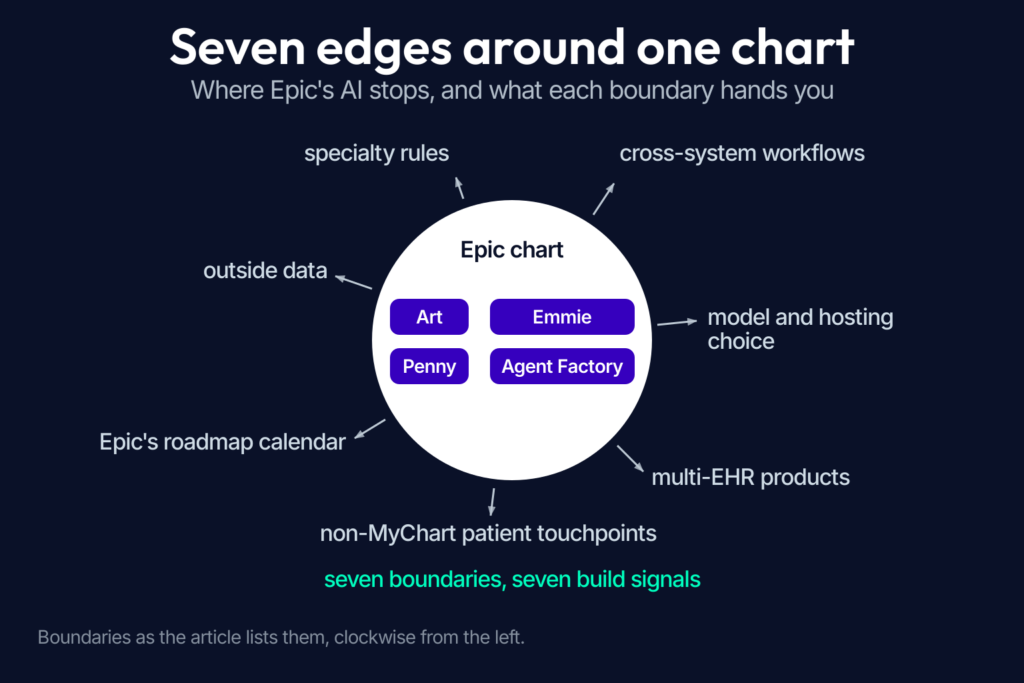
Seven boundaries separate what Epic ships from what you still build.
Seven boundaries, seven build signals. Every one of them maps to a row in the next section’s comparison.
Agent Factory vs. building outside Epic
Three ways to get agents into an Epic workflow; the table decides.
Epic Agent Factory is a visual drag-and-drop builder for agents that reason, decide, and execute steps autonomously, built on Epic’s own system so agents move across clinical, scheduling, and analytics domains. Epic announced it at HIMSS26 on March 10, 2026 as a platform for creating and monitoring AI agents, per Fierce Healthcare’s HIMSS26 coverage, after a first preview at JPM in January.
Customers customize agents with a visual builder, equip them with local policies and knowledge bases, and deploy on their own timeline, with a library of prebuilt agents.
| Row | Agent Factory inside Epic | External app on SMART on FHIR and CDS Hooks | Standalone platform on Epic APIs |
|---|---|---|---|
| Data reach | Epic chart data only; external connectors are future roadmap (native epic automation is a separate lane) | The patient and encounter in context, plus whatever your services hold | Epic’s open FHIR APIs, the surface the connection section covers |
| Model choice | Epic-provided models (Curiosity family); no bring-your-own | Your model, any vendor with a BAA | Your model, any vendor with a BAA |
| Who maintains it | Built into Epic; you own the agent config (how to customize Epic covers it) | You build and run it | You build and run everything |
| Speed to first use | Build iterations in hours, not months, per Epic | App build plus customer connection time | Full build, plus integration work |
| Portability across EHRs | None: Epic-only | SMART and CDS Hooks are cross-EHR standards; Oracle Health supports them | Standards plus vendor-specific work per EHR |
| Best fit | Epic-only internal workflows | In-workflow AI inside Epic with your own model | Products sold across many health systems (see AI agents in healthcare) |
Where Agent Factory stops
Agent Factory today stops at Epic’s walls. External connectors and partner platforms outside Epic, including Care Everywhere, are a future stage per Epic’s own Agent Factory lead, so agents act on Epic-internal data only.
The models are Epic’s: the Curiosity family, trained on de-identified Cosmos records, with no Epic source supporting bring-your-own-model. And the loop always ends at a human: clinical decisions will be approved by a doctor or nurse for the foreseeable future, while agents rate their own confidence and monitor responses.
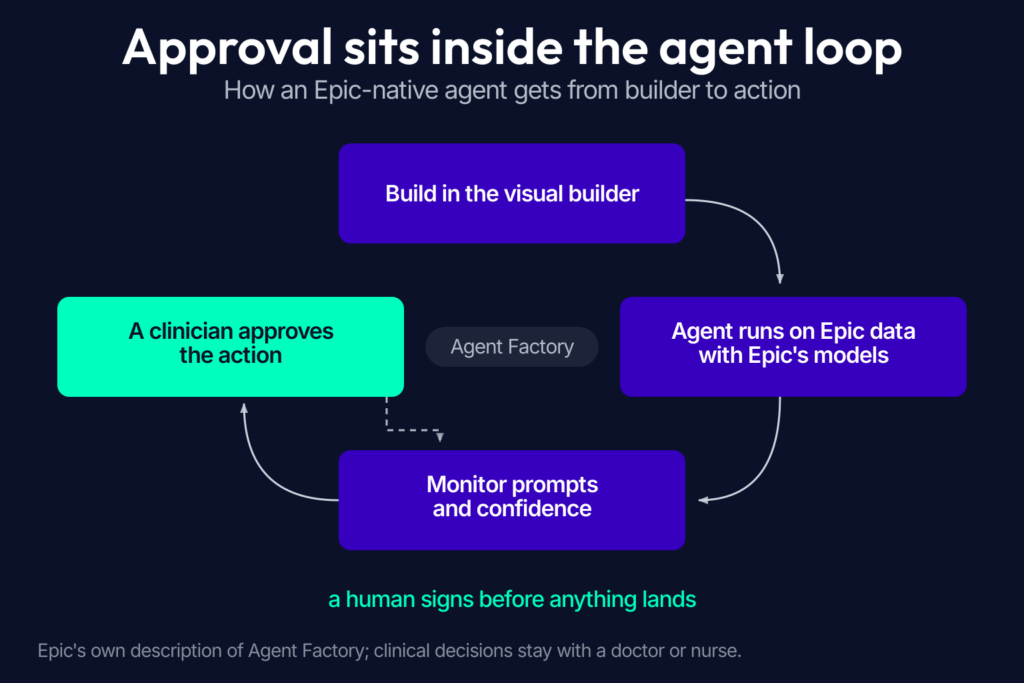
Agent Factory’s build, monitor, evaluate loop still ends at a human sign-off.
Who is building with it
Names are accumulating; the results are concrete:
- Epic Almanac names four first builders: Loma Linda, with transfers up 21%, ECU Health, Sutter Health, and Atrium Health. A transfer assistant shipped in May 2026.
- ECU Health’s transfer agent saves about 20 hours of chart review a week, with no hallucinations since deployment.
- Advocate Health built pharmacy verification and infusion chart prep prototypes.
- Epic’s speed claim: corrections happen in hours, not months.
- Showroom lists 1,000+ apps, and 2,400+ called a live API last year; it replaced App Orchard.
Portability settles the outside option: SMART App Launch and CDS Hooks are cross-EHR HL7 standards; Oracle Health’s July 2025 developer guide documents embedding SMART apps in PowerChart, so one app runs in both EHRs.
Build or use Epic? A decision framework
Five questions, asked in order, land every workflow on one of two answers: use Epic’s built-in AI, or build and connect to it. The first two questions test the use side. The last three decide the build side. Asked out of order, the same five questions produce whichever answer the room already wanted, which is why the order is part of the framework.
KLAS named the industry’s existing heuristic on May 21, 2026: Epic-first is not Epic-automatically. Customers keep third-party options alive when those tools are more specialized, faster moving, or better supported. Epic publishes no build-vs-buy heuristic of its own, so the framework below is original. Our generative AI in healthcare guide covers the general playbook, which this post narrows to five questions.
The five questions
Ask them in order, and let each answer narrow the next question.
- Does the workflow live entirely inside Epic? Chart-only work is the built-in AI’s home turf. A workflow that touches a partner portal already carries a dependency Epic cannot see.
- Does Epic already ship a feature for it, or plan to within your budget year? A shipped feature beats a planned one, and a planned one beats a contract you would sign next quarter.
- Does it need data or systems outside Epic? One outside dependency crosses the first boundary from the stops list, and the workflow leaves the built-in AI’s reach.
- Does it need specialty rules Epic does not model? Specialty logic is yours either way, so the question is where it runs, and the answer is usually beside Epic.
- Is it a product you sell to other organizations? A product for many EHRs cannot live inside one of them, and the build column from the Agent Factory table applies.
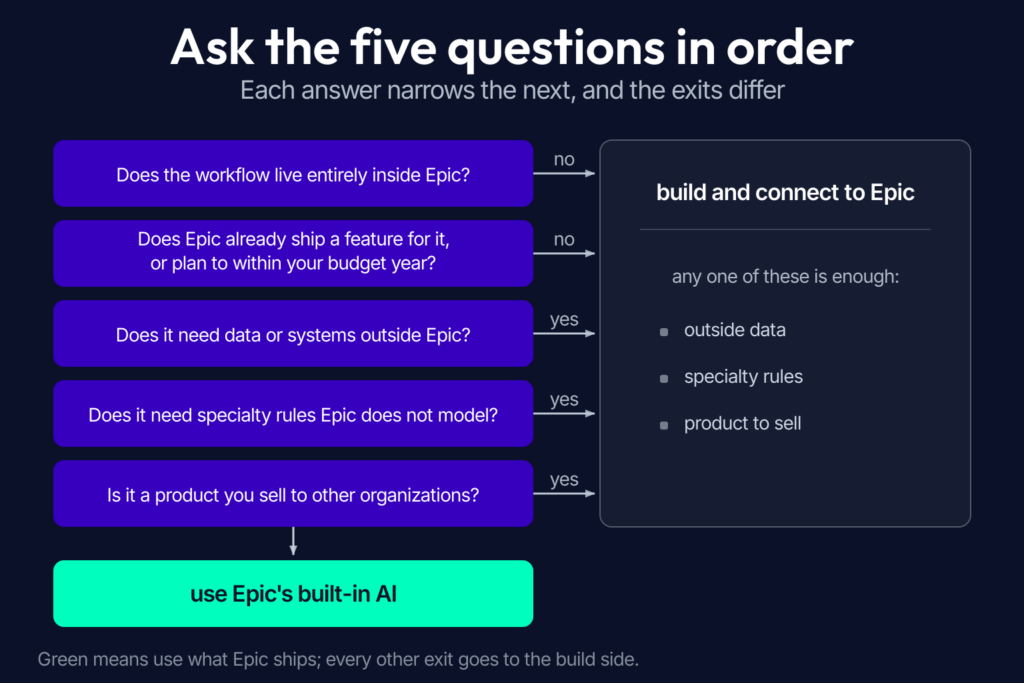
Five questions, one read-out: inside and shipping means use Epic; outside data, specialty rules, or a product to sell means build.
Reading the answers
Answers that stay inside Epic and point at a shipped feature: use Epic. Outside data, specialty rules, or a product to sell: build and connect to Epic. The five questions cost five minutes in a budget meeting and end with a defensible line item either way. Not sure which side of the line a workflow falls on? A Topflight Apps engineer will run the build-or-use review with you, question by question.
How custom AI connects to Epic
Three patterns get custom AI into and out of Epic: a SMART on FHIR launch inside the chart, CDS Hooks cards in the workflow, and FHIR write-back that a clinician signs. The launch and the cards are mostly plumbing; the write-back is the step that needs the care.
Epic recommends and supports the HL7 SMART on FHIR profile of OAuth 2.0, including EHR launch, which opens your app inside Epic’s chart with patient and encounter context. The full path is in our how to integrate with epic EHR guide.
Epic software includes support for CDS Hooks, the HL7 standard for in-workflow, provider-facing clinical decision support, with write APIs that file unsigned orders for clinician sign-off. The current spec is 2.0.1, STU 2 Release 2.
Write-back closes the loop: your AI drafts the output and posts it back through Epic APIs, with a status that reads preliminary until a clinician signs and final after. That status step is the part builders get wrong.
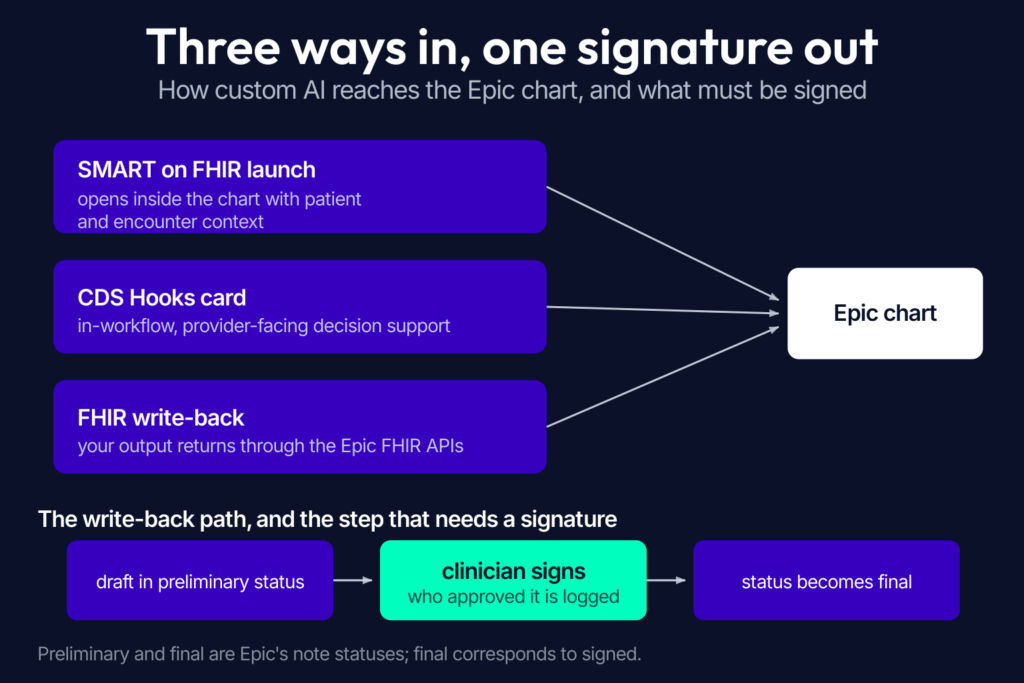
Three patterns get custom AI into Epic; the write-back path requires a clinician’s signature before anything becomes final.
Write drafts in a preliminary status
Epic’s DocumentReference.Create, from the FHIR R4 spec, files a plain-text note to an open or closed encounter. Set docStatus to preliminary and the note lands incomplete, pending clinician review and signature in Epic; final corresponds to signed. One rule for the whole team follows: AI writes drafts, clinicians make records, and the log shows who approved each write. Skip the preliminary status and an unsigned AI note lands in the chart as if a clinician wrote it.
The same discipline applies to a SMART on FHIR app that writes back: launch inside the chart, draft in preliminary, sign in Epic.
The developer program is the least bureaucratic part of this. Connection Hub registers and lists your app, Showroom is where customers browse, and there is no paid gate: self-service client ID registration, a free sandbox, customer-driven deployment.
Connect cleanly, and the governance rules apply to Epic’s AI and yours alike.
If you sell to Epic customers, will Epic replace you?
Short answer: for some vendors, yes, and the line has been clear since the February 4, 2026 launch. Epic replaces the generic middle: ambient scribing, In Basket drafting, and denial appeal letters. If your product is one of those three, the honest read is that your window is closing fast. HIT Consultant called the launch an existential threat to Abridge, Ambience, and Nabla.
KLAS drew the line on May 21, 2026: an Epic-first approach is not the same as an Epic-automatically approach. Customers keep third-party options alive when those tools are more specialized, faster moving, or better supported, with ROI and adoption materials to prove it. That list is the whole vendor playbook. Find a position on it, hold it, and bring the materials the sentence demands.
Both sides of the line have receipts, which is what makes the KLAS pattern real. On February 5, 2026, Nabla announced M Health Fairview, 10+ hospitals and 60 clinics, selected its ambient AI plus dictation for systemwide deployment inside the Epic EHR. The VA deployed Abridge’s AI scribe across all VA medical centers after a 75-center pilot, running inside the new Oracle EHR and legacy VistA/CPRS.
The community reads it the same way. Joshua Lui, in The Medical Republic, September 2026: Epic has frozen the market for new customers. Read the freeze as a map of where the demand went. It landed in the specialized lanes, which still close deals. The vendors who read it that way never stopped shipping.
The risk map for your product is the same five questions, now read from the other side of the table. Where the answers point outside Epic, you keep selling. Where they point inside, plan around it before Epic ships your feature.
Governance, HIPAA, and cost
Epic’s own words describe a HIPAA-compliant pipeline built on modern language models. What Epic does not publish is the contractual mechanics: how the built-in AI sits under your existing Epic agreement. Assume nothing; the agreement is the answer.
Custom AI carries its own BAA chain, product by product, and only for what the vendor lists as HIPAA-eligible. OpenAI’s Epic mode is BAA-covered only for products listed HIPAA-eligible, which is the pattern to copy in every vendor contract you sign. Our HIPAA compliant AI guide walks the full stack.
Validation is the other recurring duty, on both paths. Epic’s open-source Seismometer tool exists for model validation, and Michigan Medicine validated Sepsis v2 with it. The training side is worse than the tooling: KLAS’s Arch Collaborative 2026 report found fewer than 25% of clinicians who adopted AI tools say they received adequate training on validating AI-generated content.
Cost is the least public part of the whole stack. Epic publishes no public price list for the AI, and CIOs at UGM 2026 call the hybrid pricing model uniquely hard to isolate, forecast, or govern; the word they use is tokenomics. The mechanics behind it: per-million-token pass-through, with the same flow costing 12x more from a physician. Our epic ehr cost guide covers Epic’s overall cost picture.
Governance is the recurring cost on both paths, so budget for it the way you budget for uptime. The work has an owner in mature shops: the AI governance committee. Where one exists, Epic’s AI and custom AI answer to the same validation and BAA standards. Where one does not, that committee is your first build.
Why choose Topflight Apps for Epic AI development
The build-or-use honesty running through this post is also our pitch, stated plainly. Topflight Apps builds the build side of the framework. We’ll tell you when Epic’s built-in AI is the right answer, because sometimes it is, and then we’ll build the part Epic does not: the outside data, the specialty rules, the cross-EHR product.
Custom AI for Epic customers runs alongside Epic, which is where the architecture earns its keep: SMART on FHIR launch inside the chart, FHIR write-back with clinician sign-off before anything reaches the record, deployed in your own cloud account, and shipped through Epic’s developer program requirements. The sign-off step is the one we will not compromise, because a draft in the chart that reads like a signed note is how audits get painful fast.
The team behind it has shipped healthcare software for over a decade: hundreds of HIPAA-bounded builds, dozens of EHR integrations, and enough sandbox timeouts to know where an Epic project actually stalls. The five questions in this post came out of that work, which is why they read like a working tool instead of a white paper.
If you’re building Epic AI agents, or deciding whether the workflow on your whiteboard is a use or a build, book a call about your integration path. We’ll run the five questions with you, on your workflows, before any vendor conversation starts, and you keep the answers either way.
Frequently Asked Questions
What is Epic AI?
The generative and predictive AI built into Epic, organized around Art for clinicians, Emmie for patients, and Penny for revenue cycle, with Agent Factory for custom agents, all grounded in the chart.
What is Epic AI Charting?
The ambient documentation feature launched as AI Charting in February 2026 and now called Chart with Art. It listens during visits, drafts the note, and queues orders from the conversation.
What are Art, Emmie, and Penny?
Art drafts notes and answers chart questions for clinicians. Emmie handles scheduling, billing questions, and payments for patients in MyChart. Penny supports coding, denial appeals, and prior auth for revenue cycle staff.
What is Epic Agent Factory?
The platform for building, monitoring, and evaluating agents inside Epic. It pairs a visual builder with local policies and knowledge bases, and early-adopter training starts October 2026.
How much does Epic AI cost?
Pricing is not public and varies by contract. Ask about update costs and year-two pricing; the year-two concern comes from KLAS, and UGM 2026 CIOs call the pricing model tokenomics.
Can I use my own AI model with Epic?
Epic’s built-in features run Epic’s models, the Curiosity family, with no bring-your-own option documented. Your own model connects alongside through SMART on FHIR and CDS Hooks.
Does Epic's AI replace third-party ambient scribes?
Generic ambient scribing is at risk; Epic ships its own. Vendors with specialty depth or cross-EHR products are defensible, per KLAS’s Epic-first reading.
How does custom AI connect to Epic?
SMART on FHIR launches your app inside the chart. CDS Hooks adds in-workflow cards. FHIR write-back returns output in preliminary status until a clinician signs it final.
Who is Epic's biggest competitor in AI?
Oracle Health on the EHR side, but the build-or-use question outranks vendor rivalry. Our cerner vs epic comparison covers the platform choice in depth.
Is Epic's AI HIPAA-compliant?
Epic describes its pipeline as HIPAA-compliant but publishes no contractual mechanics. Custom AI carries its own BAA chain, product by product.