

If you’re stuck on the Cerner and Epic comparison, you’re not the only one. Epic and Cerner are the two EHRs (and the two medical software platforms) most hospitals end up choosing between, and they have the market shares to show for it.
For most hospitals and clinics, the call on Epic Systems vs Cerner comes down to one thing: which functionality actually fits how you work. So that’s what we’ll get into, feature by feature.
Top takeaways
- Difference between Epic and Cerner: Both offer full EHR solutions, but they’re strong in different places. Large healthcare organizations tend to pick Epic for its deep functionality and customization. Cerner (Oracle Health) often costs less and brings strong data analytics, though its market share and user-satisfaction scores have slipped as Oracle transitions the platform.
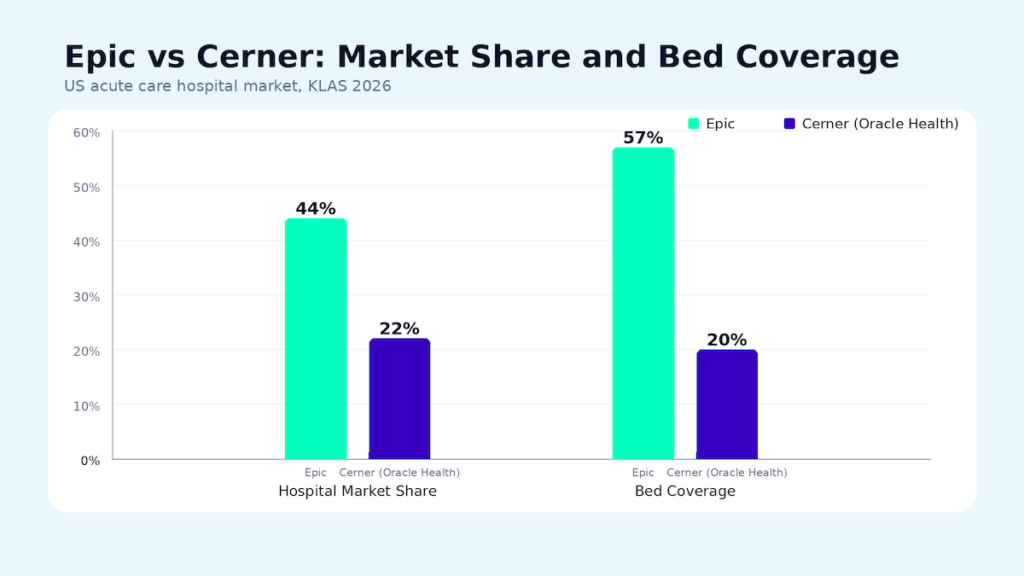
- Epic vs Cerner: Mostly a story of market dominance and bed coverage. Epic leads with about a 44% market share and serves roughly 57% of the beds in the United States; Cerner follows with about a 22% market share and 20% bed coverage. Size isn’t the whole story, though, which is what the rest of this Epic and Cerner comparison digs into.
- Security and compliance: Both treat it as non-negotiable. Role-based access controls, encryption, and regular audits are standard on each side, so patient data stays protected either way.
Table of contents
- Why choosing the right EHR matters
- Cerner and Epic product offerings, side by side
- The key features of Cerner and Epic
- Feature-by-feature comparison: where Epic and Cerner differ
- User experience and interface: Cerner vs Epic
- Interoperability with other healthcare systems
- Third-party integration: Epic versus Cerner
- Security and compliance: how Cerner and Epic compare
- Implementation and support, a comparative review
- Cost analysis: Cerner vs Epic
- Integrating your systems with Epic or Cerner
- Topflight’s experience with Epic and Cerner
- Choosing the right EHR: expert consultation
A note on naming: Cerner is now Oracle Health after Oracle’s 2022 acquisition. We use both names here, since both are still in common use.
Why choosing the right EHR matters
The electronic health record (EHR) system you pick runs through nearly every part of health care: clinical and ambulatory care, administration, finance, even legal. Get it right and you smooth out workflows, support better patient care, and give the organization room to grow. Get it wrong and you’ll feel it for years.
Cerner and Epic run most of the EHR market between them
The May 2026 KLAS US Acute Care EHR report puts the two at about 66% of the market combined: Epic out front with a hospital market share of about 44%, Cerner (Oracle Health) next at about 22%.
Look at bed coverage and the gap widens. Epic covers about 57% of the beds in the market; Cerner sits at about 20%. That kind of reach tells you how much these systems shape the way healthcare providers handle patient information.
So what actually separates them? Why do some healthcare providers swear by one over the other, and which one fits your organization? That’s the rest of this guide: product offerings, user experience, integration, security, and cost.
Quick question: “What is Epic and Cerner?”
Quick answer: “Both are EHR systems that keep a patient’s full record in one place. In practice, they run patient care and data management for a big slice of the healthcare industry.”
What EHRs actually do in healthcare
EHRs sit at the center of modern healthcare. They improve patient care, pull patients into their own care, tighten coordination, and make practices run more efficiently. Clinicians can pull up and share patient information on the spot, so decisions get made with the full picture in front of them.
Where Cerner and Epic came from
Start with Cerner. Three people, Neal Patterson, Paul Gorup, and Cliff Illig, co-founded Cerner corporation in 1979 to make health care safer and more efficient. It began with laboratory health information systems and grew from there.
Then the big one: in 2022, Oracle acquired Cerner for $28 billion. Today the platform serves more than 27,000 facilities across 35+ countries, with clinical tools that touch every part of patient care.
Epic was founded the same year, in 1979, by a small team that wanted to give patients and providers more control over their healthcare decisions. Now Epic’s EHR software runs for more than 325 million patients globally. Call it roughly 4% of the planet.
Also Read: Medical LLM Models Explained
Both companies grew into multinationals on the electronic medical record (EMR) side by adapting fast. The open question is still which one fits your organization, and that’s what the next sections work through.
Quick question: “Is Cerner better than Epic?”
Quick answer: “Depends. Cerner still gets credit for cost and strong data analytics, plus specialty-specific modules that suit niche clinics, though Epic has been pulling ahead on satisfaction and market share. The better system comes down to your needs, size, and budget. What’s critical for one setup barely registers for another.”
Why compare Cerner and Epic specifically?
Given how much of the market they hold, it makes sense to compare Cerner and Epic head to head. Both are feature-rich and serve a wide range of healthcare providers. But each has real strengths and weak spots that can make one the better fit, and those are the nuances this blog gets into, so you can decide which is better, Epic or Cerner, for your organization.
Cerner and Epic product offerings, side by side
In healthcare, EHR systems are more than digital record systems. They’re full platforms built to tidy up workflows, support patient care, and keep operations running. Here’s how Cerner and Epic line up product for product.

Cerner’s main software products
Cerner’s lineup is mostly cloud-based, aimed at a range of healthcare providers:
- Cerner Millennium: The flagship EHR platform. It pulls data from different sources into one view of patient health, with modules for clinical documentation, order management, and results reporting. More than an EHR; closer to a full clinical system.
- Cerner PowerChart Ambulatory EHR: Built for real-time access to patient information so clinicians can make quick, informed calls at the point of care.
- Cerner CareTracker: The long-term care option, made for skilled nursing facilities and assisted living centers. It handles care coordination for that setting.
Quick question: “Are Cerner and Epic competitors?”
Quick answer: “Yes. The two go head to head for the top of the EHR market, and each leans on its own mix of features to win deals.”

Epic’s main software products
Epic’s catalog is just as broad, with products aimed at different care settings:
- EpicCare: the core Epic EHR system, with modules for clinical documentation, order entry, decision support, a charting system, and more. Most of what clinicians need in one place.
- Epic MyChart: The patient portal. Patients use MyChart to see their records, message providers, and manage care online. It also allows patients to schedule appointments.
Related: Best Patient Scheduling Software
- Revenue Cycle Management (RCM): Epic’s RCM handles the money side, from billing and claims to revenue optimization.
- Healthy Planet: Epic’s population health platform. It helps providers analyze and manage patient populations, view patient data, spot risks, and run targeted interventions.
- Tapestry: Epic’s behavioral health option, built for mental health and substance abuse treatment providers.
Related: Surescripts Integration Main Steps
One note: we’re sticking to the core product offerings from each EHR vendor here. We’re skipping non-essential matchups like “Cerner vs Epic: Nursing,” where both perform about the same.
Cerner vs Epic: key products compared
It’s hard to weigh Epic and Cerner pros and cons without putting their main products next to each other. Here’s the lineup in this Cerner vs Epic matchup:
| Product | Cerner | Epic |
|---|---|---|
| Core EHR System | Millennium | EpicCare |
| Clinical Workstation Solution | PowerChart / Cerner Kiosk | N/A |
| Long-term Care EHR Solution | CareTracker | N/A |
| Patient Portal | HealtheLife / Cerner Health | MyChart |
| Financial Management Solution | N/A | Revenue Cycle Management (RCM) |
| Population Health Management Platform | HealtheIntent | Healthy Planet |
| Behavioral Health EHR Solution | N/A | Tapestry |
One thing worth weighing when you evaluate Epic EHR vs Cerner is revenue potential, especially for large healthcare organizations.
Both Cerner and Epic offer solid EHR solutions, but their product lineups differ enough that the right pick depends on your specific needs, objectives, and context.
The key features of Cerner and Epic
Choosing an EHR system isn’t a light decision. There’s a lot to weigh, so it pays to look hard at what each platform actually does. Here are the features that matter on Cerner and Epic.
When you weigh Cerner EMR vs Epic, mobile access counts too: clinicians need patient records on the go, not just at the desk.
Cerner’s strongest features
Cerner runs a deep set of products built to streamline clinical workflows and support patient care. A few things set it apart:
- Full healthcare management: Appointment and billing management, clinical workflow management, EMS, document management, EM coding, insurance and claims, lab integration (for lab results), medical templates, patient demographics, and patient history. It also includes the Cerner PHR (personal health record) for patients.
- Specialty-specific solutions: Cerner covers a wide span of specialties, from allergy and immunology to cardiology, dermatology, gastroenterology, mental and behavioral health, neurology, OB-GYN, orthopedics, pediatrics, pulmonology, radiology, and urology. Whatever your domain, it’s likely covered.
- Interoperability: Strong integration with other healthcare solutions, so data moves between systems and teams can actually collaborate.
- Security and compliance: Tight controls on patient data and adherence to HIPAA.
- Support services: Implementation and support help to get organizations onto the system and keep them running.
Worth flagging: Cerner can get heavy for smaller practices, especially in urgent care settings.
Quick question: “Is Epic or Cerner better?”
Quick answer: “They’re strong in different areas. Epic offers robust customization; Cerner tends to cost less and leans on data analytics. Your needs decide the better pick.“
Epic’s strongest features
Epic is known for a clean interface and a broad set of healthcare management tools. Its feature set covers appointment and billing management, clinical workflow management, document management, EM coding, insurance and claims, lab integration (Epic Beaker), medical templates, patient demographics, patient history, a patient portal, referrals, reporting and analytics, scheduling, voice recognition, and e-prescription. Like Cerner, it supports a broad range of specialties, so most organizations find their domain covered.
Two more things matter. Epic puts real weight on user experience, aiming for a system clinicians can navigate without a fight. And its integration with other software solutions keeps the interoperability feature working across systems. On security and compliance, Epic runs strong controls to protect patient data and meet the rules, backed by implementation and support services.
Epic is also good at pulling test results together and getting patients engaged.
For organizations weighing custom builds, healthcare app development can sit alongside Cerner or Epic and handle the operational gaps neither covers out of the box.
Cerner vs Epic: key features compared
Here’s the side-by-side on features:
| Key Features | Epic | Cerner |
|---|---|---|
| Multiple Medical Provider Access | V | V |
| Ancillary Care Provider Access | V | V |
| Meaningful Use Reporting | V | V |
| Clinical Documentation | V | V |
| Telehealth (to schedule virtual visits) | V | V |
| Mobile apps and patient portal | V | V |
| Revenue cycle management tools | V | V |
| CNA Tracking | X | V |
| Coding Assistance | V | V |
| ONC-ATCB Certified | X | V |
| Insurance Eligibility Verification | V | X |
| Compliance Tracking | V | V |
| Electronic Payments | V | V |
| Online Prescription Refills | V | V |
| Appointment Management / Scheduling (including virtual appointments) | V | V |
| Billing Integrations | V | X |
| Clinical Decision Support | V | X |
So which EHR system, Cerner or Epic, fits your organization? It comes down to your specific needs and how well each platform meets them. The right system is the one whose features line up with your goals. Telehealth is a good example: as it’s grown, both platforms have built in telemedicine integration to widen patient access.
Adding CRM functionality could push Epic EMR vs Cerner further on patient engagement and retention.
Feature-by-feature comparison: where Epic and Cerner differ
Time to compare Epic and Cerner where it counts: documentation, interoperability, the interface, and what it takes to stand the thing up.
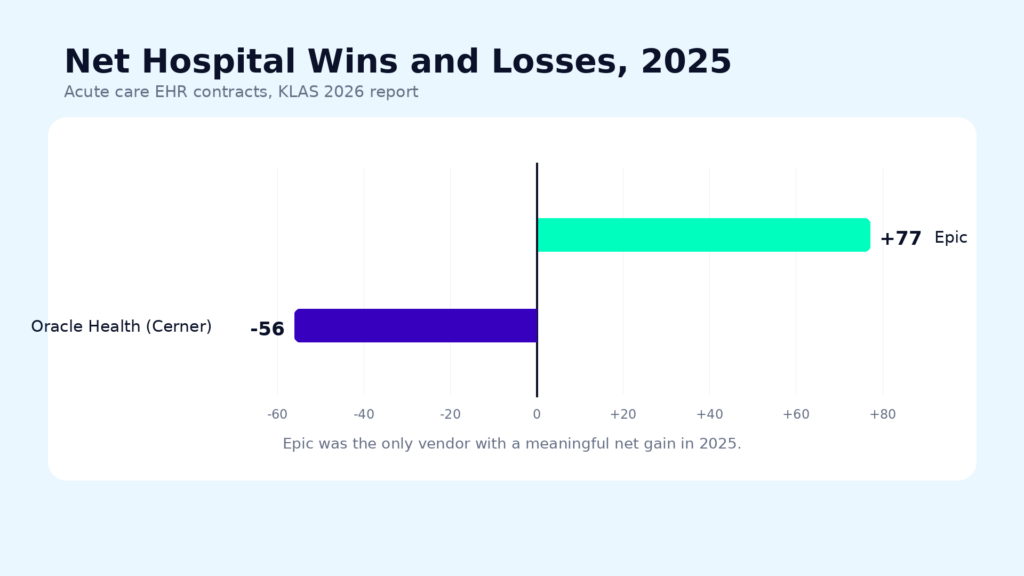
Market snapshot: KLAS’s 2026 report (covering 2025 contracts) shows Epic still pulling away. It was the only vendor to post a meaningful net gain in 2025, adding 77 hospitals while Oracle Health lost 56, and both of the year’s large health-system decisions went to Epic. Oracle Health has now posted the largest net loss of any acute care EHR vendor three years running, and its Millennium platform ranked lowest among acute care EHRs in the 2026 Best in KLAS report. Those are new-purchasing figures, though; Epic’s total installed base sits around 44% of acute care hospitals, Oracle’s around 22%.
Clinical documentation
Epic. The SmartTools suite (SmartPhrases, SmartTexts, SmartLinks, SmartLists) is mature, speeds note authoring, and is widely taught and extended across orgs. Epic is also expanding ambient documentation, turning voice into draft notes and flowsheets right inside its workflows. Adopted well, that cuts measurable chart time.
Oracle Health (Cerner). Dynamic Documentation pulls live chart data into templates and works tightly with mPages and Integrated Charting to cut screen-hopping, with a UX refresh that rolled out through 2025.
Builder to builder: Epic wins on out-of-the-box clinician macros and ambient tooling. Cerner is strong where teams invest in mPages, DD templates, and integrated charting governance.
Interoperability
Epic. Care Everywhere is big and active: Epic’s Care Everywhere page now puts it at more than 28 million record exchanges a day, though its interoperability overview cites a more conservative “over 20 million.” Either way, about half are with non-Epic orgs, across a broad national footprint plus international. On TEFCA, Epic Nexus is one of the original designated QHINs, and Epic has been onboarding its client base onto the network, having targeted full onboarding by the end of 2025, which simplifies national exchange and payer/public-health use cases. And Connection Hub/Showroom replaced App Orchard, so third-party connections are easier to find and assess.
Oracle Health (Cerner). A CommonWell co-founder; that network is a TEFCA-designated QHIN, and Oracle Health Information Network became a designated QHIN in its own right in November 2025. The emphasis is on standards (HL7, FHIR) and population-level data services (HealtheIntent, Data Intelligence), a strong pathway for cross-vendor exchange and analytics.
Net: Net: as of 2026 both operate their own designated QHINs (Epic Nexus, an original QHIN; Oracle Health Information Network, designated November 2025). Epic’s longer-running Nexus footprint still gives it the deeper live national-exchange base, while Oracle pairs its new QHIN with the Oracle data stack.
User interface and experience
- Epic: Consistent Hyperspace UX, deeply personalizable SmartTools, strong templating discipline. Teams often report faster note-time wins once SmartPhrases are curated.
- Oracle Health (Cerner): Modernized mPages and Integrated Charting pull workflows together; Dynamic Documentation renders narrative and discrete data side by side. It rewards a thoughtful build.
Epic is opinionated but coherent; Cerner is flexible but rewards governance. No UI build or playbook? Epic feels faster. Have one? Cerner can feel like yours.
Implementation timeline and costs
- Timelines (acute care): Epic’s first go-lives land in ~16-18 months for large systems (foundation plus staged rollouts). Many report 12-24 months end to end, depending on scope.
- Scale reality: The largest Epic programs can hit $1B+ TCO. Headline figures skew large; Community Connect and ambulatory footprints land much lower.
- Oracle Health (Cerner): a platform transition in motion. Oracle launched its next-generation, AI-embedded EHR for ambulatory providers in August 2025, with acute-care functionality slated for 2026. On the federal side, the VA resumed its Oracle Health rollout in April 2026 after a roughly three-year pause, going live at its first wave of sites and targeting 13 sites in 2026 and full deployment by 2031. Translation: budget for modernization overlap and change-management load.
Bottom line: Epic is the longer, heavier lift with a predictable playbook. Oracle Health can be faster in ambulatory and where the Oracle stack is already standard, but factor in platform modernization and governance over the next year or two.
User experience and interface: Cerner vs Epic
A clean, easy-to-navigate interface changes how an EHR feels to use, day in and day out. It touches everything from satisfaction to throughput. So how does the Cerner/Epic competition look here?
Cerner’s interface in practice
Cerner built its interface around one goal: a clean, usable workspace for clinicians. In practice, that shows up as:
- Organized layout: A clean, ordered screen, so finding what you need doesn’t turn into a hunt.
- Customizable dashboards: Rearrange the workspace to suit you and surface the information that matters most.
- Responsive design: An adaptable interface that holds up across devices and screen sizes.
- Modern design principles: Color coding and visual cues that make the screen easier to read and work in.
- Consistency: Some users report inconsistencies in design and navigation across modules, so there’s room to improve.
Quick question: “Can Cerner communicate with Epic?”
Quick answer: “Yes, but not out of the box. Getting Cerner and Epic talking takes custom programming and a data hub. That’s normal when two rival systems have to share.”
Related: Medical Device Integration and Examples
Epic’s interface in practice
Epic’s user-friendly interface gets praised for being clean and easy to move through. A few things back that up. The Epic software looks modern and polished, and the user interface stays consistent across modules, so you mostly know what to expect as you move around. Inside Epic Hyperspace, interactive touches like drag-and-drop and real-time updates make the platform pleasant to work in, and you can tailor templates and workflows to fit how your team operates. (If you’ve searched “Cerner Hyperspace,” that’s really Cerner’s PowerChart and mPages workspace, the counterpart to Epic Hyperspace.) The one gap users name: they’d like more flexibility customizing certain parts of the interface.
Cerner vs Epic: user experience compared
Here’s the ease-of-use comparison at a glance:
| Aspect | Cerner | Epic |
|---|---|---|
| Layout and Organization | Clean and organized | Visually appealing and modern |
| Customizability | Customizable dashboards | Customizable templates and workflows |
| Responsiveness | Responsive and adaptable | Responsive and adaptable |
| Consistency | Inconsistencies across some modules | Consistent user interface |
| Interactive Elements | Yes | Drag-and-drop functionality, real-time updates |
| Flexibility | N/A | Some limitations in customization |
Both have shaped their interfaces around how clinicians actually work. But the recent versions are only half the story. Plenty of providers are still on older builds, where user-focused design and user-friendliness weren’t the priority they are now.
That’s exactly why so many healthcare providers are building new front ends tuned to their own use cases and wiring them into whichever EHR they run, Epic or Cerner. People take to applications with new software functionalities that are easier to use.
Some teams lean toward the leaner feel of PowerChart vs Epic for certain workflows, so the choice between Epic vs PowerChart really tracks your priorities and long-term goals.
You can read up on EHR system development in our dedicated blog.
This is the point where Cerner and Epic’s interoperability and integration capabilities start to matter most. The growing demand for EHR interoperability is exactly why connecting Cerner and Epic to other systems has become so central to collaborative healthcare networks. More on that next.
Interoperability with other healthcare systems
In a connected healthcare world, integration is core to any EHR. It lets different apps and platforms talk to each other and move information cleanly. So how do Cerner and Epic EMR do here?
How Cerner handles integration
Cerner’s approach is broad and flexible. It integrates through APIs, interfaces, and other technologies, so it can fit a wide range of scenarios.
What sets Cerner medical records apart is the focus on interoperability. Cerner helped found the CommonWell Health Alliance, a not-for-profit industry trade association that sets standards and policies for sharing and accessing patient data, which lets Cerner users exchange information with other providers.
There’s more. With over 50 third-party integrations, users have plenty of ways to connect to other healthcare systems and apps, which widens what the platform can do.
One example: Cerner users can use Reference Lab Networks to send data to multiple acute and reference labs without wiring up each lab one at a time. That saves setup work and keeps data moving, so teams can stay on patient care instead of plumbing.
Quick question: “Can Cerner interoperability share medical records electronically with Epic?”
Quick answer: “Yes, though it’s not automatic. It takes custom programming and a data hub to share data accurately. That’s standard when you’re connecting rival EHRs.”
How Epic handles integration
Epic holds its own here. It built its own integration platform, Epic Bridges, to move data between Epic and other systems.
It also supports HL7 and FHIR APIs, which makes integrating with third-party apps and systems simpler and keeps Epic working cleanly with other healthcare solutions.
Epic may not list as many third-party app integrations as Cerner, but it’s built partnerships to push interoperability and data exchange, even for non-Epic users. With EpicCare Link, non-Epic providers can pull patient information from Epic about as easily as opening a file in Google Drive.
Epic’s tie-in to the Carequality network, which links EHRs nationwide, widens its reach further, so Epic users can share and access patient data across a broad set of providers.
We also cover how to integrate a healthcare app with Epic in our dedicated blog.
Integration capabilities compared
Here’s the integration side by side:
| Integration Capabilities | Cerner | Epic |
|---|---|---|
| Integration Methods | APIs, interfaces, and other technologies like Oracle Health Seamless Exchange, Interoperability Ticker, and Cerner Ignite APIs. FHIR R4 (DSTU2 retired December 2025). | Epic Bridges, HL7, FHIR APIs; plus Share Everywhere, EpicCare Link, and Epic’s One Virtual System Worldwide. Happy Together/Working Together. |
| Third-Party Integrations | Over 50 integrations | Partnerships with healthcare organizations |
| Interoperability | Collaboration with CommonWell Health Alliance (a non-profit industry trade association) | Connects to the Carequality network (a public-private org) |
Both Cerner and Epic lean hard on standardized protocols like HL7 integration to keep data flowing across systems and coordinate care.
Quick question: “Can Cerner share medical records electronically with Epic?”
Quick answer: “Yes, but treat it like a negotiation. It takes custom programming and a data hub to keep the data accurate. Par for the course with rival EHRs.”
So both Cerner and Epic put real weight on integration and interoperability; they know it’s table stakes now. But integration is one piece. How do they handle security and compliance? That’s next.
Third-party integration: Epic versus Cerner
On third-party integration, Epic versus Cerner comes down to how each one exposes its APIs and runs its marketplace. Here’s the detail.
Comparison at a glance
| Area | Epic (Connection Hub / Showroom + Epic on FHIR) | Oracle Health (Cerner): Ignite APIs for Millennium |
|---|---|---|
| Marketplace / directory | Showroom public catalog replaces App Orchard; Connection Hub flags live customer connections. Good for discovery and social proof. | Developer program with public docs; productized API surface marketed under Ignite APIs. Showcases Bulk Data, SMART, R4. |
| API surface | Free Epic on FHIR docs and sandbox; supports SMART on FHIR and Bulk FHIR (Flat FHIR). | FHIR R4 is the only supported version; Oracle retired DSTU2 in December 2025. SMART on FHIR and Bulk Data documented. |
| Launch patterns | Embedded SMART launches (EHR-context) plus standalone; FHIRcast available for context sync; Hyperdrive migration can affect iframe/handler assumptions. | Embedded SMART launches (EHR-context) plus standalone; backend services and OAuth profiles documented. |
| Bulk exports / analytics | Bulk FHIR tutorial and specs on open.epic; endpoints directory lists live org R4 endpoints. | Bulk Data Access (R4) for cohort-level exports; forums and docs detail Millennium/Soarian coverage. |
| How to list / visibility | Request listing in Showroom; requires agreeing to terms and attesting to ≥1 live Epic customer connection for Connection Hub. | No public “store” listing equivalent; visibility comes from customer deployments and Oracle partner channels; focus on R4-ready apps. |
| Gating steps (practical) | Register the app in Epic on FHIR, get client IDs/scopes; production enablement is org-by-org via the customer’s Epic team; watch Hyperdrive requirements. | Register in the Oracle Health dev console; the customer self-provisions SMART/FHIR app mapping in their environment; DSTU2 was retired in December 2025, so anything still on it must move to R4. |
| Fees | Public docs emphasize listing criteria and terms; specific fee schedules aren’t published, so treat as program/contract-dependent. | Same story: no public fee table in docs; costs tied to customer entitlements/contracting. |
What to actually do:
- Adopt an R4-first policy now. Don’t green-light new DSTU2 work; Oracle retired DSTU2 in December 2025, so anything still on it needs to move to R4.
- For Epic, run two parallel tracks: SMART on FHIR for clinician UX, and Bulk FHIR for analytics/ML pipelines. If you embed UI, validate Hyperdrive constraints early.
- For Oracle Health, budget time for customer-side provisioning (SMART/FHIR app mapping, scopes) and verify Bulk Data enablement per tenant.
If you want help from Epic integration specialists or Cerner development partners, our team works as healthcare interoperability experts and EHR migration consultants, happy to turn these seams into a concrete build plan with timelines and risk controls.
Epic App Orchard vs. Cerner SMART/FHIR
Epic (App Orchard to Connection Hub / Showroom)
Epic retired App Orchard as the focal point and moved to Connection Hub/Showroom, a public directory of live, vendor-verified connections. Translation: discovery and due diligence got easier, and the technical docs and sandboxes now live at Epic on FHIR. Listing is lightweight and, per reporting, $500/yr per product.
Oracle Health (Cerner)
Oracle’s Developer Program exposes Ignite APIs for Millennium (FHIR R4/SMART). Oracle retired DSTU2 in December 2025. Still on DSTU2? Your R4 cutover is overdue.
Our read: if you need marketplace visibility inside Epic land, Connection Hub/Showroom is the path of least resistance. If you’re building clinician-facing workflows for Cerner, SMART on FHIR over R4 is table stakes, and new DSTU2 work isn’t worth starting.
API accessibility
Epic
Free, public Epic on FHIR docs and sandbox; production enablement still routes through the customer’s Epic technical coordinator and the right interface licenses (Interconnect/Bridges modules and the like). Plan for scoping and enablement, not just code.
Oracle Health
Public docs plus registration through the Oracle Health Developer Program. FHIR R4 endpoints support SMART launches and offer Bulk Data where enabled (Millennium, and documented for Soarian). Expect org-by-org enablement and OAuth client registration.
For your build, both ecosystems are “open” on paper; real velocity depends on your customer’s entitlements and security teams. Budget calendar time for client-side enablement no matter how ready your code is. (Epic’s own docs flag non-obvious, app-triggered license impacts, so factor that into ROI.)
Custom development options
Epic extension points (pick the right seam):
- SMART on FHIR (EHR launch or standalone) for embedded, context-aware apps.
- FHIRcast to keep patient/context synced between your app and Hyperspace.
- Interconnect/Bridges and HL7 v2 for system-level integration and non-FHIR feeds (orders, ADT, charges). Governance-heavy but reliable.
Oracle Health (Cerner) extension points:
- SMART on FHIR (R4) for embedded apps; Bulk Data for population exports (Millennium, and documented for Soarian).
- mPages / Integrated Charting to surface custom UI inside Cerner workflows; DD/Integrated Charting continues to evolve.
Our take: use SMART on FHIR for clinician UX and Bulk FHIR for analytics/ML pipelines. Reach for HL7 v2/Bridges or Cerner legacy interfaces only when the FHIR surface can’t meet the use case (orders, charging edge cases). Keep a clear R4-first policy.
Security and compliance: how Cerner and Epic compare
In healthcare, where sensitive patient data moves around constantly, security and compliance aren’t optional. So how do Cerner and Epic measure up? Let’s look.
How Cerner handles security and compliance
Cerner takes data security seriously, both to protect information and to keep the trust of the clinicians who use it every day.
The key measures:
- Role-based access controls: Only authorized people reach specific data, so everyone has what they need and nothing more.
- Encryption: Data is protected at rest and in transit, so intercepted data stays unreadable.
- Audit logs: Detailed activity logs make it easy to see who did what and when, which matters when something goes wrong.
How Epic handles security and compliance
Like Cerner, Epic puts real weight on security and compliance. The system holds some of the most sensitive data a person has, and Epic builds around that:
- User authentication: Strict checks so only authorized users log in.
- Data encryption: Data is encrypted in transit and at rest to block unauthorized access.
- Regular security audits: Routine audits to find and close gaps before they become problems.
Both also meet industry standards and regulations like HIPAA, which protects patient data and shields providers from legal exposure around data handling and privacy.
Both support secure SMART on FHIR authorization too, so clinicians and patients move between connected apps without re-authenticating every time. That’s smoother to use and it tightens security, since fewer logins mean fewer openings for unauthorized access. It’s a good signal of how seriously each treats secure, usable design.
Security and compliance compared
Here’s the security and compliance side by side:
| Security and Compliance Features | Cerner | Epic |
|---|---|---|
| Role-Based Access Controls | Yes | Yes |
| Data Encryption | Yes | Yes |
| Audit Logs | Yes | Yes |
| User Authentication | Yes | Yes |
| Regular Security Audits | Yes | Yes |
| SMART on FHIR authorization | Yes | Yes |
| Compliance with Industry Standards (including HIPAA compliant messaging applications) | Yes | Yes |
Both offer strong security and compliance, with different edges. Cerner is strong on role-based access controls and audit logs; Epic on user authentication and regular audits. Overall, there’s virtually no difference between Cerner and Epic in how they handle security.
Next, we’ll compare the implementation and support services from both Cerner and Epic.
Quick question: “Can Cerner records system communicate with Epic records system?”
Quick answer: “Yes, but it takes more than an intro. Custom development and a data hub make the communication work, which is standard when you’re connecting competing EHRs.”
Implementation and support, a comparative review
With an EHR, getting live and staying supported matters as much as the feature list. An advanced system you can’t stand up, or can’t get help with when it breaks, isn’t worth much. Here’s how Cerner and Epic handle both.
Cerner’s implementation and support
Cerner knows a new EHR is a big lift, and it works to keep the rollout smooth:
- Dedicated implementation team: A team of experts guides the rollout start to finish, so you’ve got people who know the system at your side.
That team is there if you want it, but clinics and acute care hospitals aren’t required to use it. If you have a capable in-house team or an EHR implementation partner, they can lead the Cerner EHR rollout and shape it around your facility.
- Comprehensive process: Project planning, system configuration, EHR data migration, training, and go-live support, so the whole transition is handled with care.
And after go-live, Cerner offers:
- 24/7 support: Round-the-clock help, with technical issues addressed within 24 hours, because problems don’t keep business hours.
- Online resources and user forums: A deep well of answers to common issues, plus insight from other users.
- Model Experience: An implementation approach built to improve care delivery, with a model EHR system and optimization methodology. It uses HealtheIntent, Millennium, and CareAware to hit goals around outcomes, process alignment, health system, and regulatory compliance.
Quick question: “Is Cerner the same as Epic?”
Quick answer: “No. Same species, different breed. Both are powerful EHRs, but each has its own features and fits different needs across healthcare.”
Epic’s implementation and support
Like Cerner, Epic leans on solid implementation and reliable customer service. To get you onto the system, Epic:
- Provides a dedicated implementation team: Epic’s team works closely with your organization through the transition.
- Follows a comprehensive process: Same shape as Cerner’s, covering project planning, system configuration, data migration, training, and go-live support.
For ongoing support, Epic offers 24/7 help from a support team ready day or night, plus online resources and user forums whether you want quick answers or to compare notes with other users.
Implementation and support compared
On the surface, the two are close when you compare Cerner to Epic:
| Aspect | Cerner | Epic |
|---|---|---|
| Implementation Services | Offers dedicated implementation team | Offers dedicated implementation team |
| Implementation Process | Includes project planning, system configuration, data migration, training, and go-live support | Includes project planning, system configuration, data migration, training, and go-live support |
| Support Services | Offers 24/7 support, online resources, and user forums | Offers 24/7 support, online resources, and user forums |
Now have a look at these screenshots from the leading software review portals:
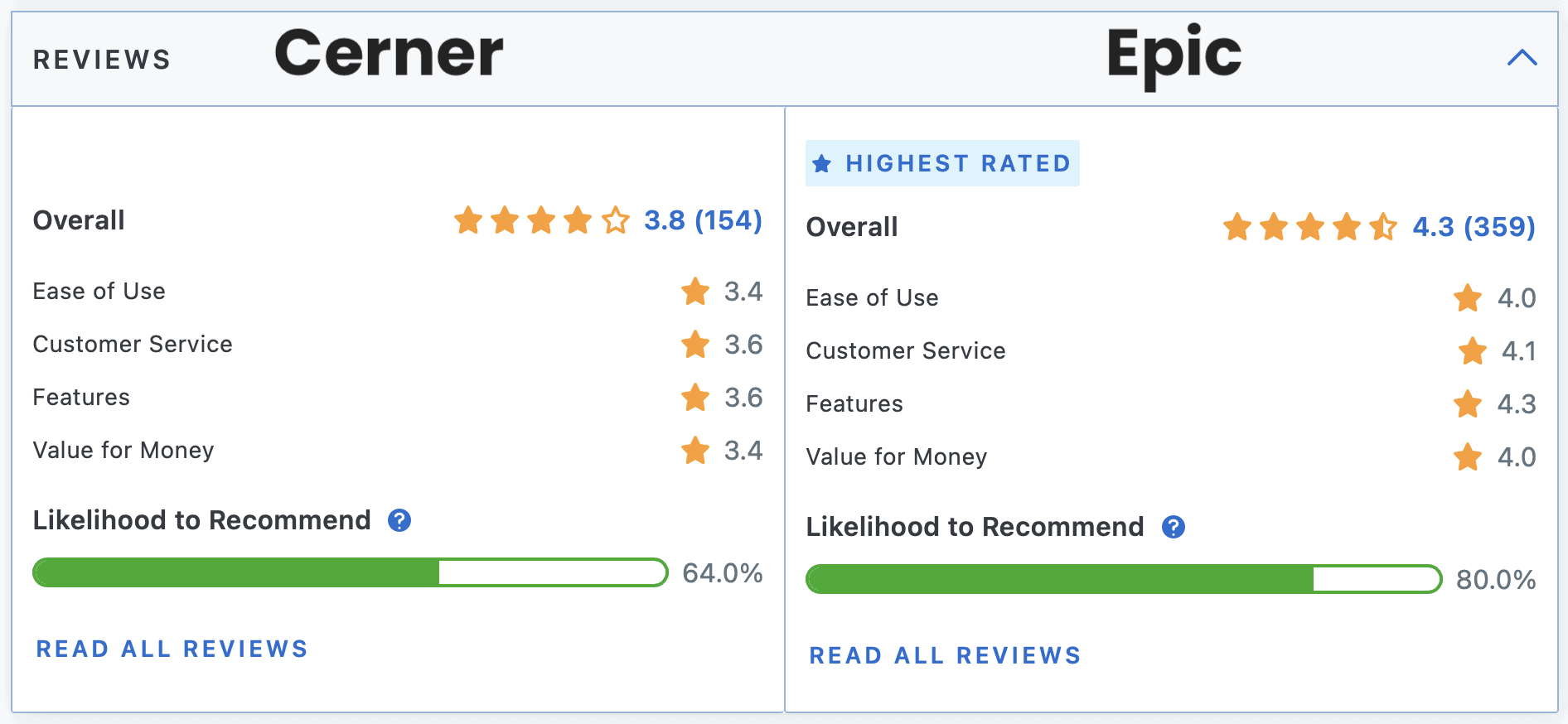
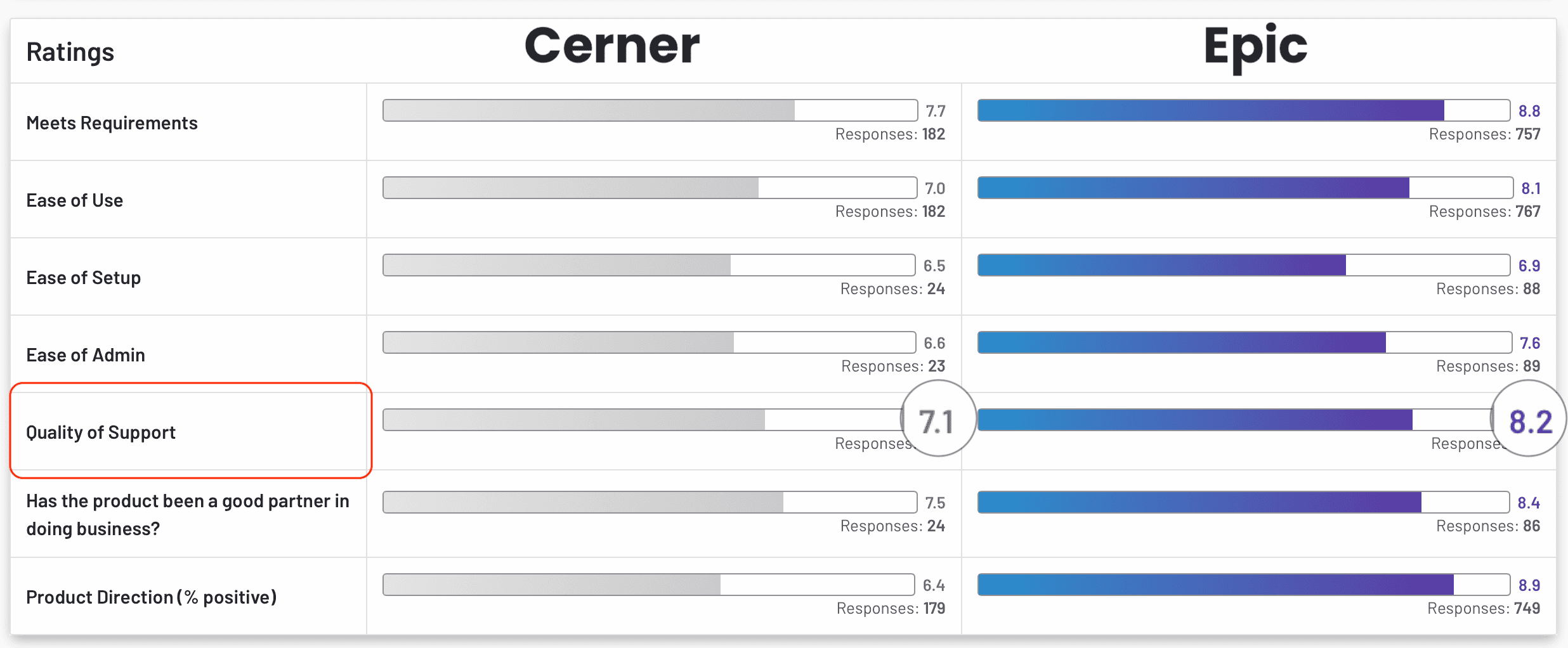
From those screenshots, Epic has a slight edge on Cerner versus Epic in customer support. Worth a thought when you pick your EHR partner.
One more thing: both Cerner and Epic keep providers current on industry news through newsletters with updates and insights.
From rollout through ongoing support, both have shown they’ll back their systems inside healthcare organizations. The next question is cost, and that’s where we go next.
Cost analysis: Cerner vs Epic
For a lot of EHR health systems, cost is the deciding factor. So how do Cerner and Epic compare on price?
Both run expensive, and most organizations treat that spend as the cost of better clinical outcomes. Neither vendor publishes list prices, so credible numbers come from disclosed contracts and analyst estimates, and real costs scale with beds, providers, and modules, from a few million for a small hospital to over a billion for the largest systems.
Let’s put Epic EHR pricing next to Cerner.
What an EHR rollout actually costs
The total swings with the size and needs of your organization. Here’s the usual breakdown for rolling out either Epic or Cerner (same line items, slightly different pricing):
- Licensing fees: Both charge based on users and modules, so larger or more complex setups pay more.
- Implementation costs: Beyond the software itself: installation, configuration, data migration, training, and customization. The more complex the rollout, the higher this runs.
- Support and maintenance: Once you’re live, budget for ongoing support. Both bill an annual fee tied to your size and support level.
- Upgrades and enhancements: Both ship updates regularly; cost depends on which modules and features you’re upgrading.
- Additional services: Consulting, data analytics, population health, and the like, priced to your needs.
Epic vs. Cerner cost comparison
Here’s the cost picture side by side:
| Cost Consideration | Cerner | Epic |
|---|---|---|
| Implementation Costs | Scales with size, and Oracle publishes no list prices. Ambulatory-cloud setups are sometimes quoted in the low hundreds of thousands, but real hospital deployments run into the millions (El Centro Regional, 161 beds, ~$3.5M), and public-sector programs reach the tens of billions (the VA lifecycle estimate is ~$37.2B). | Scales with size, and Epic publishes no list prices. A small rural hospital riding a host system’s Epic runs a few million (Campbell County Health, ~$6M); the largest multi-hospital systems reach $1.2B (Northwell, Mass General Brigham). Epic’s smaller Community Connect tiers land around $500K to $2M. |
| Licensing Fees | Custom-negotiated, with no public rate. The widely repeated “$25 per user per month” is a low-end ambulatory-cloud teaser, not an enterprise rate; hospital-grade Millennium is often estimated around $10,000 to $25,000 per provider per year. | Custom-negotiated, with no public rate. Per-physician licensing is commonly estimated at $5,000 to $7,000 per physician per year, with other clinical staff lower. |
| Maintenance Costs | Usually about 15% to 22% of license cost per year, plus internal IT staffing (absolute dollars depend on license size). | Also about 15% to 22% of license cost per year, plus Epic-experienced IT staff (commonly $150K to $500K per year). |
| Training and Support | Industry benchmark is about $1,000 to $5,000 per end-user, with superuser and implementation-team training higher. | Same benchmark, about $1,000 to $5,000 per end-user; Epic superuser training is sometimes cited at $2,000 to $5,000 per person. |
One structural caveat: Epic’s spend is front-loaded (a large upfront license plus self-hosted infrastructure), while Oracle Health is steering customers toward recurring cloud subscription, especially with its new cloud-native EHR, so the two vendors’ per-user numbers are not directly comparable.
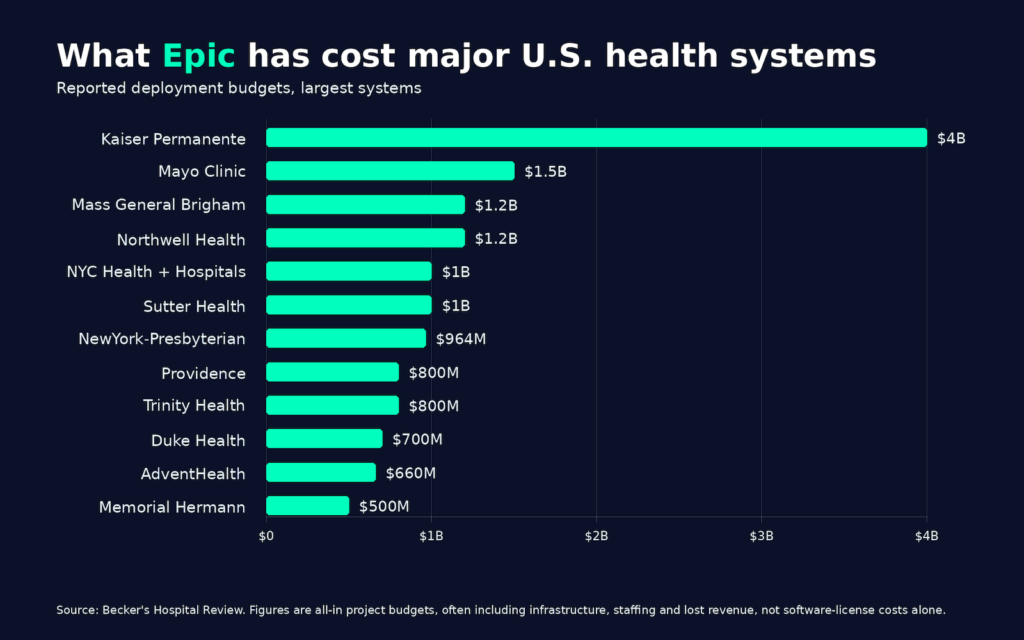
Lately, neither EHR vendor has offered a free trial.
So if you’re weighing whether Cerner or Epic Systems gives you the better value, remember the upfront price is just one part. What matters as much: how well the system fits, what it costs to maintain and upgrade, and what it returns over the long run.
Quick question: “Are Cerner and Epic rivals?”
Quick answer: “They are. In EHR, the two go at it like heavyweights, and that rivalry keeps pushing the field forward in healthcare IT.”
Integrating your systems with Epic or Cerner
Teams ask us about the Cerner relation with Epic all the time: can the two coexist, and what does integrating each actually take? Topflight specializes in both Epic and Cerner integrations, building R4-first, SMART on FHIR clinician apps, reliable HL7 v2 bridges, and Bulk FHIR pipelines, with HIPAA baked in from the start.
Why teams bring us in for EHR integration
- Standards that ship: SMART on FHIR plus HL7 v2 (orders, ADT, charges), with Bulk FHIR paths for analytics and ML.
- Hyperdrive-safe embeds and context sync: We validate iframe/handler assumptions early and design for clinician flow, not demo day.
- Compliance as a feature: HIPAA-trained U.S. support and privacy-first data handling, with security patterns like least privilege and PHI minimization.
- A delivery playbook, not vibes: Implementation guidance, workflow validation, technical ownership, go-live and training, then maintenance.
- Beyond EHR: DICOM where imaging matters; Apple Health and Google Fit when you need patient-mediated data.
Integration jumpstart
What you get, builder to builder:
- System and seams map: Data flows and auth scopes, plus interface licenses (Epic Interconnect/Bridges; Cerner Ignite/SMART).
- Endpoint inventory and gaps: Required FHIR resources vs. what’s enabled, HL7 v2 fallbacks, and Bulk export feasibility.
- Security and compliance kit: A PHI footprint reduction plan, retention windows, audit strategy, and BAA/vendor checklist.
- Enablement tracker: Org-by-org gating steps, from OAuth client registration to scopes and app listing/connection evidence.
- Golden test patients: Curated R4 datasets for repeatable integration tests and CI.
These map to our cadence, implementation, validation, ownership, go-live, so nothing falls through the cracks between architecture and production.
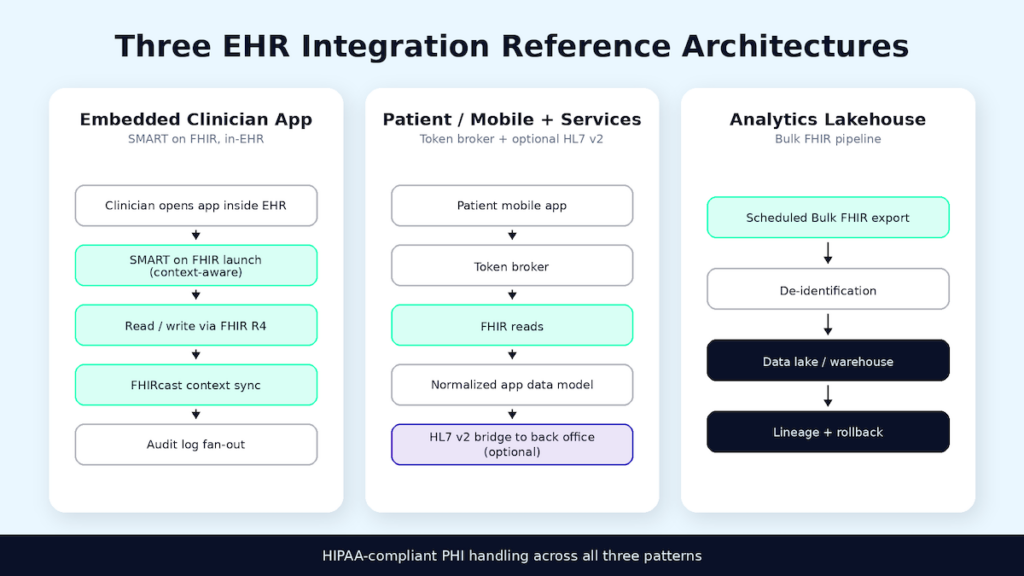
Reference architectures
- Embedded clinician app (SMART-in-EHR): Context-aware launch, read/write via R4, FHIRcast if needed, audit fan-out.
- Patient/mobile plus services: Token broker to FHIR reads to a normalized app model, with an optional HL7 v2 bridge to the back office.
- Analytics lakehouse: Scheduled Bulk FHIR exports to de-identification to a lake/warehouse, with lineage and rollback.
Relevant case studies
#1. Epic: pre-visit dermatology intake to progress note (SMART on FHIR)
Context: A startup needed dynamic pre-visit surveys that auto-compose a provider note.
What we built:
- Provider launch via SMART on FHIR inside Epic; patient auth through MyChart.
- Pulled chart context via FHIR (demographics, meds, conditions, procedures, encounters); used Epic’s private API for provider schedules.
- A rules-driven survey engine that smart-composes a progress note and writes it back to the EHR.
Why it matters: a tight SMART launch plus curated FHIR pulls let you personalize surveys without brittle screen-scrapes. Compose once, render everywhere.
#2. Epic: imaging and teleradiology network (HL7 v2 + multi-PACS)
Context: Radiology reads across multiple facilities, PACS, and billing systems.
What we built: ADT to billing, ORM to downstream PACS and sister facilities, and ORU back to Epic to finalize orders. That gave predictable v2 messaging and cleaner remote reads across sites.
Why it matters: when orders and results are king, HL7 v2 is still the shortest path to reliability, and to keeping your RCM happy.
#3. Cerner: LIMS-driven imaging dashboard (SMART on FHIR + LDAP)
Context: A non-profit hospital needed a unified MRI/radiology dashboard fed by Cerner plus an in-house LIMS.
What we built:
- Dual auth: SMART on FHIR (Cerner) or LDAP (AD).
- Pulled patients and observations from Cerner FHIR by MRN mapped from LIMS orders; a one-way read into an operational dashboard; a local DB for provider annotations.
Why it matters: clean MRN reconciliation at the seam plus a one-way FHIR read can unblock high-value clinician UX without committing to writes on day one.
#4. GaleAI: medical coding accelerator (Epic and Cerner)
Cross-EHR plus AI: the GaleAI coding accelerator included SMART/FHIR integration, a marketplace listing, and a multi-platform rollout. It reported a 97% coding-time reduction and +15% revenue from accuracy gains.
- FHIR compliance across targeted resources, with SMART on FHIR support.
- Mini-apps packaged for both the Epic and Cerner EHR marketplaces.
- Mirth Connect as the interoperability backbone where needed.
- A simplified prior-auth loop across payers, providers, and GaleAI’s coding platform (pre-check plus status).
#5. Epic: Roundr hospital rounding app (FHIR + HL7 v2 ADT)
Context: Dr. Josh Dégallier, a physician founder, needed a mobile companion to desktop-bound Epic so doctors could pull up patient data at the bedside during rounds.
What we built: Roundr is a cross-platform React Native app (iOS and Android), wired to Epic through FHIR reads and an HL7 v2 ADT interface, with Mirth Connect as the backbone. Doctors read inpatient data and imaging on the phone and write progress notes back to Epic over a HIPAA-safe PHI path.
Why it matters: a mobile front end on Epic, built on FHIR reads and an ADT feed, hands clinicians bedside workflows without rebuilding the core EHR. It’s in testing now, with hospital pilots in the works.
What to steal from these builds
- Use SMART on FHIR for clinician-facing UX; reserve HL7 v2 for orders, ADT, and results where FHIR gaps remain.
- Start read-heavy (one-way FHIR) with solid identity and ID-mapping, then graduate to writes once governance is in place.
- Treat prior-auth as a first-class workflow from the start: surface status in-EHR and broker it through integration middleware when payers aren’t FHIR-ready.
For more examples, see our portfolio (including Roundr mobile app integration with Epic EHR, RTHM RPM, and others).
Topflight’s experience with Epic and Cerner
As a healthcare app development company, we’ve put in years on both Epic and Cerner EHR systems.
Front ends that plug into Epic or Cerner
On the front-end side, we’ve built clean, efficient interfaces that connect straight into Epic and Cerner. A good front end lifts the whole experience and helps healthcare providers do more, and we’ve leaned on deep knowledge of both systems to deliver it.
Putting EHR data to work
Data runs every healthcare organization. We’ve built projects that make the most of what lives in Epic and Cerner EHRs, from custom reports to advanced analytics tooling, to help healthcare providers pull real insight from their own data.
AI engines for EHR data
AI can change how healthcare works. We’ve built AI engines that process and analyze data from Epic and Cerner EHRs, handling everything from predictive analytics to patient risk identification, which sharpens decisions and improves outcomes.
Both systems are expected to lean further into AI for diagnostic precision and patient outcomes over the next few years.
Standalone web portals and apps that launch inside an EHR
So what does going past the standard EHR look like? We’ve used our mobile and web build experience to create standalone web Cerner portals and apps that launch right inside an EHR. These are tailor-made for specific needs in healthcare, with a level of customization standard EHR systems usually lack, so providers can tighten operations and deliver better care.
Wearables and smart medical sensors
Connected wearables surpassed 1.1 billion devices worldwide in 2022, and short-range IoT devices including wearable trackers reached 17.4 billion connections by October 2025. As things get more connected, tying wearables and smart medical sensors into EHRs only grows in importance.
We’re out front on this. We’ve built integrations that let wearables and smart medical sensors feed Epic and Cerner EHRs directly, which means real-time data, better monitoring, and stronger health outcomes.
Get in touch for more on our healthcare app development services and our work with Epic and Cerner specifically.
Quick question: “Is Epic better than Cerner?”
Quick answer: “If you want deep customization and broad functionality, Epic might be your pick. But it’s really about what fits your organization.”
Choosing the right EHR: expert consultation
Choosing an EHR system goes well past comparing features of Epic and Cerner. A few other factors carry real weight in the decision.
What matters beyond features
- Current EHR system: Switching is complex. Sometimes upgrading or tuning what you have, Epic, Cerner, or another vendor, beats a full migration.
- Partnerships with EHR vendors: An existing relationship can decide it. A good agreement with a vendor often makes their system the logical call.
- Size of the organization: Scale matters. Large-scale organizations may need a heavier system; smaller ones often want something simpler and cheaper.
- Developers with Cerner and Epic certification: Your team’s expertise can tip the choice. In-house developers and certified specialists on a given EHR can pull the decision that way.
- Out-of-the-box vs. custom workflows: It also depends on whether you’ll use ready-made modules or build custom apps and sync them to the platform.
Here’s the short version of where each one fits.
When Epic is the right fit
- Integrated healthcare systems: Epic suits large healthcare organizations with complex needs that want one comprehensive solution.
- Interoperability emphasis: If smooth interoperability across providers and systems is the priority, Epic’s collaborative platform fits.
- Patient-centric focus: Epic is known for its patient-centric approach, good for organizations set on patient engagement.
- Heavy customization needs: For teams that need to tailor workflows extensively, Epic gives you the room.
When Cerner is the right fit
- Diverse settings: Cerner adapts across settings, from large hospital systems to smaller clinics.
- Population health: If you’re focused on population health and analytics, Cerner’s tooling is built for it.
- Cost-effective solutions: Smaller or budget-conscious organizations often find Cerner more cost-effective without giving up essentials.
- Ease of implementation: Cerner’s interface and rollout get cited as quicker, which suits a faster transition.
Decision tree: a 5-minute triage
Use this to narrow the field fast, then check it against the fit scenarios above.
- Footprint. Multi-hospital, multi-service system? Bias Epic for scale, playbooks, and ecosystem support. If you’re mid-Cerner and optimizing, sanity-check the modernization path before switching.
- Affiliation path. Can you join a host health system? Epic Community Connect is worth a serious look for ambulatory groups.
- Stack gravity. Heavy Oracle data/analytics investment, or Cerner legacy you’ll keep? Oracle Health (Cerner) keeps the seams simpler via Ignite APIs and CommonWell/QHIN alignment.
- Governance appetite. Want opinionated coherence or bespoke flexibility? Epic if you want faster standardization; Oracle Health if you’ll actively govern templates and workflows.
- Deployment pressure. Need ambulatory speed at lower TCO? Compare Epic Community Connect against Oracle Health Ambulatory, and pilot one specialty before any org-wide rollout.
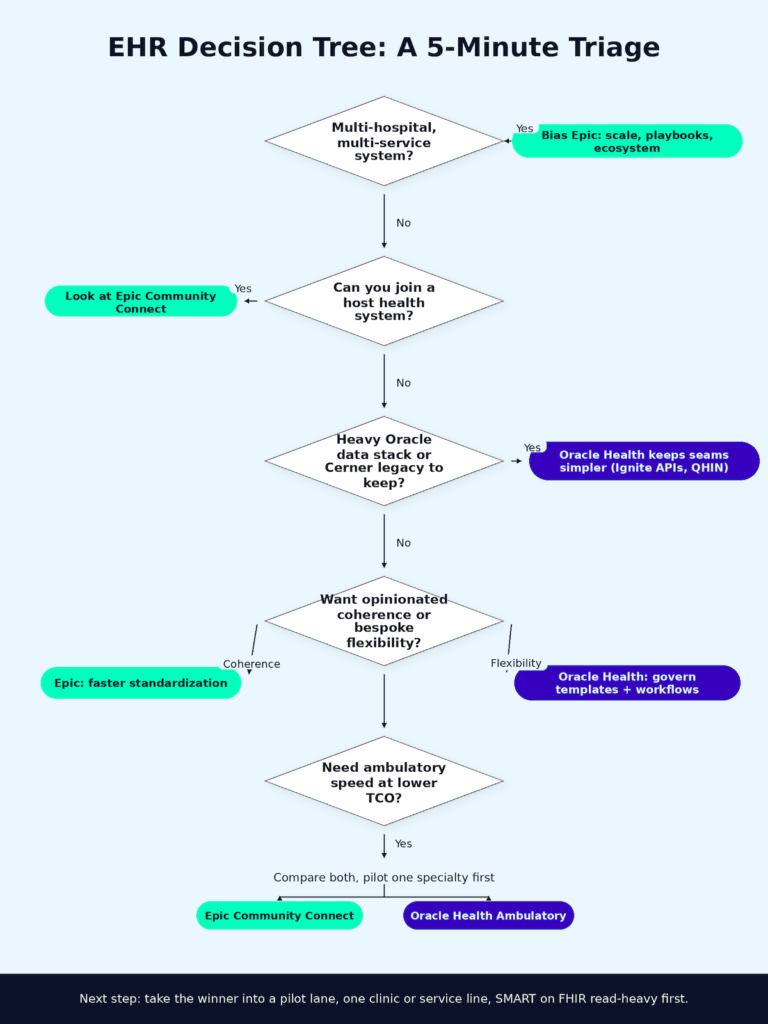
Next step: take the winner into a pilot lane (one clinic or service line, SMART on FHIR read-heavy first, with clear exit criteria).
Our EHR selection consulting
Topflight specializes in both Epic and Cerner integrations, and we help teams pick the right path before they build. In a 1-2 week selection sprint, you get:
- Current-state and constraints map: Your EHR footprint, contracts and BAAs, data flows, PHI surface, and must-keep systems.
- Requirements-to-scoring matrix: Weighted on UX (clinician workflows), interop (SMART/FHIR, HL7 v2, Bulk), RCM, analytics/AI readiness, timeline, and TCO.
- Vendor short-list and demo scripts: Apples-to-apples evaluations and decision memos your board can actually read.
- Pilot plan (proof of value): The smallest slice that proves outcomes, with targets, data sources, success metrics, and rollback.
- Executive brief: A recommendation with risks, mitigations, and a 90-day implementation roadmap.
No fluff. Builder to builder. We’ll tell you when not to switch systems, and how to get ROI out of the one you already run.
Picking an EHR means committing to a long-term partner for your organization’s future. And whether you land on Epic, Cerner, or something else, our team at Topflight is ready to help. We’re here to help you get the most out of your EHR investments.
[This blog was first published on 12/28/2023, but has been updated with more recent content]
FAQ
What is the difference between Epic and Cerner?
It mostly comes down to market share, bed coverage, and product lineup. Epic leads on market share and bed coverage; both ship broad, capable software products.
Which EHR system is better?
Both are strong. The better choice depends on your needs, size, specialty requirements, and integration plans.
What are the main software products offered by Cerner and Epic?
Cerner has Cerner Millennium, PowerChart, and CareTracker. Epic has EpicCare, MyChart, Revenue Cycle Management, Healthy Planet, and Tapestry.
Do Cerner and Epic prioritize security and compliance?
Yes. Both run role-based access controls, data encryption, and regular security audits to protect patient data and meet industry standards and regulations.
What is more cost-effective, Epic or Cerner?
Generally, Cerner runs more cost-effective than Epic, though the two price differently, Epic front-loading license and infrastructure while Oracle leans on subscription, so compare total cost over several years rather than headline rates.
Which has a larger market share, Epic or Cerner?
As of 2025, Epic holds the larger market share in the hospital market.
Which has better data analytics?
Both have solid data analytics, and Cerner has long been recognized for its analytics tooling, though Epic now leads on overall satisfaction.