

Well-executed IoT applications may often look deceptively simple yet require a lot of mastery to create a unique user experience on the edge of digital and physical realms. If you are looking to build an IoT app and want to know what goes into the process, this blog is for you. We’ll share best practices and explain everything you need to consider to create an engaging Internet of Things application.
Key Takeaways:
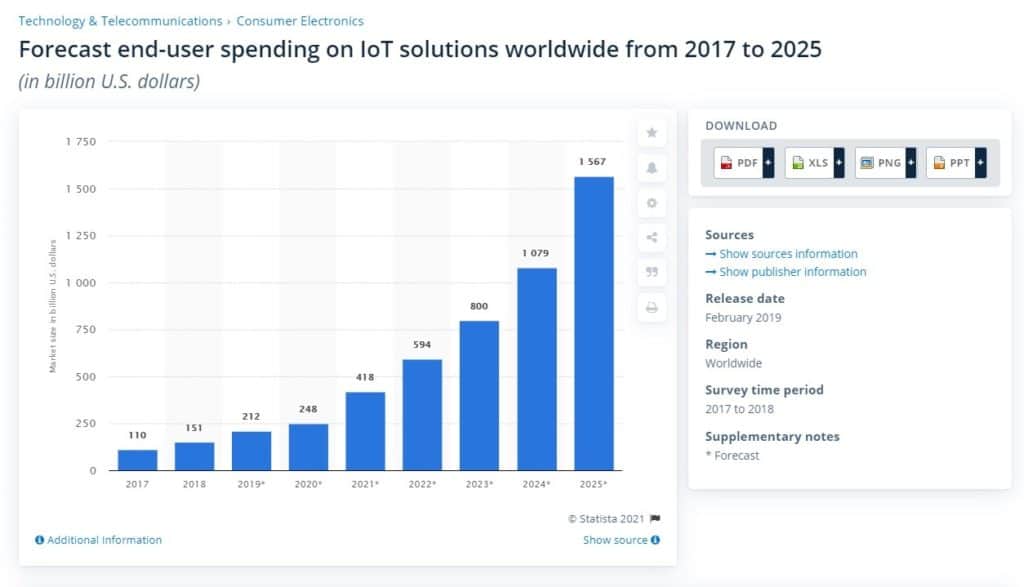
- The IoT industry is ripe for innovations promising an almost 4x increase in end-user spending on IoT products by 2025.
- IoT app development involves building an entire ecosystem comprising multiple web and mobile applications seamlessly working together.
- The answer to “ How to create an IoT app on a tight budget?” is taking advantage of existing IoT platforms offering a wide range of ready-made tools.
Table of Contents:
1. IoT Application Market Overview
2. Real-World IoT Application Success Stories
3. High-Growth Industries for IoT Application Development
4. Comprehensive IoT Application Development Process
- Step 1: IoT Platform Selection – Custom vs. Ready-Made Solutions
- Step 2: IoT Security Architecture Implementation
- Step 3: Component Development and Integration Testing
- Step 4: IoT Application Deployment Strategies
- Step 5: IoT System Maintenance and Scaling
5. IoT Technology Stack and Architecture
6. IoT Security Best Practices
7. IoT Development Platforms and Frameworks
8. IoT Application Development Cost Analysis
9. Future of IoT Application Development
10. IoT Development Methodologies and Best Practices
11. IoT Integration Strategies
12. How to Develop IoT Applications with Topflight Apps
IoT Application Market Overview
A few years ago, the Internet of Things sounded like sci-fi—now it’s quietly running hospitals, homes, and health plans. From smart things that track vitals in real time to sensors and actuators that automate patient environments, the IoT market has turned connectivity into clinical intelligence. Before we get our hands dirty with IoT app development, let’s zoom out for a second and see what’s actually fueling this connected-care boom—and why it’s only getting started.
Current IoT Market Size and Growth Projections
The IoT market keeps expanding as enterprises fund pragmatic IoT solutions that prove ROI beyond pilots. Even in cyclical budgets, fleets of smart things continue to scale because they pay for themselves in operational visibility and control.
Key IoT Technology Trends Driving Innovation
Real-world deployments are won by boring-but-critical engineering: ruggedized devices, resilient networks, and clean data from sensors and actuators. In the IoT industry, teams are pushing more intelligence to the edge, hardening security (identity, SBOMs, zero trust), and operationalizing digital twins for uptime, not just dashboards.
Impact of AI and Machine Learning on IoT Development
The AI stack is now table stakes: AI-powered data analysis triages signal from noise, drives predictive maintenance, and closes control loops faster than humans can react. For app teams, this shifts architectures toward on-device inference and cloud aggregation—exactly the kind of pattern we champion in serious IoT app development.
Blockchain Integration in IoT Solutions
Keep the chain where it earns its keep. Blockchain-based provenance and device identity help multi-party ecosystems agree on events without a single owner, and decentralized IoT solutions (think community LoRaWAN) can outcompete traditional coverage models. Use it sparingly: when you need shared trust, tamper evidence, or auditable simulation feeds for regulated workflows.
Related: Blockchain App Development Guide
Real-World IoT Application Success Stories
IoT only gets interesting when it works—when devices, data, and humans actually close the loop. Given our expertise in healthcare app development, below are real-world use cases of applying IoT in health care—spanning clinical, smart home, industrial, and consumer settings.
Healthcare IoT Applications
Aavia
Aavia is a nascent period tracker and birth control app that works with a smart pill case helping track pill intake. Users receive daily reminders while the app automatically tracks dosage and provides them with insights into their hormone cycle.
What to steal for your build: Pair a physical trigger (pill case sensor) with behavioral nudges in-app—simple hardware + software syncs can drive 80%+ adherence.
CareBand
CareBand is pioneering the use of a blockchain-based IoT platform to help caregivers provide better care to vulnerable groups of patients (dementia, children care, etc.).
The suite of apps works with a smart medical gadget that incorporates cutting-edge location and activity monitoring technologies to track patients in real time inside and outdoors and monitor their condition.
What to steal for your build: Prioritize real-time telemetry and geofencing logic that works offline; safety-critical apps can’t depend on perfect connectivity.
Propeller
Propeller gathers information about the use of asthma inhalers from a smart sensor. It uses the data to build a personalized user profile and supports the patient to follow a recommended treatment plan.
What to steal for your build: Focus on feedback loops—raw usage data becomes valuable only when it translates into actionable, personalized care plans.
Dexcom G7 + community programs
Continuous glucose monitoring paired with coaching has shown A1C reductions of ~2.4% in high-baseline populations—proof that connected sensors + app loops change outcomes, not just dashboards.
What to steal for your build: Use clinical metrics (like A1C deltas) to quantify success; ROI in health IoT is measured in outcomes, not installs.
Current Health virtual wards (NHS)
Older patients (75+) adopted and adhered to remote patient monitoring programs at higher rates than expected—proof that “tech-resistant” populations aren’t the real problem; design is.
What to steal for your build: Simplify onboarding—IoT healthcare success lives or dies on day-one user comprehension, not on feature count.
Smart Home IoT Solutions
ecobee Smart Thermostat + eco+
Documented 5–23% cooling cost savings depending on tariff and usage—clear ROI that consumers actually feel.
What to steal for your build: Always tie automation to a measurable win (cost, comfort, or safety); abstract “smarts” don’t sell, results do.
Ambient/Fall-Risk Monitoring
Smart-home sensors detect falls or inactivity patterns and alert caregivers, helping seniors live independently longer.
What to steal for your build: Fuse multiple sensor types (motion, acoustic, environmental) to reduce false alarms—trust is usability in disguise.
Circadian Lighting Systems
Hospitals and eldercare homes use smart lighting to re-entrain circadian rhythms, improving recovery and mood.
What to steal for your build: Treat light and environment as data inputs; health outcomes start with atmosphere, not just vitals.
Industrial IoT Examples
Caterpillar Fleet Telemetry
Condition monitoring and predictive maintenance minimize unplanned downtime and optimize parts usage.
What to steal for your build: Prioritize simple KPIs—mean time between failures (MTBF) and utilization—over vanity dashboards.
Siemens Digital Twins
Factories model physical systems to predict energy use and prevent equipment failure.
What to steal for your build: Bake simulation early into design; every industrial IoT win starts as a digital twin scenario.
John Deere Operations Center
Precision agriculture integrates sensors and GPS data to improve yield and reduce fertilizer use.
What to steal for your build: Streamline analytics for non-technical users—farmers shouldn’t need to learn SQL to grow smarter.
Consumer IoT Products
Oura Ring
Validated sleep and HRV accuracy make it one of the few consumer wearables with credible research backing.
What to steal for your build: Balance data density with explanation—users value clear insights over raw biometrics.
WHOOP 4.0
Tracks strain, recovery, and sleep with strong accuracy once personalized baselines are established.
What to steal for your build: Personalization beats precision; behavioral insight is more motivating than decimal-point accuracy.
Nest Protect
Smart smoke detector that talks, self-tests, and integrates into broader smart-home ecosystems.
What to steal for your build: Nail reliability before novelty—IoT products in critical roles earn trust through boring consistency.
High-Growth Industries for IoT Application Development
IoT solutions now touch every corner of the economy, but budgets follow use cases with tight feedback loops and visible ROI. Given our experience in the medical field and day-to-day IoT app development work, here’s where momentum (and money) concentrate.
Healthcare and Medical IoT Applications
Topflight’s focus is IoT healthcare app development, where device data becomes clinical action. Priority niches to watch:
- medical equipment tracking — Uptime, utilization, and loss prevention for high-value assets; pair RTLS with clear ownership handoffs.
- remote patient monitoring — Move from raw vitals to escalation rules and care team workflows; reimbursement-backed, outcome-visible.
- smart clinics and hospitals — Environment sensing + orchestration (air, light, access) tied to safety and throughput KPIs.
- wearables (e.g., connected pillboxes) — Adherence wins come from micro-interventions, not dashboards.
- activity tracking sensors — Rehab and fall-risk programs that combine passive sensing with patient coaching.
When those devices are regulated medical hardware, you don’t just wire up telemetry, you build a companion app for a medical device, which carries FDA classification and clearance work on top of the IoT stack.
If you’re mapping features and integrations, we’ve also covered how to make a healthcare IoT app in a separate deep dive.
Smart Manufacturing and Industrial IoT
- Predictive maintenance — Instrument critical assets; optimize MTBF and spares by feeding models with edge-filtered telemetry.
- Process quality & computer vision — Inline defect detection and auto-rework gates; treat the camera as a sensor, not a spreadsheet.
- Energy & sustainability — Sub-metering and load shaping to cut peak charges; digital twins to test changes before touching the line.
Smart Cities and Infrastructure IoT
- Traffic & transit — Adaptive signaling, curb management, and fleet telemetry to increase flow without pouring concrete.
- Water & utilities — Leak detection, pressure anomalies, and predictive pipe failure; compliance-friendly audit trails.
- Public safety & environment — Air quality, noise, and structural health sensors tied to incident response playbooks.
Agriculture and Environmental Monitoring IoT
- Precision irrigation — Soil moisture + weather models to drive zone-level watering; less water, higher yield.
- Livestock & field telemetry — Health, location, and fencing alerts that reduce labor while improving herd outcomes.
- Climate & habitat sensing — Micro-climate networks for frost, wildfire, or reef monitoring; edge pre-processing to cut backhaul.
Retail and Supply Chain IoT Solutions
- Inventory accuracy — RFID/computer vision to eliminate phantom stock and enable true on-shelf availability.
- Cold chain & condition monitoring — Temperature/shock sensors with alerting and chain-of-custody trails.
- In-store experience & loss prevention — Smart shelves, frictionless checkout, and zone analytics tied to staffing and shrink.
Note: This restructure intentionally preserves your original phrases—IoT solutions, IoT healthcare app development, experience in the medical field, IoT app development, medical equipment tracking, remote patient monitoring, smart clinics and hospitals, wearables (e.g., connected pillboxes), activity tracking sensors, and the closing pointer to develop a healthcare IoT app—so SEO continuity stays intact.
Comprehensive IoT Application Development Process
If you plan to develop IoT apps, you should know that it involves much more than developing a customer-facing mobile application. The latter is a pretty straightforward thing, especially if you’re a little familiar with the mobile app development process:
- design, prototype, and verify a prototype with customers
- translate the design into code using appropriate tools
- test the application in a live environment
- deploy the app to mobile stores
- maintain the app as per customer feedback and new OS releases
However, when you’re developing an app for IoT, you need to take into account behind-the-scenes but at the same time robust back-end systems.
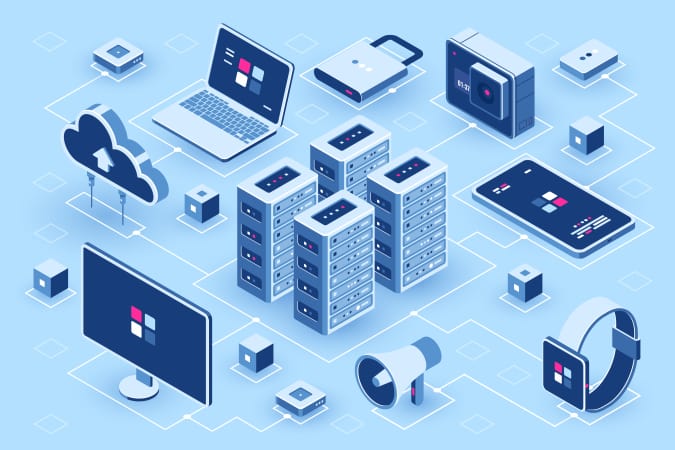
The back-end (aka server-side) components of an IoT product collect and process data coming from sensors and actuators installed in smart gadgets (aka “things”). Besides that, you will need a web portal to administer smart devices.
That’s where custom web application development for IoT comes into play. That’s because a back-end piece of an IoT puzzle and an admin portal for managing “things” are web applications and naturally imply web development.
So in a gist, to make IoT applications, you need to build mobile apps and full-fledged server-side applications. Now, what are the main steps that take us from a bright idea to a fully functional, successful IoT product?
| Step | Key Actions | Considerations |
|---|---|---|
| 1. To Build from Scratch or Not? | – Decide between custom-built IoT or leveraging SaaS/open-source IoT platforms. – Review data and network protocol compatibility (e.g., MQTT, HTTP, Bluetooth, WiFi). – Ensure scalability and flexibility in the chosen solution. |
– Opt for open APIs for integration with external systems like CRM or ERP. – Avoid vendor lock-in by choosing platform-agnostic solutions. – Verify OTA firmware update support for seamless device management. |
| 2. Secure Your IoT App | – Implement strong user authentication (e.g., FaceID, two-factor authentication). – Encrypt data in transit and at rest using proven frameworks. – Establish access control with the principle of least privilege. |
– Balance security with usability to maintain a smooth user experience. – Follow standards like ISO27001, SOC2 Type 2, and IEC 62304 for compliance. – Regularly update firmware and monitor for vulnerabilities. |
| 3. Develop and Test Components | – Design, prototype, and validate customer-facing components. – Prioritize back-end development for seamless mobile and web app integration. – Use third-party SDKs and APIs to expedite development. |
– Focus on customer-centric UI/UX for mobile apps and visualization dashboards. – Include extensive QA testing: security, performance, scalability, and usability. – Employ IoT-specific testing tools like Wireshark or mPulse. |
| 4. Deploy | – Transfer web apps to live servers. – Publish mobile apps to the App Store and Google Play. – Set up DevOps for automated updates and seamless version control. |
– Test deployment readiness to ensure minimal downtime. – Verify app store submission compliance with IoT security and privacy requirements. – Prepare for app reviews and potential revisions before final approval. |
| 5. Maintain | – Monitor customer feedback and analytics to drive updates. – Regularly update frameworks and address bugs proactively. – Add new features to enhance customer satisfaction and usability. |
– Use tools like Google Analytics or Flurry to analyze user behavior. – Plan OS-specific updates to leverage new opportunities. – Maintain high engagement with regular feature rollouts. |
IoT Architecture Fundamentals
Think in planes and paths, not just “app + device.”
- Device plane: firmware, sensors and actuators, local storage, secure boot, OTA updater.
- Edge/gateway plane: protocol translation (BLE/Zigbee/LoRaWAN → MQTT/HTTP), buffering, basic rules/inference, offline-first queues.
- Cloud plane: data ingestion, stream processing, long-term storage (hot/warm/cold), command/telemetry topics, digital-twin state.
- Control plane: identity (per-device keys), RBAC, fleet management, policy, audit logs.
- Data contracts: typed payloads and versioned schemas so mobile/web, analytics, and firmware evolve without breaking each other.
Non-negotiables: zero-trust device identity, per-device keys, encrypted transport, signed firmware, and observability (logs/metrics/traces) from day one.
IoT Development Lifecycle Overview
Treat this like a distributed system with a clinical-grade QA mindset.
- Discovery & requirements: outcomes, KPIs, regulatory posture, data flows, protocol constraints, bill of materials.
- High-level design: reference architecture, data contracts, security model, OTA plan, make/buy calls (platforms vs custom).
- Prototyping: firmware spike + gateway + cloud ingest; prove payloads, latencies, and failure modes in a sandbox.
- MVP/pilot: small fleet, real users, real environments; measure reliability (connect rate, OTA success, mean time to reconnect).
- Scale-out: sharding/partitioning, cost controls, alerting SLOs, blue/green OTA, fleet ops runbooks.
- Operate & improve: telemetry-driven roadmap; rotate keys, rotate certs, rotate tires—keep the fleet healthy.
Choosing the Right IoT Development Approach
You have three pragmatic options; pick by risk, speed, and control:
- Platform-first (SaaS/PaaS): fastest to pilot; limits deep customization. Good when protocols are standard, UX is conventional, and compliance is covered by the vendor. Watch for lock-in, data egress costs, and OTA constraints.
- Custom-first: maximal control over firmware, data model, and cost curve; slower to first value. Choose when you need unusual hardware, strict data sovereignty, or fine-grained clinical/security workflows.
- Hybrid (our usual recommendation): platform for commodity pieces (ingest, IAM, basic rules); custom for differentiators (edge logic, data model, clinician workflows, analytics). Write an exit plan on day one (data export, schema ownership, replaceable modules).
Rule of thumb: if a requirement touches identity, OTA, safety, or regulated data flows, own it; if it’s commodity plumbing, rent it.
With those fundamentals in place, the step-by-step process below shows how we take an idea from prototype to a secure, scalable fleet and the customer-facing apps that run on top.
Step 1: IoT Platform Selection – Custom vs. Ready-Made Solutions
The first thing you need to decide on before you create an application for the internet of things is whether you will build your product from the ground up or use a SaaS platform or similar ready-made platform.
Today, quite a few commercial and open-source IoT platforms exist on the market, helping you relatively quickly spin up a complete cloud infrastructure for your IoT application.
These solutions take care of a back-end data processing component, and some offer a toolchain to easily create an admin portal for managing smart devices. Others go even further by supplying mobile app shells that you can customize to work seamlessly with your IoT product.

If you decide to build an IoT app, remember about trade-offs. Companies offering off-the-shelf IoT platforms have made many tech decisions for you. Therefore, you need to check diligently if your product can successfully operate within these technological boundaries.
Things to consider when choosing a ready-made IoT platform
- You will need to check what data protocols their systems support:
- MQTT
- HTTP
- WebSocket
- DDS
All these protocols (and a few others) have their own rules on circulating data between hardware sensors and the cloud. Of course, a lot will depend on your hardware-supported protocols.
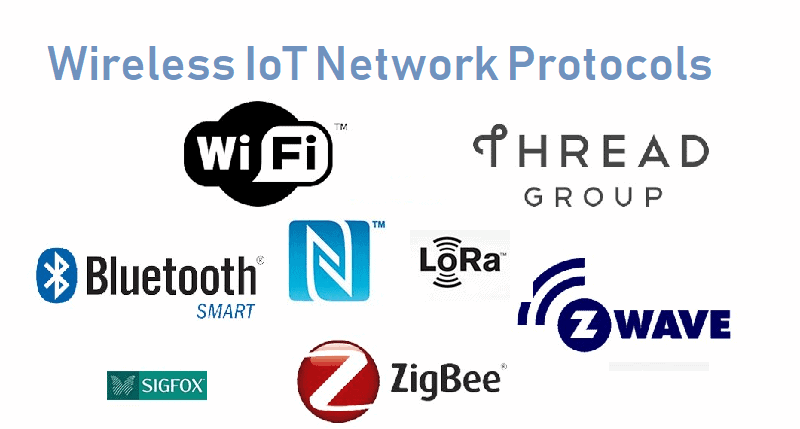
- Another aspect worth checking out about ready-made IoT platforms is the network protocols they work with:
- Bluetooth
- WiFi
- LoRaWan
- Zigbee
- Z-Wave
The more protocols a platform supports, the better. Mind that you also probably don’t want to be locked into some proprietary data transfer technology because that effectively means you can’t quickly move to a completely different provider or switch to a custom-built IoT environment.
- Examine their cloud architecture. Does it allow for any flexibility? The ideal scenario is when an IoT system allows for various deployment scenarios:
- cloud hosting setup
- on-premise option (when you host IoT running software on your own servers)
- a hybrid approach, combining the two said variants
- If you plan to connect your IoT product with other existing solutions, e.g., a CRM or ERP, look for open APIs support.
- One of the main reasons you might want to go with an out-of-the-box IoT solution is scalability. Will you be able to quickly double or triple the number of smart devices for your customers? How much data can your product process at any given time? Ideally, a system can scale up your product using clustering technologies like Docker or Kubernetes.
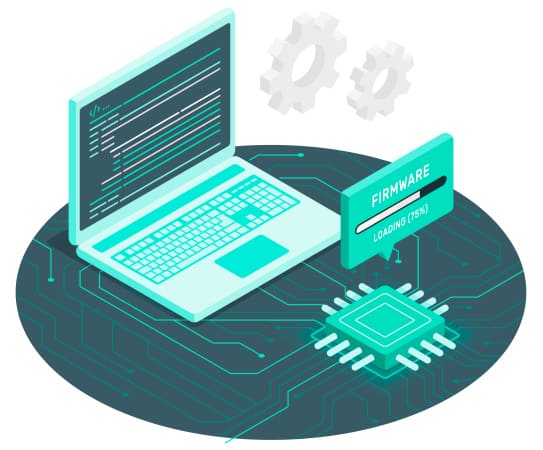
- Hardware support and firmware updates are also necessary. Some platforms only work with designated hardware, while others function as platform-agnostic solutions. You will need to determine if the IoT provider supports OTA (over-the-air) firmware updates that drastically simplify device management.

- Finally, double-check if an IoT platform of your choice includes prolific security mechanisms. In fact, the security aspect of internet of things app development is so critical, I suggest we consider it as a separate step altogether.
Related: BLE App Development Guide: The Ultimate Guide
Step 2: IoT Security Architecture Implementation
As we’ve already established, when you develop applications for the internet of things, it’s rarely a single mobile application to control hardware. In an overwhelming number of cases, you create a mini-ecosystem comprising a web-based data processing application, an admin portal, a data visualization platform, and other modules besides IoT mobile apps.
That’s why your IoT product must include a multi-layered approach to security. You have to consider baking in security at the beginning of a project as you start architecting your IoT solution.
I encourage you to scrutinize resources like the IoT Security Verification Standard by OWASP — a trusted nonprofit foundation working on software security standardization. Here are some key takeaways, though, to give you a better understanding of what it takes to make a secure IoT app.

User authentication
- Instill a strong password policy by disallowing weak passwords
- Enable two-factor authentication with text messages or authentication apps
- On mobile devices, allow users to authenticate quickly with Face ID or Touch ID
- Require users to reauthenticate before providing access to personally identifiable information
- Require customers to authenticate again after they remain inactive for some time
- Avoid hardcoded passwords or duplicate passwords across smart devices
Data encryption
- Ensure that sensitive information is securely encrypted in transit and at rest
- use well-recommended encryption frameworks to enable strong encryption instead of custom cryptography implementation
- Verify that the same encryption mechanism is implemented across the web and mobile components of your IoT product
Access rights management
- Enforce the concept of least privilege: every platform module and the user should have access to the required minimum of data
- Limit access to device debug capabilities only to approved staff, and keep a log of all access instances
- Implement a data wipe feature to efficiently erase all data from a device when it’s decommissioned or changes the owner
General security best practices
- Use the secure HTTPS connection to transfer data between devices and applications
- Verify that your security measures comply with such standards as ISO27001, SOC2 Type 2, and IEC 62304 (if it’s a healthcare-related IoT app)
One thing to keep in mind is the balance between these security requirements and the ease of use. In other words, these app protection techniques should not stand in the way of customers interacting with the application.

Step 3: Component Development and Integration Testing
Once you’ve decided on a custom vs. off-the-shelf IoT platform and reviewed your security options, it’s time to create apps for IoT by following the standard steps I’ve outlined at the very beginning:
- design, prototype, and verify a prototype with customers
- translate the design into code using appropriate tools
- test the application in a live environment
As you’d imagine, there are a couple of things you need to account for because, again, you’re building an ecosystem that spans multiple web and mobile platforms.
UX/UI
When designing IoT apps, your emphasis should be on customer-facing components, such as a mobile app and a web interface for visualizing data coming from connected devices.
If you remember, I mentioned that some ready-made IoT platforms provide essential building blocks for creating customer-facing applications. Even if that’s the case, note that you need to verify your UI/UX assumptions with customers by using interactive prototypes before cementing these user experiences.

You can safely stick with the default UI for an admin portal, as it will be managed by your employees internally.
Related: Mobile Application Design Process – UI/UX Guidelines in 2022
Code
When your app developers start to create IoT applications by putting together lines of code, ask them if they plan to use any third-party SDKs and APIs to expedite the process. There are plenty of frameworks and pluggable components on the market to accelerate the development of mobile and web applications.
Prioritizing the development of a back end, and APIs in particular, pays off in that development of mobile applications can proceed at a steady pace, without setbacks, in parallel with web development.
That’s because mobile developers need to integrate apps with the cloud using real-life APIs instead of relying on stubs and mock data. If they continue to build apps for IoT while the APIs are still being developed, there’s a high chance the mobile app’s architecture will need a significant overhaul later on.
Related: The Best Mobile App Framework for Your Application
QA
Naturally, IoT development implies much testing. Verifying that all IoT components work as intended is, of course, the privilege of your app developers and their QA associates. In fact, a solid QA strategy includes adding automated tests in code during development, besides checking app features from the customer perspective.
 Let’s list the kinds of testing you should expect from your engineering team without going too much into detail. At a minimum, include the following QA disciplines in your testing strategy:
- Security testing
- Performance testing
- Usability testing
- Compatibility testing
- Scalability testing
Another good idea is to step up your testing procedures by employing specific Internet-of-Things testing tools like Wireshark or mPulse.
Related: Mobile Apps QA Guide: Strategies, Steps, Tools, Best Practices
Step 4: IoT Application Deployment Strategies
After developing and testing your IoT product, you are finally ready to make it available for customers. You will need to transfer web apps to a live server environment, upload mobile apps to the App Store and Google Play and go through the app verification process.
One critical aspect of preparing IoT apps for a public release is ensuring you have DevOps practices and tools set up. Put simply, DevOps tools and best practices help you ship new versions of apps quicker without interrupting the service because of automation.
Step 5: IoT System Maintenance and Scaling
I bet you already know that once your app has been released, you’re still far from resting on your laurels. Besides the marketing hustle, you’ll be busy processing customer feedback and (hopefully) turning into new features or minor updates to the interface.
Someone on your team will need to analyze customer behavior based on data coming from built-in analytics solutions like Google Analytics or Flurry.
The tech team will need to keep track of updates to the frameworks employed in the product and watch new mobile OS releases to spot opportunities for enhancing user experience.
In other words, there’s more work to be done once your product is live because you serve paying customers. And if you keep refining your app, they’re likely to stick around long enough to fund another major release.
Related: App Metrics to Track: Everything You Need to Know
IoT Technology Stack and Architecture
IoT Communication Protocols Explained
Protocols aren’t a religion—they’re trade-offs. Start with your topology (one-to-many? mesh?), power budget, and what the messages need to mean (telemetry vs commands). MQTT stays the default for flaky links and small payloads; CoAP is great for sleepy sensors; AMQP shows up when ordered delivery and routing are non-negotiable. Device networks (BLE/Zigbee/Thread, LoRaWAN/NB-IoT/LTE-M) solve distance and battery problems before the cloud ever enters the chat.
- Pick MQTT for lightweight pub/sub and intermittent connectivity.
- Use CoAP when the node is constrained and REST-ish semantics help.
- Reach for AMQP if broker-level acks/routing matter (industrial/finance).
- Keep WebSockets/HTTP for apps and control surfaces—not your sensor firehose.
Pro tip: model commands and telemetry separately, and make every message idempotent with server timestamps to neutralize clock drift.
Cloud vs. Edge Computing for IoT
Don’t “choose” cloud or edge—compose them. Push decisions to the edge when latency (<150 ms), privacy, or link quality demands it; centralize learning, orchestration, and long-term storage in the cloud. The winning pattern: infer locally, ship features/aggregates upstream, train centrally, and redeploy versioned models back to the edge.
- Edge handles pre-filtering, local rules, and autonomy during outages.
- Cloud owns fleet-wide analytics, OTA coordination, identity, and policy.
Design for graceful degradation modes: the product should be useful offline and merely get smarter online.
IoT Data Management and Analytics
Treat data like a product with contracts. Your pipeline should read like a supply chain: ingest → stream process → store by temperature (hot/warm/cold) → analyze. Time-series stores serve telemetry; OLAP powers fleet views; object storage holds firmware and media. Build guardrails that reject or quarantine bad payloads so broken devices don’t poison everything downstream.
- Version your schemas; include units, timezones, and device sequence numbers.
- Split analytics into real-time (alerts), near-real-time (dashboards), and batch (forecasting, RUL).
- Apply retention by tier and tokenize PII where possible; audit and lineage are not “nice to haves.”
Microservices Architecture for IoT Applications
Monoliths melt under fleets. An event-driven, microservices setup keeps responsibilities crisp and failures contained. Think “small services stitched by events” rather than “big services called by APIs.”
Core services usually include a Device Registry, Twin/State, Command, Telemetry, Rules/Automation, and OTA—with an API gateway, IAM/RBAC, and observability wrapped around them. Reliability patterns (retries with backoff, dead-letter queues, circuit breakers, idempotency keys) are table stakes.
- Make services single-purpose and independently deployable.
- Ship an exit plan on day one: portable schemas and export paths so no vendor or broker can trap you.
IoT Security Best Practices
Device-Level Security Implementation
Security starts at manufacture, not at the app store.
- Provision unique identities: per-device keys/certs burned at factory; no shared creds, ever.
- Hardware root of trust: secure/verified boot (TPM/SE/TrustZone), measured boot with attestation on join.
- Lock debug surfaces: disable/guard JTAG/SWD/UART; require signed debug unlock with time-bound access + audit.
- Signed OTA: mandatory signature verification, staged rollouts, health checks, and automatic rollback on failure.
- SBOM & vuln hygiene: ship a software bill of materials; monitor CVEs against your images and patch on a cadence.
- Memory-safe by default: use Rust/Swift/Go where feasible; sandbox native drivers; fuzz parsers for binary protocols.
Network Security for IoT Communications
Assume the link is hostile; make the broker your choke point.
- Mutual TLS everywhere (MQTT/AMQP/HTTP): device auth via client certs; rotate certs automationally.
- Topic-level ACLs: least-privilege publish/subscribe; separate telemetry from commands; enforce idempotency.
- Segmentation & egress control: private APNs/VPN tunnels for fleets; gateways in a dedicated subnet with egress allow-lists.
- Abuse controls: server-side rate limits/backoff, DoS detection, and dead-letter queues; drop malformed payloads early.
- Key/identity rotation: rotate device credentials on schedule and on suspicion; revoke instantly via CRL/OCSP.
Cloud Security for IoT Data
Treat each tenant and device as a boundary—not just each user.
- Strong tenancy isolation: per-tenant data partitions and KMS keys; encrypt at rest with envelope encryption.
- Service-to-service auth: mTLS/JWT between microservices; no long-lived shared secrets.
- Least-privilege IAM: scoped roles for ops, OTA, analytics; break-glass accounts with hardware keys and session recording.
- Immutable audit & lineage: append-only logs, signed events; lineage on transforms so you can trust analytics.
- Retention & minimization: hot/warm/cold tiers with explicit TTLs; tokenize or drop PII you don’t need.
IoT Security Standards and Compliance
Pick standards that match your domain and use them to drive acceptance criteria (not binderware).
- OWASP ISVS: control checklist for device, network, and cloud layers—great for backlog hardening.
- ETSI EN 303 645: consumer IoT baseline (no default passwords, vulnerability disclosure, update policy).
- NISTIR 8259/8259A: device cybersecurity capabilities & non-technical requirements—useful in RFPs.
- IEC 62443: industrial control/IIoT; map zones, conduits, and security levels for plants and utilities.
- ISO 27001/27701: organizational infosec & privacy extensions—prove your program, not just your product.
- Healthcare add-ons (when applicable): HIPAA Security Rule guardrails and FDA pre/post-market cybersecurity for SaMD/SiMD.
Threat Detection and Response for IoT Systems
Assume compromise; design fast containment and clean recovery.
- Behavior baselines: per-device models for connect cadence, payload size, topic mix; alert on drift.
- Firmware integrity: periodic attestation + random challenge-response; quarantine on mismatch.
- Canaries & honeypots: sacrificial devices/brokers to detect mass scans and exploit attempts early.
- Fleet quarantine & kill-switch: isolate by cohort (model/region/firmware) without bricking; require signed re-enrollment.
- Runbooks & drills: automated playbooks (revoke → rotate → redeploy), vendor SLAs for CVEs, and tabletop exercises with ops, product, and legal.
IoT Development Platforms and Frameworks
I promised you we’d take a look at some of the popular off-the-shelf IoT platforms that can significantly improve your time to market with an IoT product. Here they are.
Enterprise IoT Platforms Comparison
When you’re shortlisting for production, weigh platforms on four axes: time-to-pilot, customizability, fleet ops/OTA, and compliance/security posture. A quick positioning to guide RFPs:
- Kaa (enterprise open-source): end-to-end building blocks with module swap-outs; good when you want an opinionated stack you can still customize.
- Helium (network-first, open-source): LoRaWAN coverage economics for low-power fleets; pair with your preferred cloud analytics.
- Cloud providers (AWS/Azure/Google): deepest managed services + AI integrations; plan schema and data portability up front.

Open-Source IoT Development Tools
Thinger.io
Thinger.io is an open-source platform for creating custom Internet of Things applications. One of the things developers appreciate about Thinger.io is that it’s open-source, so you can take the source code and customize it according to your liking. They also offer a free tier for startups (with up to two connected devices) when using their cloud solution.
Thinger also provides libraries for microcontrollers to connect them to the internet. Some other exciting features include:
- customizable out-of-the-box dashboards
- cloud-based file storage
- mobile apps for iOS and Android to manage smart sensors
Kaa IoT Platform
Kaa is one of the established players in the IoT services marketplace. It’s an end-to-end IoT platform that provides all the necessary building blocks for creating powerful applications for internet-connected products. From harvesting data to dashboards to device management to analytics — Kaa has you covered. In addition, you can customize different Kaa modules, replace them with your code, or use their open APIs to integrate the platform’s features into your apps.
Helium
Helium takes a blockchain approach to Internet-of-Things implementation. It’s an open-source IoT platform that operates on a public (meaning anyone can join) blockchain and takes advantage of LoRaWan.
Companies offering micro-mobility solutions use Helium to power asset tracking, healthcare companies implement COVID-19 contact tracing and remote health monitoring solutions, etc.
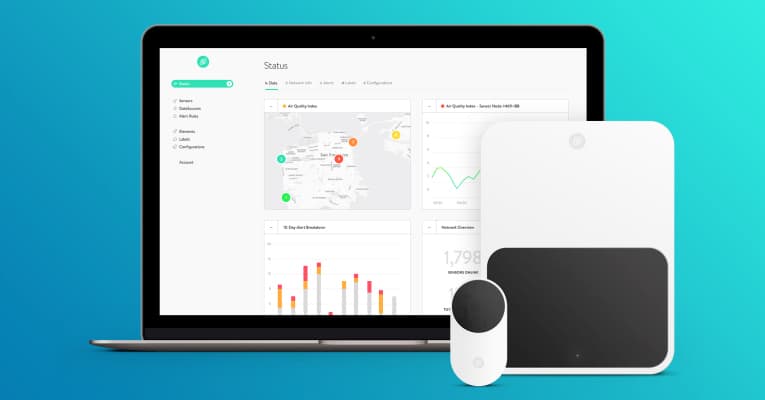
The product features out-of-the-box integrations with larger Internet of Things service providers like AWS IoT Core, Ubidots, and TagoIO.
Cloud Provider IoT Services (AWS, Azure, Google)
Tech giants Amazon, Microsoft, and Google also offer IoT cloud services, and what’s even more exciting is that you can merge their IoT platforms with AI capabilities provided by the same companies. That’s going to play a crucial role in your IoT app if you plan to use machine learning algorithms to analyze data.
Related: machine learning app development
IoT Testing and Monitoring Tools
Production IoT lives or dies on observability and testability. Useful names to anchor this subsection:
- Memfault — device-level observability + OTA rollouts (release health, crash logs, fleet metrics). Ideal for embedded/Linux/Android fleets.
- Datadog IoT Monitoring — unify device health, logs, and app/APM in one place; includes an IoT Agent tuned for constrained devices.
- balenaCloud — containerized fleet ops for Linux devices (provisioning, remote logs/SSH, OTA). Great for gateway-class hardware.
- Particle Cloud / OTA — integrated device management + safe OTA at fleet scale; solid for Particle-based products.
- HiveMQ Control Center — broker-level KPIs (client sessions, publish rates, queued/retained messages) for MQTT estates.
- EMQX Dashboard + Prometheus/Grafana — broker monitoring with native dashboard, REST/system topics, and Prometheus/Grafana hooks.
- MQTTX (by EMQ) — fast desktop/CLI MQTT client for protocol testing, payload inspection, and scripted scenarios.
- Security add-ons (cloud-native): AWS IoT Device Defender and Microsoft Defender for IoT (via Azure IoT) for policy audits, anomaly detection, and alerting.
IoT Application Development Cost Analysis
After delivering more than a dozen IoT apps, I can say that the price range for building these solutions may vary significantly. An MVP IoT app will likely require a $60,000 budget, and a full-fledged product may end up costing around $180,000.
The cost of developing an IoT app depends on what components the product will include:
- Mobile apps
- Web application with analytics
- Admin panel for managing devices
Another huge factor in app development costs is the use of an out-of-the-box IoT platform vs. custom back-end development.
Cost Factors in IoT Development
Think in systems, not screens—the bill follows complexity across layers:
- Device complexity: custom firmware, sensors, battery life targets, OTA requirements, certifications (FCC/CE).
- Connectivity matrix: BLE/Zigbee vs LoRaWAN/NB-IoT/LTE-M; gateways, SIM/data plans, private APN/VPN.
- Edge vs cloud split: on-device inference, buffering, and rules vs cloud ingestion, storage tiers, analytics.
- Data ops & security: schema/versioning, encryption, IAM, audit logs, SBOMs, pen testing.
- Integrations & workflows: EHR/ERP/CRM, payment flows, role-based access, alerts/automations.
- Quality & tooling: hardware-in-the-loop benches, test fixtures, broker/protocol testing, monitoring.
- Team shape & cadence: embedded + backend + mobile/web + QA/DevOps; parallelization vs critical path.
MVP vs. Full-Scale IoT Product Costs
Scope determines spend:
MVP (~$60K)
1 hardware class, narrow workflow, basic mobile/web, cloud ingest + dashboards, light ops, staged OTA. Goal: validate problem/fit and latency/reliability in a small pilot.
Full-scale (~$180K)
multiple device SKUs/regions, advanced analytics, role-based workflows, CI/CD for firmware + apps, observability, compliance hardening, support runbooks. Goal: reliable fleet operations and measurable business outcomes.
Rule of thumb: if it touches identity/OTA/safety/compliance, budget for doing it right—those lines protect your future velocity.
Hardware and Infrastructure Expenses
Your TCO isn’t just code:
- BoM & fixtures: dev kits, prototypes, enclosures, test jigs; per-unit BoM for pilot vs production.
- Certifications: radio/safety pre-compliance, formal FCC/CE where required.
- Connectivity: SIM plans or LPWAN gateways, network management, failover.
- Cloud & broker: ingest (messages/sec), stream processing, hot/warm/cold storage, egress, backups.
- Edge compute: gateway devices or on-prem nodes for inference and buffering.
Ongoing Maintenance and Scaling Costs
Post-launch is a real line item:
- Fleet ops: monitoring, incident response, SLOs (connect rate, OTA success), firmware rotations.
- Security upkeep: CVE tracking, key/cert rotation, audit retention, periodic pen tests.
- Product iteration: new integrations, UI/UX updates, model retraining (if using AI), data pipeline evolution.
- Hardware lifecycle: replacement rates, RMA handling, accessory/charger attrition.
IoT Development ROI Calculation
Decisions land when ROI is explicit. Use simple math and operational KPIs:
ROI = (Annual Benefits − Annual Costs) ÷ Annual Costs
Where benefits = cost reductions (e.g., fewer truck rolls, lower downtime, reduced manual triage) + new revenue (e.g., premium features, service contracts).
Example: If connected monitoring cuts field visits by 40/month at $250 each and reduces unplanned downtime by 10 hours/month at $400/hour, annualized benefit ≈ $(40×250 + 10×400)×12 = $168,000. If annualized costs (cloud + connectivity + support + amortized build) are $112,000, ROI ≈ (168k−112k)/112k ≈ 50%, payback ~24 months if the initial build is capitalized.
Make it defensible: pick 2–3 KPIs (e.g., MTBF, adherence %, first-pass yield, days-to-install), set baselines during pilot, and commit to quarterly deltas. If the numbers don’t move, neither should the roadmap.
Future of IoT Application Development
5G Impact on IoT Applications
5G isn’t about headline speed; it’s about determinism. Ultra-reliable low-latency comms make near-real-time control loops viable at city scale. Design for network slicing and QoS early, or you’ll ship a 4G app with a 5G bill.
AI and Machine Learning Integration Trends
AI has moved from “phase two” to “why we’re doing this at all.” Expect smaller, task-specific models; feature stores at the edge; and human-in-the-loop tooling for exceptions. Your MLOps must understand fleets, not just datasets.
Edge AI for IoT Devices
Run lightweight inference on-device; ship features upstream, not raw streams. The winners: sparse models, robust OTA for models, and graceful degradation—useful offline, smarter online.
Quantum Computing Applications in IoT
Near-term reality: quantum-inspired optimization helps routing, scheduling, and anomaly search. Mid-term risk: post-quantum cryptography—plan migration paths (keys, certs, firmware signing) now, not later.
Sustainable IoT Development Practices
Green is ops, not PR. Cut data egress, right-size models, adopt duty-cycling, and prefer repairable hardware. Measure carbon right next to latency and cost; sustainability is just performance with a longer horizon.
IoT Development Methodologies and Best Practices
Agile Development for IoT Projects
Treat each sprint as a thin, end-to-end slice: device → edge → cloud → app. Your definition of done is a measured outcome (e.g., “p95 command round-trip ≤ 250 ms in a hallway pilot”), not a pile of closed tickets.
- Split backlog by capabilities (measure, decide, act), not by “mobile/firmware/backend.”
- Demo with real hardware in hostile conditions (bad Wi-Fi, dead batteries), not just simulators.
- Lock a change window for firmware right before sprint review to keep demos stable.
DevOps Practices for IoT Applications
Ops starts at commit, not at go-live. Keep infrastructure, broker topics, device policies, and OTA waves in version control so the whole fleet is reproducible on demand. Maintain a single source of truth for fleet configuration—certificate lifetimes, topic ACLs, rollout cohorts—and review it like code.
Define observability budgets alongside features (what you’ll log, sample, and retain, and what it costs) so telemetry doesn’t quietly eat your margins.
Finally, treat device identity as a lifecycle: bootstrap with short-lived credentials, rotate to long-lived identities on first join, and schedule regular rotations; this prevents “forever credentials” from becoming forever incidents.
Continuous Integration/Deployment for IoT
You have two lanes: fast CI/CD for apps/services, and staged OTA for firmware/models. Design them to talk to each other.
- Gate merges on contract tests (schemas, topics, message shapes).
- Use progressive delivery: 1% canary → 10% cohort → fleet, with health checks and auto-rollback.
- Sign everything (artifacts, configs, models). Devices refuse unsigned updates—no exceptions.
IoT Testing Strategies and Automation
Automate the physics and the protocols—your test matrix should break things the way production will.
- Hardware-in-the-loop rigs that press buttons, drain batteries, and flip sensors.
- Network chaos (jitter, drops, reordering, captive portals) to assert backoff and idempotency.
- Soak tests running days to surface memory leaks, clock drift, and OTA edge cases.
Performance Optimization for IoT Systems
Performance = latency, reliability, and cost per useful decision. Start by budgeting your end-to-end latency and enforcing it across device, broker, and backend services; nothing hides a busted control loop like a fast dashboard. Treat storage by temperature—hot for real-time decisioning, warm for recent analytics, cold for compliance/archive—and move data “down in temperature” on a schedule. Keep a small public scoreboard (connect success %, OTA success %, p95 command RTT, $/device/month) and make roadmap decisions against it.
- Push cheap computation to the edge (filtering, simple rules) and ship aggregates upstream.
- Batch telemetry where acceptable; send commands individually with strict timeouts.
- Profile the wire regularly—packet captures will reveal issues dashboards miss.
IoT Integration Strategies
API Development for IoT Applications
Design APIs around capabilities (measure, configure, command) rather than individual devices. Keep telemetry event-driven and asynchronous; keep commands idempotent with server timestamps to defeat clock drift. Version schemas as first-class artifacts—breaking changes travel slower than firmware, so deprecate gracefully. Finally, separate “who can do what” (RBAC/ABAC) from transport details; you’ll change brokers or gateways long before you change your authorization model.
Third-Party Service Integration
Assume every external service will be slow, bursty, and occasionally down. Wrap vendors with adapters that: (1) translate to your internal data contract, (2) add retries with jittered backoff, and (3) expose circuit-breaker states so the UI can degrade gracefully. Mirror the minimal critical data you need to operate during outages (think: last known configuration, recent alerts). For healthcare/regulated flows, pin vendor versions and log all request/response pairs to an audit stream—future you will thank you.
Legacy System Integration with IoT
Don’t forklift-upgrade a functioning legacy system; wrap it. Put a thin translation layer next to the legacy app that maps its data model to your event schema (units, time zones, device IDs). Start with the smallest viable handshake—auth, a single telemetry path, one control message—prove reliability, then expand. Preserve provenance on every transformed record so you can trace anomalies back to the original source without guesswork.
Cross-Platform IoT Development
Share the core; specialize the edges. Keep domain logic (parsing, validation, rules) in portable libraries used by mobile, web, and services; let each UI focus on accessibility and workflow. For device apps, hide platform specifics (BLE permissions, background policies, push channels) behind interfaces and enforce parity with contract tests, not hope. If you’re shipping on multiple OSes, align your offline models so features behave identically with or without connectivity.
IoT Standards and Interoperability
Interoperability is a product feature—budget for it. Pick standards that reduce friction in your domain and implement them properly, not performatively:
- Consumer: Matter/Thread for home ecosystems; test in mixed-vendor networks, not just lab pairs.
- Industrial: OPC UA and IEC 62443 alignment so plants don’t treat you as a bolt-on risk.
- Data exchange: Async events (MQTT topic conventions), typed payloads with semantic units, and explicit versioning.
Publish your data contracts, validate at the edge, and run conformance tests in CI. If integration is easy on day one and still easy on day 400, you did it right.
How to Develop IoT Applications with Topflight
We’ve worked on a variety of IoT applications. Here are a few compelling examples.
JOOVV. Type: customer-facing IoT medical app
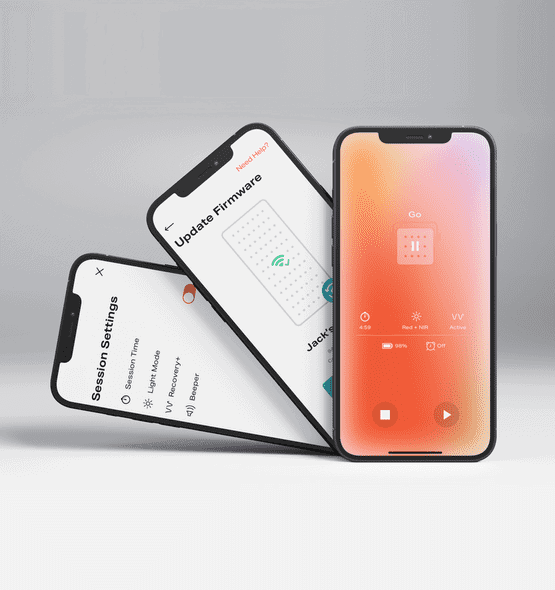 JOOVV is a light therapy app that works with red and infrared LED light therapy devices. Customers use the app to control the devices and schedule their therapy sessions. In addition to mobile apps for iPhone and Android, we also built a web portal to let the company:
- Track app usage metrics
- Manage users and in-app notifications
- Sync user data with a CRM
- Administer firmware updates
Read more in the JOOVV case study.
Southwire. Type: surge protection monitoring app
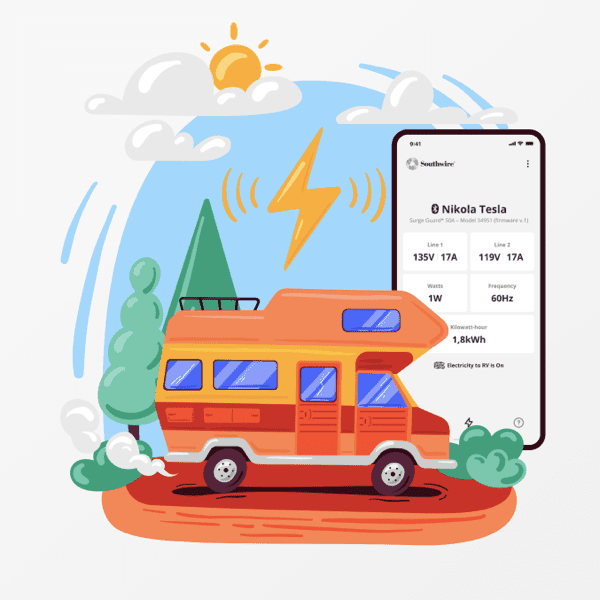
Southwire developed an IoT-enabled solution for consumers to control and monitor their surge protection devices. Topflight created the mobile apps that allow users to remotely check device status, receive real-time alerts for power surges, and optimize energy management. These apps ensure seamless connectivity and empower users to safeguard their home electronics efficiently.
Read more in the Southwire case study.
iFaint. Type: customer-facing IoT app
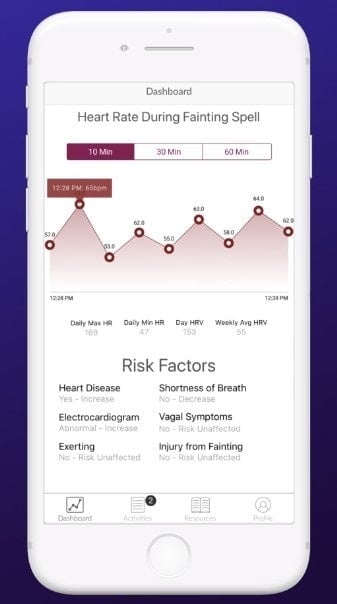
We built a mobile application for Stanford’s medical study on fainting spells. The mobile app connects to a heart-rate tracking sensor and visualizes gathered info, also providing feedback on the patient’s symptoms.
Read more in the iFaint case study.
[This blog was originally published in July 2021 and has been updated for more recent content]
Frequently Asked Questions
How long does it take to develop an IoT app?
One-two months for an MVP; three-four months for a market-ready product.
If I choose to go with an off-the-shelf IoT platform for creating the back end of my IoT application, will I be able to make changes to it?
Yes; however, you may be locked into using specific hardware. The software is customizable for the most part.
What's the best protocol to exchange data between smart devices and the system?
BLE or LoRaWAn.
Do you have experience developing a complete IoT platform from scratch, including mobile apps and server data-processing side, etc?
Yes.
How about mobile app design frameworks? You haven't said a word about them and I heard that's important in app development.
es, that’s become a common practice on many IoT app development projects.
Can I use cross-platform app development tools like React Native to develop IoT apps faster?
No, these are free mobile application development frameworks.