

Most lists of top healthcare app development companies read like someone sorted Clutch by “highest rating” and hit publish. Congrats: you now have 37 “best” options and zero confidence you won’t pick the team that panics the first time an EHR integration, PHI boundary, or audit log shows up.
This post is built for the real moment buyers face in 2026: you’re not “starting from scratch.” You’re staring at a half-working prototype (sometimes vibe-coded, sometimes a graveyard of Figma screens), and you need a partner who can productionize, securitize, and maintain it without rewriting everything twice.
So we’ll rank companies the way a skeptical healthcare operator would: public healthcare case studies, compliance receipts (not slogans), mobile execution, integration experience (EHR/HL7/FHIR realities), long-term support, and honest positioning on what they’re actually good at.
If you want a shortlist you can act on — not a directory page cosplay — keep reading.
Key Takeaways
- Treat “best” lists as a starting point, not a decision. Shortlist vendors using proof: public healthcare case studies, integration maturity (EHR/HL7/FHIR), and operational readiness (auditability + support), not just ratings.
- In 2026, the core buyer problem is prototype-to-production: hardening security, PHI boundaries, and maintainability—especially when the “prototype” was vibe-coded or scope-shifted.
- Match the partner to the use case (telehealth, RPM, eRx, EHR access, clinical automation, mental health). The wrong fit is what causes rewrites—not “bad developers.”
Table of Contents
- Ranking Criteria: How We Selected The Best Healthcare App Development Companies
- Shortlist Fast: 12 Questions That Expose a Pretend-Healthcare Shop
- Top Healthcare Mobile App Development Companies (2026)
- Healthcare App Use Cases These Development Companies Deliver
- How to Choose the Right One Among Top Healthcare App Development Companies
Ranking Criteria: How We Selected The Best Healthcare App Development Companies
Before we name names, a quick transparency note: this isn’t a pay-to-play list, and we didn’t include anyone who only claims healthcare expertise on a services page. Every company below has public healthcare case studies (or clearly documented healthcare work), plus enough signal that they can operate in regulated environments without learning HIPAA/GDPR on your budget.
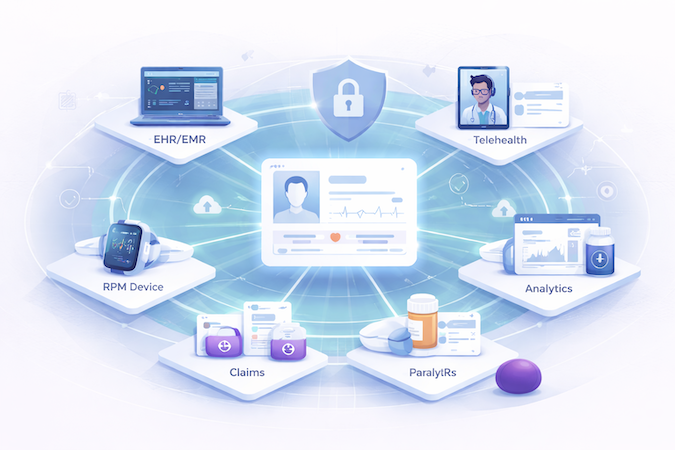
We also filtered for US-based / US-operating teams (US HQ preferred, but strong US delivery presence is acceptable), because “timezone roulette” becomes expensive once you add clinicians, integrations, and compliance stakeholders. If you’re evaluating a healthcare app development company, these are the criteria that will save you from the “looks great on a list, collapses in delivery” problem.
Healthcare Case Studies
We prioritized evidence over adjectives:
- Named healthcare clients or detailed case studies (not “we helped a major healthcare org” with zero specifics).
- Proof they’ve shipped production healthcare solutions, not just a wellness app with a heart icon.
- Extra credit for harder categories: telemedicine platforms, remote patient monitoring, EHR/EMR-connected workflows, and anything involving patient data handoffs.
Compliance & Certifications
We’re not awarding points for “HIPAA-compliant” in a hero banner. We looked for signs they can execute in regulated environments:
- Clear approach to access control, audit logs, encryption, and third-party vendor risk.
- Willingness to discuss BAAs, incident response, and security practices (even at a high level).
- Awareness of GDPR implications if the product touches EU users.
Tech Stack & Mobile Expertise
Healthcare apps fail in boring ways: brittle releases, unreliable sync, slow UIs, messy offline behavior. We screened for:
- Real mobile engineering depth (iOS/Android; cross-platform when appropriate).
- Backend maturity (APIs, auth, data modeling, observability).
- Practical UI/UX capability for patient engagement and clinician workflows (different users, different stakes).
Telehealth/EHR Integrations
Integrations are where “we can build an app” shops tap out:
- Demonstrated experience with EHR/EMR ecosystems and healthcare data exchange patterns (HL7/FHIR, middleware, interface engines).
- Comfort talking about data mapping, permissions, and “source of truth” without hand-waving.
Regulatory Knowledge
We favored teams that don’t treat healthcare as one compliance checkbox:
- Understanding how HIPAA and GDPR differ in practice, plus adjacent expectations (risk assessments, vendor oversight, auditability).
- Ability to design for regulatory realities from day one, not bolt them on in month six.
Support & Long-term Maintenance
A healthcare app doesn’t “finish” at launch:
- Clear post-launch support model, monitoring, release cadence, and ownership boundaries.
- Ability to evolve the product without triggering a rewrite every time requirements shift.
Pricing Transparency
We kept pricing qualitative, but scored vendors on whether they:
- Explain how they price (discovery, team mix, milestones, change control).
- Set realistic expectations on timelines and tradeoffs (no “90 days to an EHR-integrated platform,” please).
Client Testimonials
Directories and reviews can help, but we didn’t treat star ratings as truth:
- Consistency of feedback (communication, delivery, accountability).
- Healthcare-specific signals (domain understanding, compliance posture, integration experience).
Scoring approach (simple, repeatable):
- Case studies (25)
- Compliance & security maturity (20)
- Mobile + UX delivery strength (15)
- Integrations (15)
- Regulatory fluency (10)
- Support & maintenance (10)
- Pricing clarity (5)
Shortlist Fast: 12 Questions That Expose a Pretend-Healthcare Shop
Most “rankings” pages don’t help you choose. They help you scroll. If you’re comparing top healthcare application development companies, this is the fastest way to separate teams that understand regulated delivery from teams that just discovered the word “HIPAA” yesterday.
- Show me one public healthcare case study you’re proud of — and one that was painful. What went wrong?
Real teams can describe tradeoffs, mistakes, and fixes without hiding behind NDA theater. - Where does PHI live in your architecture, and what never touches PHI?
If they can’t explain data boundaries clearly, expect accidental exposure through analytics, logs, or “temporary” shortcuts. - What’s your default rule for third-party SDKs in healthcare apps?
Good answers include “minimum necessary,” vendor review, and strict controls on what gets instrumented. - Walk me through your access control model. Who can see what — and how does that evolve without breaking everything?
Permissions always drift. If they don’t design for it, you’ll rebuild when role #6 appears (“one more admin type, promise”). - What does your audit trail cover?
Not “we log stuff.” You want: access events, changes to records, critical actions, and who approved what. - Give me a real integration example: what systems, what data, what broke, and how you tested it.
The word “EHR” is cheap. The details aren’t. Look for calm explanations of mapping, identity matching, retries, and failure handling. - How do you handle “source of truth” conflicts?
If patient data changes in two places, what wins, and how do you prevent silent corruption? - How do you design UX differently for patients vs clinicians?
Patients need clarity and reassurance. Clinicians need speed, predictability, and fewer clicks. If their portfolio looks like the same UI wearing two different outfits, beware. - What’s your plan for reliability: monitoring, alerting, and incident response?
A healthcare app isn’t “done” at go-live. If they can’t describe on-call expectations and what they monitor, you’ll own the chaos. - What do you consider “MVP” in healthcare — and what’s explicitly out of scope?
This is where you learn if they control scope or let it control them. - What’s your security baseline for mobile + backend?
Listen for practical fundamentals: encryption in transit/at rest, secrets management, secure auth, and sensible environments—not vague “enterprise-grade” talk. - How do you keep prototypes from becoming production by accident?
In 2026, everyone has a prototype. The winners are the teams who can harden it into something maintainable without ripping it apart.
If a company gives clear, specific answers to these questions (with receipts), they’re probably worth a deeper conversation. If you get buzzwords, evasiveness, or “we’ll figure it out later,” that’s your cue to keep scrolling—just not on their proposal.
Top Healthcare Mobile App Development Companies (2026)
Here’s a quick side-by-side snapshot of the 11 firms—use it to shortlist fast, then read the full profiles for context on fit, proof, and tradeoffs.
| Company | Best for | Proof (public examples) | Integration depth | Compliance signal | Pricing (qual.) |
| Topflight Apps | AI + EHR/integration complexity; prototype → production | Cedars-Sinai, Cleveland Clinic, Stanford, Merck, Medable; GaleAI, AlgoRX | High (EHR/API, FHIR/HL7 patterns) | HIPAA-focused; compliance engineers | Mid–high |
| Sidebench | Product studio for evolving workflows | Diathrive Health, Catasys, INDHA Health | Medium | Verify “receipts” in discovery | Mid–high |
| ArcTouch (AKQA) | PBM/member apps + accessibility | Magellan Rx, Prime Therapeutics | Medium | HIPAA claim on Magellan Rx case | Mid–high |
| BlueLabel | Patient-facing mobile; chronic-care products | Mayo Clinic; Sugarmate (Tandem) | Medium | Verify security/compliance ops | Mid–high |
| Fueled (10up) | Digital health platform/website + CMS | Vida Health | Low–medium | Not enough PHI proof from case | Mid–high |
| Zco | Patient apps + program apps | mindLAMP; SMI Adviser; CMC Connect | Medium | Markets HIPAA capability | Mid |
| Softeq | IoMT/RPM + devices + ML PoCs | Viit Health; Veriskin | High (device/IoT + data) | Regulated frameworks exposure | Mid–high |
| Chetu | Big delivery bench; system workflows | DrOrdrz; OSIS | Medium–high | HIPAA-marketed; validate how | Often cost-efficient at scale |
| ScienceSoft | Telehealth/mental health MVPs + support | Telehealth + iOS telemed MVP examples; Clutch client list | Medium–high | HIPAA positioning + cases | Mid |
| EPAM | Enterprise scale + governance + long-term ops | MSKCC; NCPC; Altera | High | “Safeguard medical info” focus | High |
| Cognizant | Enterprise programs; rollout + ops | Sensyne Health | Medium | Validate compliance controls | High |
Company #1 — Topflight Apps
Overview & Specialties
Topflight is a US-based digital health product team that leans into the messy stuff most agencies avoid: regulated data, clinical workflows, and “we already have a prototype… now make it real.” Their public positioning is explicit about building connected health products “powered by AI where it matters,” with dedicated lanes for multi-modal AI (including Generative AI, computer vision, etc.), EHR integration, and rapid prototyping.
Notable Healthcare Clients
Topflight publicly lists healthcare clients including Cedars-Sinai, Cleveland Clinic, Stanford Medicine, Merck, and Medable.
Key Solutions
- AI where it creates leverage (not demos): clinical NLP / OCR workflows and “AI inside the product” delivery (see GaleAI case study for a full AI medical coding platform).
- Health data integration & interoperability: integration-heavy builds, including EHR/API connectivity (GaleAI references integrations via SMART on FHIR plus Athenahealth/Epic APIs and Mirth Connect in the delivered stack).
- Product engineering end-to-end: mobile + web delivery, plus the operational plumbing (admin, analytics, workflows) needed to ship a real system (e.g., AlgoRX’s eRx + telehealth commerce flow with provider workflows and pharmacy integrations).
Compliance Capabilities
Topflight explicitly positions its healthcare delivery as secure and HIPAA-aligned, including experience with HL7/FHIR-oriented systems on their healthcare services page.
In case-study proof, Topflight describes HIPAA-oriented safeguards and PHI handling patterns (e.g., Allheartz security highlights like encryption + secure transport; GaleAI calls out de-identification + encryption + “SOC-2 principles” as part of its compliance posture).
Best for
- Teams with AI + integration complexity (computer vision → classical ML → LLM integration) who still need auditability and clean data boundaries.
- Products where EHR software development isn’t a “phase 2” fantasy, but part of how the workflow actually works.
- Founders who want rapid prototyping that results in working software, then a credible path to production hardening (Topflight’s “built in 2 weeks” rapid prototype offer is public).
Pricing
Mid-to-high range (consistent with integration-heavy, compliance-aware healthcare builds rather than commodity app work).
Company #2 — Sidebench
Overview & Specialties
Sidebench positions itself as a product-focused software studio with a visible healthcare footprint, spanning mobile and web builds plus UX. Public materials and third-party reviews consistently describe them as strong on collaboration and end-to-end delivery (design through engineering), which is usually what you want when the “requirements” are still moving targets.
Notable Healthcare Clients
From their public case study catalog, Sidebench highlights multiple health-related builds, including Diathrive Health, Catasys, and INDHA Health. (All of these are public references, not anonymized “stealth healthcare startup” hand-waving.)
Key Solutions
Based on verified review writeups, Sidebench has delivered health-adjacent platforms with practical workflow features like secure portals, messaging, scheduling/calendaring, and document upload—the kind of “boring infrastructure” that determines whether patient engagement and care workflows actually stick.
Compliance Capabilities
Sidebench’s public materials don’t spell out operational compliance details (BAAs, audit logging, PHI boundary rules). Validate those in discovery. So the right way to evaluate them is to ask direct questions: BAA readiness, access control model, audit trail scope, third-party SDK policy, and incident response expectations.
Best for
Teams that want a product-studio partner (UX + engineering) for a healthcare build where workflows and scope are still evolving—but still need solid execution discipline.
Pricing
Clutch reviews indicate Sidebench commonly lands in mid-to-high budget ranges (with examples spanning from hundreds of thousands into seven figures depending on scope), which aligns with “product studio” positioning rather than bargain dev shop economics.
Company #3 — ArcTouch
Overview & Specialties
ArcTouch (an AKQA studio) is a product design + development agency with demonstrated healthcare-adjacent delivery, especially around pharmacy benefits and member-facing experiences. They’re also unusually loud (in a good way) about accessibility—not as a checkbox, but as a design and engineering constraint that affects real user journeys.
Notable Healthcare Clients
- Magellan Rx (member-facing pharmacy benefits app)
- Prime Therapeutics (post–Magellan Rx merger rebrand + new site)
Key Solutions
ArcTouch’s most relevant healthcare proof is concrete and specific (i.e., not “we build digital health solutions” fluff):
- Magellan Rx app (iOS + Android): delivered as a cross-platform Flutter build focused on pharmacy benefit “self-service” tasks—transparent prescription pricing, medication information, prescription history, and pickup vs home delivery comparison.
- Accessibility as a first-class requirement: the Magellan Rx case study calls out screen reader support and font scaling, and the project highlights include inclusive design/development plus biometric authentication.
- Prime Therapeutics website: designed a responsive site after Prime’s merger/rebrand, with an “accessible design system” and explicit claims of WCAG 2.2 AA + Section 508 alignment, plus advanced search/filtering and a scalable CMS for content-heavy orgs.
Compliance Capabilities
ArcTouch’s Magellan Rx case study explicitly describes the app as “HIPAA-compliant and secure.” That’s a meaningful signal for at least one real-world build—but it’s still a single project claim, not a full view into their standard operating model. In evaluation, I’d ask them to walk through how they handle PHI boundaries, logging/auditability, and third-party SDK policy on mobile.
Best for
Healthcare organizations building member/patient-facing experiences (especially PBM/pharmacy benefit workflows) where accessibility and UX quality are non-negotiable, and where a cross-platform approach (Flutter) is acceptable.
Pricing
Qualitatively: mid-to-high. Directionally, Clutch shows ArcTouch engagements that reach seven figures (example review lists a $1M–$9.99M project), and review highlights emphasize strong project management/communication—with a recurring caution about occasional resource retention affecting continuity.
Company #4 — BlueLabel
Overview & Specialties
BlueLabel (Blue Label Labs) is a New York product studio that builds mobile apps and digital products end-to-end. They’re not “healthcare-only,” but they do have a visible healthcare practice area and multiple public healthcare signals across their site and third-party reviews.
Notable Healthcare Clients
- Mayo Clinic is referenced directly on BlueLabel’s healthcare page (addiction care–related work).
- Sugarmate is listed in BlueLabel’s Work portfolio, and BlueLabel notes it was acquired by Tandem Diabetes Care.
Key Solutions
- Chronic condition / diabetes product work: BlueLabel’s portfolio includes Sugarmate with mobile platform tags, and their own description ties it to real-world diabetes management usage.
- Healthcare product delivery beyond “pretty UI”: their healthcare page positions them around outcomes + patient-facing experiences (again: marketing copy, but at least it’s a clearly owned vertical, not a one-off mention).
Compliance Capabilities
BlueLabel’s public pages don’t lay out “compliance receipts” (e.g., audit logging scope, PHI boundary rules, third-party SDK policy). So treat them as healthcare-experienced rather than automatically “HIPAA experts,” and verify the operational stuff during selection (security posture, privacy-by-design, access control model, incident response expectations).
Best for
Teams building a patient-facing mobile product (especially chronic-care / engagement apps) who want a product studio that can run discovery → design → build with strong PM hygiene.
Pricing
Qualitatively mid-to-high. Clutch’s BlueLabel profile shows the most common project size is $50k–$199k (based on their reviewed sample), with reported projects ranging from $25k to $1M+.
Company #5 — Fueled
Overview & Specialties
Fueled is a digital product agency known for design-led web and app delivery, with a strong emphasis on “treat the site like a product” (research, stakeholder alignment, iteration—not just a reskin). In 2023, Fueled merged with 10up to form a larger combined digital services org, which matters if you’re worried about long-term support and content-heavy platforms at scale.
Notable Healthcare Clients
- Vida Health — Fueled published a detailed case study on redesigning Vida’s website experience and CMS.
Key Solutions
Fueled’s healthcare proof here is not a “clinical workflow engine” case study—it’s a digital health platform/website case study. But it’s still relevant if your growth funnel, employer-facing story, and content architecture are central to how you sell and onboard.
From the Vida Health case study, Fueled describes:
- Research-driven discovery to align stakeholders and clarify what the site needs to do (not just how it should look).
- A rebuilt web experience that deliberately serves two different audiences (enterprise vs individuals) with clearer paths and content structure.
- A WordPress CMS implementation designed for ongoing ownership by the client team (so marketing isn’t filing tickets to ship basic updates).
Compliance Capabilities
This proof is CMS + web experience, not PHI-heavy workflows. If you need HIPAA-grade app delivery, ask for healthcare app case studies with PHI boundaries, audit logs, and BAA readiness. If compliance is central to your build, you’d want to validate how Fueled handles privacy-by-design, analytics/SDK governance, identity and access, and security reviews on regulated products (not just marketing sites).
Best for
Digital health companies that need a high-performing product website / platform experience (often enterprise + consumer paths), strong discovery, and a CMS that won’t collapse the minute your content strategy evolves.
Pricing
Qualitatively: mid-to-high. Clutch lists Fueled’s most common project size as $200,000–$999,999 (based on verified reviews on their profile).
Company #6 — Zco Corporation
Overview & Specialties
Zco is a long-running US app and custom software shop (founded 1989) with a dedicated healthcare practice page that’s unusually specific for an agency: they talk about encryption, database/API interoperability, and even mention REDCap as a data-safety integration pattern (not a generic “we take security seriously” line).
Notable Healthcare Clients
Zco publicly highlights multiple healthcare/medical client apps, including:
- mindLAMP (measurement-based care / neuropsychiatric research app)
- SMI Adviser (American Psychiatric Association program; clinician support portal + app)
- Catholic Medical Center (CMC Connect) (patient-facing mobile app)
Key Solutions
- Patient access + “hospital front door” apps: CMC Connect includes location navigation plus practical workflows like appointment scheduling and class/event registration (as described in their case study).
- Mental health / measurement-based care tooling: their healthcare page spotlights mindLAMP and SMI Adviser as medical/clinical apps running on iOS and Android.
- Integration-first builds: their healthcare services page explicitly emphasizes connecting to existing databases and medical APIs (useful if you’re dealing with legacy systems rather than greenfield builds).
Compliance Capabilities
Zco explicitly markets “HIPAA Compliant Software” on its healthcare services page and ties it to security requirements and encryption methods. That’s a claim—not a full audit trail—so in selection you’d still validate specifics (PHI boundaries, audit logs, third-party SDK policy, incident response).
Best for
Organizations that want a sizeable, established team for patient-facing apps and healthcare program apps (including mental health adjacent), where integration and “enterprise hygiene” matter as much as UI polish.
Pricing
Qualitatively mid-range relative to US agencies. On Clutch: minimum project size $10,000+, and most common project size $50,000–$199,999 (based on 42 reviews).
Company #7 — Softeq
Overview & Specialties
Softeq is a Houston-headquartered product engineering firm (founded in 1997) that’s strongest when a healthcare “app” is really a system: software + hardware/IoT + data pipelines + AI/ML. Their own healthcare industry page leans into telecare, ML-assisted medical imaging, and workflow tools for hospitals and digital health startups.
Notable Healthcare Clients
Softeq has multiple public healthcare/med-tech case studies, including:
- Viit Health — non-invasive biomarker monitoring (glucose, blood pressure, SpO₂) with a rapid prototype for near-infrared spectroscopy + on-device ML.
- Veriskin (medical device company) — handheld skin cancer screening device PoC/firmware work to test viability and build core device components.
Key Solutions
- Rapid med-tech prototyping that’s actually instrumented: For Viit Health, Softeq describes building a working PoC with hardware integration and on-device ML, explicitly aimed at validating feasibility and supporting early clinical readiness.
- Medical device firmware + embedded systems: For Veriskin, they describe delivering PoC/firmware for a Wi-Fi enabled handheld device, including device drivers/BSP work and secure login (SSH).
- IoMT (healthcare IoT) stack capability: Their IoMT page explicitly names navigating security/regulatory frameworks like FDA, HITRUST, HIPAA, HL7, DICOM, and ISO 13485:2016 when building healthcare devices + supporting software.
Compliance Capabilities
They don’t present a single “we are compliant” badge as proof. Instead, the stronger signal is where their healthcare work lives: connected devices, clinical readiness, and frameworks like HIPAA/HL7/DICOM/ISO 13485 referenced in their IoMT practice. That said, you should still validate specifics (PHI boundaries, audit logging, incident response, third-party SDK policy) for your exact product.
Best for
Healthcare teams building device-adjacent products (RPM/IoMT), med-tech proof-of-concepts headed toward trials, or anything where embedded + mobile + AI need to behave like one coherent system.
Pricing
Qualitatively mid-to-high. Clutch notes projects ranging from $5,000 to $300,000+ and summarizes verified reviews as generally positive on flexibility/quality and on-time delivery (with some feedback that costs can be high when scaling fast).
Company #8 — Chetu
Overview & Specialties
Chetu is a Florida-headquartered, large-scale custom software provider (Clutch lists 1,000–9,999 employees, founded 2000). The reason they make a healthcare shortlist isn’t “boutique craft” — it’s breadth and throughput. They publish a lot of healthcare work publicly, which makes them easier to validate than firms that hide behind “stealth startup” fog.
Notable Healthcare Clients
Chetu’s public healthcare case studies include:
- DrOrdrz (secure web app designed to bridge communication between EMR systems)
- OSIS (analytics/reporting tool supporting federally-qualified health centers)
Key Solutions
- Interoperability-focused web platforms: In the DrOrdrz case study, Chetu describes building a device-agnostic, HIPAA-compliant MVC web application to support exchange of electronic medical records and physician-signed documents, with a specific stack called out (SQL Server, .NET Framework, Entity Framework, and tools including Twilio).
- Healthcare analytics modernization: In the OSIS case study, they describe a toolchain for exporting/importing reports between systems that evolved into an integrated analytics platform; they also cite performance improvement (“20–30 seconds to load” → “loads instantly”).
Compliance Capabilities
Chetu explicitly markets HIPAA-compliant development and publishes HIPAA-labeled healthcare pages/case studies. That’s a useful signal — but you should still validate “how” (PHI boundaries, audit logging scope, access controls, third-party SDK rules, incident response). In other words: don’t accept “HIPAA-compliant” as a vibes-based adjective; make them show process.
Best for
Organizations that need a large delivery bench for healthcare platforms (especially system-to-system workflows like EMR/records exchange or healthcare analytics), and that can run a disciplined vendor-management process to keep scope, quality, and communication tight.
Pricing
Qualitatively: often positioned as cost-efficient at scale. On Clutch: minimum project size $10,000+, and most common project size < $49,999 (based on 64 reviews).
Company #9 — ScienceSoft
Overview & Specialties
ScienceSoft is a McKinney, Texas–based software development and consulting firm (founded 1989) with a clearly documented healthcare track record and a lot of “systems” DNA: mobile apps, back ends, security work, and ongoing support. They’re not a boutique studio; they read more like a mature delivery org with formal governance (PMO / architecture practices) and a broad bench.
Notable Healthcare Clients
On their Clutch profile, ScienceSoft lists healthcare clients including Rivanna Medical, ScribeAmerica, and Delaware Valley Community Health.
Key Solutions
What makes ScienceSoft credible isn’t just a services page — it’s that their case studies describe real workflows and implementation constraints:
- HIPAA telehealth Android app: appointment booking + secure video conferencing, with explicit mention of integration into practice workflows and systems (EHR/EMR, RIS, LIS) and syncing patient data prior to visits.
- iOS telemedicine MVP for a mental health startup: delivered in 4 months with concrete scope (scheduling, video visits, messaging, journaling, payments), and an explicit note that HIPAA-required PHI protections were implemented (e.g., encryption + MFA called out in the case study).
Compliance Capabilities
They make explicit HIPAA positioning across their healthcare materials, and their case studies use HIPAA language in context (not just a banner claim). Still, “HIPAA-compliant” can mean anything from “we hosted it somewhere” to “we engineered real auditability.” In vendor screening, ask them to walk through: PHI boundary decisions, audit logging scope, access control model, third-party SDK policy, and incident response expectations.
Best for
Teams that want a multi-disciplinary delivery partner (mobile + backend + security) for telehealth / mental health / patient portal workflows—especially when integration and long-term support matter as much as the initial build.
Pricing
On Clutch: minimum project size $5,000+, and most common project size $50,000–$199,999 (based on 30 reviews).
Company #10 — EPAM
Overview & Specialties
EPAM is the “enterprise-grade delivery machine” on this list. If your healthcare product lives in a messy ecosystem (multiple internal systems, governance layers, long maintenance tail), EPAM’s strength is operating at that scale without treating healthcare like a cute startup vertical. Their healthcare client-work library is unusually dense, with multiple publicly accessible case studies across patient engagement, clinical decision tools, and healthcare enterprise platforms.
Notable Healthcare Clients
- Memorial Sloan Kettering Cancer Center — patient community mobile app for teenage & young adult cancer patients (public PDF case study).
- National Capital Poison Center (NCPC) — webPOISONCONTROL® poison triage app; EPAM describes a 10-year partnership and milestones like helping 1M+ users (public case study page).
- Altera Digital Health — AI/agent work using EPAM’s orchestration platform DIAL (public case study page).
Key Solutions
- Patient engagement mobile apps with moderation controls: The MSK “Lounge” app case study explicitly calls out monitoring functionality to safeguard against sharing medical information or suspicious account activity, which is a very real requirement for patient communities. (They also list the tech stack used.)
- Public-facing clinical decision/triage tooling at scale: EPAM describes maintaining and enhancing webPOISONCONTROL® over a long-term partnership, and notes a redesign in February 2025 aimed at making the experience faster/easier/clearer, plus the “1M+ users helped” milestone.
- Healthcare AI/agent delivery that ties to business outcomes: The Altera case study is framed around lowering costs and improving efficiency/customer experience via custom AI agents and supporting new product creation.
Compliance Capabilities
EPAM’s public healthcare materials show they’ve shipped products where safeguarding medical information is a first-order requirement (e.g., moderation/monitoring for patient community apps) and where decision-support tools must be trustworthy and maintained over time. That said, you should still validate the practical “compliance receipts” for your use case: PHI boundaries, audit logging scope, access control model, third-party SDK policy, and incident response workflow.
Best for
Large healthcare organizations (providers, payers, health-tech platforms) that need enterprise-scale delivery + long-term ownership, especially for patient-facing platforms and high-traffic public tools where reliability and governance matter as much as features.
Pricing
High. On Clutch: minimum project size $100,000+, and most common project size $10,000–$49,999 (based on 1 review — treat this “most common” signal as low-confidence due to sample size).
Company #11 — Cognizant
Overview & Specialties
Cognizant is a Teaneck, New Jersey–headquartered enterprise services firm that shows up when healthcare work stops being “build an app” and becomes build + integrate + operate. They’re geared for programs with multiple stakeholders, procurement constraints, and long maintenance tails—i.e., the kind of work where your biggest risk is organizational gravity, not Swift code. (Their corporate address and HQ are publicly listed.)
Notable Healthcare Clients
- Sensyne Health — Cognizant published a dedicated case study on building a COVID-era symptom monitoring mobile app with Sensyne.
Key Solutions
Cognizant’s most concrete, publicly described “app” example in this set is the Sensyne engagement:
- Built CVm-Health, a mobile symptom-tracker that lets people record and monitor COVID-19 symptoms and related risk factors.
- Included COVID testing status management and a vital signs tracker (record/store vitals), with the explicit goal that users can share the data with a medical provider to speed up care.
- The PDF version of the case study frames this as a rapid-response build during the early pandemic period (March timeframe referenced).
Compliance Capabilities
Cognizant clearly markets virtual health services (launch/scale/enhance virtual health experiences), which is relevant for regulated healthcare delivery, but these public materials don’t provide enough detail to claim specific compliance controls as standard (e.g., audit logging patterns, PHI boundary rules, third-party SDK governance). Treat compliance as something to validate in discovery: data classification, access controls, auditability, vendor risk, and incident response.
Best for
Large healthcare organizations (providers, payers, public-sector health programs) that need enterprise delivery + governance—especially where integration, rollout, and long-term operations matter as much as the first release.
Pricing
High / enterprise-tier (typically program-based delivery rather than “build an MVP for $X”).
Healthcare App Use Cases These Development Companies Deliver
When people search for the best healthcare app development companies, they’re usually not hunting for “an agency.” They’re trying to ship a specific workflow inside a regulated environment—often with legacy systems, picky stakeholders, and patient data that can’t be treated like normal app telemetry. Below are the most common use cases these teams deliver, plus what typically separates a smooth launch from a six-month rebuild.
Telemedicine & Virtual Visits
Telemedicine platforms look deceptively simple (“video + scheduling”), then reality shows up: appointment scheduling rules, clinician availability, state-by-state constraints, consent flows, and post-visit documentation. Solid teams build the boring core: secure identity, role-based access, visit context, and reliable call quality—then make the UI/UX feel effortless for patients and healthcare professionals. If your product is early, prioritize healthcare app development that proves the visit flow works end-to-end before you scale features.
Remote Patient Monitoring (RPM)
Remote patient monitoring lives or dies on data fidelity and trust. The app isn’t just charts—it’s device pairing, background sync, edge-case handling, and real time alert logic that doesn’t spam care teams into ignoring it. Strong RPM builds also think through escalation paths (who gets notified, when, and why) and protect patient data across mobile solutions, cloud pipelines, and clinician dashboards. If medical devices are involved, expect more upfront engineering rigor—and more regulatory compliance conversations.
E-prescription & Pharmacy Platforms
Pharmacy workflows are full of sharp edges: eligibility checks, formulary logic, refill timing, and integrations that are “supported” until they aren’t. Good builds design for failures (pharmacy lookup issues, network timeouts, partial data) and keep medical records and medication histories consistent across systems. The best implementations feel fast for patients, but stay auditable behind the scenes for healthcare organizations that need traceability.
Related: E-Pharmacy App Development
Fitness & Wellness Apps
This is the friendliest category—until you blend it with clinical care delivery or employer programs. The winners here nail retention mechanics (habit loops, personalization, coaching UX) without turning the experience into a guilt machine. If you’re touching health monitoring or collecting sensitive patient data, teams should treat privacy and analytics governance seriously from day one, including GDPR considerations when relevant.
Insurance & Claims Apps
Claims apps are less “mobile app” and more “workflow automation with a front end.” Users want status transparency, document upload, and fewer phone calls. Payers want accurate data, fraud controls, and integration into management systems that were built when flip phones were aspirational. This is where the best mobile app development companies for healthcare show their value: they can bridge old systems, deliver clear patient-facing UX, and keep the operational side stable and measurable.
EHR/EMR Access Apps
EHR/EMR access is rarely a single “integration.” It’s permissions, data mapping, identity matching, auditability, and making sure your app doesn’t become a PHI sprinkler. Strong teams understand the practical differences between “reading data” and “writing data,” and they design flows so clinicians trust what they see. If you’re comparing vendors, this is a good place to separate generalists from teams that behave like top healthcare software development companies—because integration maturity isn’t a vibe.
Clinical Workflow Automation
This category covers the stuff that actually saves time: intake automation, routing, task queues, documentation helpers, coding support, and internal tools that reduce clicks. The best results often come from AI driven components used narrowly and safely (summaries, extraction, classification), with guardrails and review workflows that clinicians can live with. Great delivery partners obsess over “who does what next” and build systems that don’t collapse when roles and permissions inevitably expand.
Patient Engagement Apps
Patient engagement is not “send notifications.” It’s building trust: secure messaging, education, reminders, care plans, and sensible escalation logic. The difference between okay and excellent is how well the app supports messy reality—missed appointments, incomplete forms, language and accessibility needs, and inconsistent connectivity. Look for teams that can make the patient experience humane while keeping the provider-side workload sane.
Mental Health & CBT
Mental health products require more than pretty screens: crisis-safe UX, privacy-first defaults, careful content handling, and consistency across journaling, messaging, and progress tracking. CBT-style flows work best when personalization is respectful and not creepy—especially around sensitive inputs. If this is your lane, evaluate teams with direct proof in mental health app development, because the edge cases (consent, confidentiality expectations, and trust) matter as much as the feature list.
How to Choose the Right One Among Top Healthcare App Development Companies
Picking the “right” vendor is mostly about avoiding mismatches: the wrong team can look amazing on a deck and still ship something your clinicians won’t touch—or your security team won’t approve. Use the criteria below to narrow down to a short list of app developers you can actually trust with patient care.
Domain Expertise
Healthcare experience isn’t “we built a wellness tracker once.” Ask for proof they understand real workflows for healthcare providers: intake, triage, documentation, billing touchpoints, and how the work moves between roles. A strong development partner can explain the tradeoffs they’ve made in past builds (what they simplified, what they hardened, and what they refused to ship). “Leading” shops don’t just show shiny screenshots—they show they can survive real operations.
Integration Experience
Integrations are where timelines go to die. Don’t ask “Can you integrate with an EHR?” Ask how they handle identity matching, permissions, and source-of-truth conflicts across systems. Get them to outline their integration approach in plain language, including what breaks most often and how they test it. If your product is AI powered, integrations matter even more—because the model is only as trustworthy as the data pipeline feeding it.
UX for Patients vs Clinicians
Patients need clarity, reassurance, and low-friction tasks. Clinicians need speed, predictability, and fewer clicks. If a vendor claims they do both, make them show both—separate flows, separate UI/UX priorities, and evidence they’ve designed under real clinical constraints. A good team will talk about reducing cognitive load and failure-proofing the experience, not just “modern design.”
Regulatory Fit Per Geography
Don’t treat compliance as one checkbox. US-first products still vary based on payer/provider context and the type of data you handle, and cross-border products introduce GDPR expectations that affect consent, data retention, and auditability. If you’re selecting from top HIPAA compliant app development companies for healthcare, push them beyond slogans: how do they design access controls, logging, and third-party SDK governance so compliance doesn’t collapse during iteration?
Total Cost of Ownership
The sticker price is rarely the real cost. Total cost of ownership includes monitoring, bug fix velocity, security updates, cloud spend, and the cost of changing workflows after go-live. “Cost effective” doesn’t mean cheap—it means the architecture and delivery approach won’t force a rewrite when requirements evolve. Ask vendors what they consider expensive mistakes (and how they prevent them). That answer tells you more than a rate card.
Support & Maintenance Models
The best launch is the one you can still maintain 12 months later. Get specifics: who handles incidents, what the SLA looks like, how releases are managed, and what happens when key engineers rotate off the account. If your roadmap includes HIPAA compliant app development, you also need to understand ongoing security responsibilities (dependency updates, access reviews, audits). If they can’t articulate the maintenance model, you’re buying a prototype with a countdown timer.
Time-to-market Considerations
Speed is real, but it has a price. The best healthcare mobile app development company will tell you where speed is safe (validated workflows, phased releases, reusable components) and where speed is reckless (permissions, data handling, integrations, auditability). Push for a plan that gets you to a usable version fast without turning the first release into technical debt you’ll pay for twice.
Frequently Asked Questions
What services do the top healthcare app develoment companies typically provide?
Discovery and UX, mobile + web development, backend/APIs, integrations (EHR/EMR, telehealth, devices), security/compliance engineering, testing, deployment, and post-launch support. Strong teams also help define roles/permissions, audit trails, monitoring, and change control so the product stays maintainable.
How do the top healthcare app development companies ensure HIPAA and GDPR compliance?
They design data boundaries early (what is PHI, where it lives, who can access it), enforce role-based access, encryption, and audit logging, limit third-party SDK risk, and bake privacy/security into delivery (reviews, documentation, incident response planning). For GDPR, consent/retention and user rights matter.
How much do the top healthcare app development companies charge for building a healthcare mobile app?
It varies by scope and risk: integrations, security posture, and ongoing support usually drive cost more than UI. Expect “mid-to-high” pricing for teams doing regulated workflows and EHR work; enterprise firms trend higher. Treat quotes without scope boundaries as unreliable.
How long does it usually take to launch a healthcare app?
A usable release can be fast if the workflow is narrow and integrations are limited, but timelines stretch when you add EHR/EMR connectivity, role/permission complexity, auditability, and maintenance requirements. Vendors should tell you where speed is safe vs reckless, not just promise dates.
What should I prepare before talking to a healthcare app development partner?
Bring the core workflow (who does what, in what order), user roles, data types (what counts as PHI), any integration targets, and your “must-not-fail” risks (compliance, uptime, security, timeline). The best partners will pressure-test assumptions and define scope boundaries early.