

The funding decision is behind you. What’s left is a go-live date and three service lines waiting on somebody to say what actually gets built: telestroke, tele-ICU, virtual nursing. The workforce shortage that made the case in the first place hasn’t moved.
Tele-specialty platform development starts where the board meeting ended. And here’s the rule it all sits on: a critical access hospital can meet its 24-hour emergency obligation with a physician assistant, nurse practitioner, or clinical nurse specialist on site and the physician on call.
Intermountain Healthcare matched patients 10% of the time when it first exchanged records outside its own walls. That’s the other end of the same build. These are life-critical systems running across two organizations at once, and what decides whether they hold up sits underneath the video: the routing that picks a clinician, the failover that catches a dropped session, the identity layer that recognizes the patient in both charts, and the authority the hub holds when it sees something.
How do you build a tele-specialty platform for rural hospitals?
Build it around four decisions. Licensure-aware routing resolves license, privileges, and prescribing registration per clinician per spoke. Latency and failover budgets get tiered per modality against clinical clocks like the 60-minute door-to-needle target. Patient identity starts provisional, with a reconciliation queue behind it. And the hub’s decision-making authority gets documented, since tele-ICU mortality benefit only appears where the remote team can act. Licensure and consent both vary by state, so both belong in runtime configuration rather than code.
Key takeaways:
- Ship the hub’s order-entry rights in version one. Where tele-ICU teams held decision-making authority, ICU mortality fell; limited to consultation, they showed no advantage.
- Provider routing is a licensure data model before it’s a scheduling feature. Three gates (license, privileges at that spoke, prescribing registration) are held per clinician per site, with effective dates, and they move.
- Consent is per-room, per-state, revocable state your software has to hold. Roughly a dozen jurisdictions require all-party consent, so audio is the fault line and the room’s consent status has to be queryable at runtime.
- Tier the acute path yourself, because the contract language won’t. A 95% visit-success floor is one failed visit in 20, which lands differently inside a 60-minute treatment window.
Table of contents
- What hub-and-spoke tele-specialty care actually is: one specialist hub, many rural spokes
- Telestroke and teleneurology: door-to-needle time sets your latency and failover budget
- Tele-ICU (eICU): continuous telemetry, alarm load, and command-center escalation
- Virtual nursing and virtual sitters: continuous observation turns consent and staffing into architecture
- Interstate licensure and credentialing decide who can cover which spoke
- The hub-and-spoke architecture that holds up: licensure-aware routing, low-latency video, hard failover
- The hardware layer: telepresence carts, PTZ cameras, and the peripherals clinicians actually use
- Cross-site EHR and patient identity: the same patient in two charts
- The tele-specialty platform build checklist
- Why Topflight Apps for tele-specialty platform builds
What hub-and-spoke tele-specialty care actually is: one specialist hub, many rural spokes
Four terms carry this whole model, and teams that blur them write requirements your engineers can’t act on. Worth getting straight now: the money is committed and the specification isn’t.
The hub is where the specialist is, the spoke is where the patient is
Hub-and-spoke telehealth puts the specialist in one place and the patients in many. The hub site is where that specialist sits. Each spoke site is a hospital that doesn’t have the specialty on staff and needs it anyway.
There’s a second set of names, and it follows the patient: the spoke is the originating site, because that’s where the patient is, and the hub is the distant site.
The hub-and-spoke model earns its keep on that ratio. One hub serving many spokes puts a specialist no single rural hospital could justify hiring in front of all of them. Everything hard about the build comes out of that arithmetic.

A spoke can meet its overnight obligation without a physician in the building
A critical access hospital (CAH) has to provide emergency services around the clock. Who counts as coverage is the part that matters for a platform build. Qualifying coverage can be:
- an MD or DO
- a physician assistant
- a nurse practitioner
- a clinical nurse specialist with emergency training
- a registered nurse, under temporary limited circumstances
The physician has to be on call and available on site inside 30 minutes, or 60 in qualifying frontier and remote areas, per the Rural Health Information Hub’s summary of the Conditions of Participation. Stricter state licensure law overrides all of it.
So overnight at a CAH, there may be no physician on site at all. That’s the standing condition across 1,388 critical access hospitals as of July 2026, and it’s why the platform is the only path to a specialist that exists.
Definitive Healthcare reports that critical access hospitals are also less likely than other acute hospitals to have an on-site ICU, cardiac catheterization, or designated surgical facilities.
The three modalities share the hub-and-spoke shape and little else
Same architecture, different tolerances. Latency budget, data type, bedside hardware, and who staffs the hub all shift by service line, and every shift lands somewhere in the build.
| Modality | Setting | Data type | Latency tolerance | Bedside hardware | Who staffs the hub |
|---|---|---|---|---|---|
| Telestroke and teleneurology | Spoke emergency department, local provider at the bedside | Live audio and video, plus CT read remotely | Tightest; minutes against a published door-to-needle target | Cart with a camera the hub clinician drives | Vascular neurologists on call around the clock |
| Tele-ICU | Inpatient intensive care beds, continuously | Continuous physiologic telemetry, episodic video | Continuous ingestion; alarm response in minutes | Installed monitors via a device-integration layer, plus an in-room camera | Intensivists, advanced practice providers, and critical care nurses in a central operations center |
| Virtual nursing and virtual sitting | Inpatient medical-surgical rooms; continuous observation or scheduled tasks | In-room video and audio; no physiologic feed | Loosest; seconds to minutes for observation | Fixed in-room camera and audio, sometimes added sensing | Virtual registered nurses or monitoring technicians covering many rooms at once |
The money showed up on December 29, 2025: CMS announced Rural Health Transformation Program (RHTP) awards and listed specialized hub-and-spoke models among what states plan to build. The funding and procurement side of that lives in our RHTP build-fast-and-integrate playbook.
Telestroke and teleneurology: door-to-needle time sets your latency and failover budget
Of the three modalities, telestroke platform development is the one where somebody else already published your deadline. That deadline is a treatment window, so every latency and failover choice downstream is a clinical choice.
How a telestroke consult actually runs
The whole loop happens inside one visit to the spoke’s emergency department. The local provider suspects stroke and activates the hub, CT happens at the spoke, the hub’s stroke specialist runs a live consult and reads the imaging remotely, then sends the recommendation back, per Mayo Clinic Health System.

The door-to-needle clock is published, and it isn’t yours to set
The American Heart Association’s Target: Stroke Phase III sets door-to-needle time goals of 60 minutes for at least 85% of patients treated with intravenous thrombolytics, 45 minutes for 75%, and 30 minutes for 50%.
Those are hospital quality metrics the stroke team already reports on. Whatever your platform spends getting a specialist onto the screen comes out of the same 60 minutes tPA has to be delivered inside, which puts the connect path on the clinical side of the ledger.
The exam degrades before the video does
Remote NIHSS scoring holds up in aggregate: an intraclass correlation of 0.936 against bedside scoring across 95 patients at two centers, per Saban and colleagues in Frontiers in Neurology, 2022. Item level is where it breaks. A 2025 study building a caregiver-assisted remote scale dropped four items for poor agreement over video:
- visual field
- facial palsy
- extinction and inattention
- ataxia
Remote exams also run longer, a mean of 9.70 minutes against 6.55 at the bedside in Shafqat’s 1999 work.
Every one of those four depends on what the camera is pointed at and who’s standing next to the patient. Camera control and the bedside presenter are part of whether the exam scores at all.
Telestroke is a Class 1 recommendation now
The 2026 AHA/ASA acute ischemic stroke guideline, published in Stroke on January 26, 2026, replaced the 2018 guideline and its 2019 update. Three of its recommendations speak directly to this setting:
- Telestroke systems for emergency departments without acute neurological expertise: Class 1, level of evidence B-R. The finding behind it: they outperform usual care by the ED team on thrombolysis decision-making, with more thrombolytic administered and less time to delivery.
- Teleradiology for emergency departments without in-house imaging interpretation: Class 1, B-NR.
- Telestroke at hospitals without local stroke expertise, as reasonable for reducing short-term mortality: Class 2a, B-NR.
Those recommendations cover live review. Store-and-forward is the asynchronous counterpart, a separate path with its own tradeoffs. A platform here implements a standard of care and gets measured against one, which is a different procurement conversation from a feature comparison.
A dropped session inside the window is a clinical event
Inside a 60-minute target, a dropped session is an interrupted neurological exam. Somebody has to restart it or move to a fallback path, and the clock keeps running while they do. Session drops belong on the same escalation path as anything else that costs a stroke patient minutes.
Billing has a stake in the same seconds. Medicare’s 2025 modifier guidance keeps G0 for telestroke evaluations only, so the encounter data gets captured live.
Tele-ICU (eICU): continuous telemetry, alarm load, and command-center escalation
Tele-ICU software development starts as an ingestion problem: many intensive care beds streaming continuously into one room. It ends as a permissions problem, because what the people in that room are allowed to do decides whether any of it changes an outcome.
Acute bed monitoring and home monitoring are different build problems
Tele-ICU is hospital intensive care beds, plural, streaming continuously into a central hub where clinicians can act on what they see. Home monitoring means consumer devices in a patient’s living room, sending readings when they get sent. The data rate is different and so is the answer to who responds.
The home-based version lives in our guide to remote patient monitoring app development.
Telemetry arrives dirty, from fleets you didn’t choose
Physiologic data from different vendors’ monitors means nothing until it’s normalized, which is why IHE Patient Care Device integration profiles and IHE Rosetta Terminology Mapping exist, per Philips’ clinical informatics documentation. That makes the device-integration layer your ingestion target for remote patient telemetry, with ICU monitoring feeds arriving through it, one layer up from the monitor itself.
88% of the alarms are the machines talking about themselves
A five-year study published in Scientific Reports in March 2026 counted 65.6 million alarms across 17,442 patient encounters and found 88% of them technical rather than physiologic. Intensive care units ran up to 10 audible alarms per patient-hour, over half technical.

A hub aggregating many spokes inherits a suppression and classification problem before it has a routing problem. Forwarding everything to a human is the failure mode.
The outcome tracks how much authority the hub holds
MUSC and Avel eCARE both run hospital-based virtual care of this kind at scale, and the evidence on whether it works splits on one variable.
A 2021 systematic review and meta-analysis of tele-ICU care sorted studies by how much authority the remote team held. Where the tele-ICU had decision-making authority, ICU mortality fell, with a pooled risk ratio of 0.82 and a confidence interval of 0.71 to 0.94. Where the remote team was limited to expert consultation, the analysis found no advantage.
A separate review puts the benefit in nighttime admissions.
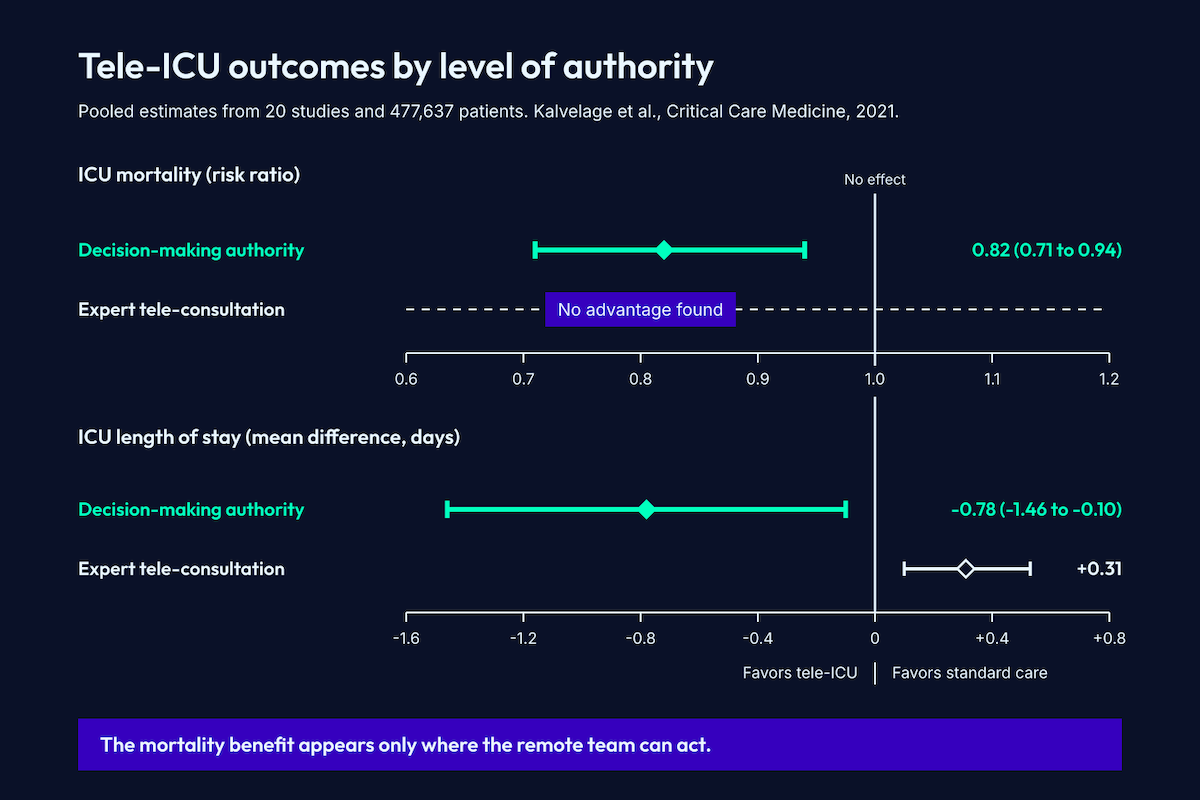
So the design conversation is about permissions. Order-entry rights and documented escalation authority, including what the intensivist on the hub side can do without waiting for a callback, both get decided in your command center software, or get decided by default. Ship the video without the authority and you’ve built the arm of the study that showed no advantage.
Supplement or substitute is a decision the platform encodes
A wrongful-death suit filed in Connecticut in March 2026 alleges that an intensive care unit was covered overnight by a remote physician alone, with no on-site physician assessment across an 18-hour admission. The complaint hasn’t been adjudicated. The state Department of Public Health’s after-action report found, separately, that staffing prevented constant and consistent care.
The evidence backs a hub that supplements thin bedside hours. Making that difference operative is the platform’s job, and it comes down to what you specify rather than discover:
- on-site acknowledgement requirements
- an escalation workflow with named responders
- an explicit ceiling on what the hub does alone
One constraint did come off: CMS permanently removed telehealth frequency limits on critical care consultation codes effective January 1, 2026.
Virtual nursing and virtual sitters: continuous observation turns consent and staffing into architecture
A virtual nursing platform is usually the first of the three a hospital funds, partly because the gap it answers has a federal label on it: the health professional shortage area (HPSA) designation. It’s also the one where the state a room sits in decides what your software is allowed to do.
What the virtual nurse actually takes off the bedside
At Yale New Haven Health, virtual nursing supported 78% of discharges and more than half of admissions, cut discharge order-to-departure time by 30 minutes, and reduced incidental overtime occurrences and cost by 10%, per Nursing Administration Quarterly in 2026.
The design finding that matters more: length-of-stay and readmission gains trace to engagement at admission rather than at discharge, and to shorter admission and treatment service durations, per a 2025 study on virtual nurse adoption. Admission is where the outcome numbers come from, so that’s where the platform has to be present.
The evidence is uneven, per JMIR Nursing: a dozen studies behind fall prevention observation, three pilots behind the rest.
Consent is a state-law problem, and audio is the fault line
Continuous observation means a camera pointed at a patient for hours, and that lands you in a body of law with nothing to do with health IT.
HIPAA already permits creating and internally using recordings that contain PHI for treatment and operations, without separate written authorization, per Accountable’s analysis. What binds you is state wiretap and all-party consent law, plus your own facility policy. Roughly a dozen jurisdictions require all-party consent, with SVMIC counting California, Florida, Illinois, Massachusetts, Pennsylvania, and Washington among them, which makes audio the fault line.
Before an in-room camera runs, the room needs:
- written informed consent, or consent from a legally authorized representative
- the roommate’s consent, or a different room, in semi-private settings
- conspicuous signage at the door and on the device
- disclosure of whether the audio is live
- a retention period
- a revocation path
- a named list of who may view
Every line of that is runtime state: consent is per-room, per-state, and revocable, and your software has to hold it. Recorded patient images are PHI, per MIEC, so retention and access belong inside the security risk analysis.
One nurse covering twelve beds only works if the handoff is written down
Command center staffing in production runs to a virtual nurse carrying up to 12 patients while bedside nurses carry five or six, per Becker’s Hospital Review in December 2025.
That ratio holds when the division of labor lives in the software. Put it in a policy document and bedside nurses end up doing parts of the work twice: a survey of 880 of them reported exactly that, along with communication gaps between the two roles, per Telehealth.org in June 2026.
Every task the virtual nurse owns needs a state the bedside nurse can see.
Interstate licensure and credentialing decide who can cover which spoke
Yes, your hub clinician needs a license in the state where the patient is. Two more gates sit behind that one, and neither is a license.
The compacts speed up how you get licensed, they don’t waive the requirement
Each interstate licensure compact does something different. The Interstate Medical Licensure Compact (IMLC) is an expedited path to separate state licenses rather than a national one, with California, New York, and Oregon outside it; the Nurse Licensure Compact issues a multistate license; the Psychology Interjurisdictional Compact (PSYPACT) grants a practice privilege. The Center for Connected Health Policy tracks the current map.
A routing rule keyed to compact membership ships a defect: it will assign clinicians to states where they hold no license at all.
Privileges at that spoke are the second gate, and proxy is the spoke’s choice
Under 42 CFR 482.22(a)(3) and (a)(4), with 485.616(c) for critical access hospitals, the spoke can rely on the hub’s credentialing decisions under a written agreement. Credentialing by proxy carries four conditions:
- the distant-site hospital participates in Medicare
- the practitioner is privileged at the distant site, with a current privilege list supplied to the spoke
- the practitioner holds a license issued or recognized by the state where the spoke sits
- the spoke reviews the practitioner’s performance and returns it for periodic appraisal
Reliance is the spoke governing body’s option, per CMS survey and certification letter 11-32 from July 2011, so a platform can’t assume it.
Proxy trades the receiving hospital’s workload for reliance on the other hospital’s assurance that Medicare credentialing was met, and that reliance carries CMS liability, as Rose Willis of Dickinson Wright put it in Relias Media in 2021.
Prescribing is the third gate, and it turns on registration in the patient’s state
DEA controlled substance prescribing has its own standing exception. Under 21 U.S.C. 802(54), a remote practitioner registered in the patient’s state can prescribe for a patient physically located at a DEA-registered hospital, per the DEA and HHS special-registration rulemaking of January 2025.
A spoke consult rests on that standing exception. The telemedicine flexibility that expires December 31, 2026 is a separate question.
What the platform stores, per clinician, per spoke
Each gate is held per clinician and per spoke, with its own source of truth and its own stale-data consequence. Your tele-specialty consult platform has to hold all three:
| Gate | Where it comes from | What the platform stores | When it goes stale |
|---|---|---|---|
| License | A license issued or recognized by the state where the spoke is located, per 42 CFR 482.22(a)(4)(iii) | License state and status per clinician, with an expiry date | The clinician isn’t assignable to that spoke at all |
| Privileges | Privileges at that specific spoke, by proxy under a written agreement or through the spoke’s own credentialing, per 42 CFR 482.22(a)(3) and (a)(4), and 485.616(c) for critical access hospitals | Per clinician per site, plus which route applies and whether the written agreement exists | Not assignable to that site, and the exposure sits with the receiving hospital |
| Prescribing registration | DEA registration in the state where the patient is, per 21 U.S.C. 802(54)(A) | Registration state per clinician | The consult can still proceed; the controlled-substance prescription can’t |
The map is being moved on purpose. The Rural Health Transformation Program scores state participation in licensure compacts and rewards states that commit to join by 2027.
Eligibility belongs in configuration, with effective dates and a change history behind it, because the state list changes faster than your release cycle. Somebody also has to watch it: one academic telestroke network’s 2020 build gave licensing and credentialing its own dashboard alongside the clinical work queues.
The hub-and-spoke architecture that holds up: licensure-aware routing, low-latency video, hard failover
Everything the three modalities asked for lands here, on one rural hospital telehealth platform. Start with what this market currently accepts as reliable. It sits below what an acute path needs.
Routing is a query against the three gates
A consult request from a spoke resolves against the licensure data model before it reaches a person. In order, the platform needs a clinician who is:
- licensed in that state
- privileged at that site
- registered to prescribe there, if prescribing is in scope
- on shift
- free
The audit trail lives on the routing path itself, because every exclusion along that chain has to be loggable.
The eligible pool may be wider than your roster assumes. Across 303 consults, thrombolysis recommendation rates didn’t differ significantly between an emergency-medicine physician and neurologists, per Choi and colleagues in Frontiers in Neurology, 2021.
The general build ground under all of this is telehealth app development.
The transport numbers, and why 1% loss still shows on screen
Interactive clinical video over WebRTC runs to 200 to 300 milliseconds round trip, average jitter under about 30 milliseconds, and loss under roughly 1%, thresholds derived from ITU-T G.1010 and published voice and video guidance.
Sub-1% loss is still visible on screen because every modern codec references prior frames. One lost packet can corrupt a keyframe, and the picture garbles until the next one arrives.
The market’s floor is 95% of visits, and it isn’t tiered
The words a buyer uses are the words you’ll be measured on, so it’s worth reading one. A 15-hospital health system put its telemedicine requirements out for bid in May 2024, and the document is public. What it asks for:
- a technical visit success rate of at least 95%
- named fallback paths when a call drops, specifically switching video to phone and a patient reconnect route
- technical requirements weighted highest of all categories, at 150 of 500 scoring points
- customer data, including backups and replicated copies, barred from leaving the 48 contiguous states
- equipment adequate for telestroke consultation
What the document never does is tier. There’s no separate reliability commitment for an acute care telehealth path.
And a 95% floor is one failed visit in 20, which reads differently at a stroke bedside than at a routine follow-up. That’s the language a real buyer used.
Tiering is achievable, and specifying it is your job
One academic telestroke network’s 2020 program materials record service levels L1 through L4 mapped to Critical, High, Medium, and Low. The same materials track system availability, session activity, and calls logged as standing operational metrics.
The uptime SLA you write can carry tiers. Leave it flat and the acute path inherits the routine one’s number.
The console and the failover path get specified early or inherited late
A clinician covering many sites needs a prioritized queue carrying each site’s context and their eligibility for it, with the clinical clock on every row, reached through single sign-on, one credential across every site. And the failover path is a state the system enters deliberately, with a named notification and an owner.
The hardware layer: telepresence carts, PTZ cameras, and the peripherals clinicians actually use
The kit at the bedside decides whether the specialty exam is scoreable. That makes it a clinical requirement, and it belongs in the clinical spec. It’s also the layer a hub team tends to hand straight to procurement.
The remote clinician has to be the one driving the camera
Far-end camera control is the capability that carries the weight. The hub clinician drives the PTZ camera directly, without relaying instructions to whoever happens to be standing at the bedside.
The four exam items that lose reliability over video are exactly the ones that depend on where the camera is pointed. Control belongs to the clinician doing the scoring.
Treat control latency the way you treat video latency: same budget, same tier. A camera that lags behind the clinician’s hand is a camera they stop driving.
The specification floor a 15-hospital buyer wrote down for telestroke-capable rooms in 2024: a 20x pan-tilt-zoom camera, a beamforming microphone, and a connected stethoscope.
Every peripheral is an integration job, and somebody has to be trained on it
A hospital-grade cart connects through a configurable input panel and carries:
- an exam camera
- an otoscope
- a dermatoscope
- a digital stethoscope
- a vitals monitor
- a 12-lead ECG
- sometimes an ultrasound probe
Those peripheral devices stream alongside the video, so the session carries both at once.
Each peripheral has its own driver and its own failure mode, and the count is what makes this expensive. That effort lands in medical device integration.
The same cart usually covers more than one service line, telehospitalist software included, so the integration work gets amortized across programs.
The American Telemedicine Association publishes standards for the bedside presenter role. A cart the staff can’t position is furniture. Put the presenting role in the spoke’s staffing budget, because the hub will assume it’s already there.
The ambulatory version of the same bedside problem shows up in school-based telehealth platform development.
Cross-site EHR and patient identity: the same patient in two charts
This is the layer that fails quietly. Identity and documentation both break in ways that surface at an audit or after a bad outcome, long after go-live. The hub-side team usually finds out from the spoke.
Matching across two organizations starts worse than anyone expects
Intermountain Healthcare had invested heavily in health IT and expected a high match rate when it started exchanging records with other organizations. It got 10%, per the Sequoia Project’s cross-organizational patient identity framework. Getting off that number took algorithm and data-quality work first, then human workflow and data-entry work.
Patient identity matching fails for mundane reasons. Across 398,939 confirmed duplicate records, the single field responsible for the largest share of mismatches was the middle name, at 58.3%, per AHIMA. ONC concluded back in 2014 that no current method reaches a zero percent error rate.
An acute consult can’t wait for reconciliation, so the encounter proceeds under a provisional identity and gets resolved afterwards, through a queue with somebody’s name on it.

Three documentation patterns, and you have to pick one on purpose
Three documented options, and the buyer that specified the first two runs Oracle Health (Cerner):
- An encounter launched natively inside the spoke’s own EHR. What the 15-hospital system specifies for facilities on its own platform.
- The hub clinician documenting directly into the spoke’s native chart, as a visitor. What that same buyer specifies for facilities on a different EHR.
- The hub keeping its own record and transmitting out. How one health system’s stroke neurologists worked while virtually present at 34 hospitals, as of a 2016 case study.
Option 1 needs both ends on the same platform, Epic to Epic or Oracle Health to Oracle Health. Option 2 is what a mixed network gets.
Two of the three need a login on somebody else’s system, and that request goes to a different department than the one that hired you. Either way, the transmission itself runs on HL7 and FHIR.
How many EHRs the network spans and who owns the legal record drive the choice. Make it late and you build two of the three.
Getting the note into the spoke’s chart is its own step
In one academic telestroke program’s 2020 build, documentation transmission was a work-queue in-basket in its own right, separate from writing the note, and it sat alongside a surface for closing the loop.
Transmission needs a tracked state with visible failures, and an owner. A note that was written and never landed reads as complete on the hub side and absent on the spoke side.
The named-EHR work is where the estimate goes; we’ve written ours up in integrate with Epic EHR.
And PHI is moving between two covered entities during a live encounter, so the business associate agreement (BAA) chain and the rest of the HIPAA compliant software development stack apply to the transport itself.
The tele-specialty platform build checklist
This is the requirement set we hand to engineering when a client sets out to build a telestroke platform. None of it shows up on a feature list.
Who can cover which spoke
- License state and status per clinician per spoke, with effective dates
- Privileges per spoke, with the credentialing route and written agreement
- Prescribing registration by state
- Eligibility as configuration with a change history behind it
The clinical path
- Latency, jitter, and loss targets per modality, acute paths tiered separately
- A fallback path the system enters deliberately, with a named notification
- Session drops routed to whoever answers clinical events
The bedside
- Far-end camera control in every room running a specialty exam
- A peripheral inventory per spoke, with a named integration owner
- A trained presenting role at each spoke
- Consent state per room and per state, revocable, with semi-private rooms handled
Data in
- Telemetry through the device-integration layer, normalized across vendor fleets
- Alarm suppression and classification before anything reaches a human
The record, and the years after
- A provisional identity at consult start, with a reconciliation queue and owner
- A documentation pattern chosen explicitly, per spoke
- Transmission tracked as its own step, with failures visible
- Live encounter capture of both locations, the modality, and the duration
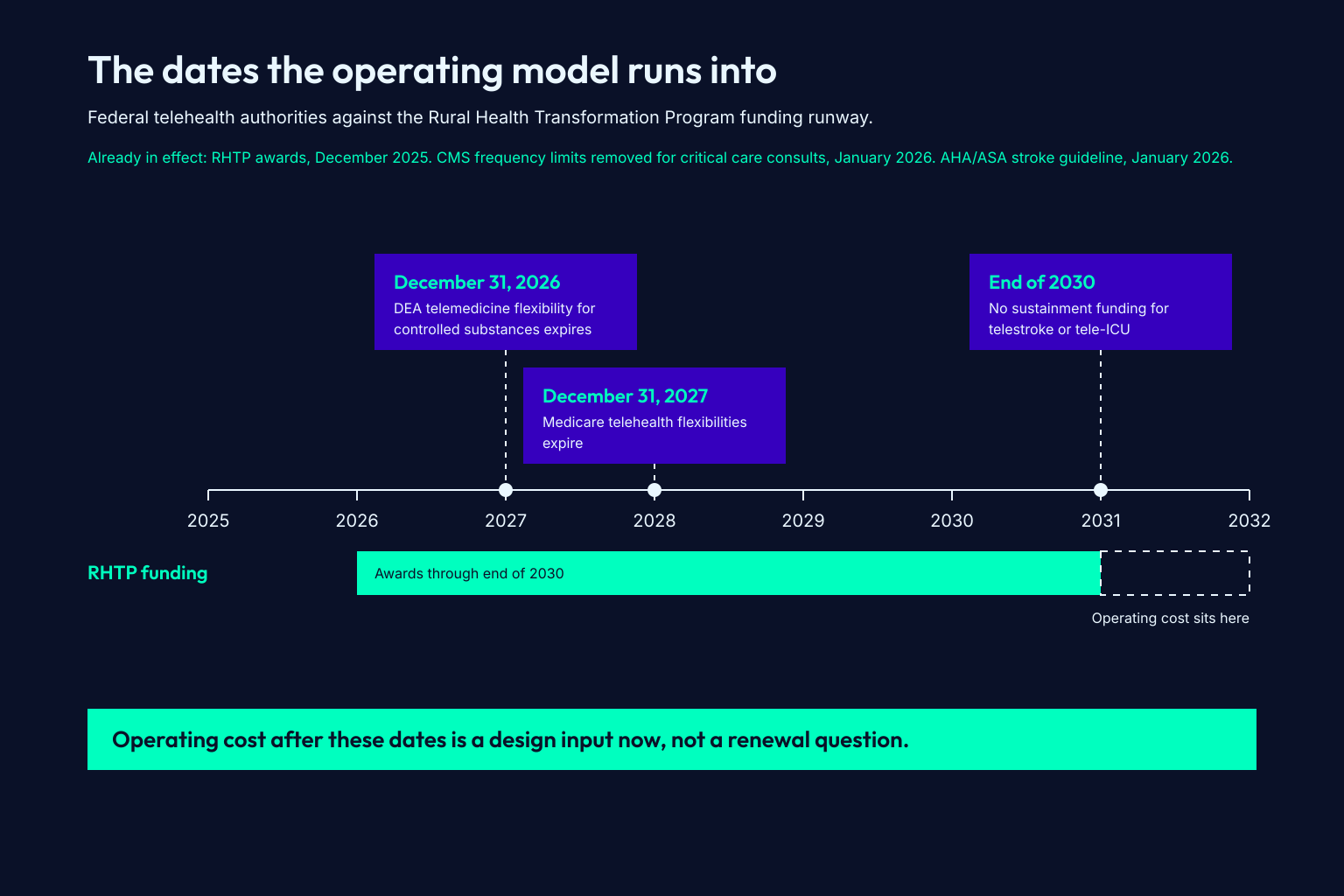
Telestroke and tele-ICU carry no sustainment funding past 2030, and the Medicare telehealth flexibilities a billing model rests on expire December 31, 2027, per healthsystemCIO in August 2026. The USDA Distance Learning and Telemedicine grant runs on its own cycle. Operating cost after those dates is a design input now.
Why Topflight Apps for tele-specialty platform builds
By now you have a funded program with a date on it, and a list of requirements that weren’t in the original scope. What decides how the build goes is whether your engineering partner already understands licensure-aware routing, a failover path with tiers, cross-site identity, and a hub that holds real authority. Learning those four on your project is expensive in a way that shows up as schedule, and the schedule is the thing you can’t renegotiate.
We’ve built tele-ICU and remote monitoring systems, done the EHR and medical device integration work underneath them, and shipped command-center software. On a stroke path the platform is clinical infrastructure with a go-live date on it, and we build it that way. Budget shape is its own conversation, and we’ve written up how we scope it in healthcare app development cost.
The first thing we’d build is the eligibility data model, because every other decision in the system routes through it and retrofitting it means touching everything.
If you’re standing up hospital-based telehealth development against a fixed go-live, send us the spoke list, the EHRs in play, the modalities in scope, and the date. We’ll come back with what has to be built first and what can wait until after the ribbon-cutting. Do physicians need a license in the patient’s state to provide tele-specialty care?
Frequently Asked Questions
What is the hub and spoke model in telehealth?
A specialist hub covers many spoke sites that don’t have that specialty on staff. The spoke is the originating site, the hub the distant site.
How does telestroke work?
The spoke provider activates the hub, CT happens locally, a remote neurologist examines the patient over video and reviews the imaging, then transmits a treatment recommendation back.
What is the difference between tele-ICU and home remote patient monitoring?
Setting and responder. Tele-ICU streams continuous telemetry from hospital ICU beds to clinicians who can intervene; home monitoring collects episodic consumer-device readings.
Do physicians need a license in the patient's state to provide tele-speciality care?
Yes. Compacts speed up how you get that license; privileges at the spoke and prescribing registration are two more gates behind it.
What happens if the video connection drops during an acute tele-specilaity consult?
Inside a clinical window it counts as a clinical event, so the platform needs a defined fallback path it enters deliberately, with a named notification and an owner.
How is tele-speciality care for rural hospitals funded?
Through state Rural Health Transformation Program awards and rural telehealth grants.