

How do you build a Change Healthcare competitor in 2026?
Rent the payer rails through API clearinghouses like Stedi (3,500+ payers) and spend the budget on the agent layer: one agent codes charts, one predicts denials before submission, one turns denials into appeals, all orchestrated with human-in-the-loop review. Go to market by running claims defense on contingency beside the incumbent stack, with SOC 2 Type II and HIPAA architecture in place before the first pitch. An AI-core MVP runs roughly $150K to $200K.
When Change Healthcare went dark in February 2024, Maniya Health watched 95% of its revenue vanish overnight. The practice borrowed about $200K just to make payroll while claims sat frozen.
The story repeated across the industry: 94% of hospitals in an AHA survey took a financial hit, and 192.7 million people’s records were exposed. Two years on, founders comparing Change Healthcare competitors are looking at a re-sorted map, and the most interesting spot on it is still unclaimed.
The wound hasn’t closed, which is what makes 2026 the moment. Fact discovery in the consolidated MDL runs through November 2026, suits over Optum’s loan clawbacks and the outage itself kept arriving through August, and no settlement has been reached, with class certification motions not due until January 2027.
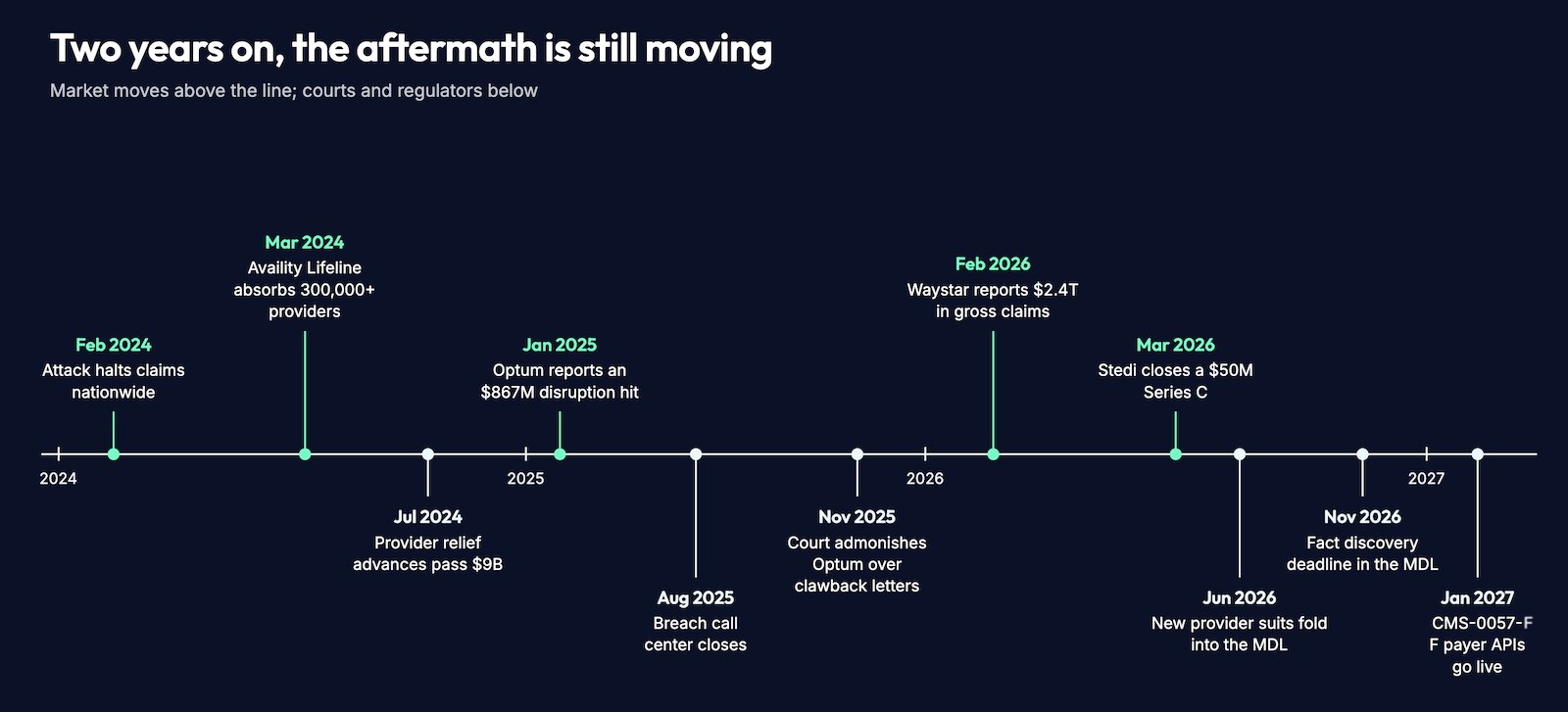
The aftermath converted “we need a vendor” into “we need redundancy and control over our claims flow.” That shift is the market opening for founders and RCM veterans who want to build into it.
Key Takeaways:
- The next RCM winners run autonomous agents over rented rails. February 2024 exposed the concentration risk of one centralized clearinghouse; the durable position in 2026 is the intelligence layer on top of the pipes.
- Production AI plus rentable rails put the entry cost at startup scale. Autonomous coding already runs at or above human accuracy: Fathom at 95.5% automation with 98.3% accuracy, and CodaMetrix ranked KLAS #1 for 2026. With payer connectivity rented through Stedi or Candid, an AI-core MVP lands around $150K to $200K.
- Providers want redundancy and control over their claims flow, and the aftermath keeps that demand alive. The MDL is unsettled and Optum’s clawback disputes are still landing in court; a platform that hands providers both is the pitch.
Table of Contents
- Change Healthcare competitors
- Unbundling the black box with AI agents
- The tech stack that gets you to market
- Sell claims defense first: the Trojan horse GTM
- Why Topflight Apps for your RCM platform build
Change Healthcare competitors: who won the exodus, and what’s still broken
Ask who moves medical claims currently and you get five answers: Optum’s rebuilt Change network, Availity, Waystar, Office Ally and Claim.MD at the small-practice end, and Stedi in the API-first lane. Each came out of the exodus holding a different piece of the market.
| Platform | Built for | Scale signal | Model |
|---|---|---|---|
| Optum (rebuilt Change network) | Enterprises already deep in the UnitedHealth ecosystem | Rebuilt post-attack; in active win-back mode | Full-service legacy clearinghouse |
| Availity | Payer-provider connectivity at health-system scale | Lifeline absorbed 300,000+ providers and moved $10B+ across 5.7M backlogged claims mid-outage | Dual-sided real-time network |
| Waystar | Health systems consolidating RCM on one platform | FY2025: 7.5B+ transactions, $2.4T gross claims, ~60% of US patients | Full RCM platform; pricing tied to claims and payments |
| Office Ally / Claim.MD | Small practices that need cheap, fast onboarding | The outage-era refuge for practices that had to move in a hurry | Low-cost web clearinghouses |
| Stedi | Developer teams building claims products on APIs | 3,500+ payers; $142M total raised | JSON-native APIs over X12; multi-region active-active routing |
Those positions were staked out fast. Availity stood up Lifeline as a free, slimmed-down offering mid-crisis and worked through a backlog of millions of claims. Waystar took the enterprise tier, adding roughly $600 billion in annual gross claims volume between 2024 and 2025. Stedi opened the API-first lane and closed a $50M Series C in March to widen it. Office Ally picked up the small practices that just needed claims moving again that week.
The incumbent paid for all of it. Optum Insight lost $867 million in FY2024 revenue to cyberattack business disruption, and UnitedHealth put the year’s total cyberattack impact at about $3.1 billion. Change’s network is back online, but reconnecting meant redoing enrollments from scratch, and some of the lost business hasn’t returned.
Here’s the uncomfortable part: the exodus gave concentration risk a new address. Waystar alone now spans roughly 60% of US patients. John Riggi, National Advisor for Cybersecurity and Risk at the AHA, told Becker’s that concentrating that many essential services and that much PHI at Change had “created enormous risk.” The 2026 map rebuilt the same shape with new logos.
And switching stayed painful. Two-thirds of the 960 hospitals the AHA surveyed called changing clearinghouses difficult or very difficult, which is why the redundancy demand hasn’t faded: HFMA found 53% of health systems that ran Change as their primary planned to go multi-clearinghouse. For a builder, multi-clearinghouse as a policy means half the market now keeps a slot open for another claims vendor. That’s a very different buying posture than the single-pipe loyalty Change enjoyed for a decade.
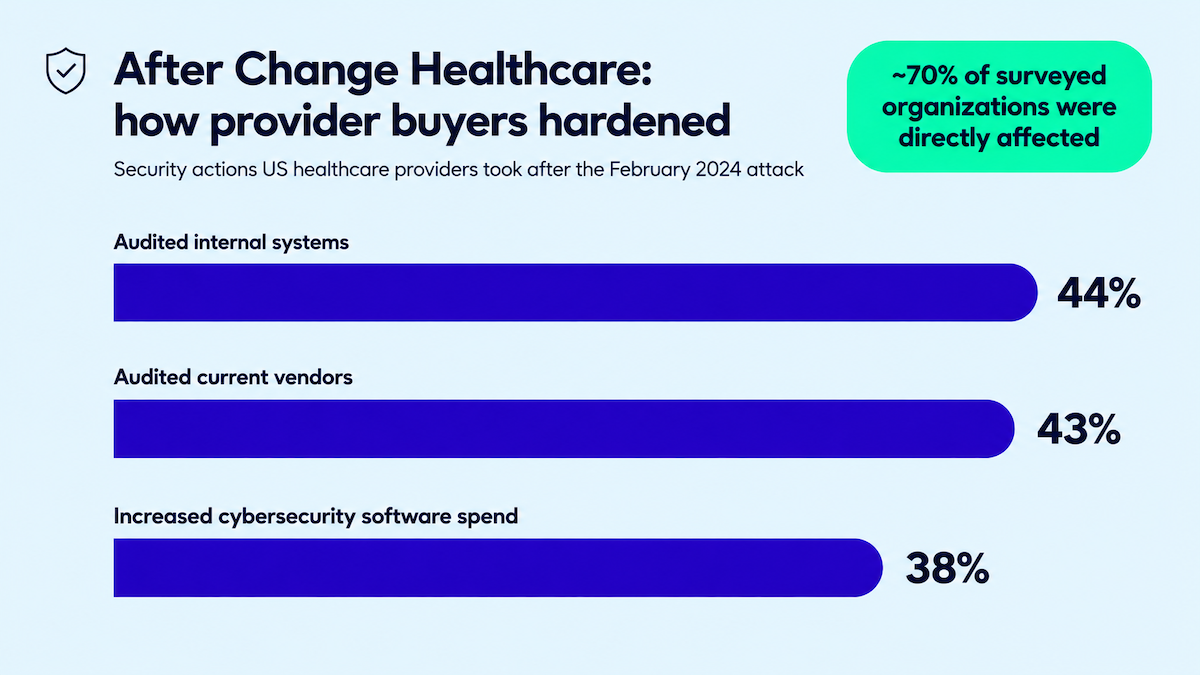
Now look at what every winner on this map actually sells: medical claims processing software that routes transactions. Eligibility checks in, claims out, status pings, remits back. Coding happens in someone’s head or a bolt-on tool. Scrubbing runs on static rule libraries that payers out-evolve every quarter. Appeals sit in a work queue until a biller gets to them. The pipes got new owners while the intelligence layer above them still has no clear owner. That layer is the opening.
Epic ships coding and denial-appeal tools to its own customers, and Stedi relaunched itself in September as a headless RCM engine, yet a July 2026 KLAS report says it has yet to validate a truly end-to-end RCM suite.
One honest caveat: no public figure exists for how many providers permanently switched after the outage. The stats above are the citable proxies, and the gap itself is market intelligence a new entrant can exploit.
Unbundling the black box T AI agents
Walk the claims pipeline the way most practices still run it: a coder reads the chart, assigns the codes, the claim goes out, everyone waits, and whatever bounces lands in a denials queue for a biller to untangle, often weeks after the visit. Every step is a human reading a screen, and every human step is where the margin leaks.
The payer side retired that model years ago. Cigna’s PXDX system denied 300,000 claims in two months of 2022 at an average of 1.2 seconds of medical-director review each, and the ERISA class action over it was allowed to proceed in March 2025. Physicians see the asymmetry: 61% told the AMA’s 2024 prior-auth survey they’re concerned payer AI is pushing denials up. Fighting machine denials with human throughput is the losing position, and providers know it.
So unbundle the pipeline into agents. The three below carry the margin.
The Coder agent: reads the chart, assigns the codes
Autonomous coding is the piece with production receipts, so start there. Fathom’s Your Health deployment runs at 95.5% automation with 98.3% accuracy across all service lines, and the platform holds Epic’s Toolbox designation for Fully Autonomous Coding. CodaMetrix, born inside Mass General Brigham, took the KLAS #1 spot for Autonomous Medical Coding in 2026 and says it cuts manual coding by over 70% and coding-related denials by up to 60% across its 30+ health systems.
The people running these tools inside health systems say so too. Bill Gress, Director of Revenue Cycle Operations at Cottage Health, told Becker’s that early data shows autonomous coding “above the quality of a human coder” for select service lines, and faster, with results still climbing.
We’ve seen the same thing from the build side. GaleAI, an automated medical coding engine we helped build, ran a 1-month retrospective audit that caught 7.9% of codes human coders had missed, worth an estimated $1.14M a year; we unpacked those numbers in our guide to AI in medical coding and billing. (Nym is a third name to benchmark if you’re shopping the ED lane.) For a founder, coding accuracy is a solved input. The agent wrapping it doesn’t get tired at 4pm and doesn’t fat-finger a modifier.
The Scrubber agent: predicts the denial before submission
The Scrubber is an architecture decision. Every outgoing claim runs against a payer-behavior corpus before it leaves the building, a corpus built from:
- denial codes, by payer and procedure
- payer-specific edits
- adjudication outcomes from your own claims history
A retrieval layer matches each claim against that record, and the agent flags the ones shaped like tomorrow’s rejections while they’re still cheap to fix. The output is specific: this claim will likely bounce off this payer, so correct the modifier before it goes. The Scrubber checks payer behavior, which is what gets claims paid.
And every 835 that comes back enriches the corpus. That flywheel is the moat.
The Chaser agent: turns denials into appeals automatically
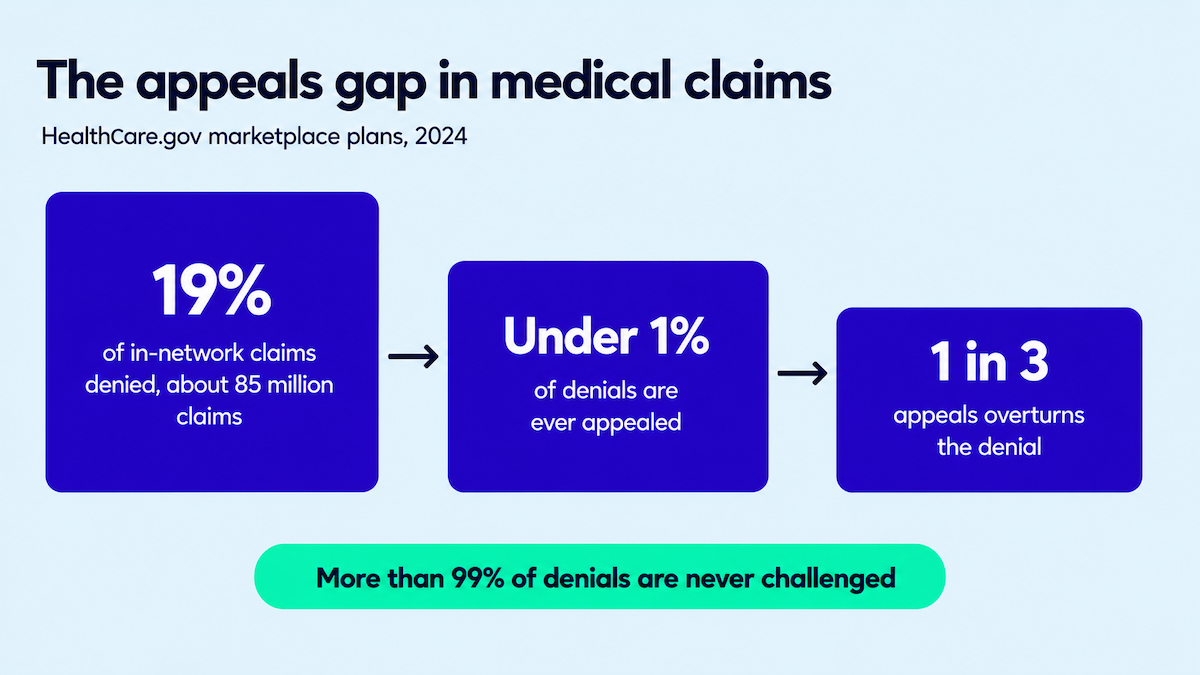
In HealthCare.gov plans, fewer than 1% of denied in-network claims are ever appealed. That gap is recoverable revenue left sitting in the denials queue. The appeal itself is templatable work: pull the denial reason, match it to chart evidence and policy language, generate the letter, resubmit, track.
Mayo Clinic already runs a bot that writes appeal letters, alongside claims-statusing bots; the program trimmed roughly 30 FTEs through attrition and $700K in vendor costs over two years. When a system with Mayo’s resources builds the Chaser in-house, the product case for everyone without Mayo’s engineering bench is made.
Stack the three agents and the biller’s job compresses into exception management: approve what the agent got right, and correct or escalate what it flagged. That queue is a product surface, so design it like one.
The tech stack that gets you to market without a $50M budget
The $50M assumption came from the pipes. Building direct connections to thousands of payers, one enrollment and one X12 companion guide at a time, took years of capital before the first claim moved, and that math kept AI revenue cycle management a big-company game. In 2026 the pipes are rentable. The budget goes to the one layer you can’t rent: the payer-behavior corpus your Scrubber runs on.
The rails: rent the payer connections
Stedi is the headless option: JSON-native APIs over X12, 3,500+ payers, multi-region active-active routing, and $142M raised to keep building it. Active-active matters more than it sounds after February 2024, because the rail reroutes around a failing connection before it becomes your outage. The transaction surface covers what a claims platform needs on day one:
- eligibility checks (270/271)
- claims submission (837)
- claim status (276/277)
- ERAs (835)
- API-based transaction enrollment
Its September relaunch added a claims lifecycle API and payment tools on top of those rails. The agents and the payer-behavior corpus behind them stay with you, and that’s where your budget goes.
Candid Health sits a layer above bare EDI as an RCM-automation rail, with about $219M raised after a $120M Series D in July 2026, and 190% year-over-year growth in contracted run-rate revenue. Its headline metric is the one a CFO reads twice: 95%+ touchless claim and net collection rates. Candid also deprecated its own Change-wrapped eligibility endpoint in favor of a Stedi passthrough. Even the modern rails route around the incumbent now.

The honest tradeoff: payer transaction enrollment still takes real calendar time, and ERA enrollment runs one clearinghouse per payer at a time. Plan the migration schedule instead of assuming day-one coverage.
The brain: orchestration you don’t have to invent
A claim is a weeks-long stateful process with waits measured in payer response times, so the orchestration layer needs durable state and explicit control flow. LangGraph is the 2026 production standard for that kind of process, and one feature earns it the job here: human-in-the-loop interrupts. The interrupt is the mechanism behind “the biller manages exceptions”; the graph pauses while a human rules on a flagged claim, then resumes with the ruling in state.
Keep the model layer swappable. Google has already shut down every Gemini 1.0 and 1.5 model, and requests to them now return 404s. Pin your platform to a model version and you inherit its deprecation schedule. The swap stays compliant too, since every major LLM provider now signs healthcare BAAs, from OpenAI’s API through Claude on Bedrock, Gemini, and Azure OpenAI.
The front end: a dashboard that shows only the exceptions
What the biller sees decides adoption. Billers have watched a decade of tools automate the easy 10% and hand the hard 90% back with extra clicks, so the screen has to prove the ratio flipped within the first week. The right screen is a queue of flagged claims, each with the agent’s reasoning attached and the triage actions from the last section one click away. Underneath, an audit trail records every touch. The 10% that needs a human, surfaced; the rest, invisible.
The dashboard is also the fastest layer to ship: we stand these up with Specode when a build needs the front end inside a quarter.
The bill: what this actually costs
Two anchors from our own build sheets:
- an AI-core billing automation MVP runs about $150K to $200K
- full custom medical billing software development lands between $110K and $290K
The spread is mostly integration count and how many service lines the Coder has to learn. Neither number includes the $50M pipes, because you’re renting those. Timing helps too: payer prior-auth APIs land January 1, 2027 under CMS-0057-F, so a platform built in 2026 integrates just as that wave arrives. For the scope-by-scope cost split, our medical billing automation guide breaks it down.
Sell claims defense first: the Trojan horse GTM
The pitch that closes in health-system procurement: keep everything you have, and let our auditor run beside it. The incumbent clearinghouse is wired into the EHR and a decade of payer enrollments, and providers spent 2024 learning exactly how brutal unwinding that is.
The wedge leaves that wiring in place. Rip-and-replace asks the buyer to absorb migration risk before your product has proven anything; the shadow pitch asks for read access.
The wedge play: shadow audit, contingency proof, expansion
The sequence has three steps, and the order is the strategy:
- Shadow audit. Run pre-bill audit and claims defense in shadow mode beside the incumbent stack. The workflow stays as it is: the incumbent keeps moving transactions while your agents read the same claims.
- Contingency proof. Price it as a percentage of found revenue. A pilot that costs nothing unless it finds money is a yes a CFO can sign without a committee.
- Expansion. Once the found-revenue number does the selling, expand until the platform owns the pipeline from scrub to appeal.
SmarterDx already ran this exact play. It priced the pre-bill audit on contingency and backed it with a 5:1 ROI guarantee; the yield claim now runs about $3.5M in realized annual revenue per 10,000 DRG discharges. At McLaren Health Care, the audit surfaced $11.3M in realized annual net new revenue, sitting beside a mature CDI program that had already been through those charts. That’s the classic “we found $50K you were leaving on the table” pitch, executed at more than 200 times the scale. And the expansion step has a precedent: SmarterDenials for appeals automation, then the Smarter Technologies rollup, whose agentic platform claimed up to 70% of revenue cycle tasks automated at its May 2025 launch.
Timing leans the same way. In the AMA’s 2025 prior-auth survey, 74% of physicians said denials rose over five years, and only 33% believe the June 2025 insurer reform pledge will change anything. And CMS-0057-F started forcing specific denial reasons on 72-hour expedited and 7-day standard clocks on January 1, 2026, which hands your Chaser structured inputs where it used to get boilerplate.
The objection that kills it anyway: security review
The wedge still hits a wall the demo can’t talk through: the security review. Post-Change, procurement hardened. In Vanta’s State of Trust research, 65% of organizations said customers and investors now demand more compliance proof than before, and the newer edition puts that at 77%. Out-Of-Pocket’s compliance deep-dive with Vanta ties the harder reviews directly to the breach: enterprises watched one vendor’s failure cascade through the whole industry and moved their security questions to the front of the deal. A wedge pitch is a new-vendor pitch, so it inherits the hardest version of that scrutiny.
Hospitals buying HIPAA compliant AI agents ask for the audit evidence before the demo: SOC 2 Type II, and HIPAA architecture with BAAs across every subprocessor that touches PHI. Have both in place before the first pitch, or the wedge never reaches a signature; compliance drag is where deals go to die quietly. Our guide to HIPAA compliant app development covers the architecture half.
Which makes compliance a build-partner selection question, settled before the first sprint.
Why Topflight Apps for your RCM platform build
That security-review deal-blocker is an architecture problem, and architecture gets decided in sprint one. That’s the case for a build partner who does both jobs in one motion. Topflight Apps builds the platform and the compliance underneath it together, so SOC 2 and HIPAA controls ship in the codebase itself, and the security questionnaire gets answered by pointing at it.
GaleAI is what that looks like shipped. Built with Topflight Apps, it’s the coding engine whose 1-month audit put human undercoding at $1.14M a year. That’s the kind of number that closes a contingency pilot.
The scope runs from product strategy through HIPAA-bounded engineering, plus the audit-ready documentation enterprise procurement wants to see.
The demand side is already moving. Providers spent the last two years hunting for redundancy and an alternative to Change Healthcare, and the unsettled aftermath keeps that search alive through 2026. The map’s most interesting spot is still unclaimed. If you’re building the platform that hands providers back control of their claims flow, talk to us.
Frequently Asked Questions
Who picked up Change Healthcare's clearinghouse business after the outage?
Availity absorbed the biggest surge through Lifeline, Waystar took the enterprise tier, Office Ally and Claim.MD caught small practices, Stedi opened the API-first lane, and Optum rebuilt Change.
Is AI medical coding accurate enough to replace human coders?
Production deployments run 95%+ automation with accuracy above human coders on select service lines. Coders shift to reviewing the exceptions the AI flags.
How much does it cost to build an AI claims platform?
Roughly $150K to $200K for an AI-core MVP when payer rails are rented via API clearinghouses. The $50M figure belonged to the build-your-own-pipes era.
What's the fastest way to sell a new RCM tool into hospitals?
Run claims defense in shadow mode beside the incumbent stack, priced on contingency. Expand once the found-revenue number proves itself; SmarterDx scaled that play.
Do I need my own payer connections to submit claims?
API clearinghouses handle payer connections and enrollment for you. ERA enrollment still runs one clearinghouse per payer at a time, so plan the migration schedule.
Which compliance frameworks does an AI claims platform need?
HIPAA with BAAs across the full stack, plus SOC 2 Type II for enterprise procurement. Add CMS-0057-F awareness if the platform touches prior-auth workflows.