

In a 2025 Pediatrics interview study, parents of infants with chronic critical illness who went home on medical technology felt highly supported in the NICU and strikingly under-supported after discharge. That drop is the transition of care this post is about.
This guide to NICU to home app development is for the teams building what fills that gap. The line between a clinical app for these families and the baby apps they already use: who sets the alert threshold, and who responds when it trips.
FDA’s May 3, 2024 over-the-counter clearance of the Masimo Stork carries the same exclusion as the Owlet Dream Sock, in the label’s words: not intended for infants and neonates previously diagnosed with cardiovascular or respiratory disease or conditions.
A 2022 JAMA Network Open simulation used home oximeter data from 20 preterm infants with moderate to severe bronchopulmonary dysplasia, a chronic lung disease of prematurity. Typical settings at the authors’ institution would have produced a median 23.1 alarms per 8 hours.
FDA’s clinical decision support guidance of January 29, 2026 treats a pulse oximetry deterioration alert sent to a clinician as a device function.
So the build starts with which infants actually go home fragile.
How do you build a NICU-to-home app for medically fragile infants?
Build it for infants who go home on oxygen or a feeding tube, with a clinician setting each alert threshold and a named care-team role answering. Plan data around the monitor maker’s cloud and your EHR’s write-back rules, keep the phone as a secondary alarm channel, and map FDA status function by function.
Key Takeaways:
- Who sets the threshold and who answers is what separates a NICU-to-home app from a baby tracker. Trackers already sync logs, and FDA-authorized OTC monitors already alert on a preset range; the clinical app adds a clinician-set threshold and a named care-team role.
- No alert is guaranteed to reach a parent, so escalation has to climb until a person answers. In one simulation, threshold and delay moved home oximetry alarms from a median 23.1 per 8 hours to under 1.
- FDA status is decided function by function, and privacy by who deploys the app. Parent-facing flags and signal-based alerts are device functions even when a nurse gets the alert, and a hospital-deployed app answers to HIPAA while a direct-to-parent app answers to the FTC breach rule.
Table of contents
- The neonatal transition of care: who goes home fragile, and why the risk outlasts the first visit
- A NICU-to-home app is defined by who sets the threshold and who responds
- Design for limited health literacy, because you cannot tell which parents have it
- A home pulse oximeter or apnea monitor comes with a data path someone else already chose
- Red-flag alerts trade sensitivity against sleep, and the phone is a secondary channel
- Parent-facing functions and time-critical alerts fall outside the clinical decision support boundary: the FDA line, function by function
- There is no single care team after discharge, so the care team dashboard routes by role and by state
- Pediatric PHI and proxy access start with who deploys the app
- The NICU-to-home app development checklist, staged by regulatory risk
- Build your NICU-to-home app with Topflight Apps
The neonatal transition of care: who goes home fragile, and why the risk outlasts the first visit
The neonatal transition of care that a NICU-to-home app serves belongs to infants who go home on oxygen or a feeding tube. That’s a small group inside a big population. In 2023, 9.8% of US infants were admitted to a neonatal intensive care unit, per CDC birth certificate data. Of infants discharged in 2009 from 228 Pediatrix Medical Group NICUs across 30 states, 2.6% went home on oxygen, rising to 28% of those born at 23 to 28 weeks (Journal of Pediatrics, 2013).
Fragility follows the equipment, and it reaches infants born near term. In that same cohort, 61% of the late preterm and term infants sent home on oxygen had never been on a ventilator.
The first follow-up visit comes fast. Among 22,214 commercially insured NICU survivors across all 50 states (2015 to 2017), half saw an outpatient clinician within 2 days of discharge and 90% within 5 days (Bernardo and colleagues, 2024). So the product’s real work starts after that visit.
Risk and dependence run much longer than a week:
- Weeks. Among children born at 22 to 31 weeks in England and Wales (2013 to 2018), 57.5% of unplanned PICU admissions before age 2 came within 50 days of neonatal discharge (JAMA Network Open, 2024).
- Months. In a US study of infants born at 30 weeks or earlier and sent home with feeding tubes, only 24% of those with surgically placed tubes were on full oral feeds at 12 months corrected age, meaning age counted from the due date (Journal of Perinatology, 2025).
Weeks for the admissions, months for the tubes. That stretch after the first visit is where a medically fragile infant app earns its keep.
A NICU-to-home app is defined by who sets the threshold and who responds
A NICU-to-home app differs from an infant health tracking app in who sets the alert threshold and who responds when it trips. A clinician sets the threshold for this infant’s condition, and a named care-team role answers. The infants it serves also include ones the over-the-counter monitor labels exclude.
Features alone don’t settle it: Huckleberry’s US App Store listing (viewed September 2026) already offers medicine logging synced across caregivers and exportable trend reports for a pediatrician. On-demand pediatric telehealth is a separate product, covered in our pediatrics on-demand app development guide.

Consumer hardware already alerts parents
Families who want a home monitoring app for babies can already buy an FDA-authorized monitor that notifies them. Owlet’s Dream Sock was authorized for over-the-counter home use on November 8, 2023, to notify caregivers when pulse rate or SpO2 moves outside a preset range, prompting them to assess the infant.
As of September 2026, FDA lists two authorizations under product code QYU: the Dream Sock and the Masimo Stork.
The Masimo Stork’s OTC clearance of May 3, 2024 carries the Dream Sock’s exclusion, in the label’s words: not intended for infants and neonates previously diagnosed with cardiovascular or respiratory disease or conditions. The infants a NICU-to-home app serves include exactly the ones both labels leave out.
A preset range is the wrong design for these infants
The American Heart Association’s 2020 scientific statement on interstage home monitoring (for infants with single-ventricle heart disease in the months between staged heart surgeries) lists an unanticipated rise in oxygen saturation from the infant’s own baseline as a red flag. Only a clinician who knows the infant can set that threshold.
Who responds is the other half
In Cincinnati Children’s remote patient monitoring program for neonatal patients who depend on feeding tubes or oxygen, registered nurses review the family-reported data with pediatric specialists. Here’s the layer-by-layer comparison (our chronic disease management app development guide covers the adult version):
| Layer | Consumer baby tracker | OTC infant monitor | NICU-to-home app |
| Capture | Parents keep a feeding log plus sleep, diapers, growth, developmental milestones and medicine | Monitor reads pulse rate and SpO2 | Family reports readings through the app for the care team |
| Guidance | AI chat guidance in paid tiers | A notification prompts the caregiver to assess the infant | The care team’s discharge plan, written for parents |
| Alert threshold | None listed | Preset range | Set by a clinician for this infant’s condition |
| Who responds | Parents, who can share exported trend reports with a pediatrician | The caregiver assesses the infant | A named care-team role reviews the data and answers |
Hospital-built apps can land in the wrong column too. NICU-2-Home, a preemie app tested in a pilot RCT at Lurie Children’s, paired education and tracking with no direct clinician messaging. The bottom row is what places a product in the NICU-to-home column.
Design for limited health literacy, because you cannot tell which parents have it
Design every screen of a NICU parent app for limited health literacy, because it’s common among NICU parents and nothing an app sees at signup shows who has it.
The numbers are hard to wave away:
- One NICU. At Christiana Care in Delaware, 43% of English-speaking parents at admission and 32% at discharge had suspected limited health literacy on the Newest Vital Sign. And 39% of those parents were college-educated.
- Several US sites. Among 137 parents of infants born at 32 weeks or earlier, 31% missed 3 or more of 8 questions on the Parent Health Literacy Activities Test, which includes reading prescription labels. Lower scores tracked lower nurse ratings of discharge readiness. The parents’ own ratings didn’t.
So a college degree won’t tell you, and neither will a parent’s confidence at the end of discharge planning. Build every screen for the parent who’s struggling.
Medication doses stay exactly as labeled
The AAP policy statement “Preventing Home Medication Administration Errors,” as summarized on HealthyChildren.org (February 27, 2026), is specific:
- prescribe doses in mL only, with no spoon-based or nonmetric units
- use an oral syringe as the preferred device
- make sure the tool can measure the prescribed amount: a 0.1 mL syringe can’t measure 1.56 mL, so the dose rounds to 1.6 mL if that’s appropriate for the drug
Our recommendation follows from that. The medication schedule shows the volume in mL exactly as the pharmacy label gives it for the syringe the family went home with. It never converts or recomputes, because a recomputed dose can land on a volume that syringe can’t measure.
Plain words, then a test for meaning
Pick a reading level and write to it. AHRQ’s Health Literacy Universal Precautions Toolkit (Tool 11) recommends a 4th to 6th grade level for patient materials. Readability formulas only count word and sentence length, though, so the toolkit pairs them with PEMAT scoring for understandability and actionability. Parent education content stays calm and actionable, and plain wording never softens an escalation step.
Hospital deployments bring access duties
When a children’s hospital deploys the app, its communication duties come with it. As of September 2026:
- Section 1557 (45 CFR 92.201) requires a covered entity, such as a children’s hospital taking Medicaid, to have a qualified human translator review machine translation when accuracy is essential. A vendor is reached through its contract.
- Section 504 (45 CFR 84.77) requires HHS funding recipients to communicate as effectively with companions with disabilities as with anyone else. A companion includes a family member, such as the infant’s parent.
In practice, translated guidance gets qualified human review before release, and the app works with the parent’s own captions and screen reader.
Treat silence as a signal
In Berlin’s single-center interstage app study (30 infants between staged heart surgeries), caregivers sent 93% of requested data in the first 8 weeks and 89% after that. Staff contacted parents after 3 days with no data, and the authors attributed usage problems mainly to language. Expect gaps in capture, and make a run of silent days something a person actually sees.
A home pulse oximeter or apnea monitor comes with a data path someone else already chose
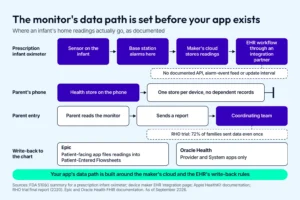
A prescription or a DME rental picks the infant’s monitor before a pediatric remote monitoring app exists. The app’s data path then gets built around the oximeter maker’s cloud and the EHR vendor’s write-back rules.
The home monitoring devices in play arrive through those channels. Both infant pulse oximeters below are prescription devices, and HCPCS codes home apnea monitors as DME rentals: E0618 without a recording feature, E0619 with one.
Readings sit in the maker’s cloud, and the phone’s health store belongs to its user
Start with what the device makers actually document:
- Masimo Stork (prescription). Masimo’s 510(k) summary (K223721, December 15, 2023) puts the physiological data in a Stork Cloud and lists remote access to monitored data, but describes no clinician portal, EHR interface or third-party data access. The Stork App it lists is the maker’s own companion app, the pattern our companion app development guide walks through.
- Owlet BabySat (prescription). Owlet’s Owlet Connect page (January 15, 2026) names SpO2 and pulse rate reaching EHR workflows through Rhapsody’s FHIR and HL7 pathway. It doesn’t document alarm events, an update interval or an API.
The phone’s own health store won’t close that gap. As of September 2026, Apple’s HealthKit documentation gives each device its own store and says an app can’t save characteristic data such as date of birth, which only the user edits in the Health app.
It describes no way to store a dependent’s data, and the infant is that dependent. For Bluetooth LE and background sync on the devices you do control, see our medical device companion app development guide.
In a funded trial, readings arrived only when parents sent them
The RHO trial ran from November 2013 to December 2017 and is reported in its PCORI final report (2020). It monitored premature babies’ oxygen levels at home with a Masimo Rad-8 carrying a data recorder and a removable memory card.
After each 4 to 7 day recording period, parents emailed downloaded reports to a data coordinating center, or mailed the card.
Here’s how that held up:
- 72% of intervention families sent data even once
- families averaged 2.4 reports a month against a target of about 4
- technology problems, like the oximeter not recording or uploads failing, were the top obstacle at 25%
Every step a parent had to take was a point where reports stopped arriving.
Write-back to the chart depends on the EHR vendor
As of September 2026, the two largest vendors document different paths:
| Epic | Oracle Health | |
| Which apps can file readings | An app with a patient-facing UI, via Observation.Create into Patient-Entered Flowsheets | Provider and System apps only |
| Conditions | The app’s primary user type is Patients, the patient has an active MyChart account the hospital provisions, and an RPM program order triggers account linking from MyChart | Vital-sign writes need a Practitioner as performer; pulse-oximetry writes are still under development |
| What’s undocumented | How a MyChart proxy, such as a parent acting for an infant, launches the app or files readings | A write path for patient-facing apps |
Normalizing all of it into HL7 and FHIR is its own project, and our medical device integration guide covers it.
Red-flag alerts trade sensitivity against sleep, and the phone is a secondary channel
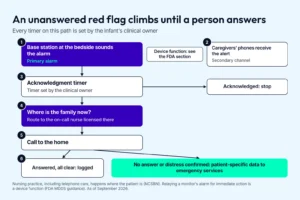
No alarm setting catches every event without false alarms, and no phone notification is guaranteed to arrive. So red-flag alerts in a post-discharge monitoring app sound at the monitor first, reach the phone as a secondary channel, and climb a ladder of acknowledgment timers until a person answers. FDA’s 2023 De Novo order for the Dream Sock lists false negatives, false positives and over-reliance as separate risks.
Threshold and delay set how many alarms a family lives with
Herrick and colleagues’ 2022 study in JAMA Network Open simulated alarm counts from the home oximeter data of 20 preterm infants with moderate to severe bronchopulmonary dysplasia in their first 4 weeks after discharge, half on nasal cannula and half on room air. The counts are simulated, and the gap is still striking:
- 90% limit, no delay (the authors’ institution’s typical setting): a median 23.1 alarms per 8 hours
- 80% limit, 15-second delay: under 1
That’s alert fatigue and caregiver burden in one comparison, and the right setting belongs to each infant’s clinician. Store threshold and delay as per-infant settings, with who set them and when.
Keep the alarm on the base station, because no phone notification is guaranteed to arrive
Cleared monitors already put the phone second. In Owlet’s BabySat 3 (510(k) K222597, cleared June 2023), the audible and visual alarms sit on the base station, and the mobile app receives alarms remotely.
The phone belongs in second place:
- Delivery on iOS. Apple’s push service stores one undelivered notification per app, so a later routine push can replace a red flag on an offline phone.
- Sound on iOS. Sounding through mute or Do Not Disturb takes Apple’s Critical Alerts entitlement, which Apple grants by request form with no published eligibility criteria (as of September 2026).
- Sound on Android. An alert channel can bypass Do Not Disturb once the parent grants the app Do Not Disturb policy access.
Whether that relay makes your app a device function is covered in the FDA map below.
Escalation climbs a ladder of timers until a person answers
Every rung before the last has an acknowledgment timer and a named next rung, and the alert keeps climbing until someone acknowledges it.
A 2025 Nemours economic study of home monitoring for children with tracheostomies proposes one version: a 24/7 center calls the home when a ventilator or oximeter alarm stays unresolved for 30 seconds, and an unanswered call or confirmed distress sends patient-specific data to EMS. Those 30 seconds rest on specialist opinion for that population, so treat them as that pediatric RPM program’s number.
For your program, the ladder runs like this, with each timer set by the infant’s clinical owner:
- The monitor alarms at the bedside base station.
- The alert reaches caregivers’ phones as a secondary channel.
- If no one acknowledges it in time, the on-call nurse licensed where the family is calls the home.
- If no one answers or distress is confirmed, patient-specific data goes to emergency services.
Parent-facing functions and time-critical alerts fall outside the clinical decision support boundary: the FDA line, function by function
As of September 2026, FDA’s clinical decision support guidance of January 29, 2026 says software that supports or provides recommendations to patients or caregivers meets the definition of a device, and that FDA intends to stay consistent with its existing policies when regulating it. For a parent-facing app, the clinical decision support boundary covers less than most teams hope, so place each function on its own. For the CDS criteria, the FDA wellness vs device line and clearance pathways, see our health AI FDA clearance guide.
Sending the alert to a nurse keeps it a device function. Example 24 in the same guidance covers software that analyzes hourly pulse oximetry and heart rate to flag deterioration for a clinician, and FDA calls it a device because it analyzes a pattern and supports time-critical decisions.
Function by function:
| Function | Where it sits (as of September 2026) | What moves it into device territory |
| Logging | Storing and displaying readings: not a device (MDDS). Vital-sign trending: enforcement discretion (Appendix B) | Generating alarms from the readings (MDDS) |
| Medication reminders | Enforcement discretion when parent-configured (Appendix B) | The app calculating the dose |
| Unit display | Not addressed by FDA | Recomputing the labeled volume, which we treat as dose math |
| Dose or feed recalculation | Dose: device function, by the closest FDA example (Example 28). Feed recipe: not addressed by FDA | Dose: already there. Feed recipe: a 513(g) question |
| Growth chart and weight tracking | Weight plot: not addressed, closest to vital-sign trending. A parent-facing off-course flag: device function (CDS guidance) | Adding the flag |
| Symptom logging and guidance | Checklist advising when to consult a clinician: enforcement discretion (Appendix B) | Advice specific to this infant (CDS guidance) |
| Signal-based alerts | Device function, whether it alerts the parent (CDS guidance) or a clinician (Example 24) | Already there |
| Alarm relay | Readings shown for later review: not a device. Alarms relayed for immediate action: device function (MDDS) | Intent that a caregiver act immediately |
Appendix B belongs to FDA’s Policy for Device Software Functions and Mobile Medical Applications (September 28, 2022, still current as of September 2026), and enforcement discretion means a function may be a device FDA doesn’t intend to enforce against. Example 28, a patient-facing bolus insulin calculator, is the closest FDA example for a parent-facing weight-based dose tool.
If your functions land in the device rows, you have two routes:
- Let a cleared monitor keep the alarm. The app only stores and displays the monitor’s readings, which isn’t a device under FDA’s MDDS guidance of September 28, 2022.
- Ask FDA. Under the Q-Submission guidance of May 29, 2025, classification questions go in a 513(g) Request for Information. Other questions can go in a Pre-Sub, with written feedback targeted within 70 days and no user fee.
A 513(g) request costs $8,596 in FY2027, or $4,298 for a small business.
There is no single care team after discharge, so the care team dashboard routes by role and by state
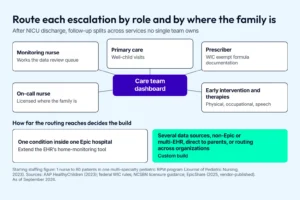
The care team dashboard routes every escalation by role and by the state the family is in. How far that routing reaches past one EHR decides whether you extend the EHR’s own tool or build.
Follow-up splits across services, so every escalation needs a named owner. Per the AAP’s HealthyChildren page (updated January 2023), premature infants may need early intervention plus physical, occupational and speech therapy. WIC sits outside the team too: federal rules require a licensed prescriber’s documentation for exempt infant formula, and premature birth qualifies, so the dashboard carries a prescriber task.
Extend Care Companion when the whole program runs inside Epic
Epic’s EpicShare reports (vendor-published, September 2025) that in July 2021 CHOP added a MyChart Care Companion care plan to its infant single-ventricle monitoring program. Caregivers enter the baby’s daily weight, oxygen saturation, heart rate and intake in MyChart. For an Epic hospital running one condition-specific program, that’s the proven path.
A custom build earns its cost when:
- parent data arrives from several sources
- the buyer runs a non-Epic or multi-EHR environment
- the product goes direct to parents, as a special needs baby care app sold outside a hospital would
- escalations cross a care team the EHR doesn’t own
Route each call to a nurse licensed where the family is
As of September 2026, NCSBN’s guidance says nursing practice happens where the patient is, including telehealth and telephone care. A nurse advising an out-of-state family by phone or video visit needs a license there. So the dashboard logs the family’s location at each contact, routes to a nurse licensed in that state, and flags when none is on shift.
Nurse review sets the staffing
Lori Erickson, PhD, NP, director of Remote Health Solutions at Children’s Mercy Kansas City, says its single-ventricle home monitoring program has “always a nurse or nurse practitioner looking at that data proactively.” So the dashboard is a review queue, sized by how many patients one reviewer carries. Cincinnati Children’s centralized RPM nursing team reported a 1:80 nurse-to-patient ratio across multi-specialty pediatric programs (Journal of Pediatric Nursing, 2023).
Someone has to fund the nurse who reviews the data
That review time needs a payer:
- No readmission penalty. Children’s hospitals are excluded from Medicare’s inpatient prospective payment system under 42 CFR 412.23(d), so readmission reduction stays an aim with no penalty behind it.
- Grants. A 2012 CMS Health Care Innovation Award gave Women & Infants Hospital of Rhode Island $3,261,494 for transition services to families of premature and high-risk infants.
- Narrow Medicaid coverage. The September 2026 Texas Medicaid Provider Procedures Manual covers telemonitoring for clients 20 and younger only with end-stage solid organ disease, an organ transplant or mechanical ventilation.
RPM billing codes, CMS rules and rates are in our remote patient monitoring app development guide.
Pediatric PHI and proxy access start with who deploys the app
Who deploys a NICU-to-home app decides which privacy regime the infant’s data answers to, before anyone writes an access rule. As of September 2026:
| Hospital-deployed | Direct-to-parent | |
| HIPAA status (OCR’s 2016 app scenarios, fact-specific) | An app the provider contracts with is its business associate | An app the parent chooses isn’t a business associate |
| Federal rule | HIPAA | The FTC Health Breach Notification Rule, whose definitions reach apps that track medications, vital signs or symptoms |
| Washington’s My Health My Data Act | Exempts HIPAA PHI and data intermingled with it; other health data the vendor collects isn’t exempt | Can apply to the app’s health data |
Business associate agreements and safeguards are covered in our HIPAA compliant software development guide.
Legal authority over the infant’s care and family ties are separate questions, and pediatric PHI access follows legal authority. Under 45 CFR 164.502(g), the provider treats the infant’s personal representative as the infant, and that’s whoever holds authority under applicable law to make the infant’s health care decisions. A parent usually does, though being a parent isn’t enough on its own. Under 164.510(b), an involved relative gets only the PHI directly relevant to that involvement, with the representative’s agreement, and 164.506(c)(2) covers disclosures for a home nursing agency’s treatment.
Three roles follow:
- Full proxy access for whoever holds legal decision authority
- A narrower, scoped view for other caregivers, opened by that person’s agreement (parental consent, in plain terms)
- Treatment access for home nurses
Authority can also move after discharge. ONC’s 2026 Pediatric Health IT Developer Informational Resource notes it can change with foster care entry or divorce and recommends access control that follows court orders without a new release (Recommendation 7), plus segmentation so a parent’s access doesn’t expose protected maternal information such as substance use (Recommendation 8).
The NICU-to-home app development checklist, staged by regulatory risk
For neonatal care app development, release in three versions ordered by regulatory risk. Items that wait on FDA or Apple start early and are marked long lead.
V1: capture, education and secure messaging
- Keep every parent-facing V1 function on the not-a-device or enforcement-discretion side of FDA’s line.
- Meet your accessibility deadline (as of September 2026): WCAG 2.1 AA by April 26, 2027 for public entities serving 50,000+ people under ADA Title II, and May 11, 2027 for HHS-funded recipients with 15+ employees under Section 504. See parent design.
- Settle who deploys the app, which decides whether HIPAA applies.
- Build in telehealth support and reminders, two of Vermont Oxford Network’s Potentially Better Practices for Follow-through (2020), for the months after the first visit.
- Long lead: request Apple’s Critical Alerts entitlement now; an Apple staff forum reply (July 2025) says no prototype is needed to apply. See alert delivery.
V2: device data
- Map each monitor’s path out of its maker’s cloud.
- Decide between extending the EHR’s own home-monitoring tool and a custom build.
- Long lead: if alert functions land on the device side, request a Pre-Sub during V2. See the FDA map.
V3: clinician in the loop
- Define reviewers and review frequency, a per-parameter escalation threshold and an off-hours plan, as a 2022 pediatric RPM review in Pediatrics recommends. That’s the threshold owner in practice.
- For device functions, include section 524B cybersecurity content (a software bill of materials and a vulnerability plan) in the premarket submission.
- Keep the monitor’s base station as the primary alarm and the phone as a secondary channel.
- Staff and fund the escalation path, routed by role and state, per the care team section.
Turn on the first clinician-set alert only when every V3 item is in place.
Build your NICU-to-home app with Topflight Apps
If your program is one condition inside one Epic hospital, the EHR’s own home-monitoring tool may cover it. A custom build earns its cost when parent data arrives from several sources, when the buyer runs a non-Epic or multi-EHR stack, when the product sells direct to parents, or when escalations route across a care team the EHR doesn’t own.
We’ve built the care-team side before. Topflight Apps built Dedica Health, a remote patient monitoring platform for a cardiology practice: patients use certified medical sensors at home, and physicians and assistants review vitals and message patients on a dashboard. The parent-facing guidance side has a precedent too. A founder built a pregnancy and postpartum platform on Specode, Topflight Apps’ sister platform, with a warning-signs tool that tells patients to wait, call, or seek care and a provider portal with a shared patient panel.
If you’re scoping a NICU discharge app, start with a working session. We’ll begin from your discharge population and who answers when a threshold trips, work through care coordination with the checklist above as the agenda, and finish with a build scope.
Frequently Asked Questions
What is a NICU-to-home app and who uses it?
It carries a clinician-set care plan home. Parents of infants discharged on oxygen or a feeding tube log readings and get guidance, and a care-team role reviews the data and responds.
How is it different from a consumer baby-tracking app?
A clinician sets its alert thresholds for the infant’s condition, and a care-team role responds. Consumer trackers log for parents, and over-the-counter monitors alert parents on a preset range.
Does a NICU-to-home app need FDA clearance?
It depends on the function. Logging, reminders and when-to-call checklists sit outside device oversight or under enforcement discretion. Parent-facing flags, dose recalculation and signal-based alerts are device functions, and feed-recipe math needs a regulatory opinion.
How do home monitoring devices connect to the app?
Through paths set before the app exists. The device maker’s cloud decides which readings leave it, and each EHR vendor decides whether a parent-facing app can write them back to the chart.
Who can access an infant's health data in the app?
The person with legal authority for the infant’s care, usually a parent, gets full access, and other caregivers get a narrower role. OCR’s December 3, 2025 letter made parental access an enforcement priority.
How do you prevent alert fatigue for parents?
Let a clinician set each infant’s threshold and delay, keep the monitor’s own alarm primary with the phone as a secondary channel, and route unanswered alerts up a ladder until a person answers.