

Fitness app development cost 2026: all figures below were checked and updated October 2026.
Fitness app development cost in 2026 breaks into three bands: $45K to $75K for an MVP, $120K to $200K for a mid-complexity app, and $250K to $450K for a full AI coaching platform. Year-1 running costs add 50 to 75% of the build on top. How much does it cost to make a fitness app that earns its cost back? That depends on the band you’re in.
Today’s users expect real-time data, TikTok-grade UX, and personalization that doesn’t scream template. This guide unpacks the real numbers behind a feature-rich fitness app, no fluff, no vendor spin.
From MVPs that actually retain users to backend traps that quietly bleed your runway, we break down what founders wish they knew before the first commit. Read this if you’re budgeting seriously, or pitching investors who can do math.
How much does it cost to build a fitness app?
$45,000 to $75,000 for an MVP in 12 to 16 weeks, $120,000 to $200,000 for workout plans, nutrition, and a paywall, and $250,000 to $450,000 for a full AI coaching platform. Add 50 to 75% of the build cost for year-1 running expenses.
Key Takeaways
- How much does it cost to create a fitness app in 2026? $45K to $75K for an MVP, $120K to $200K for a mid-complexity build, and $250K to $450K once AI coaching and compliance enter the spec.
- Year-1 running costs land at 50 to 75% of the build: cloud, maintenance, store fees, and compliance.
- Cutting costs without cutting corners means reusable components, a scoped MVP, and kill switches, each priced with real numbers below.
What we’ve seen on real fitness builds
- A fixed-price prototype in about a month for $25K, real code and all.
- Cutting a fitness MVP from 12 features to 5 lifted activation 35%.
- Walker Tracker went from 2.3 to 4.6 stars, then got acquired by Terryberry.
- Rework dropped 60% on our last health tracker project.
Table of Contents
- Fitness app development cost at a glance
- Fitness app development cost by complexity
- Fitness app development cost by app type
- Fitness app feature cost breakdown
- Key factors that influence fitness app development cost
- Ongoing and hidden costs of running a fitness app
- Native vs. cross-platform: how your tech choice changes the cost
- Fitness app developer rates and team costs in 2026
- Reducing the cost of fitness app development without sacrificing quality
- Is a fitness app profitable? ROI and break-even math
- How Topflight stretches your development budget
Fitness app development cost at a glance
One table rules the rest of this page: MVP cost, timelines, and year-1 running expenses, reconciled so every section references the same numbers.
| Tier | Example scope | Build cost | Timeline | Year-1 running cost |
|---|---|---|---|---|
| MVP | Auth, workout logging, Apple HealthKit / Health Connect sync, push reminders | $45,000–$75,000 | 12–16 weeks | $30,000–$60,000 |
| Mid-complexity | Workout plans, nutrition tracking, subscription paywall, social basics | $120,000–$200,000 | 5–7 months | $70,000–$120,000 |
| Full-scale AI platform | AI coaching, leaderboards, social loops, compliance (SOC 2 / HIPAA) | $250,000–$450,000 | 8–12 months | $150,000–$300,000 |
Assumptions: cross-platform build (Flutter or React Native), US or near-shore team, October 2026 rates. Year-1 running covers cloud, support, maintenance, and compliance.
Not sure which tier fits your scope? A fixed-price prototype settles it in about a month, before you commit to a band.
Fitness app development cost by complexity
Remember those pitch-deck slides promising a “$30K fitness MVP in six weeks”? Cute. In 2026 the baseline has moved: AI snacks, Apple Health sync, and social loops are table stakes.
Below is the unvarnished budget reality, broken down by phase, with line-item numbers you can actually plug into a spreadsheet.
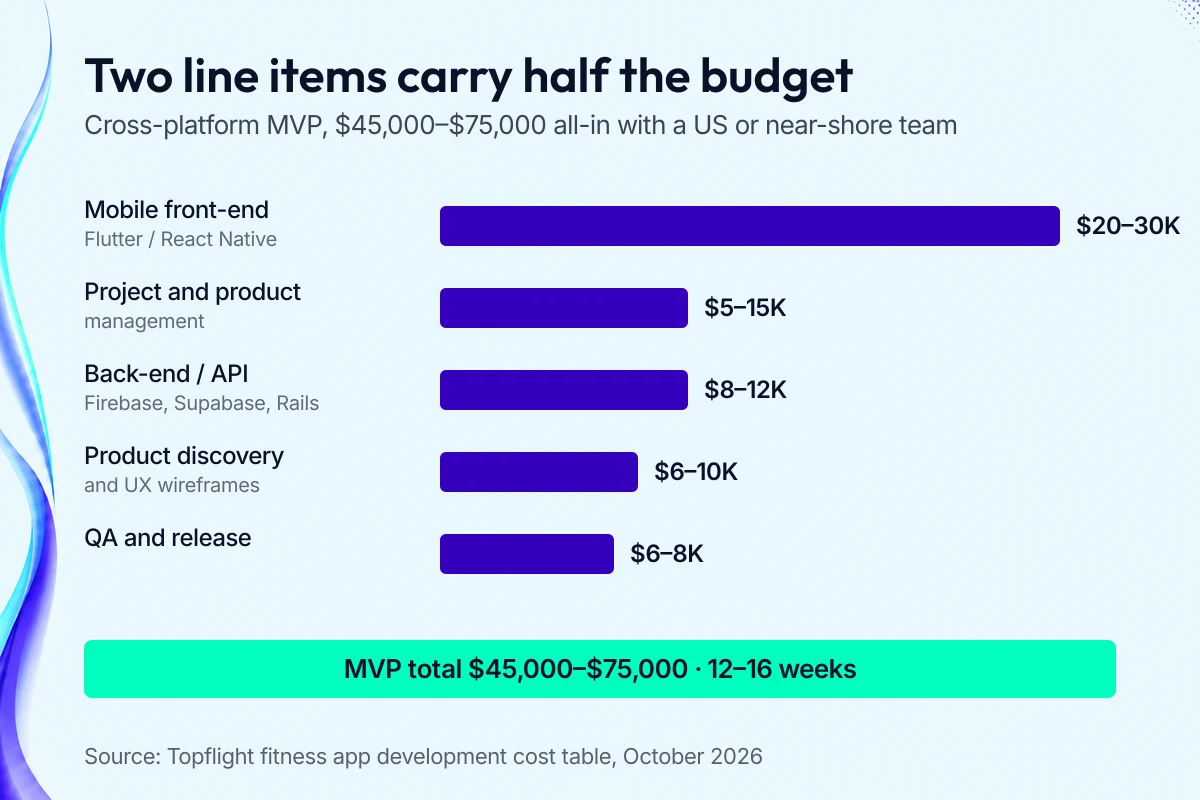
Front-end and discovery alone take more than half of a $45K-$75K MVP budget.
MVP fitness app: basic functionality and costs
Typical scope: user auth, workout logging, Apple HealthKit / Android Health Connect sync, push reminders.
Reality check on your fitness app development cost: $45K–$75K for a cross-platform build by a US or near-shore team (12–16 weeks).
Cost estimation break-down
- Product discovery and UX wireframes: $6–10K
- Mobile front-end (Flutter/React Native): $20–30K
- Back-end/API (Firebase, Supabase, or Rails): $8–12K
- QA + release: $6–8K
- Project and product management: $5–15K
Line items sum to $45K–$75K. Assumptions: cross-platform, US or near-shore team, October 2026.
That’s lean, but not bargain-bin, software development. Skip usability testing and you’ll pay the difference later in 1-star reviews.
Medium complexity: adding workout plans and nutrition features
Once you bolt on templated workout plans, macro tracking, and barcode scanning, complexity, and therefore mobile app development hours, jumps 50 to 70%. Expect $120K–$200K and a 5- to 7-month timeline.
Budgeting red flags:
- Licensed food database: $999/yr for Edamam or $1,200/mo for a USDA premium API.
- Workout plans CMS: off-the-shelf SDKs run $300–500/mo; custom rules engine ≈ $15K one-off.
- Contingency buffer: add 10% for unexpected edge cases (e.g., Android power-saving kills background sync more often than you’d think).
Nail your scope early. Complexity creep turns workout plans into a budgeting workout of their own.
Full-scale fitness apps: advanced features and their price impact
Here’s where costs vault to $250K–$450K. Why? You’re layering advanced features: AI coaching chat, real-time leaderboards, personalized workout recommendations, and viral social loops, all to drive user engagement.
Price multipliers:
- AI workout app development stack:
- OpenAI GPT-4o usage: $2.50 per 1M input tokens, $10.00 per 1M output (OpenAI pricing, October 2026).
- Vector DB reads/writes to serve personalized workout content.
- Realtime sockets and video form-checks: extra $20–30K back-end spend.
- Community feed and moderation tools: $15–25K for report queues, AI toxicity filters, etc.
Advanced features crank up infra bills but, done right, keep churn below 3% MoM.
Bottom line: Pick your tier from the table above, then plan the compliance stamps, infra safety nets, and AI layers your users never see. They’re the budget killers, and they’ll ambush your runway if you don’t.
Fitness app development cost by app type
How much does it cost to make a fitness app depends first on what kind of app. Six archetypes, one table, with MVP, v1.0, and year-1 running costs.
| App type | MVP | v1.0 | Year-1 running |
|---|---|---|---|
| Activity tracker | $45,000–$75,000 | $90,000–$150,000 | $30,000–$60,000 |
| Workout and training | $60,000–$100,000 | $130,000–$200,000 | $70,000–$120,000 |
| Nutrition and diet | $55,000–$95,000 | $120,000–$180,000 | $60,000–$100,000 |
| Coaching platform | $60,000–$100,000 | $130,000–$200,000 | $70,000–$120,000 |
| Connected hardware | $100,000–$180,000 | $250,000–$400,000+ | $100,000–$250,000+ |
| AI coach | $120,000–$180,000 | $250,000–$450,000 | $150,000–$300,000 |
Bands as of October 2026; cross-platform builds, US or near-shore teams. MVP is the smallest sellable scope, v1.0 the full launch.
- Activity trackers lean on phone sensors and cost the least; the fitness tracker guide covers the build.
- Workout and training apps add exercise databases and plan logic on top of a tracker’s skeleton; the fitness app guide walks through it.
- Nutrition apps pay for food databases and barcode scanning; see the diet and nutrition app guide.
- Coaching platforms pair programs with a human or AI layer, which is where retention lives; the wellness app guide covers the coaching-adjacent territory.
- Connected hardware means BLE sensors and regulatory surface; the wearable app guide and heart monitoring app guide cover it.
- An AI coach starts higher because of inference, guardrails, and personalization infrastructure; see the AI fitness app guide.
Which row is yours? Cross-check it against the tier table at the top before you quote anyone a number.
Fitness app feature cost breakdown
Feature packs drive budget more than slogans. Use these bands for planning; actual spend depends on scope, platform, and QA surface.
Feature complexity cost breakdown
Features don’t burn budget equally. Use this as a planning lens. It kills the “one sprint” fairy tale.
| Complexity tier | Typical features | Engineering cost drivers | Integration / policy landmines |
|---|---|---|---|
| Low (usually cheap, predictable) | Email/password auth, basic onboarding, static programs, CMS content pulls, push notifications, basic streak counters | Auth flows, session/state, basic analytics, notification setup, lightweight CMS models | Store review copy, privacy prompts, data retention defaults |
| Medium (where estimates drift) | Subscription paywall (App Store/Play) with Stripe for web; refunds, proration, EU SCA; workout builder with templating + offline media; social basics (follows, simple leaderboards, abuse reporting) | IAP edge cases, receipt validation, proration logic, SCA flows, offline sync, media caching, basic moderation pipelines | ATT/consents, subscription policy changes, backend consistency under partial connectivity, abuse handling expectations |
| High (budget multipliers) | Continuous BLE streaming (HRV, cadence), real-time coaching, lossless offline sync; advanced personalization/LLM coaching with rationale logs and safety rails; deep wearable graphs (WHOOP/Polar/Garmin) with rate-limit-aware caching & conflict resolution | Native bridges (HealthKit/Health Connect/BLE), background processing, queuing/retry strategies, telemetry, model hosting/guardrails, vendor rate limits | Health data restrictions (no ads on HealthKit), PHI classification/storage, audit logging, store rejection risks for “medical” claims |
Fitness app development cost breakdown by feature complexity tier, October 2026.
Where founders blow budget:
- Feature soup at v1 (too many “must-haves”),
- Underestimating native bridges (BLE/HealthKit/Health Connect),
- Ignoring App Store/Play policy and fee knock-ons.
Use it right:
- Declare your tier per feature in the backlog.
- Gate high-tier items behind milestones with real data.
- Kill anything that breaks your margin story or compliance posture.
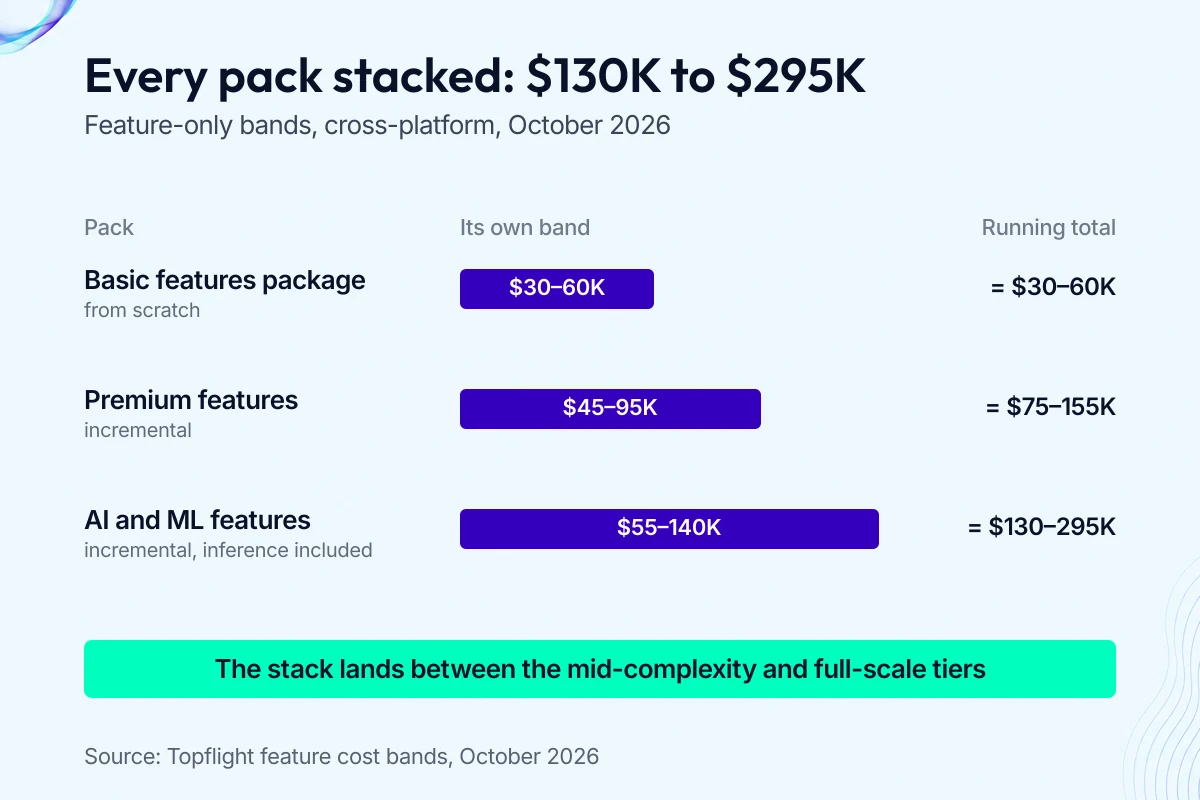
Stack every pack and the feature bill lands between the mid-complexity and full-scale build tiers.
Basic features package cost
The “no-drama” bundle most MVPs start from: account creation, onboarding, simple workout logging, CMS content pulls, push reminders, and baseline analytics. Durable scaffolding you won’t rip out later.
Typical build band (from scratch): $30K–$60K (cross-platform)
If added to an existing codebase: $18K–$35K
Feature build only: excludes discovery, QA, and PM. From-scratch bands.
What nudges cost up or down:
- Design fidelity (template vs. bespoke micro-interactions) and agreed QA matrix.
- Analytics depth (events only vs. experiment-ready) and whether activation metrics are wired now.
- CMS shape: static content vs. structured programs you’ll query and sort.
- Notification complexity (simple reminders vs. segmentation and quiet-hour logic).
Scope guardrail: excludes subscription paywalls, rich builders, and social loops. That lives in “Premium.”
Premium features investment
Adds the engagement and revenue engine: paywalls across App Store/Play + Stripe web, a workout builder with offline media, and community basics (follows, simple leaderboards, abuse reporting).
Typical build band (incremental): $45K–$95K
Incremental on an existing codebase.
Why the spread:
- Workout planner complexity (templating, periodization, offline caching): $40K–$65K if bespoke.
- Community + moderation (reports, queues, toxicity filters): $15K–$25K add-on.
- IAP/web billing edge cases (refunds, proration, EU SCA, receipt validation) expand integration/QA time.
- Video form-checks or realtime sockets can add $20K–$30K in back-end work.
Ongoing tail: larger QA matrix and store/billing policy drift. Retest purchase and receipt flows on every SDK or policy change.
AI and ML features pricing
Recommendation loops, AI coaching chat, embeddings/vector search, and guardrails. Cost depends on vendor-only wiring vs. hosting bespoke components.
Typical build band (incremental): $55K–$140K
Incremental; inference figures as of October 2026.
Key drivers:
- Model inference costs (scale with chat/usage).
- Vector DB + retrieval (storage/ops grow with content and embeddings).
- MLOps/observability for pipelines, evals, and monitoring (~$4K–$8K/month once live).
- Guardrails & moderation (extra services and review workflows for user-generated prompts).
Ongoing tail: monthly inference + experimentation budget; ship behind flags to cap blast radius.
Wearable integration costs
From health aggregators to premium device SDKs to custom BLE hardware.
Typical build bands (per integration):
- HealthKit / Health Connect baseline: 1–2 weeks.
- One premium device (e.g., Fitbit/Garmin/WHOOP): 2–4 weeks for SDK + UX.
- Custom BLE device: roughly 2× a standard SDK (protocols, buffers, retries).
Hidden edges to budget for:
- Device QA matrix (firmware variants, offline-sync conflict resolution).
- Consent scopes and platform rules (e.g., no ads tied to HealthKit data; no PHI in iCloud).
- Rate-limit-aware caching if you aggregate multiple vendor APIs.
Use these bands to price what you’re adding; pair them with your overall approach and timeline to keep the budget honest.
Key factors that influence fitness app development cost
Behind every feature-rich fitness app is a stack of invisible decisions that quietly multiply the cost to develop a fitness app. Here are the usual suspects, with numbers.
UI/UX design: custom vs. template approaches
Let’s start with the shiny stuff. Yes, killer UI/UX is what users remember, and what blows up timelines fast.
A fully custom design built in Figma and implemented via native Swift/Kotlin or Flutter can inflate sprint estimates by 20–30% compared to template-based builds. Why? Every animation, transition, and micro-interaction needs pixel-perfect tweaking and QA across devices. That slick 3D progress ring or animated streak counter? That’s a few extra dev days right there.
On the flip side, template approaches using libraries like FlutterFlow’s prebuilt UI packs or React Native Paper shave both time and cost but limit your visual identity, and can feel generic fast. If your brand lives and dies by experience (think apps like Peloton, Future, or WHOOP), custom is table stakes.
Bottom line: UI/UX design is where many founders underestimate the true cost to develop a fitness app.
Testing & QA: the hidden expense of quality
Spoiler: bugs don’t just vanish because your devs are “senior.” You pay for quality upfront, or later, in poor reviews and churn.
At scale, fitness app development demands multi-platform, multi-device testing. That includes regression, usability, load, and smoke testing. And real devices matter when testing step counters, haptics, or Bluetooth sync, on top of emulator runs.
Expect to budget $4–6K/month for full-suite QA, including BrowserStack, Firebase Test Lab, and manual regression testing across common iOS/Android devices. Add another $2–4K/month if you’re running automation with tools like Appium or TestRail.
If you’re using offshore development services, double-check the QA process. In some shops, “QA” means one guy clicking around at 5 PM. A rigorous development process includes daily smoke tests, bug triaging, and integration coverage.
Skimping on QA is deferred disaster. Run a real cost analysis of what user trust costs to regain.
Third-party integration expenses
Want to sync steps from Apple Watch, pull HRV from WHOOP, or gamify workouts with badges like Strava? Welcome to the wearable app development rabbit hole. Integrations with wearable devices add 1 to 3 sprints each, and the vendors take a slice every month after that.
Beyond the build, plan for the run rates (all checked October 2026):
- App Store and Google Play fees: 15% up to $1M/year for small developers; terms differ by region and product type.
- Payments: Stripe card processing in the US runs about 2.9% + $0.30 (Stripe pricing).
- Messaging: Twilio SMS in the US starts around $0.0083 per message (Twilio pricing); WhatsApp differs by template and session.
- Health data rules: Apple bans using HealthKit data for advertising and storing PHI in iCloud. Violations mean rework and delays.
Pro move: list each integration with its build effort, unit economics, and policy constraints, then kill anything that breaks your margin story.
Localization & accessibility: global reach, hidden budget
Localization means adapting entire flows to right-to-left scripts, tweaking visuals for long strings (hello, German), adding voice-over for vision-impaired users, and haptic feedback cues for accessibility.
Complying with WCAG 2.2, building keyboard navigability, and integrating iOS’s VoiceOver or Android’s TalkBack features adds real overhead across design, dev, and QA.
Each new language adds:
- ~1 week of UI review and copy QA
- Potential rewrites for culture-specific flows (e.g., BMI norms differ by region)
- Additional testing cycles on device-specific settings
If you’re serious about global reach and inclusive user experience, factor in an extra 10–20% on top of your original build estimate. Most devs forget this until users in Dubai or Tokyo start dropping support tickets.
That’s your cost anatomy, unwrapped. Most pricing calculators don’t go here because it’s messy and unglamorous. This is where your fitness app budget lives or dies.
Trying to guess integration costs? Don’t. Let us gut-check your scope before BLE syncing eats your budget alive. Schedule a call now.
Ongoing and hidden costs of running a fitness app
Year-1 running costs typically land at 50 to 75% of the build cost, and a lean MVP can hit 80% because the fixed costs don’t shrink with the build. That’s cloud, maintenance, compliance, store fees, and the AI inference bill, and most quotes leave all of it out.
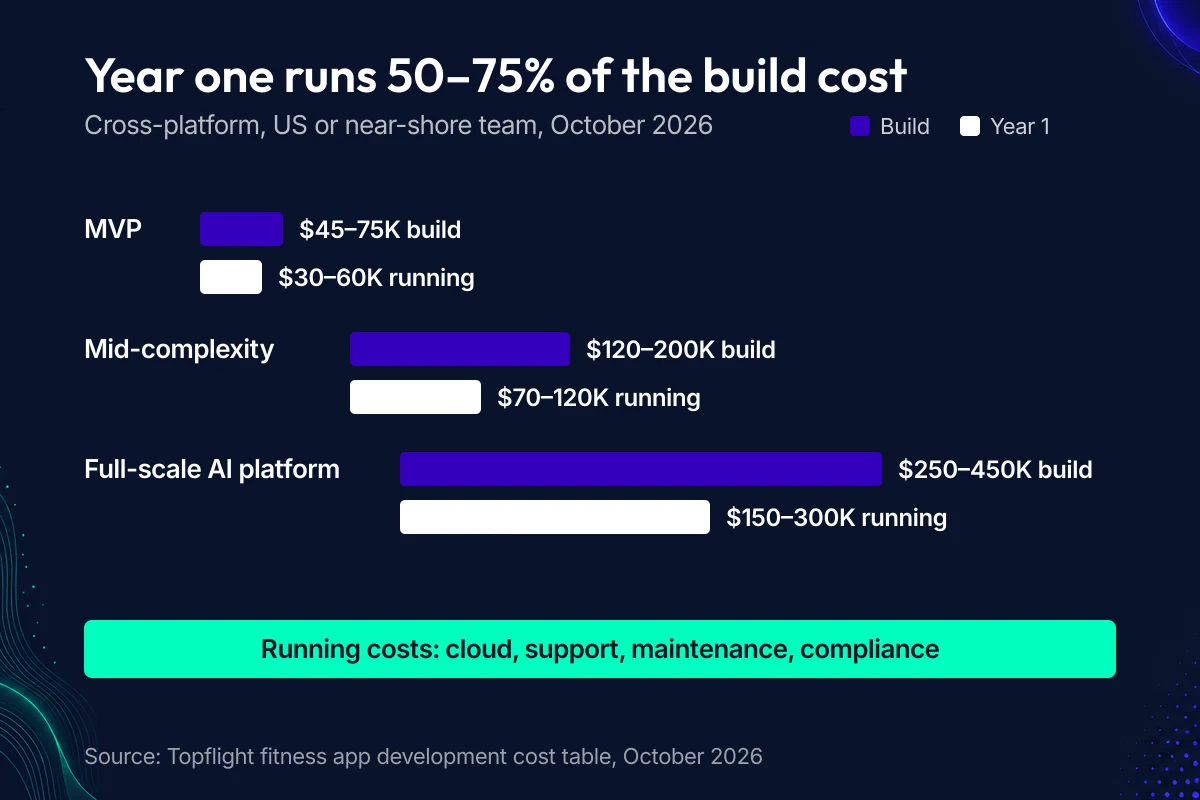
Year-1 running costs land between half and three-quarters of what the build cost.
Ongoing maintenance considerations
You shipped the app. Great. Now the real work begins.
Ongoing maintenance covers API updates, OS upgrades, edge cases on new Android devices, and keeping up with user expectations (read: TikTok-level UI polish). Think $2–6K/month depending on your velocity and stack.
And features are never done. You’ll tweak workout algorithms You’ll tweak workout algorithms, redesign onboarding flows, A/B test reward systems, and experiment with AI personalization. All of that hits your budget over time.
Smart teams reduce long-term burn by modularizing code, using CI/CD pipelines, and prioritizing telemetry-driven updates over vanity features.
Maintenance isn’t optional. It’s the tax you pay for staying relevant. To keep that tax predictable, treat maintenance as a first-class program with owners and a budget of its own, separate from new work.
- Release management: plan feature updates on a predictable cadence; ship behind flags; keep a parallel hotfix lane.
- Support matrix & deprecation windows: set minimum supported OS/SDK/device/watch versions and announce sunset dates before users break.
- Security & compliance: rotate keys/certs, patch dependencies on a cadence, re-verify HealthKit/PHI data paths, and keep audit logs queryable.
- Store & billing resilience: re-run IAP/receipt/subscription tests after SDK/policy changes; watch proration/refund edge cases.
- Observability & SLOs: define crash-free and cold-start targets; cap logs/metrics to avoid runaway costs; run post-incident reviews.
If it’s not on a maintenance Kanban with named owners, it won’t happen until it breaks in prod.
Backend infrastructure & cloud architecture: the pay-as-you-go trap
You might start lean, but your backend won’t stay cheap.
Auto-scaling databases, real-time notifications, and third-party observability tools quietly compound over time. That free-tier Firebase? It’s a gateway drug.
Here’s what typically lurks under the hood (ballpark prices, October 2026):
- AWS RDS + S3 + CloudFront for a basic media-heavy app: $500–2K/month
- Datadog Pro at 5M logs/day: about $3K/month (Datadog pricing)
- Firebase Cloud Messaging + Firestore + Functions at scale: easily hits $1.5–3K/month once you have 100K+ MAUs
- Sentry for error tracking: $400–1K/month (Sentry pricing)
And guess what? These total cost factors spike long before you hit revenue. Many founders don’t notice until the AWS bill looks suspiciously like a Series A check.
Want to scale wisely? Architect for load from day one, or face costly replatforming later.
Hidden costs: security, compliance, and cloud bills
That glossy quote rarely mentions the 10–30% uplift hiding in the weeds of app development costs. Watch for:
- SOC 2 Type II audit: $10K–$150K (most seed-stage teams land in the $40–50K band).
- HIPAA readiness (if you ever touch PHI): $12–50K for startup-sized orgs.
- AWS Shield Advanced: flat $3K/mo before data-transfer fees (AWS pricing, October 2026).
- Encrypted S3 + KMS calls: pennies per 10K requests, but they add up at scale.
- Snowflake on-demand warehouse: $2–3/credit; an idle XS cluster left running 24/7 ≈ $430/mo (Snowflake pricing).
Skimp here and a single breach wipes out your entire marketing budget, and maybe the company.
Budgeting for AI and personalization layers
Vector search, custom embeddings, and recommendation loops tack on a brand-new cost stratum. For web development in your project, pencil in $4–8K/month just for infra + MLOps:
- Vector DB storage: Pinecone Standard $0.33/GB/mo or Weaviate Serverless $0.095 per 1M vector dims + $25 base (Pinecone, Weaviate, October 2026)
- Model inference: GPT-4o runs $2.50 per 1M input tokens and $10.00 per 1M output (October 2026); a mid-size fitness app doing 50K AI chats/day burns about $1.2K/mo.
- GPU cluster for fine-tuned models: a rented A100 at $1.80/hr, or another $1.3K/mo if kept warm 24/7.
- Feature flag and experimentation tooling (Optimizely / GrowthBook): $200–800/mo.
Yes, personalization boosts LTV, but be ready to defend that MRR-vs-GPU line item when board meetings roll around.
Native vs. cross-platform: how your tech choice changes the cost
Selecting a tech stack is less like picking ice cream flavors and more like choosing the right tool for the job. Native Swift or Kotlin, or a Flutter or React Native build: each choice moves performance, time-to-market, and budget differently.
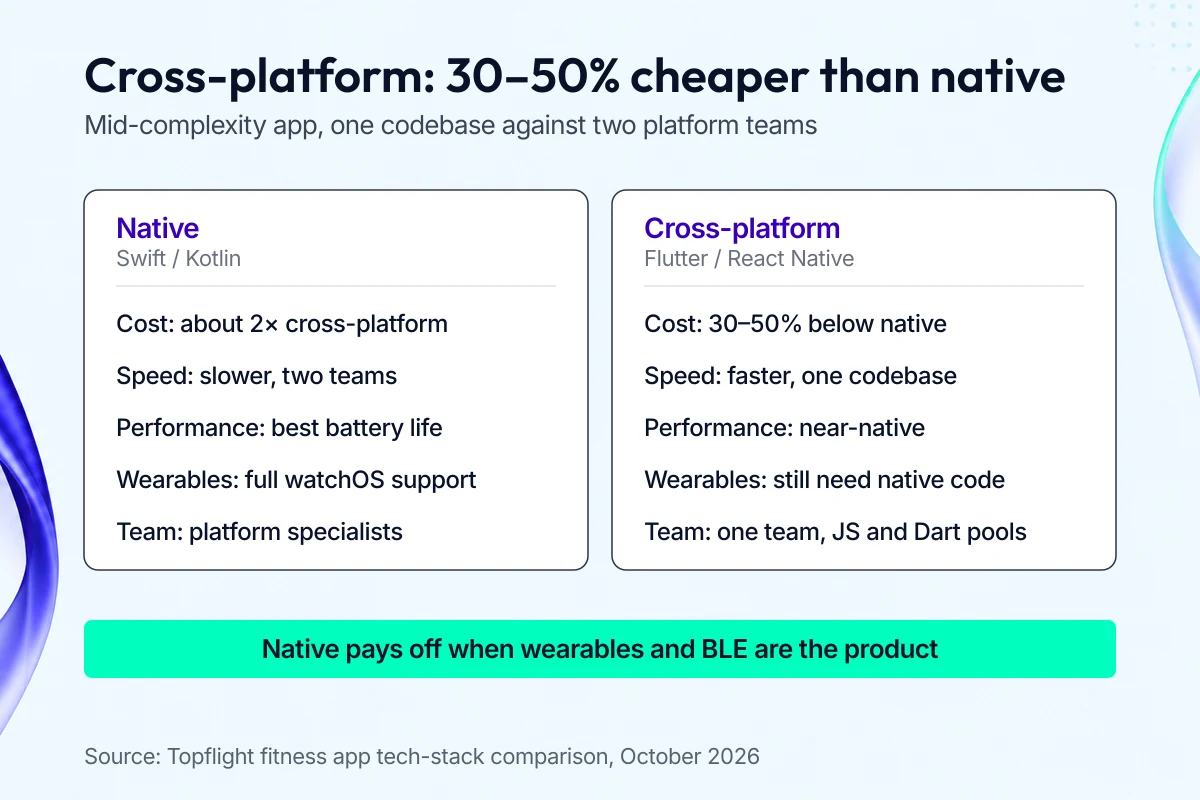
Native costs about double; cross-platform saves 30 to 50% until wearables and BLE enter the scope.
Platform choice impact on budget
Your platform bet sets both your velocity and your burn. Native (Swift/Kotlin) wins when you need tight HealthKit/WatchOS hooks, low BLE latency, or buttery haptics. Cross-platform (Flutter/React Native) buys you one codebase, but count on native modules for anything non-trivial (BLE, HealthKit/Health Connect quirks, watch surfaces), which dilutes savings over time. PWAs are fine for marketing, not for high-fidelity sensors and offline coaching.
Quick calls:
- iOS-first can be cheaper for health/fitness MVPs when Apple Watch + HealthKit is core; App Store distribution and HealthKit privacy rules are predictable (but strict).
- React Native/Flutter still need bridges (Native Modules / Platform Channels) for BLE streaming, sensors, and some wearables. Budget time for that glue.
- WatchOS adds a second UI surface and sync path; don’t conflate that with “free” if you choose Flutter/React Native: watch apps are native.
- EU distribution is evolving: App Store fees and rules are shifting under DMA. Budget legal and product time on top of engineering.
Native development: when performance is a priority
Native apps (Swift/Kotlin) deliver unbeatable user experience but typically double the cost of developing a fitness app compared to cross-platform options.
Pros:
- Maximum performance and battery efficiency
- Precise integration with platform-specific APIs
- Optimal real-time data tracking and animations
Cons:
- Higher upfront costs
- Need specialized, platform-specific development team
If your budget can handle premium prices, native development ensures top-tier performance. Yes, the app developers you hire must be platform-specific specialists. Yes, it’s pricier upfront. But if you’re aiming for the absolute pinnacle of performance and have the budget, going native is the smartest money you’ll spend.
Hybrid & cross-platform apps: cutting down time and cost
Hybrid solutions like Flutter and React Native slash initial development costs by roughly 30–50%, speeding up your time-to-market.
React Native:
- Extensive JavaScript community speeds hiring and development time
- Massive ecosystem ideal to quickly fitness tracking app development
Flutter:
- Smoother performance due to its Dart-based ARM code
- Self-rendering UI engine for consistent visuals
- Faster release cycles
Ideal if you’re after rapid MVP launches without significantly compromising user experience, and a React Native team hires fast from a huge JavaScript pool.
Across stacks, the average cost of application development shifts more on team choice than framework choice. React Native offers abundant talent but risks costly native rework later; Flutter delivers balanced speed and performance with fewer hidden costs.
Can you build a fitness app yourself? No-code and AI builders vs. custom development
Build it yourself / no-code is a real option for the first version. FlutterFlow, Bubble, and AI app builders like Lovable get a workout-logging MVP into the app stores for a few thousand dollars and a few weeks, and a React Native template lands in the same price zone when a JS team is already on staff. Where they stall: wearable sync, subscription payments, and anything HIPAA-adjacent. Those need real code.
We took a Lovable prototype down the HIPAA path and wrote up exactly where the platform stops and engineering starts in the Lovable prototype to HIPAA-compliant app walkthrough. If the roadmap includes wearables, payments, or compliance, custom development wins.
Choose wisely. Your tech stack affects every sweaty workout your users tackle.
Still torn between Flutter and full native? Let’s talk it through over a quick call, before your dev bill doubles. Schedule a call now.
Fitness app developer rates and team costs in 2026
Your app’s budget lives or dies by who’s coding it. Here’s how the cost to build a fitness app breaks down by sourcing models (freelancers, agencies, in-house), location, and headcount.
Freelancers vs. agencies: who’s cheaper in the long run?
Freelancers
- Rates: $30–$80/hr for developing a fitness app, costs rise with complexity and region.
- Overhead: Add 10–15% management overhead from scratch if you’re coordinating freelancers individually.
- Pitfall: Lower hourly rates initially tempting, but costs inflate quickly due to hidden PM hours.
Agencies
- Bundled rate: $100–$150/hr in North America; $70–$100/hr offshore with an app development company.
- Pros: All-in-one: PM, design, dev, and QA baked in.
- Cons: Higher per‑hour, but often lower total bill thanks to fewer delays.
Quick math: A $100/hr agency doing 500 hrs = $50K. Freelancers at $50/hr may hit $37.5K, but budget ~60 hrs PM support and suddenly you’re looking at $60K. Ouch.
In-house vs. outsourced teams: pros, cons, and costs
| Team Type | Upfront Costs | Annual Burn | Pros | Cons |
|---|---|---|---|---|
| In‑House | +$4K hire cost ❗ | $120K–$160K/dev (salary, benefits) | Deep alignment with target audience, direct control | Slow hiring (1–2 mos), expensive overhead |
| Outsourced | ~$0 hiring | $300–$500/day/team of 3–5 | Faster ramp, no benefits | Misalignment risk; success depends on PM discipline 💣 |
Outsource MVP for speed and efficiency; selectively hire fitness professionals in-house once your app resonates strongly with your target audience.
Developer hourly rates by region and expertise
Median freelance rates, from Arc.dev’s 2026 survey of 5,302 developers (Arc 2026 freelance developer rates):
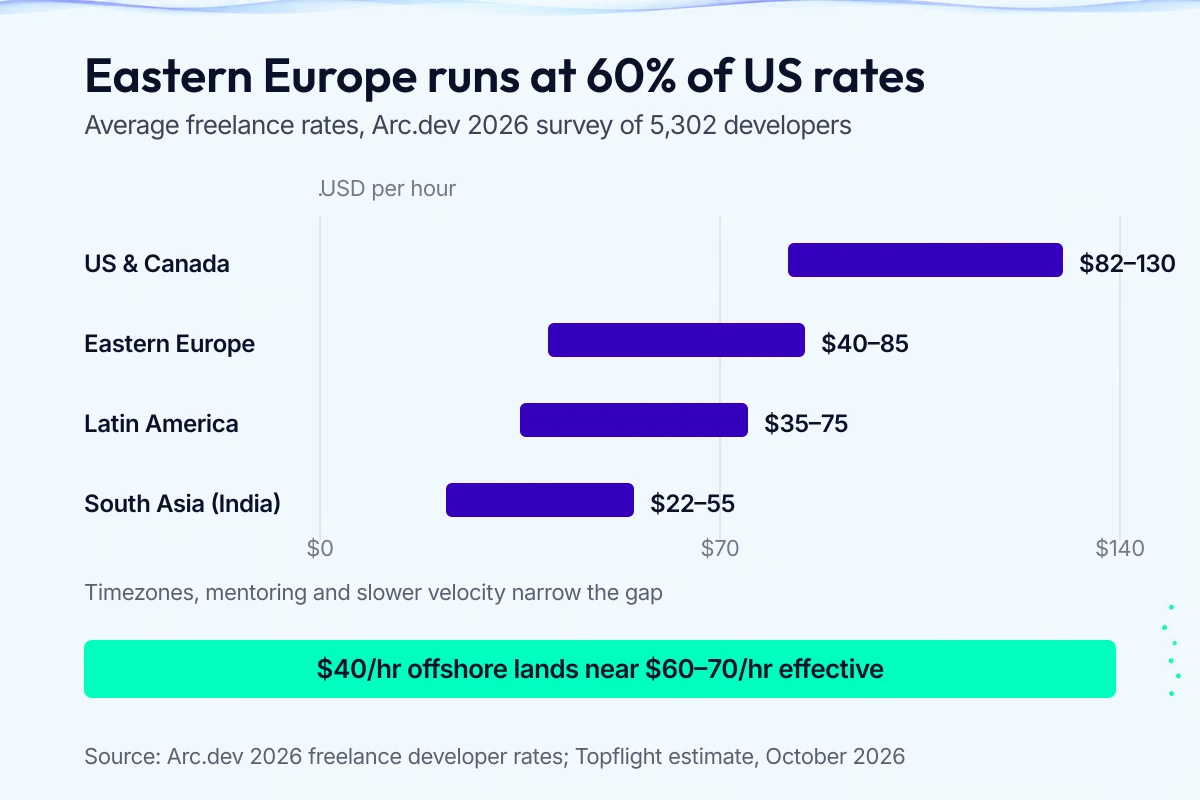
The cheapest hourly rate is not the cheapest team once timezones, mentoring and slower velocity are counted.
| Region | Average freelance rate (USD/hr) |
|---|---|
| US & Canada | $82–$130 |
| Eastern Europe | $40–$85 |
| Latin America | $35–$75 |
| South Asia (India) | $22–$55 |
DevOps teams reliably command a 15 to 25% uplift, because activity tracking and CI/CD pipelines are non-negotiable in wellness app development.
Reality check: Hiring a $40/hr India team doesn’t mean “half‑price.” Add timezone drains (PST/IST overlap ≈ 2 hours), mentoring, and slower velocity. Your effective cost could be ~$60–70/hr. Premium for PM and QA still applies.
How team size affects timeframes and expenses
- Solo or duo: Cheapest: $80–$120K for one senior dev for six months, but risky for ambitious fitness goals.
- Small team (3–5): $300–$500K/year; ideal for MVP or early beta.
- Mid-sized (6–10): $600K–$1M/year; multiplies parallel work but brings coordination politics.
Game plan:
- 🕒 Need it fast (e.g., holiday promotions)? Scale to 6–8.
- 💰 Need lean and precise? Stick to 3–4, invest in sharp PM, then add as you scale.
Remember: each extra head adds collaboration drag: about 10 to 15% extra coordination time.
Hidden roles: product, DevOps & compliance overhead
Think dev salaries are the whole story? Think again. Expect these roles to tack on 15–30% payroll overhead:
- Product Manager: $60–$120K/yr (depends on region); guides features, roadmaps, ensures in-app purchases convert.
- DevOps/SecOps: +18–25% rate premium; critical for activity-tracking backends and uptime.
- QA Automation: saves bug-sprouting chaos later, typically about 10% of engineering time.
- Compliance Lead: mandatory if you collect health data or run in-app purchases. Budget $20–40K/yr or hourly audit support.
Pitfall alert: Skimp on these, and you’re hemorrhaging risks. SOC 2, privacy laws, and audit-readiness are the ticket to play for serious fitness brands.
Need a team that scales and doesn’t drain your runway? Let’s build one that fits your burn rate. Schedule a call now.
Reducing the cost of fitness app development without sacrificing quality
Cutting corners is easy. Building lean and smart takes strategy, and a few budget-saving tricks we’ve battle-tested in the wild.
Starting with an evidence-based MVP (not just a feature diet)
Too many founders think cutting features equals reducing the cost to make a fitness app. Wrong. The real trick? Laser-focus your MVP on a single activation metric like daily active minutes or first-week progress tracking completion rates.
At Topflight, we once stripped a fitness app MVP from 12 features down to 5 after discovering through early user interviews that calorie logging had zero impact on retention. By doubling down on workout streak tracking, we saw activation spike 35%. Every sprint, revisit your activation metric. Kill anything that doesn’t move the needle.
Reusing certified components & open-source frameworks safely
Reusable components can drastically cut fitness and healthcare app development cost, but compliance can’t be compromised. Trust platforms like Expo, Twilio, and RevenueCat for their built-in security and reliability, but always verify.
Feature prioritization matrix: pain, proof, payoff
Every sprint, backlog items should pass through a ruthless prioritization matrix:
- Pain: Does this directly solve an acute user problem?
- Proof: Is there concrete evidence users want this?
- Payoff: Will this immediately impact revenue or retention?
When we launched Walker Tracker, our team found users consistently requested community challenges. Scoring high on pain (motivation), proof (user surveys), and payoff (engagement retention), we prioritized social challenges as a Tier-1 feature, increasing monthly active users by 42%. Skip nice-to-haves; ship the must-haves first.
Agile done right: sprint rituals that slash rework
Stakeholder scope creep is the fastest way to blow a budget. At Topflight, we enforce “story-point locks” to prevent inflation mid-sprint. If a feature is scored as a “5,” it’s non-negotiable unless reprioritized entirely in the next sprint.
Our demo-day definition of done demands fully tested, user-ready functionality. By holding ourselves rigorously accountable each sprint, rework dropped 60% on our last health tracker project, speeding up delivery and preserving budget.
Kill switches & A/B flags: cheap insurance against bad ideas
Remote configuration tools like LaunchDarkly let you phase features in gradually and keep experiments reversible.
Use phased rollouts when implementing personalized workout recommendations, activating the feature initially for just 10% of users. Early feedback will flag UI confusion, letting you pivot UI tweaks quickly before broader release.
A budget without a calendar is wishful thinking. Before locking costs, sanity-check the scope against realistic app development time. Our stage-by-stage breakdown for simple, mid, and complex MVPs will keep your estimates honest.
Is a fitness app profitable? ROI and break-even math
Are fitness apps profitable? Yes, when the unit math works. The cost of developing a fitness app only matters against what it earns back, so here’s the ROI side: scenarios, benchmarks, and the break-even count.
Scenario showdown: bootstrapped vs. VC-backed vs. enterprise pilot
Your funding model sets your risk tolerance as much as your runway.
- Bootstrapped teams often strip QA to the bone, reuse third-party APIs, and cross fingers during compliance audits. Hey, we’ve been there.
- VC-Backed startups build infra headroom early: Kubernetes clusters, event-driven analytics, and launch-ready CI/CD pipelines. Money buys time… and scalability.
- Enterprise Pilots burn slow but heavy: legal reviews, SOC 2 prep, procurement dance. It’s a longer sales cycle, but with higher average contract value (ACV).
Same idea, different tolerance for chaos.
ROI levers: LTV, retention, and monetisation mix
Let’s talk numbers your CFO actually cares about.
- Avg. LTV per paying user: $16.44 median, $31.12 top quartile (Health & Fitness, RevenueCat State of Subscription Apps 2025).
- Monthly churn (paid users): 5.3 to 6.0%, same report.
- 14-day ARPU (Health & Fitness): $0.44 median, $1.31 upper quartile, same report.
- Freemium conversion: about 2.5% of free users pay, same report.
For a paid app with decent retention, a 3-to-4x LTV-to-CAC ratio is achievable. Freemium needs scale, and ruthless onboarding.
Breakeven calculator: when will the app pay for itself?

Break-even lands at 12,105 payers, about 485,000 installs at a 2.5% conversion rate.
Let’s walk the math on a mid-complexity app (a worked example, not a market benchmark):
- CapEx (v1.0 Build): $150K
- Year-1 OPEX: $80K
- Avg. LTV per Paying User: $24 (weighted midpoint)
- CAC: $5
Break-even = Total Investment ÷ Profit per User
→ $230K ÷ ($24 – $5) = 12,105 paying users
If your conversion rate is 2.5%, you’ll need ~485K installs to hit breakeven. With 5%, cut that to 242K installs. Either way, acquisition costs can make or break your model.
For the investor deck, our planning numbers for a mid-complexity app: payback period 45 to 60 days, gross margin about 85% estimated, 12-month paid retention 33%. Format it visually. Paragraphs on slide 7 of 19 don’t get read.
How Topflight stretches your development budget
We spend on proof before polish: a time-boxed, fixed-price AI rapid prototype, reusable components over reinvention, pricing you can read from prototype to MVP, and sprints run against hard ROI metrics (retention, crash-free rate, conversion) so feature updates don’t turn into budget leaks.
Efficient development process
We move from concept to a working prototype in about a month on a fixed price, so you validate workflows before you bankroll a full build.
That prototype ships with real code, deployment, a discovery report, user journeys, a roadmap, and a design system: everything your team needs to estimate the MVP with eyes open.
What this buys you:
- Time box: ~1 month, fixed $25K for an interactive prototype (not slides).
- Risk kill: HIPAA-minded architecture and data flows from day one.
- Credibility: our prototyping track record spans 50+ healthcare apps and $135M+ raised by clients.
You’ll know the prototype cost upfront and what’s inside it. Because the prototype is real software, we can project effort per feature with less variance, on a documented path from POC to MVP to growth, with what you get at each step.
Pre-built component library savings
Where it fits, we move faster with reusable components you own and can extend. We have a decent library of fitness-app-ready modules that drop in cleanly and cut development cycles.
Components we commonly use:
- Notifications (in-app/email/SMS/push) with HIPAA-safe templates and preferences.
- Tracking & Outcomes (symptoms, mood, vitals, goals) that map well to fitness logging and progress views.
- Chat & Video Calls for coaching and support without reinventing secure comms.
Why it matters:
- Faster assembly + HIPAA-friendly patterns (if required).
- Clear code ownership; swap or extend components as your product matures.
ROI-focused development approach
We build for measurable outcomes: retention, ratings, conversion. Example: Walker Tracker moved from a 2.3★ rating to 4.6★, increased reviews 1.7×, and was later acquired by Terryberry (2022) after a focused mix of UX revamp, instrumentation, in-app review prompts, and modernized code.
How we drive ROI:
- Instrument first: Amplitude-backed experiments and a kill switch for risky prompts/features.
- Ship small, learn fast: staged rollouts and scheduled releases across iOS/Android.
- Reliability work as growth: refactors that reduce crashes and support load.
Light next step: if you want a grounded budget, start with the fixed-price prototype and we’ll scope MVP from that working foundation.
TCO: freelancer vs agency vs Topflight
Use this total cost of ownership view to sanity-check runway, hourly stickers included.
| Dimension | Freelancer stack | Traditional agency | Topflight |
|---|---|---|---|
| Team shape | You assemble designer + devs; PM is you (or you hire one). Coordination tax is real. | Bundled PM/Design/Dev/QA; fewer handoffs than freelancers. | Fixed-price AI Rapid Prototype → blended team; then MVP sprints. HIPAA-first by default. |
| Speed to validated prototype | Varies; often static mockups and ad-hoc code. | Design-led prototypes common; not always production-ready. | Working prototype in ~1 month ($25K) with real code, deploy, journeys, roadmap, design system. |
| Reuse / components | Mostly custom per feature. | Some internal libs; still heavy custom work. | Pre-built components (e.g., Notifications, Tracking & Outcomes, Chat/Video) reduce cycles; you own the code. |
| QA & compliance posture | Inconsistent; QA/automation and HIPAA discipline often light. | Standardized QA; compliance varies by shop. | QA baked in + HIPAA-friendly patterns from day one; audit-friendly artifacts ship with the proto. |
| Pricing clarity | Hourly; scope creep hides in coordination time. | Hourly/project; change orders common. | Clear: fixed prototype price → MVP estimate from a running codebase (less variance). |
| Example TCO signal | Lower sticker, higher hidden PM: your earlier calc shows $50/hr freelancers can land above an agency’s $50K once PM/overhead hits. | $100/hr × 500 hrs ≈ $50K (fewer delays vs. freelancers). | $25K validated proto + targeted MVP sprints; Specode, our internal code-generation toolkit, and HIPAA defaults reduce rework risk against generic agencies. |
| ROI proof | Depends on your rigor. | Depends on theirs. | Walker Tracker: 2.3★ → 4.6★, 1.7× more reviews, later acquired on the back of measured outcomes. |
| Example 12-month TCO (medium fitness app) | $240K | $280K | $210K |
If the metric is total cost of outcomes, start with a fixed-price prototype, then spend where the data says. Our model is built for that.
So that’s the full tour, from pricing landmines to break-even math. Pick a tier from the table at the top, budget the year-1 costs, and start with a prototype before you commit.
Curious what this all adds up to for your app? We’ll run the numbers for you, spreadsheets included. Schedule a call now.
[Reviewed October 2026]
Frequently Asked Questions
How much does it cost to build a fitness app?
Anywhere from $45,000 for a lean MVP to $450,000 for a full AI coaching platform. The mid-complexity band, with workout plans, nutrition, and a paywall, runs $120,000 to $200,000. Year-1 running costs add 50 to 75% of the build.
How much does it cost to develop a fitness app?
A lean MVP runs $45,000 to $75,000 and takes 12 to 16 weeks. Mid-complexity apps run $120,000 to $200,000, and AI coaching platforms run $250,000 to $450,000. Platform choice, team region, and feature depth move the number; all three are priced above.
How much does it cost to start a workout app?
A workout-logging MVP runs $45K to $75K. To spend less before you know the scope works, start with the $25K fixed-price prototype and scale from there.
How long does it take to build a fitness app from scratch?
Anywhere from 3 to 9 months depending on complexity. A simple tracker app can ship in 12–16 weeks; full-scale platforms with AI, wearables, and custom CMS take 6+ months.
How much does it cost to maintain a fitness app per year?
Roughly 50 to 75% of the build cost in year one: $30K to $60K for an MVP, $70K to $120K for a mid-complexity app, and $150K to $300K for an AI platform. Most of it is cloud, support, and compliance.
Are fitness apps profitable?
They can be, but only about 2.5% of freemium users convert to paid. A paid app with good retention can hit a 3-to-4x LTV-to-CAC ratio. The break-even math above shows the scale: a $150K build needs roughly 12,000 paying users at $24 LTV and $5 CAC.
Is it cheaper to build a fitness app yourself?
For a first version, yes: no-code and AI builders get an MVP live for a few thousand dollars. They stall on wearable sync, payments, and compliance, which is where custom development takes over.
How much does it cost to add AI coaching to a fitness app?
A first AI coaching layer runs $55K to $140K incremental on an existing app, mostly inference, vector search, and guardrails. A full AI platform built from scratch starts at $250K.
How do I monetize a fitness app?
Subscription revenue is the backbone for most fitness apps: freemium with in-app purchases, premium tiers, coaching upsells, and brand partnerships are the common playbooks. The trap is conversion: about 2.5% of freemium users pay, so the funnel needs volume.
Can I integrate wearable devices like Apple Watch or Fitbit?
Yes, but it’s not a toggle switch. Expect 1–3 sprints per integration, plus extra QA and compliance time. BLE syncing and real-time data bring edge cases you don’t want to underestimate.
Does a fitness app need to be HIPAA compliant?
Not usually. HIPAA applies only when you handle protected health information for covered entities or their business associates. A consumer fitness app that stays clear of PHI answers to the FTC Health Breach Notification Rule instead. If you do touch PHI, plan for BAAs, audit trails, and PHI-handling workflows from day one.
What's the best tech stack for fitness apps in 2026?
Flutter leads the cross-platform field for UX and dev hours. React Native is still viable for large JS teams, and native wins on performance. For health data, build on Apple HealthKit and Android Health Connect: Google Fit shuts down at the end of 2026.
Do I need separate apps for iOS and Android?
Not necessarily. With Flutter or React Native, you can build one codebase for both platforms. But if ultra-smooth animations or device-specific features are critical, native might still win.