

Last updated: November 18, 2026
If your partially built health platform is still “75% done” and the pilot date is approaching, a working demo can feel like permission to push ahead. You still need to know what it would take to turn that demo into a platform you can safely launch.
Start a healthcare software project rescue with an independent audit: establish what works and what you have access to. Assess the remaining work, then decide which modules to keep, fix or replace based on whether they can run reliably and meet applicable compliance requirements.
The 90-90 rule, attributed to Tom Cargill of Bell Labs, jokes that the first 90% of the code takes 90% of the time; the final 10% takes another 90%.
Visible screens can leave compliance, integration and audit infrastructure unfinished. Even getting control of the app’s store listing and hosting account can affect when the rescued platform is ready to launch.
Before you spend more on healthcare app development, use the audit checklist and salvage-versus-rebuild matrix alongside healthcare-specific failure checks and a vendor handover checklist.
Should you finish a partially built health platform or rebuild it?
Ask an independent team to verify which modules support the required clinical workflows and protect patient data in production. Keep the modules that pass. For each gap, compare repairing the existing code with replacing the affected module, including the work of moving data and keeping patient services available.
Key takeaways:
- Make a test release part of the handover. Ask an incoming engineer to deploy from the company’s repository in a safe environment. That shows whether the team can reproduce the build without help from the original developer.
- One failed control can change the plan for a single module. A team may need to replace audit logging if it can’t record who opened a patient’s chart. It can still keep the clinical data model if it fits the workflow.
- Compare bids for the same release. Ask both teams to price the same live patient workflow and security checks. Include any data migration and the cost of keeping patient services running during the switch.
Table of contents
- A software development project rescue starts by checking what works
- “75% done” still needs proof of production readiness
- The rescue audit needs a verdict for every module
- Salvage, refactor, or rebuild: decide one module at a time
- Healthcare-only problems can block a working release
- The rescue roadmap starts with access and stabilization
- Rescue costs depend on the work you can safely keep
- The healthcare software project rescue checklist starts with control
- How Topflight Apps can help
A software development project rescue starts by checking what works
A health app rescue is a software project rescue where the incoming team takes over a stalled, failing or abandoned build and tests what works to plan its release. In healthcare software development, that means proving the app handles PHI lawfully, meets applicable HIPAA Security Rule requirements, satisfies FDA rules for any medical device functions and connects to the EHR it needs.
At vendor handover, triage the stalled project. As in any IT project rescue, your remediation plan should identify code to stabilize and keep or refactor in place. Rebuild individual modules or the whole system if repairs fall short.
Consider a software development project rescue if you recognize these signs.
- You’ve heard “almost done” for 3 straight sprints without seeing what the team finished.
- The team ships less each sprint despite steady or rising headcount, so hiring alone may not help.
- Each fix introduces another bug, with no automated tests to catch it.
- You can’t get repository, cloud or app store admin access, so your next team can’t take control.
- The team can’t diagram where PHI goes, leaving you unsure who holds a copy.
- The vendor resists independent code review, leaving its progress claims unchecked.
- Key developers left without documenting the architecture, so their successors must piece it together.
- Your pilot partner’s unanswered security questionnaire is holding up its decision to proceed.
Can the incoming team release the build?
To test “almost done,” request the build and deployment files with exact tool versions. Have the incoming team demonstrate a release from those files in an agreed safe environment. That checks whether someone else can reproduce the build, as Google recommends in its release engineering guidance.
Ask Topflight Apps for an independent, fixed-scope rescue audit and a written verdict on each module.
“75% done” still needs proof of production readiness
“My app is 75% done” might describe working screens and demo flows. Before launch, verify security controls, audit trails, applicable signed BAAs, production integrations and required regulatory records.
Use the 75% iceberg across the platform. A mobile app audit adds store checks.
| What looks done | What still needs evidence |
|---|---|
| Web portal opens at your domain | Check who controls hosting and the domain. Watch the incoming team deploy from source in an agreed test environment. |
| Login screen works | Test multi-factor authentication (MFA), session timeout, role-based access control (RBAC) and account lockout. |
| Patient records display | Verify encryption at rest with managed keys and server-enforced field permissions. |
| “We log everything” | Run a query showing who accessed which PHI and when. Verify log reviews and consider immutable storage. |
| Push notifications and SMS send | Verify the messaging vendor’s signed BAA and channel coverage after handover. Twilio limits eligible SMS/MMS to US area codes, requires authenticated MMS media URLs and excludes WhatsApp. Apple advises excluding or encrypting sensitive notification data. Inspect payloads and remove PHI. Check Google Cloud resource metadata and Identity Platform custom attributes and claims for PHI. |
| EHR demo works | Demonstrate authorized exchange with production credentials in the customer’s configured EHR. Check Epic registration and deployment or applicable Oracle Health approval and provisioning. A sandbox or Epic listing leaves production unproven. |
| Analytics dashboard is live | Trace PHI flows. Verify signed BAAs for qualifying Mixpanel Enterprise and non-trial Sentry Business/Enterprise plans. Google Analytics for Firebase prohibits PHI and offers no BAA. Assess eligible Google Cloud services separately. |
| iOS app runs on TestFlight | Verify company control of the Apple Developer account and cloud hosting, or arrange transfer or migration. Apple’s ordinary App Store transfer requires Account Holder action, an eligible app and a released App Store version. Check capability-specific rules, exchange source and build files separately and confirm another route for TestFlight-only builds. |
| Android test build opens | For a Google Play transfer, verify both developer accounts qualify. Check access to linked services such as Firebase separately. |
| AI feature works | Request FDA classification analysis by function. For SaMD, inspect design history and applicable QMSR design and development records. |
Mark unshown items in the 75% iceberg as unverified and request proof. The next section shows how the twelve-domain rescue audit documents which modules to keep, fix or replace.

The rescue audit needs a verdict for every module
We start the twelve-domain rescue audit by checking ownership and access before inspecting an inherited codebase. Depending on scope, allow 1-3 weeks for a written report recommending which modules to keep, fix or replace.
When comparing code audit services, ask whether technical due diligence covers the controls in our HIPAA compliant software development guide. Agree on scope during the discovery phase.
Builder Alert. Before code review, verify company control of the AWS root, Apple Developer and Google Play Console accounts you use. Confirm continuing BAA coverage. Check intellectual property rights separately.
| Audit domain | What to check | Red flag | Typical verdict |
|---|---|---|---|
| Ownership and access | Repository admin, cloud root access, app store accounts, domains and contractual IP assignment. | Vendor alone controls AWS root, Apple Developer or Google Play. | Restore control first. |
| BAA chain | Identify vendors handling PHI across cloud, database, SMS, email, analytics, logging and video services. Confirm service and feature eligibility on AWS, Azure and Google Cloud. | Missing BAA or agency agreement that leaves a handover gap. | Preserve valid subcontractor chains. Sign new agreements or replace vendors to close gaps. |
| PHI data flows | Diagram PHI creation, storage, transmission, logging and deletion. For AI-assisted log review, see AI in healthcare compliance. | Unexpected PHI in logs, crash reports or staging databases. | Stop the exposure and check whether it requires a breach assessment. |
| Security controls | MFA, RBAC, encryption at rest, encryption in transit, key management and sessions. Check workforce permissions against applicable minimum necessary policies under HHS guidance. | Shared admin accounts or secrets in the repository. | Repair controls. Replace authentication if safe repair is impossible. |
| Audit logging | Query who viewed or changed which PHI, when and from where. Check risk-based tamper protection and applicable retention requirements. | Logs can’t be queried or show no trace of edits. | Repair logging. Rebuild if the logging layer can’t record the required events. |
| Data model | Check schema fit for clinical records and consent. Following AWS guidance, test cross-tenant access using actual tenant and application roles. | Unstructured patient data doesn’t fit the workflow, or tenants can read each other’s records. | Keep a suitable model. Plan migration for a replacement. |
| Code quality | Code quality audit of consistency and test coverage. Run SonarQube static analysis and a Snyk dependency audit for outdated libraries. | Investigate coverage under 20%, outdated frameworks or copy-paste code. | Verify clinical workflow behavior and module value before refactoring or rebuilding. |
| Architecture | Architecture review for scale, separation of responsibilities and cost of changing a monolith or microservices. | Mobile client business logic blocks changes. | Refactor or replace the affected component in stages. |
| Integrations | Check which exchanges the HL7 FHIR R4 endpoint supports. Test patient workflows with the app’s granted SMART on FHIR permissions. Verify medical device integration software, labs and payments. | EHR marked complete after sandbox testing alone. | Keep verified work and finish production exchange. |
| Infrastructure and DevOps | Environments, infrastructure as code, CI/CD, backups and restore tests. | Manual deploys or untested restores. | Fix deployment and recovery. |
| Regulatory | Check FDA SaMD status by function, clinical decision support exclusions and applicable design controls. Use ONC guidance to check whether information-blocking rules cover the party restricting interoperability. | Clinical algorithm lacks classification analysis. | Assess applicability before release. |
| Product and documentation | Match requirements and architecture documents to clinical workflows. | Team can’t explain a feature’s purpose. | Recover the rationale before changing code. |
If an EHR connector reads a patient record in a sandbox, the software audit may recommend keeping the code. Before release, demonstrate the same read with production permissions.
For technology due diligence, request the written report from the twelve-domain rescue audit. For each recommendation, ask what passed and what still blocks release. Weigh the module-level verdict in the matrix below.
Salvage, refactor, or rebuild: decide one module at a time
If you’re asking “should I rebuild or fix my app?” start with the module that’s holding up release.
- Keep a module whose behavior and data model fit the clinical workflow.
- Refactor a module you can safely repair.
- Replace a layer you can’t bring up to standard at a reasonable cost.
For a refactor vs rewrite decision, weigh all six signals together to reach the module-level verdict.
| Signal | Salvage (continue) | Refactor in place | Rebuild |
|---|---|---|---|
| Data model | Model verified against required clinical workflows. | Model mostly fits but needs a data migration. | Model can’t represent the clinical workflow. |
| Security and audit logging | Controls and logs pass verification. | Controls or logs exist but have gaps. | Design lacks controls or logging at its foundation. |
| Test coverage | Tests check required behavior and failure cases. | Few tests, but the code is readable. | No tests and unreadable code. |
| Tech stack | Current components with active support. | Dated components with a viable upgrade path. | End-of-life or niche components with no support or upgrade path. |
| Original developers | Original developers available for handover. | Some developers available for handover. | Developers gone and no documentation. |
| Cost to finish vs. rebuild | Under 40% of rebuild cost. | 40-70% of rebuild cost. | Over 70% of rebuild cost. |
Use the cost bands as planning guides. Estimate both options for the same workflows and operating requirements. Even a repair estimate under 40% needs a second look if the team can’t show how it will protect PHI.
If refactoring involves moving data with AWS DMS (Database Migration Service), allow time to reconcile pending or failed validation results and retest critical workflows.
Martin Fowler writes, “Test coverage is a useful tool for finding untested parts of a codebase.” Ask the reviewer to show what the tests verify when a workflow succeeds or fails.
Use NIST SSDF guidance in your technical debt assessment to check who maintains each component and what the team will do if it becomes unavailable or loses support. If the original developers are gone, see what your incoming team can reconstruct.
Our default is to keep working legacy code. Joel Spolsky explains why in Things You Should Never Do, Part I. Even awkward code can preserve fixes for bugs a new team would have to rediscover.
If access controls can’t protect PHI or logs can’t show who opened a record, compare the cost of fixing that layer with rebuilding it. We’d replace it if a safe retrofit costs more.
For a modular rebuild, Martin Fowler’s strangler fig pattern lets old and new modules coexist behind a stable interface. Switch one workflow at a time, keeping the old route available until patients can use the new one.

Instructional example. Rebuild authentication and audit logging if their designs can’t support the required controls. Keep the verified clinical data model and salvage the FHIR integration once it demonstrates the required exchange.

Ask Topflight Apps healthcare engineers for a rescue audit and a written recommendation for each module.
Healthcare-only problems can block a working release
A working build can leave PHI in a crash report or rely on a vendor agreement that ends at handover. Before release, verify who can handle that data and have the incoming team show how it will trace access and keep patient services running.
Check the BAA chain that will exist after handover
Start the HIPAA compliance audit with the accounts that will handle PHI the day after handover. If the agency holds the cloud account, you may find its name on the business associate agreement (BAA) with the provider. HHS cloud guidance allows that arrangement when the agreements cover the full chain from the covered entity through its business associate to the cloud subcontractor.
Inventory every vendor and service. For each one, check who signed the agreement and whether it still covers the service when the agency leaves. Where coverage ends, arrange a replacement agreement or migrate to a covered account.
Follow PHI into the tools around the app
Ask an engineer to trace one patient record beyond the production database. Look for copies in five places.
- Crash reporters that capture patient details with an error.
- Analytics SDKs that send patient details with an event.
- Application logs that record PHI during a request.
- Staging databases seeded with production data.
- Screenshots shared in Slack for debugging.
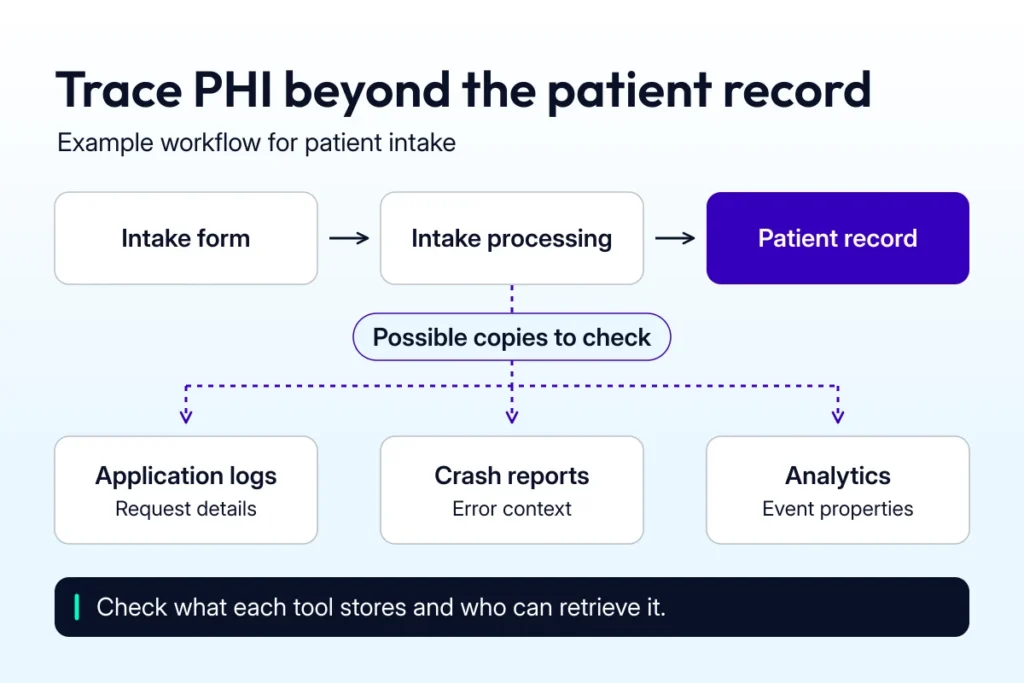
HHS guidance on safeguarding ePHI applies to those copies, too. Map each flow and check which service accounts can still retrieve the data. Stop the unwanted collection and work with incident responders to scrub existing copies.
For help putting controls around the flows you’ve identified, see our guide to HIPAA compliant app development.
An exposure finding needs a breach assessment
If PHI was publicly accessible or reached a vendor without a required BAA, involve counsel and incident responders promptly. The HHS Breach Notification Rule concerns unsecured PHI. An impermissible disclosure is presumed to be a breach unless an exception applies or a documented assessment shows a low probability that the PHI was compromised.
Document the answers to four questions.
- Nature and extent. Which PHI and identifiers were disclosed, and how likely is it that someone could re-identify the patients?
- Unauthorized person. Who used the PHI or received the disclosure?
- Acquisition or viewing. What evidence shows whether anyone actually acquired or viewed the PHI?
- Mitigation. How far did the response reduce the risk to the PHI?
When notice is required, the business associate must notify the covered entity, and the covered entity must notify affected individuals. Each must act without unreasonable delay and no later than 60 days after discovery, which can predate the audit report. Small breaches follow a separate annual deadline for reporting to HHS.
Ask the logs a patient-access question
“Who viewed this patient’s record last Tuesday?” Have the team run that query and show how it reviews access events. A sign-in log alone won’t tell you which record someone opened.
Under 45 CFR 164.312(b), systems that contain or use ePHI need mechanisms to record and examine activity. For the audit logging review, ask what protects entries from changes and how the team chose its data retention period. Have the team document the requirements and risks behind both decisions, including whether tampering risk warrants immutable storage.
Device features need the applicable design record
Start an FDA SaMD assessment with the intended use of each software function. The 21st Century Cures Act excludes qualifying clinical decision support functions from the device definition. Use our guide to health AI FDA clearance to work through the criteria.
For a function subject to design controls, ask for the design and test records made during development. A missing design history file is hard to reconstruct from a working build. The code can show what shipped, but it may tell you little about why the design changed or how the team tested it.
The FDA’s QMSR took effect February 2, 2026, and incorporates ISO 13485:2016. Retain relevant legacy records and identify any decisions the evidence can’t substantiate under the applicable design and development controls. Include available IEC 62304 software lifecycle evidence for the device functions under review.
Prove the EHR connection in production
A sandbox demo leaves the production EHR integration unproven. If the handover cites App Orchard or points to an Epic Showroom or Connection Hub listing, ask for the Epic app registration and the customer’s deployment records. A listing can’t tell you whether that site has enabled the app.
- Verify required Oracle Health (Cerner) provisioning and approvals.
- Check the customer’s Oracle configuration.
- Confirm the production client ID and tenant for either EHR.
- Demonstrate the patient workflow’s authorized data exchange in production.
For implementation steps, see how to integrate with Epic EHR.
Keep patient services running during stabilization
Before handover, identify the workflows patients need that day. For each one, ask who’ll see a failure and who can make an urgent fix. Keep those services running with monitoring in place.
Discretionary feature work can pause while the team handles patient-safety or security fixes. Start broader refactoring once the critical workflows are stable.
Separate the proposed Security Rule from current duties
An inherited security plan may treat proposed changes as overdue fixes. The January 2025 HHS notice of proposed rulemaking would require a technology asset inventory. It would also require MFA and encryption with limited exceptions.
Those changes remain proposed. Assess the platform against the HIPAA Security Rule in force today, and label work tied to the proposal separately so the team knows which gaps it needs to fix for release.
The rescue roadmap starts with access and stabilization
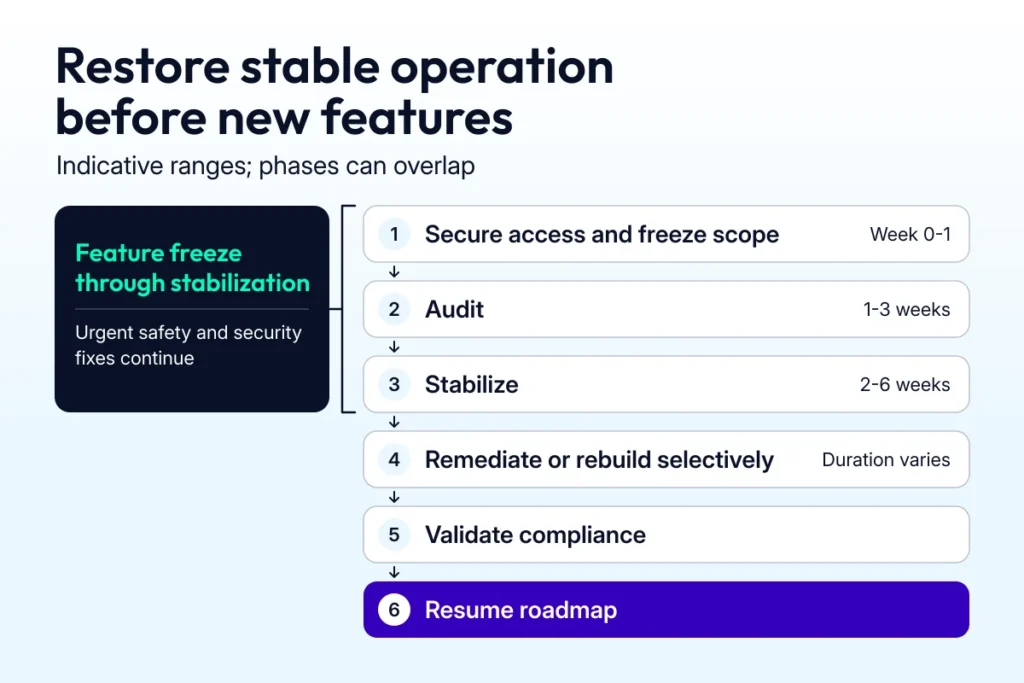
Before you switch app development company, confirm who controls production and can restore patient access if login breaks. Use the audit verdicts to schedule module repairs around the workflows patients rely on. Phases can overlap, and timing depends on scope.
- Secure access and freeze scope (week 0-1). Transfer accounts to your company through each provider’s handover process. Check which live services use each credential before rotating it. Hold the feature freeze through stabilization. Each new feature adds behavior to diagnose and retest. Leave repairs and urgent patient-safety or security fixes outside the code freeze.
- Audit (1-3 weeks). Ask for a written rescue audit report covering all twelve domains. Each module gets a keep, fix or replace verdict with the evidence behind it.
- Stabilize (2-6 weeks). Fix critical security gaps and set up monitoring. Following Google SRE guidance, have the team reproduce a build and demonstrate a tested release through CI/CD. Which signal would trigger a rollback? Set up backups and review their logs. To test backup integrity as NIST recommends, restore a copy and run a patient workflow on it.
- Remediate or rebuild selectively (duration varies). Follow each module’s verdict. Where a live workflow can move independently, use the strangler fig pattern. Run both versions side by side until patients can use the new route.
- Validate compliance. Complete the HIPAA security risk assessment and penetration testing. Confirm the BAA chain for vendors handling PHI. If a buyer also asks for a SOC 2 report, see our SOC 2 healthcare startups guide.
- Resume the roadmap. Once the team can release safely, restore patient workflows and show that the agreed compliance checks passed, use backlog triage to choose the first new feature.
Rescue costs depend on the work you can safely keep
The cost to rescue a health platform depends on which modules you can reuse and which gaps still block a safe release. Use the audit to compare the cost of closing those gaps with the cost of delivering the same patient workflows in a new build.
What you paid the previous agency is a sunk cost. Suppose your pilot needs a clinician to open a patient record in Epic. One proposal stops at a working screen. The other includes authorized access in the pilot site’s production EHR and a log of who viewed the record. Ask both teams to estimate that second outcome so you can compare their proposals.
| Work | What to include in the estimate |
|---|---|
| Audit | Agree on which repositories and environments the team can inspect, what the written report will cover for each module and any fee for the review. |
| Stabilization | Which live services need urgent fixes and how the team will demonstrate a safe release and a working restore. |
| Targeted remediation | Which modules need repair or replacement, what depends on them and which patient workflows need retesting. |
| Full rebuild | Recreating the agreed workflows, migrating and validating patient records, restoring production EHR connections and keeping the live service available during the switch. |
Ask each team what sets the time to market and what you’ll have to support after launch. If both systems will run during migration, include the cost of supporting both when you compare total cost of ownership. When comparing fixed-price vs time and materials proposals, ask which assumptions would change the bill.
Our guides to healthcare app development cost and app development costs can help you scope a new build. For the platform you already have, ask Topflight Apps for an audit that identifies what you can keep and what still needs funding.
The healthcare software project rescue checklist starts with control
If your app developer disappeared, you’ll need proof of ownership and working access to take over a healthcare app from another agency.
Ownership and access
- Secure company admin control of cloud, app store, domain and third-party accounts through the provider’s approved role change, app transfer, account assignment or migration.
- Verify cloud account ownership. An AWS assignment requires recipient-controlled root credentials and updated account details. If the account holds PHI, the recipient’s own AWS BAA must cover it immediately upon transfer.
- For an eligible app with an App Store release, get the outgoing Account Holder’s transfer confirmation. Record the route for TestFlight-only builds. Collect source and build files separately.
- Confirm both accounts qualify for the Google Play Console transfer. Verify access to linked services separately.
- Verify source code ownership against the written IP assignment. Under 17 USC § 204, the owner or authorized agent must sign a copyright transfer unless it occurs by operation of law.
- Following OWASP guidance, inventory all credentials and secrets by owner and dependent service. After handover, rotate credentials in an order that keeps those services running. Revoke outgoing access, including active temporary sessions.
HIPAA and PHI
- Match the PHI flow map to the signed BAAs covering each business associate and subcontractor after handover.
- Check the BAA termination terms. Confirm the outgoing vendor returned or destroyed its PHI copies where feasible. If neither is feasible, document why. Under HHS rules, the vendor must protect retained PHI and limit further use or disclosure to that purpose.
Code and architecture
- Get repository access to the full codebase and its commit history. A source-only ZIP omits that history. After a GitHub transfer, review retained collaborators, webhooks, secrets and deploy keys.
- Collect the architecture docs, API docs and environment setup instructions.
Integrations and regulatory
- Save proof of authorized production EHR exchange for each customer. Where device design controls apply, file the function’s design and test records. Mark any gaps.
Team and process
- Hold knowledge transfer sessions with any developers still reachable. Following Google’s SRE guidance, trace a patient request together. Sign off once incoming engineers can set up and run the service using the docs.

Put ownership clauses in your next vendor contract. Escode describes source code escrow as depositing agreed source and build materials with a neutral third party. Specify when it must release them.
How Topflight Apps can help
When a development partner calls your health platform “75% done,” you still have to decide what to fund. Our software audit services give you a second opinion on which parts you can safely keep.
We take over and stabilize React Native, Flutter and web codebases. For unfinished EHR integrations, we can complete FHIR data exchange and verify SMART on FHIR permissions in your customer’s Epic or Oracle Health environment. For a live rebuild, we use the strangler fig pattern to replace one workflow at a time while patients keep using the platform.
How we audit. Our fixed-scope rescue audit covers twelve domains, starting with ownership and access. We trace PHI data flows and check the BAA chain for gaps in vendor coverage. Our HIPAA review also examines audit logging and security controls. Those findings shape the written keep, fix or replace verdict for each module. Your project recovery plan tells you which work to tackle first.
Our SoberBuddy case study shows how we took over a shaky prototype and rebuilt the app. Medpike’s co-founders described the migration of their previous team’s code as “exceptionally clear and well explained.”
If you’re considering software project rescue services for a partially built health platform, ask our healthcare app developers for an independent rescue audit before you fund another sprint.
Frequently Asked Questions
My health app is 75% done. Should I finish it or start over?
Audit the modules before you decide. Finish modules whose behavior you can verify and whose remaining gaps you can safely fix. Replace an individual module if its design can’t support the clinical workflow.
What is a software project rescue?
An incoming team takes over a stalled build and tests which modules it can finish or needs to replace. In healthcare, that includes verifying that clinical workflows run safely and meet applicable privacy and regulatory requirements.
How do I know if my healthcare software project needs a rescue?
Seek an independent review if sprints pass without a demonstrable release or each fix breaks another workflow. Ask an incoming engineer to build from the repository and demonstrate a release in a safe environment.
What does a code audit for a healthcare app include?
The twelve-domain audit starts with ownership and access. Alongside automated code checks, reviewers examine architecture, the data model, infrastructure and integrations. They trace PHI flows and review the BAA chain, security controls, audit logging, regulatory obligations and product documentation. The written report gives each module a verdict and the evidence behind it.
How long does a software project rescue take?
Allow roughly 1-3 weeks for the audit and 2-6 weeks for stabilization, depending on scope. Those phases can overlap. “75% done” tells you little about how long the remaining repairs will take.
How much does it cost to rescue a partially built health platform vs. rebuilding it?
A rescue estimate depends on what the audit shows you can safely reuse. Ask for two estimates covering the same patient workflows and release requirements. Include data migration and the work of keeping patient services online wherever either option needs them.
When is it better to rebuild than refactor?
Rebuild a module when you can’t repair it safely or when replacement meets the same requirements at a lower cost. For example, a data model that lets one clinic see another clinic’s patient records may need replacement even if its screens work.
My app developer disappeared. How do I get my code and accounts back?
Start with your signed IP and account records to establish what your company controls. Request the full repository and commit history, then verify the build files. Use each provider’s recovery, transfer or migration process for the accounts.
Can a new agency take over a HIPAA-compliant app built by another vendor?
Yes, if the new agency has the rights and access to operate it. Map where PHI will flow after handover. Check the signed BAAs covering those services and test that the safeguards still work.
What happens to the BAAs when I switch development vendors?
Keep agreements that still cover the services handling PHI and replace any that leave a gap. When a BAA ends, confirm the outgoing vendor returns or destroys the PHI it holds where feasible. If neither is feasible, protections continue and further use or disclosure is limited to the reason for retention.
What if the audit finds that PHI was exposed?
Involve counsel and incident responders promptly to assess the PHI and identifiers involved, who received them, whether anyone viewed or acquired them, and how far the response reduced the risk. An impermissible disclosure of unsecured PHI is presumed a breach unless an exception applies or a documented assessment shows a low probability of compromise. Where notice is required, business associates must notify covered entities and covered entities must notify affected individuals without unreasonable delay and within 60 days of discovery, which can predate the audit report. Small breaches have a separate annual HHS reporting deadline.
Do I need technical due diligence before investing more in a vendor-built health platform?
Yes, if you lack evidence of what your company controls or what the platform can safely do. Ask for risks and remaining work by module before funding the next sprint.