

Vibe coding health apps is the fastest way to get from zero to “wow, it works.” It’s also the fastest way to ship yourself into a corner. In healthcare, the demo is the easy part. The hard part is the stuff nobody claps for: PHI boundaries, auditability, uptime, integrations, and a compliance story you can explain without squinting.
This guide is for the teams who already have something real—maybe messy, maybe fragile—and need to turn it into a product that survives pilots and earns clinician trust. Not more features. A foundation.
Top takeaways
- A pretty prototype isn’t a launch candidate until you can defend the basics.
If PHI is involved, you need clear data boundaries, access control, logging, and vendor agreements—or you’re negotiating with risk teams using vibes. - Production is a stack, not a sprint.
Security → reliability → AI governance → enterprise readiness. Skip layers and you’ll “move fast” straight into rewrites, outages, and blocked pilots. - Integrations are where timelines go to die—and where serious teams differentiate.
HL7/FHIR/EHR work is less “API calls” and more real-world constraints, mapping, testing, and institutional controls. Plan for it early if you want pilots to stick.
Table of Contents
- The 60-Second Verdict: Is Your Vibe-Coded Prototype Launchable (or a Liability)?
- The Vibe Coding Trap: Why Vibe-Code Prototypes Don’t Survive Healthcare Reality
- Productionizing a Healthcare AI Prototype
- Healthcare Integrations: Where Prototypes Go to Die
- “Buy vs Build” Compliance: What You Can Outsource, What You Can’t
- Launch Checklist for 2026: Technical + Legal + Trust
- How Topflight Turns Vibe-Coded Prototypes Into Working, Compliant Software
The 60-Second Verdict: Is Your Vibe-Coded Prototype Launchable (or a Liability)?

Launch Readiness Red Flags
You only need a minute to size up a healthcare AI prototype launch. If your current build was stitched together with prototyping tools over a weekend, treat this like a screening step: quick pass → proceed or halt. Start here:
PHI (Protected Health Information)
PHI is everywhere in care delivery.
- Does the app collect, store, transmit, or generate patient-identifiable data?
If yes, you’re instantly in patient data security territory. And the blast radius is not hypothetical: by the end of 2024, 259 million Americans’ PHI had been reported as hacked (a record year, heavily driven by major vendor-related incidents).
A demo built without access controls and basic safeguards isn’t a “rough MVP.” It’s a breach waiting to happen.
Authentication and Authorization
Ask one simple question:
- Can you integrate SSO and enforce roles tomorrow—or are you hard-coding permissions?
Anything resembling “shared staff login” is a compliance and ops smell. It also kills your ability to pilot with real organizations.
Logs and Uptime
Vibe-coded demos often skip logging and fall over as soon as real usage starts.
- No audit trail → no accountability
- No monitoring → no idea what broke
- Single instance + no backups → outages become existential
Ransomware downtime is especially brutal: estimates put the average cost at ~$1.9M per day, with ~17 days of downtime per incident for healthcare organizations.
Integrations
- Does your product talk to an EHR, pharmacy system, lab, claims workflow, or scheduling tool?
Quick API calls without mapping, retries, and error handling will break in pilot—usually at the worst possible moment.
Also Read: How to Integrate you health app with EPIC EHR
Keep or Rebuild Decision
After this triage, decide what’s worth preserving.
Keep:
- Workflows that already match real clinical behavior
- UX learnings (what clinicians actually clicked, ignored, or hated)
Rebuild (or re-implement properly):
- Security foundations
- Infrastructure and ops
- Anything touching PHI data handling
Don’t confuse a slick demo with a HIPAA-compliant AI prototype launch. You can recycle wireframes, user flows, and even core algorithms—but you’ll usually need to re-implement the data layer with:
- encryption (including at rest, where applicable)
- secret rotation
- audit trails
If you’ve been calling it healthcare MVP development, remember: “Minimum Viable” doesn’t mean “ignore compliance.” In regulated environments, MVP development still needs consent boundaries and privacy-by-design decisions.
Many teams discover too late that their favorite hackathon stack doesn’t match HIPAA expectations without serious hardening. Before you sink another sprint into the wrong foundation, get a seasoned engineer (or agency) to run a fast readiness review. You’ll leave with a blunt answer: launch candidate—or liability.
The Vibe Coding Trap: Why Vibe-Code Prototypes Don’t Survive Healthcare Reality

From Prototype Wins to Pilot Failures
“Vibe coding” is fun. It’s also wildly efficient at producing something that looks real… right up until it meets a real pilot.
You ship a demo. It works on your machine. Investors nod. Then an actual clinic touches it and asks questions you can’t answer.
And it’s not just a healthcare thing. MIT-linked research on enterprise GenAI rollouts suggests 95% of pilots fail to deliver measurable ROI. Not because the model is “bad,” but because the rest of the system is. Integration, data readiness, workflow fit — the boring stuff wins.
Healthcare makes that gap extra spicy:
- Data lives in five places and none of them agree
- Clinical context is messy, incomplete, and constantly changing
- “Good enough for a demo” quickly becomes “unsafe, untraceable, un-deployable”
A lot of teams start by **vibe coding a health app** that reads labs and “helps” clinicians. Cool. Then the first clinician asks, “Why did it say that?” and your answer is basically… vibes.
Without audit logs, you can’t reconstruct what happened. You can’t debug. You can’t defend the system. You can’t improve it without guessing.
And if PHI is involved, there’s another hard stop: if you can’t sign a business associate agreement (BAA), a serious pilot doesn’t happen. Period.
The Compliance Gap in Plain English
“Compliance” sounds like a checkbox. In practice, it’s a short list of uncomfortable questions:
- Where does PHI flow — exactly?
- Who can access it — and how do you prove it?
- Is data encrypted at rest and in transit?
- Which vendors touch PHI — and do you have the right paperwork?
This part bites because the risk often isn’t your app. It’s your dependencies.
AHA reporting shows over 80% of stolen protected health information records weren’t stolen from hospitals — they were taken from third-party vendors/business associates, and over 90% of hacked health records were stolen outside the EHR.
So when you launch a health app, the “compliance gap” is rarely one missing policy doc. It’s usually:
- fuzzy PHI boundaries
- weak vendor controls
- and no defensible trail of who did what, when
Also, breaches aren’t just “bad PR.” IBM’s breach-cost data (as reported in HIPAA Journal) puts the average healthcare data breach cost at $7.42 million. That’s a number you feel.
Feature Bloat and Brittle Architecture
Here’s the other trap: speed feels like progress. Especially when you treat LLM integration like duct tape for product strategy.
You start with a chatbot that summarizes notes. Then it’s “just one more feature”:
- prescribing workflows
- image uploads
- analytics dashboards
- patient messaging
If your architecture isn’t modular, every “small” feature introduces coupling and surprise data flows. Changes get scary. Bugs get weird. Velocity dies — right when you need it most.
This is where plenty of generative AI in pharma ambitions stall too. Teams chase too many shiny bets at once, and the platform never stabilizes long enough to be trusted.
A saner approach:
- keep the core workflow small and defensible
- isolate PHI-handling components
- add features only when you can trace and test the full data path end-to-end
Use generative AI to learn quickly. Absolutely. Just don’t confuse “demo momentum” with “pilot readiness.”
Productionizing a Healthcare AI Prototype
A prototype can be “impressive” and still be unshippable. The gap isn’t the model. It’s everything around it.
Think of this as an AI medical assistant guide for climbing out of demo-land. Four layers. Each one makes the next one possible. Skip one, and you’ll pay for it later (usually at 2 a.m.).

Security Baseline for PHI
Before you add features, lock down the basics. If the system touches PHI, you’re not building a normal SaaS app.
Start with the boring (read: essential):
- containerization (Docker / Kubernetes) so environments don’t drift between laptops, staging, and prod
- secrets in a vault, not source control
- encryption by default (at rest + in transit)
- least-privilege access and tight service boundaries
- routine penetration testing, plus automated checks in CI
Then treat your data pipeline like it’s radioactive:
- minimize what you store
- separate identifiers from clinical data when you can
- restrict who can query raw data (and who can export it)
This isn’t “security theater.” It’s the line between a product and a headline.
Reliability and Operations Foundation
This is where most prototypes quietly die: not in the model, but in uptime, deploys, and performance.
If you want to productionize a health AI app, you need a real release muscle:
- CI/CD with staged environments and rollback
- monitoring, logs, traces, and alerts that catch issues before users do
- API rate limiting and circuit breakers so one bad client (or one bad integration) doesn’t take you down
- latency budgets and performance tests, because latency is a product feature in clinical workflows
That’s why “we’ll harden it after launch” is not a plan. It’s a gamble.
AI Safety and Governance Controls
Now the model-risk layer — the part everyone says they care about, and then forgets the moment a demo looks good.
If you’re using LLMs, assume AI hallucinations will happen. Your job is to make them:
- less frequent
- less harmful
- easier to detect
- easier to audit
Treat predictive analytics the same way: if it influences clinical decisions, it needs guardrails, monitoring, and an audit trail—not ‘it looked right in the demo.’
Practical controls that actually help:
- RAG (Retrieval-Augmented Generation) to ground answers in approved sources
- evals that reflect real tasks (not just “looks good to me”)
- drift monitoring and versioning so you know when performance changes
- clear “human-in-the-loop” gates for high-stakes outputs
- careful handling of model fine-tuning (only when retrieval isn’t enough, and only with explicit data governance)
And don’t skip clinical validation. It’s not a “nice to have.” It’s what keeps the system honest when it meets real workflows.
A recent JAMA Health Forum study looking at 691 FDA-cleared AI/ML devices found that key evidence is often missing from summaries — and only 6 devices (1.6%) reported data from randomized clinical trials.
That’s not a reason to panic. It’s a reason to be disciplined. You don’t want your “AI feature” to be the least defensible part of your product.
This is what AI governance in healthcare looks like in practice: not a committee deck. Guardrails, monitoring, documentation, and the ability to answer “why” without squinting.
Enterprise Readiness Expectations
If you’re selling into institutions, you’re not just shipping software. You’re shipping proof.
The usual expectations show up fast:
- SSO + MFA
- auditability and access reporting
- vendor questionnaires you can answer without improvising
- a credible roadmap to SOC2 certification and/or HITRUST
Also: a paper trail. Versioned models, logged changes, traceable data flows. Not because it’s fun — because enterprise buyers require it.
If you do these four layers well, you don’t just “deploy a model.” You turn a prototype into something a cautious organization can actually run.
Healthcare Integrations: Where Prototypes Go to Die
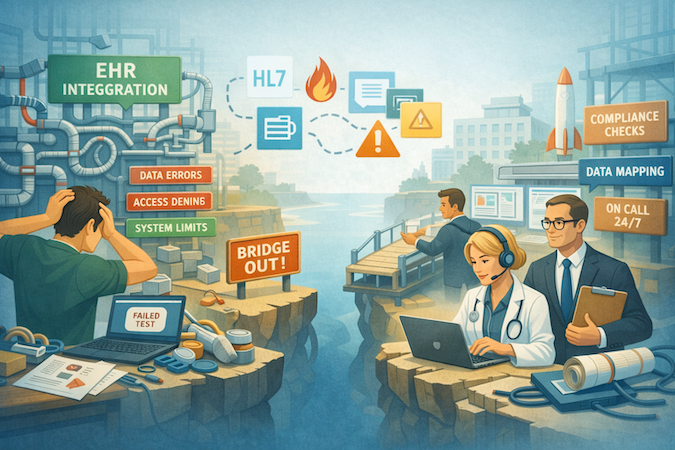
Interoperability Reality Check
Founders love to say, “We’ll just connect to the EHR.” That sentence has ended more timelines than scope creep.
Interoperability (HL7 / FHIR) gives you a shared language. It does not give you plug-and-play connectors. Every hospital has its own mix of vendor versions, custom fields, and “we’ve always done it this way.”
Two truths can exist at once:
- EHR adoption is basically universal: 96% of non-federal acute care hospitals have adopted a certified EHR.
- True “full interoperability” has historically lagged. Older national research found less than 30% of hospitals could find, send, receive, and integrate outside data.
What this means for your build:
- HL7 v2 is often “structured-ish” text that still varies by installation
- FHIR is cleaner (JSON resources), but implementations are uneven and frequently extended
- Mapping (and re-mapping) is normal. So is “why is this field empty in prod?”
Integration work is mostly data hygiene and edge cases. It’s not glamorous, but it’s how pilots survive.
EHR Integration Constraints
Real EHR integration (Epic / Cerner) is less about endpoints and more about workflows, governance, and operational constraints.
Even when the technical path is clear, the org path isn’t:
- sandboxes don’t behave like production
- access approvals and security reviews take time
- throughput limits and query patterns matter (you can get throttled)
- upgrades happen on their schedule, not yours
The common prototype mistake is building against a generic or open-source FHIR server, then acting surprised when a real EHR behaves differently. (It will. It always will.)
If your AI feature needs large reads, frequent polling, or broad access “just for now,” expect pushback. Institutional IT teams have seen this movie. They know how it ends.
Institutional Data Controls
Once you’re inside a hospital perimeter, you’re not just shipping software. You’re joining an ecosystem that already has rules, audits, and a long memory.
Expect requirements like:
- data sanitization before anything leaves their network boundary
- strict identity controls (roles, least privilege, access review)
- network constraints (allowlists, segmentation, monitored egress)
- vendor risk scrutiny that goes beyond your code
This is where medical app development stops being “add a feature” and becomes “prove the whole system is safe to operate.” Data flow diagrams. Access reports. Change management. The unsexy stuff that determines whether you get turned on—or turned off.
If you want to deploy healthcare AI solutions, treat integrations like a first-class product surface:
- budget real time for mapping + testing + failure handling
- plan for break/fix after go-live (EHRs change; your app has to keep up)
- build for institutional controls from day one, not after the first security questionnaire lands
That’s why agencies earn their keep here. Not because your team can’t write code—because this maze has rules, and the rules aren’t written on the walls.
“Buy vs Build” Compliance: What You Can Outsource, What You Can’t

Where HIPAA Platforms Help and Where They Stop
There’s a cottage industry of “HIPAA-as-a-service” platforms promising instant compliance. They can absolutely accelerate HIPAA compliant app development when you’re trying to prove a workflow fast.
They’re good at commoditized plumbing:
- secure messaging primitives
- baseline audit trails (for their layer)
- templated agreements (sometimes)
- sensible defaults for storage and access
But here’s where the magic ends.
A platform can’t stop you from:
- misconfiguring permissions
- leaking data through a third-party SDK
- building a feature that quietly expands who can access what
- shipping an “admin-only” shortcut that becomes permanent
And no, “we used a HIPAA platform” won’t impress a risk team if you can’t explain your own system boundaries.
Hosting and Isolation Decisions
Choosing secure medical app hosting is a trade-off, not a checkbox.
- Shared environments can be cost-effective and fast, but you inherit constraints.
- Dedicated environments cost more, but can give you cleaner isolation and clearer answers to security questionnaires.
Either way, don’t negotiate with physics: you still need data encryption at rest across all storage layers (databases, object storage, backups, snapshots). And in multi-tenant setups, “logical separation” only matters if you can demonstrate it—with controls, evidence, and repeatable enforcement.
If you’re trying to bring a digital health product to market, speed is great. Speed without guardrails is how you end up rewriting the foundation while customers are waiting.
A practical buyer-grade checklist looks like this:
- Who owns patient data in transit and at rest?
- Who signs the BAA, and for which components?
- How are updates tested, approved, and rolled back?
- What’s the exit plan if you outgrow the platform? (data portability, infra scripts, configs)
Outsourcing compliance doesn’t outsource accountability. Treat third-party providers like components in your architecture—not magic boxes. Platforms can accelerate you. They can’t replace diligence.
Launch Checklist for 2026: Technical + Legal + Trust
Go Live Technical Checklist
Before you launch a healthcare AI prototype, treat “go-live” like a controlled burn, not a celebratory button click.
Operational basics (the stuff that stops 2 a.m. fires):
- Load test for realistic peak usage (and the boring “everyone logs in at 8:00 AM” spike)
- Define acceptable response-time targets and alert when you miss them
- Set up monitoring for error rates, latency, and dependency failures
- Make logging comprehensive (auth events, API calls, data access) and tamper-resistant
- Test restores from backups—because untested backups are wishful thinking
Failure drills (do them before users do them for you):
- Practice rollback on a bad deployment
- Simulate a dependency outage and confirm the app degrades gracefully
- Run vulnerability scans on dependencies and fix high-risk findings
- Do a final scaling healthtech readiness pass: capacity, queueing, and rate limits
Regulatory Tripwires and Risk Flags
Healthcare software wanders into SaMD (Software as a Medical Device) territory faster than founders expect—especially once the product influences diagnosis, treatment decisions, or triage.
A few reality-check stats to calibrate expectations:
- As of July 2025, over 1,200 AI-enabled medical devices had received FDA authorization.
- As of August 2024, about 97% of FDA-authorized AI devices were cleared through the FDA 510(k) pathway.
- In one analysis of 691 FDA-cleared AI/ML devices through 2023, only 6 (1.6%) reported data from randomized clinical trials—and 40 devices (5.8%) were recalled (113 recalls), mostly due to software issues.
What to do with that:
- If your intended use nudges clinical decisions, assume you’ll need a real regulatory strategy (not “we’ll see later”)
- Document intended use, risk analysis, and change control early
- If you’re building medical device software, align engineering processes with lifecycle expectations (your regulatory counsel will thank you)
Also: don’t casually promise “continuous improvement” without guardrails. Adaptive models and rapid updates are where compliance questions get sharp—fast.
Earning Clinical Trust at Launch
Clinicians don’t reject AI because they hate technology. They reject it when it wastes time, interrupts workflow, or can’t explain itself.
If you want to scale a healthtech startup, do the trust work upfront:
- Start small (one workflow, one site, one team)
- Make it easy to override and document why
- Provide clear “what it can’t do” guidance (not buried in a PDF)
- Track where it fails and fix those first
- Publish evidence you can defend (even if it’s internal at the beginning)
The fastest path to losing trust is shipping something that feels like extra clicks plus uncertainty. The fastest path to earning it is boring competence: reliability, clarity, and measurable workflow lift.
How Topflight Turns Vibe-Coded Prototypes Into Working, Compliant Software
If you already have a prototype, you don’t need another pep talk. You need a path from “demo that impresses” to “system that survives pilots.”
That’s what our Rapid Prototyping (Fast Track) service is built for: we take whatever you’ve got—Replit build, Figma, half-working repo—and turn it into a prototype that’s engineered like it plans to live. Not perfect. Not overbuilt. Just production-minded enough that you’re not forced into a full rewrite the moment a real customer shows up.
What this looks like in practice:
- Scope that holds up under pressure: we lock the workflow, define PHI boundaries, and prevent “one more feature” from turning into architectural spaghetti.
- AI that’s governed, not guessed: we set up a pragmatic evaluation approach, safety rails, and a plan for iteration without turning the model into a moving target.
- Integrations that don’t collapse in pilot: when you need EHR connectivity, we design for real-world constraints—SMART on FHIR, HL7/FHIR interfaces, marketplace onboarding, and implementation inside EHR workflows when needed.
If you’re stuck between “ship it” and “we can’t risk it,” this is the gap we close. You bring the prototype and the urgency. We bring the boring competence: security posture, integration reality, and a plan you can defend. And yes—when it’s time for a healthcare AI prototype launch, we’ll tell you exactly what needs fixing before you put it in front of clinicians.
Frequently Asked Questions
Can I launch an app built entirely by AI?
You can ship a demo, but “launch” for real users means owning the architecture, security model, monitoring, and failure modes. Treat AI-generated code as a draft. Your team still has to productionize it and be accountable.
How much does it cost to make a HIPAA compliant prototype?
It depends on scope and risk. Expect most effort to go into access control, audit logs, data encryption at rest, vendor BAAs, and testing. If the prototype is sloppy, you’ll spend more rewriting than “hardening.”
What is the difference between an MVP and Prototype?
A prototype proves a workflow or idea. An MVP is a usable product with real constraints: authentication, reliability, support, and measurable outcomes. Prototypes optimize for learning speed; MVPs optimize for repeatable value and survivable operations.
Do I need FDA approval for my AI health app?
Only if it functions as medical device software (SaMD) or supports diagnosis/treatment decisions in a regulated way. Many apps don’t. But you still need clinical validation and a safety story, especially if you market clinical claims.
How do I fix AI hallucinations in a medical context?
Don’t “fix” them with vibes. Constrain outputs with RAG, cite sources, add confidence thresholds, require human review for high-risk actions, and log everything. Build guardrails so the model can safely refuse, not confidently guess.
How long does it take to rewrite a prototype for production?
Usually weeks to months, not days. The timeline is driven by data model cleanup, permissions, integration work, testing, and compliance controls. If the prototype skipped fundamentals, rewriting is faster than patching.