

Most device projects die on the hill between a blinking monitor and a living chart. This guide is for teams who need medical device EHR integration that won’t crack at the first upgrade window.
We’ll pick the right rails (HL7/FHIR/DICOM), choose architectures that scale (gateways, engines, APIs), and run pilots that become production, backed by hard security, validation, and cost discipline. If you’re allergic to buzzwords and double-charting, you’re in the right place.
Key Takeaways
- Standards and contracts prevent outages: profile messages, pin units/codes, simulate edge cases, and version everything.
- Architecture is situational: start narrow, use engines/gateways to scale, and treat every EHR upgrade like a mini go-live.
- Secure and measure or don’t ship: HIPAA controls, audit trails, and observability are non-negotiable; wins look like fewer clicks, faster charting, cleaner alerts, and a sane path to ROI.
Table of Contents
- Understanding Medical Device EHR Integration
- Benefits of Integrating Medical Devices with EHR Systems
- Medical Device Integration Standards and Protocols
- Integration Architecture and Technical Approaches
- Step-by-Step Implementation Guide
- EHR-Specific Integration Considerations
- Common Medical Devices and Integration Scenarios
- Security and Compliance Requirements
- Challenges and Solutions in Device Integration
- Cost Considerations and Budgeting
- Future Trends in Medical Device EHR Integration
- Best Practices and Lessons Learned
- How Topflight Integrates Medical Devices with EHR
Understanding Medical Device EHR Integration
First, a quick level-set on what “device → EHR” actually means in practice, beyond buzzwords and demo scripts.
What Is Medical Device EHR Integration?
To integrate medical devices with EHR is to enable a direct, validated data flow from devices into the chart, no manual data entry. Under the hood: interoperability via HL7, FHIR, DICOM, and IHE profiles; device-side IEEE 11073 semantics; and hospital-grade middleware/integration engine exposing REST API/web services for real-time data or batch processing.
Why Healthcare Organizations Need Device Integration
You trade clipboard time for clinical signal:
- fewer transcription errors (BCMA eliminated transcription errors; 41.4% fewer non-timing med-admin errors; 50.8% fewer potential ADEs).
- improved accuracy (automated vital-signs upload cut documentation errors to <1% vs 10% on paper and 4.4% manual EMR).
- better patient safety (smart pump↔EHR interoperability reduced IV med-admin errors by 16% across hospitals).
Clinicians get clinical decision support with timely alerts/notifications, and ops sees streamlined workflows, time savings, efficiency gains, and measurable ROI. Guardrails: HIPAA compliance, data security, encryption, and PHI protection baked into the path.
Types of Medical Devices That Integrate with EHRs
Think bedside devices and monitoring devices vital signs monitors, ECG machines, infusion pumps/smart pumps, ventilators, pulse oximeters, blood pressure monitors, glucose meters/CGM, plus wearable devices across the IoMT.
On the diagnostic side: ultrasound, MRI, CT scanners, PACS, and lab analyzers at the point of care. Connectivity spans serial communication, TCP/IP, bluetooth/BLE, and hardened wireless connectivity.
Current State of Device Integration in Healthcare
Adoption is real but uneven: mature units standardize on medical device integration software or a device integration platform; everyone else wrestles with bespoke drivers.
EHRs are nearly universal (96% of U.S. hospitals had a certified EHR by 2021), but device-to-EHR interoperability still lags. As a bellwether, smart infusion pump–EHR interoperability is live at only ~10–15% of hospitals despite broad smart-pump adoption, reflecting cost, testing, and change-management friction.
Scale makes this hard: hospitals run thousands of networked devices; a HIMSS-cited study of German hospitals reported an average of 25,150 medical devices (median 3,600), which translates to a long tail of drivers, versions, and governance.
Trend lines are clear: well-integrated remote monitoring programs reduce hospital service use in 72% of randomized trials, while safety bodies (ECRI) flag home-device use as a top 2024 risk, i.e., pressure to integrate, and pressure to do it safely.
Benefits of Integrating Medical Devices with EHR Systems
This is where medical device connectivity pays offthe short list healthcare app developers obsess over when they wire the last mile.
Eliminating Manual Data Entry and Transcription Errors
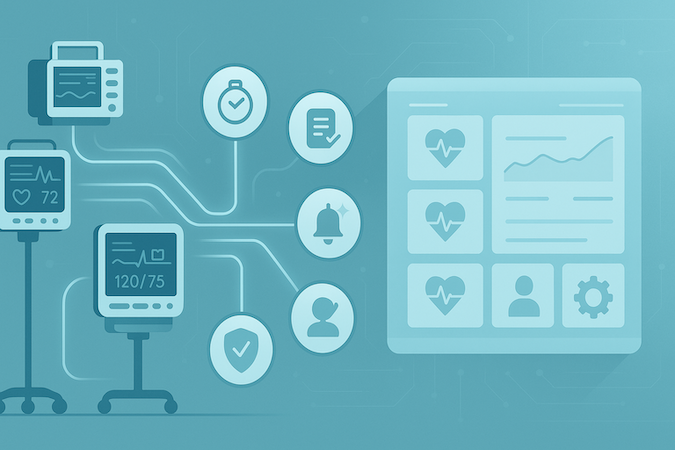
Automated capture is the low-friction win of medical device EHR integration. In an ED study, automatic device→EHR documentation cut time-to-entry by 6.1 minutes (0.6 vs 7.7) and pushed completeness to 98%.
Real-Time Clinical Decision Support
When the data arrives clean and on time, CDS actually helps, especially for real-time monitoring use cases. AHRQ’s 2024 rapid review found CDSS reduces medication errors and adverse drug events (moderate/low certainty, but directionally solid), assuming solid data validation upstream.
Improved Nursing and Clinical Workflows
Auto-upload trims keyboard time and lowers NASA-TLX temporal demand, so nurses can work the patient, not the screen, i.e., smoother clinical workflows with faster charting.
Enhanced Patient Safety and Care Quality
At the sharp end, wiring devices to the EHR moves needles: a 2025 systematic review of smart infusion pump interoperability reported post-implementation error reductions ranging from ~15% to ~55% across hospitals.
Regulatory Compliance and Audit Trails
HIPAA isn’t optional. The Security Rule requires audit trails and technical safeguards for ePHI, log who sent what, when, and where, backed by rigorous data validation. Build for audits from day one.
ROI and Cost Savings Analysis
Start with time saved per data set (e.g., −6.1 minutes for ED vitals), multiply by volumes, then layer avoided errors/rework and reduced duplicate documentation. That’s your baseline business case, before downstream quality and throughput gains.
Medical Device Integration Standards and Protocols
For EHR medical device integration, standards are your guardrails, treat this as a compact EHR integration guide to the protocols that actually ship. Most EHR integration solutions mix open standards with vendor specifics, then harden for standardization, data mapping, data normalization, and fault tolerance.
HL7 Standards for Healthcare Data Exchange
HL7 v2.x runs real-time events (ADT/ORM/ORU); FHIR brings resource-centric, web APIs. In the wild, v2 handles live telemetry/orders while FHIR covers config, tasks, and mobile.
Ship tips: lock segment profiles, pin units/codes for data normalization, and regression-test around upgrade windows for fault tolerance.
DICOM for Imaging Device Integration
DICOM is how modalities talk to PACS, store, query/retrieve, and display. The EHR usually references DICOM studies/series rather than hauling pixels through HL7/FHIR.
Ship tips: treat accession numbers/UIDs as truth; validate WADO/Q/R end-to-end with your PACS.
IHE Integration Profiles
IHE turns “it depends” into repeatable contracts. PCD (e.g., DEC) defines device→enterprise flows; Rosetta Terminology Mapping harmonizes metrics/units, your fast path to standardization and cleaner data mapping.
Ship tips: publish a site-level metric dictionary early; enforce it at interface QA.
IEEE 11073 for Point-of-Care Devices
IEEE 11073 SDC enables manufacturer-agnostic device-to-device/system comms in high-acuity rooms (info model + service-oriented transport). It complements, not replaces, HL7/FHIR.
Ship tips: deploy SDC at the bedside; bridge into v2/FHIR for the record with strict data normalization.
Proprietary Device Protocols and APIs
Vendors will hand you serial strings, SOAP/REST SDKs, or bespoke feeds. Treat them as upstream; normalize units/codes, perform data mapping to a canonical model, then publish via v2/FHIR/DICOM.
Deliverables that save projects: a living mapping spec, conformance notes, and a simulator for repeatable tests, your practical backbone for fault tolerance.
Integration Architecture and Technical Approaches
There’s no single “right” stack for healthcare device integration, only trade-offs. Pick the pattern that survives your next upgrade and your first on-call page.

Direct Device-to-EHR Integration
Point-to-point works when you need to integrate medical devices with EMR in a single unit or pilot. Lowest moving parts, fastest to demo and quickest to crumble at scale. Use for narrow scope; retire early.
- Use when: one device class, one site.
- Watch-outs: brittle mappings, limited data transformation, no central error handling.
Middleware and Integration Engines
Mirth Connect, Rhapsody, Cloverleaf: the hospital workhorses. They normalize payloads, route messages, and enforce contracts, your control plane for messy realities.
- Use when: multiple vendors, evolving workflows.
- Strengths: canonical models, reusable maps, governed retries.
- Bonus: first stop for centralized error handling.
Medical Device Gateways and Servers
Capsule, Bernoulli, etc., aggregate device feeds, manage device drivers, and speak hospital protocols upstream. They decouple bedside chaos from enterprise interfaces.
- Use when: high-acuity floors, lots of serial/networked gear.
- Strengths: asset mgmt, signal quality, clinician-friendly deployment.
Cloud-Based Integration Platforms
Modern SaaS adds elastic pipes, managed upgrades, and compliance tooling (BAAs, audit configs). Great for multisite rollouts and analytics without burying your team in servers.
- Use when: quick scale across facilities.
- Strengths: horizontal scalability, built-in redundancy.
- Watch-outs: network paths, PHI routing, change windows with the EHR.
Edge Computing for Real-Time Processing
Process at the bedside for sub-second alarms, de-noising, and pre-validation before uplink, especially valuable for remote patient monitoring (RPM) and telemetry-heavy units.
- Use when: low latency or intermittent connectivity.
- Strengths: resilience, local decisions; upstream sends are cleaner and cheaper.
API-Based Integration Strategies
Modern devices expose REST + webhooks; EHRs expose FHIR + service hooks. Treat this as your backbone for apps and IoT telehealth integration, versioned endpoints, OAuth2, replay-safe webhooks.
- Use when: mixed vendors, mobile/web apps.
- Strengths: product velocity, safer upgrades; pair with the engine for governance.
Step-by-Step Implementation Guide
Use this pragmatic roadmap to go from device pilot to production-grade EHR connectivity, on time, audit-ready, and without breaking clinician workflows.
Phase 1: Assessment and Planning
Inventory devices, map current clinician paths, and define success metrics for medical device interoperability and EHR connectivity. Capture interface counts, latency targets, and identity-matching rules. Note regulatory scope (e.g., FDA regulations) and the cut line between MVP and production.
Phase 2: Vendor Selection and Evaluation
Shortlist engines/gateways and decide build vs buy vs partner in healthcare app development. Demand proof with your devices, not demo data. Validate support for your EHR version, upgrade cadence, and ops tooling (monitoring, alerting, rollbacks).
Phase 3: Technical Design and Architecture
Write the contract: message profiles, mapping tables, identity keys, and error semantics for EHR device integration. Threat-model auth paths, choose retry/backoff, and define observability. Design for downstream workflow automation without breaking clinical context.
Phase 4: Development and Configuration
Build adapters, configure routes, and stand up test harnesses with emulators plus “golden” payloads. Version every map/profile; no ad-hoc edits on prod boxes. Bake in idempotency and message ordering early.
Phase 5: Validation and Testing
Run end-to-end tests: accuracy (unit normalization, codes), reconciliation in the UI, throughput under load, failover drills, and security scans. Keep a signed test report and change log per interface.
Phase 6: Pilot Deployment
Roll out to one unit or service line. Shadow-chart for a sprint, collect defect stats and clinician feedback, and tune alarms and thresholds. Success = stable signal, zero unexpected alerts, and no added clicks.
Phase 7: Full Deployment and Training
Stage by stage, not all at once. Train super-users, publish quick-reference runbooks, and lock a change window with the EHR team. Measure adoption and “time-to-chart” weekly for the first month.
Phase 8: Monitoring and Optimization
Operationalize: dashboards, SLOs, on-call rota, and weekly defect triage. Tune mappings as devices update firmware. Prove resilience with backups, failover tests, and a documented disaster recovery playbook. Continuous improvement beats “set and forget.”
Read also: How to Build an EHR System.
EHR-Specific Integration Considerations
Treat this as the vendor layer of medical device EMR integration. Great clinical device integration happens when your medical device software development aligns to each vendor’s pipes and preserves physician workflows for safer, reduced errors and cleaner compliance reporting, including feeds from wearables.

Epic Medical Device Integration
Two lanes: HL7 v2 via Bridges for classic events; FHIR for resource-centric work. Route through Connection Hub, version your profiles, and test on upgrade windows. Success = stable mapping, predictable auth, zero surprise UI impacts.
Epic’s Medical Device Integration (Epic MDI) platform and Bridges module handle the heavy lifting for 42% of U.S. acute-care hospitals. For a deeper, implementation-level breakdown, see epic ehr integration.
Cerner Device Connectivity
Cerner CareAware (with iBus) is your device backbone. Normalize upstream signals there, then map outward to clinical workflows, treat driver coverage, alarm semantics, and retry behavior as first-class specs.
athenahealth Device Integration
Cloud-first with an open marketplace. Solid path for API velocity and ingesting wearable technology in healthcare or RPM data, still demands disciplined mapping, monitoring, and rollback plans.
For teams connecting remote monitoring tools or device data streams to athenahealth, Athena EMR/EHR integration requires careful API scoping, field mapping, validation, and post-launch monitoring.
Altera (formerly Allscripts)
API/FHIR via the developer program. Expect project-by-project mapping; plan environments, credentials, and conformance artifacts early to keep timelines honest.
MEDITECH Integration Capabilities
Expanse exposes FHIR alongside traditional interfaces. Good when you want standards-based reads/writes without heavy custom plumbing, mind partner coverage and certify the exact workflows you rely on.
NextGen and eClinicalWorks Connectivity
Both are API-forward. The risk isn’t capability; it’s scoping, mapping, and environment access. Pin units/codes, simulate device payloads, and guard upgrades with regression packs.
Ship note: across vendors, boring wins, profile messages, lock units/codes, simulate edge cases, and treat observability/rollbacks as part of the build, not an afterthought.
Common Medical Devices and Integration Scenarios
The edge cases live here, map device reality to chart reality or you’ll chase ghosts in production.
Vital Signs Monitors and Bedside Devices
Philips/GE/Welch Allyn monitors stream heart rate, SpO₂, NIBP, and waveforms. For connecting medical devices to EHR, start with gateway normalization, then map to vital panels and flowsheets. Win condition: zero double-charting and smoother nurse workflows.
Diagnostic Imaging Equipment
X-ray/CT/MRI/ultrasound ride DICOM into PACS; the EHR links studies and reports rather than shuttling pixels. Tight device data integration here means:
- reliable orders
- accession numbers
- status updates across diagnostic equipment
Laboratory Analyzers and Point-of-Care Testing
Blood gas and chemistry analyzers push results through a LIS/LIMS bridge. Guard against unit drift and reference-range mismatches; failed mappings here ripple directly into clinical outcomes.
Infusion Pumps and Smart Pump Integration
Bi-directional pumps read the MAR and write back rate/volume/alerts. The safety story is dose-limit libraries plus closed-loop confirmations; design for bedside reliability first, dashboards second, to deliver reduced errors without extra clicks.
Ventilators and Respiratory Devices
ICU vents produce dense, time-series signals. Buffer at the edge, filter noise, and summarize trends the chart can digest. Expect strict network isolation and predictable network protocols for alarms.
Cardiac Devices and ECG Systems
12-lead ECGs, stress tests, and telemetry send structured measurements and PDFs. Ensure identity, timestamp, and lead metadata survive transit; otherwise, downstream decision support degrades.
Wearable and Remote Monitoring Devices
CGMs and home kits stream intermittently. Normalize units, annotate gaps, and flag patient-actionable events. If you’re doing remote patient monitoring app development, wire ingestion → triage → EHR handoff as one path, this is where patient outcomes meet ops: fewer callbacks, clearer escalations, and real-world adherence signals.
Security and Compliance Requirements
If it touches PHI, it must be secure, auditable, and boring, in the best possible way for HIPAA compliant app development.

HIPAA Compliance for Device Data
Encrypt in transit/at rest, segment clinical networks, and log every hop. Treat vendor gateways as part of your ePHI boundary and prove access controls in audits.
FDA Regulations for Connected Medical Devices
Integration can shift medical device classification (especially for Class II devices) if your software influences diagnosis or therapy, i.e., potential SaMD territory. Document intended use and keep your validation pack current.
That same classification question shapes the patient-facing side too: shipping an FDA-ready companion app depends on what the app itself does, not just how it feeds the chart.
Cybersecurity Best Practices
Assume breach. Patch firmware, enforce least privilege, rotate creds, and monitor for anomalous traffic. Maintain offline runbooks and backup systems for continuity during incidents.
Data Validation and Integrity
No silent failures. Validate ranges/units, de-duplicate, and reconcile in the clinician UI. Event ordering and idempotency prevent phantom updates during retries.
Audit Logging and Compliance Reporting
Who sent what, when, and where, down to device serials and user IDs. Centralize logs for investigations and routine compliance reporting; make exports painless for regulators and internal QA.
If any device can’t explain its payloads or network protocols on paper, it won’t behave in production, escalate early, or your “pilot” becomes your outage.
Challenges and Solutions in Device Integration
Legacy Device Connectivity
Older gear won’t learn new tricks, meet it where it is. Wrap RS-232/422 with device servers, normalize ASCII frames at the gateway, and checksum everything. Document quirks in a living conformance note so your medical device integration with EHR systems doesn’t hinge on tribal knowledge.
Network Infrastructure Limitations
Throughput, jitter, dead zones, clinical floors magnify all three. Design the pipe before the payload.
- Segment VLANs for clinical traffic; apply QoS to alarm/telemetry over convenience apps.
- Do a site survey; add redundant APs/switch paths where signal drops.
- Buffer at edge/gateway; define reconnect/backoff SLOs and jitter budgets.
Data Standardization Across Devices
Different vendors, same patient. Lock a canonical model; enforce units (UCUM), codes (LOINC/SNOMED), and timestamp rules at the gateway. Version every map; add drift detection so firmware updates don’t quietly corrupt flowsheets.
Change Management and User Adoption
Tech ships; habits stick. Prove “fewer clicks” on day one.
- Super-user model, elbow support, and 5-minute quick sheets per role.
- Guardrails against alert fatigue; verify workflows in real rooms, not conference rooms.
- Close the loop: show clinicians how data they capture improves their next shift.
Scalability and Performance Issues
Today’s pilot is tomorrow’s hospital. Plan for bursty telemetry and upgrades.
- Scale gateways horizontally; partition by unit/service line.
- Back-pressure and queue health as first-class metrics; load-test with real message mixes.
- Prebake failover and warm spares; rehearse cutovers like mini go-lives.
Vendor Lock-in and Interoperability
Prefer standards, but write contracts like you’ll be migrating: data export rights, documented schemas, and versioned APIs. Use a healthcare integration platform to abstract vendors, keep mappings portable, and swap components without ripping out clinician workflows.
Cost Considerations and Budgeting
Build your numbers like your interfaces: explicit contracts, no wishful thinking.

Initial Investment Requirements
For medical equipment EHR integration, expect: device gateways, interface-engine licenses, vendor driver/API fees, EHR interface provisioning, implementation services, certs/PKI, and network/infra upgrades. If your integration touches Epic, the cost of Epic EHR integration can also affect the budget through interface provisioning, vendor-side configuration, testing environments, and upgrade-window validation.
Don’t ignore healthcare app development cost to surface device data in clinician UI (flowsheets, alerts, mobile), not just the pipes.
Ongoing Operational Costs
Line items: interface monitoring, log retention, on-call/support, map maintenance, firmware/upgrade regression tests per release window, vuln scanning, pen tests, incident runbooks. Cloud adds egress/storage; on-prem adds hardware refresh and spares.
Hidden Costs to Consider
Training and super-user time, backfill labor during go-live, change-management collateral, validation documentation, interface fees per added unit/site, and data-quality remediation after vendor firmware updates. Downtime windows have a real opportunity cost.
Cost-Benefit Analysis Framework
Quantify cost savings with a simple stack: time saved per data set × volume × loaded labor rate + avoided rework/errors + throughput gains (beds/day, procedures/day).
Compare against TCO (CapEx amortized + OpEx + healthcare app development cost).
Stage-gate: Pilot → 2–3 units → systemwide, releasing budget only when the previous phase hits measurable targets.
Future Trends in Medical Device EHR Integration
Six waves worth budgeting for: because “we’ll add it later” is how integrations die.
- Edge + AI on the wire. More inference happens bedside: denoising, artifact rejection, and event triage before the EHR ever sees a packet. FDA’s 2025 cybersecurity guidance pushes richer software design evidence and SBOMs, making these AI pipelines auditable, not magical.
- 5G everywhere (private, hospital-first). Sub-10 ms latency and high reliability make continuous telemetry, AR support rounds, and mobile carts feel native instead of fragile Wi-Fi hacks. Think care delivery that moves with the patient instead of the access point.
- FHIR Subscriptions go mainstream. Push, not poll: R5 Subscriptions (and backports) let servers notify clients on data changes in near real time, cleaner alarms, lighter loads, and fewer race conditions across device→gateway→EHR.
- TEFCA turns “outside the walls” into first-class. With designated QHINs live, cross-network exchange hardens, helpful when device data must follow patients across orgs and vendors. Plan your integration to publish/consume through those pipes.
- Wearables graduate from novelty to intake. Adoption keeps climbing and dollars follow; remote data is no longer a pilot-only story. Expect more direct chart hooks and protocolized review flows as volumes explode.
- Blockchain where audit really matters. Not for everything, but consent, provenance, and supply-chain traceability are credible fits when multi-party trust and tamper-evidence beat another siloed log file. Kick the tires where regulator and workflow pressure align.
- SDC plug-and-play at the bedside. IEEE 11073 SDC is creeping from the OR into high-acuity floors, promising manufacturer-independent, service-oriented device interoperability on clinical networks. Budget a bridge into your v2/FHIR stack.
Best Practices and Lessons Learned
What we actually ship in the field: no magic, just patterns that survive Mondays.

Start Small and Scale Gradually
- One device class, one unit, one clear owner, prove the lane before duplicating it.
- Define exit criteria up front (signal quality, time-to-chart, zero double-entry).
- Rehearse cutover/rollback; clone the playbook only after a stable sprint.
Engage Clinical Champions Early
- Recruit a nurse super-user and a physician sponsor; schedule 15-minute hallway huddles.
- Prototype flowsheets and alarm routes with them; delete clicks, don’t add them.
- Close the loop: show how cleaner data improves the next shift.
Prioritize High-Impact Devices First
- Pick high-touch, safety-critical gear (vitals, pumps, vents) before “nice-to-have” peripherals.
- Tie each integration to one measurable workflow win (fewer handoffs, faster charting).
- Resist the shiny: stabilize the backbone before wearables at scale.
Document Everything Thoroughly
- Living mapping spec: units, codes, timestamps, edge cases, per device/firmware.
- Conformance notes and sample payloads in version control; no tribal knowledge.
- Runbooks for alarms, retries, and rollbacks; keep them one page, not a novella.
Plan for Ongoing Support and Maintenance
- Dashboards with SLOs (throughput, error rate, latency) and an on-call rota.
- Version every map; regression-test on every EHR upgrade window.
- Manage firmware like code (staging, sign-off, rollback) and keep warm spares ready.
How Topflight Integrates Medical Devices with EHR
Here’s the honest version: device→EHR isn’t “plug in a cable.” It’s contracts, vocabularies, and battle-tested pipes. We’ve shipped the two halves you actually need: EHR mechanics and device ingestion, then we stitch them into one dependable lane.
Cerner + Laboratory Information Management System (LIMS)
We built a provider-facing dashboard that authenticated via SMART on FHIR to Cerner, pulled MRI/radiology and patient data from Cerner, and synchronized lab orders from a proprietary Laboratory Information Management System (LIMS). One-way FHIR into the app, LDAP for hospital SSO.
RPM-Grade Device Ingestion
Our RPM platform ingests vitals from clinically certified sensors, normalizes them, and exposes audit-ready trails, exactly the pre-EHR work most teams skip. It’s in daily use (1,100+ patients; HIPAA controls; Validic pipeline).
Clinical-Trial IoT Reliability
For a Fortune-100 pharma study we integrated a smart flowmeter and smart pillbox, streaming data into a real-time dashboard, tight timestamping, no dropped payloads. That reliability layer is the backbone you want before touching an EHR.
Topflight’s Integration Playbook
- Authenticate & scope: SMART on FHIR launch, roles, and a clear read/write contract.
- Normalize & validate: units (UCUM), codes (LOINC/SNOMED), provenance, and time sync across devices.
- Interface responsibly: HL7 v2/FHIR resources mapped to clinician workflows; queues and retries; regression tests pinned to EHR version windows.
- Prove it in the UI: clinician-friendly reconciliation so bad data dies before it reaches the chart.
Want a “demo day” win? Any stack will do. Want it still humming after the next EHR upgrade? Follow this playbook to integrate diagnostic devices with EHR and keep it stable.
If you’re staring at a device vendor PDF and an EHR integration guide and thinking, “these two have never met,” let’s talk. Our medical device integration services map payloads to FHIR/HL7, sanity-check security, and price the real work, before you promise go-live to clinicians. Schedule a call.
FAQ
What medical devices cna be integrated with EHRs?
Vitals monitors, infusion pumps, ventilators, anesthesia machines, glucometers, spirometers, imaging devices, and RPM hubs—anything exporting structured data (HL7 v2, FHIR, DICOM, or vendor APIs) with patient/context identifiers.
How long does medical device integration typically take?
Timeline depends on protocols, EHR capabilities, and validation scope. Simple one-device HL7/FHIR feeds can be fast; multi-site, bidirectional workflows with alerts/orders take longer due to testing, security reviews, and change control.
What are the costs associated with device integration?
Licenses (gateways/interface engines), integration and QA effort, validation documentation, cybersecurity hardening, monitoring, and support. Expect EHR interface fees and vendor professional services. Budget for change management and clinician training.
Can we integrate devices from multiple manufacturers?
Yes, via interface engines, vendor-neutral gateways, or HL7/FHIR abstraction. Standardize units and codes (LOINC, UCUM), normalize device identifiers (UDI), and define a canonical data model to avoid one-off mappings.
How do we ensure data accuracy during integration?
Enforce time sync (NTP), unit normalization (UCUM), code sets (LOINC/SNOMED), validation rules, and round-trip reconciliation in clinician UI. Monitor interfaces with dashboards and sample chart audits.
What happens if a device loses connectivity?
Buffer data on device or gateway, queue and retry on reconnect, mark records as delayed, and alert only for critical gaps. Never drop messages: log, trace, and reconcile discrepancies.
How do we handle device integration during EHR upgrades?
Freeze interface changes during upgrade windows, regression-test in non-prod, re-validate HL7/FHIR versions and authentication, and maintain versioned contracts with fallbacks.
What happens if a device loses connectivity?
Real-time streams events immediately for monitoring/alerts batch moves periodic files for trending, billing, or analytics. Real-time improves safety and responsiveness; batch reduces interface load and suits non-urgent data.
How can we measure the success of our device integration project?
Track data completeness/latency, alert precision, reduced charting time, eliminated duplicate documentation, error rates, clinician satisfaction, and clinical outcomes/throughput. Tie results to cost metrics and support ticket trends.