

The longevity market is projected to hit $44.2B by 2030. The biohacking supplement market alone sits at $15.6B. And the quantified-self consumer spends 3–5x what the average health app user does on digital tools. For founders evaluating longevity app development, the timing is as good as it gets.
Yet the infrastructure layer that ties all of this together — aggregating wearable data, CGM readings, and lab results into a single personalized view, then turning raw biomarker data into actionable protocols — is largely unbuilt. Whether you are building a Bryan Johnson Blueprint-style protocol engine or a Peter Attia-informed biomarker dashboard, the decisions laid out here determine whether your product genuinely extends healthspan for users — or becomes another lifespan tracker collecting dust.
How do you build a longevity or biohacking app?
Start by choosing one of the four product archetypes — biomarker aggregator, protocol manager, single-modality optimizer, or AI longevity coach — and build a minimum insight loop around a single data source (HealthKit or Health Connect) and one high-signal biomarker. Most longevity apps qualify as general wellness software under the FDA’s framework and do not require clearance, as long as all features and AI outputs use optimization framing rather than clinical or diagnostic language. Expand to multi-device integrations, AI-powered insight synthesis, and subscription monetization in subsequent phases.
Key takeaways:
- The regulatory path is clearer than most founders expect. The FDA’s general wellness exemption covers nearly every core longevity app feature — wearable tracking, glucose trends, biological age estimates, protocol management — as long as your UI, marketing, and AI outputs avoid disease-specific diagnostic or treatment language. The framing is the compliance decision.
- Data collection is not the product — insight is. The longevity consumer churns within 90 days if your app collects data without interpreting it. Build for the “aha moment” — the specific, personalized insight that changes behavior — and design every feature around closing the loop between biomarker data and protocol adjustment.
- Start narrow, prove the loop, then expand. Ship a v1 with one data source, one primary biomarker, and one protocol feature in 12 weeks. Add AI coaching, multi-device integrations, and lab data APIs in v2. Layer monetization, community features, and B2B2C employer contracts in v3. The founders who try to build the full stack from day one ship nothing.
Table of Contents
- What Is a Longevity / Biohacking App? The Four Product Archetypes
- The Regulatory Reality — Most Longevity Apps Are NOT Medical Devices
- The Longevity App Feature Matrix — What to Build, FDA Risk, and Complexity
- The Integration Guide — Every Wearable and Lab Data Source Worth Building On
- Data Architecture for a Longevity App — The Decisions That Determine Your Product
- The User Psychology of the Longevity Consumer — Why Most Biohacking Apps Fail at Retention
- Monetization Models for Longevity and Biohacking Apps
- The Compliance Checklist for Longevity and Biohacking Apps
- The Build Roadmap — What to Ship First, Second, and Third
- Why Choose Topflight Apps for Longevity and Biohacking App Development
- The Opportunity in Front of You
What Is a Longevity / Biohacking App? The Four Product Archetypes
A longevity or biohacking app helps users track, analyze, and optimize biological markers associated with health, performance, and lifespan extension. The landscape of biohacking app development is not one market — it is four overlapping markets. Here is the taxonomy.

Archetype 1: The Biomarker Aggregator
The aggregator connects to multiple data sources — wearables, lab tests, CGM devices, subjective logs — and presents a unified view of the user’s biological state over time. The core value is longitudinal data visibility: not just what your HRV was today, but how it has trended over 18 months and what correlates with it. Biomarker tracking is the primary function.
- Core technical challenge: data normalization across devices and lab reference ranges
- Core product challenge: making the dashboard useful rather than overwhelming — raw data without interpretation is a retention killer
- Reference products: InsideTracker and Heads Up Health
Archetype 2: The Protocol Manager
The protocol manager helps users design, track, and optimize a personal health protocol — supplement stacks, training blocks, sleep optimization targets, fasting windows, cold exposure schedules. Where the aggregator asks “what is happening in my body?”, the protocol manager asks “is my plan working?” The self-optimization loop — define a protocol, follow it, measure the biomarker response, adjust — is the core product mechanic.
- Core product challenge: generic protocols generate no loyalty — the health protocol must feel personal and responsive to the user’s own data
- Reference products: Bryan Johnson’s Blueprint app and Levels Health
Archetype 3: The Single-Modality Optimizer
This archetype goes deep on one longevity lever: sleep, metabolic health, VO2 max, cognitive performance. The quantified self consumer values expertise over generality — and pays premium prices for it.
- Build advantage: focus — one data source, one insight engine, one user journey
- Build risk: ceiling — users may outgrow a single-modality tool
- Reference products: WHOOP (recovery and HRV optimization), Eight Sleep (sleep physiology), Levels Health (glucose metabolism)
Archetype 4: The AI Longevity Coach
The AI coach synthesizes inputs from multiple biomarker sources and generates personalized recommendations in natural language. This is the fastest-growing archetype and the most technically complex — and the one most likely to brush against regulatory boundaries.
- Core product mechanic: AI health coaching that translates raw biomarker data into actionable protocol adjustments
- Core regulatory risk: the line between “personalized optimization recommendation” and “clinical decision support” is not always obvious
- Reference products: emerging category — no dominant player yet, which is the biggest opportunity
Founders building in this space should understand the health AI FDA clearance framework before writing a single system prompt.
Most successful longevity products will eventually incorporate elements of multiple archetypes. But the founders who ship successfully pick one archetype as their v1 core and expand from there.
The Regulatory Reality — Most Longevity Apps Are NOT Medical Devices
The vast majority of longevity and biohacking apps qualify as general wellness software under the FDA’s framework and do not require clearance. The general wellness exemption covers apps that promote healthy behaviors and general health maintenance without disease-specific diagnostic or treatment claims.
Tracking sleep quality, glucose variability, biological age estimates, and supplement adherence all fall within general wellness when properly framed. The line that longevity founders must not cross is specific:
- Do not claim your app diagnoses, treats, or monitors a specific medical condition
- Do not market your biological age feature as detecting disease or predicting clinical events
- Do not describe your AI coach as providing medical advice
- Do not use disease terminology in your UI without a cleared FDA pathway
The same feature — a biological age score derived from wearable and lab inputs — can be either clearly exempt or clearly regulated depending on a single sentence of UI copy. “Here is your estimated biological age based on these markers” is a performance metric. “Your epigenetic clock suggests elevated cancer risk” is clinical decision support and likely qualifies as FDA SaMD (Software as a Medical Device).
⚠ AI coach risk flag. An AI that says “your biomarkers suggest early-stage metabolic dysfunction” has crossed into clinical territory. Every system prompt and output template must be reviewed against the wellness/SaMD boundary before launch. The phrase “recommend consulting a physician” does not protect you — the clinical interpretation preceding it is the issue.
The regulatory picture in this market is cleaner than most health app categories. But the wellness exemption is maintained through disciplined language in the UI, marketing, AI outputs, and App Store listing. Lose that discipline, and you may be building a wellness app that is actually a medical device.
The Longevity App Feature Matrix — What to Build, FDA Risk, and Complexity
Not every feature in a longevity tracking app carries the same regulatory weight or build complexity. Use the matrix below as a planning tool.
| Feature | FDA Risk | HIPAA Req. | Primary Data Source | Key Build Consideration |
| Wearable data aggregation (HRV, sleep, steps, SpO2) | Low | Not required | HealthKit / Health Connect / wearable SDK | Multi-device sync; unified data model |
| CGM glucose tracking + trends | Low | Not required | Dexcom / Abbott API or HealthKit | Trend alert logic; no diabetes claims |
| Bloodwork / lab result tracking | Low | Not required (DTC lab) | Function Health, InsideTracker, LabCorp APIs; manual entry | Lab data normalization; no diagnostic claims |
| Biological age estimation | Medium | Not required | Composite of wearable + lab inputs | Frame as performance metric, not diagnosis |
| Protocol / supplement stack tracker | Low | Not required | User input | Supplement interaction checking is a CDS gray zone |
| AI personalized recommendations (wellness framing) | Medium | Not required | All aggregated inputs | No clinical condition language; LLM provider BAA if PHI processed |
| AI longevity coach (conversational) | Medium–High | Conditional | All inputs + conversation history | Clinical claim guardrails essential; LLM provider BAA required |
| VO2 max tracking + training zone guidance | Low | Not required | Wearable SDK (Garmin, Apple, WHOOP) | Training load algorithms; no clinical claims |
| Epigenetic / methylation clock integration | Medium | Not required | TruDiagnostic, Zymo | Framing is compliance-critical |
| Provider-connected bloodwork ordering | High | Required | Lab partner + physician ordering network | HIPAA mandatory; state-by-state ordering model |
| Community / cohort benchmarking | Low | Not required | Aggregated de-identified data | De-identification must be robust |
| Sleep physiology analysis | Low | Not required | Oura, WHOOP, Eight Sleep, Apple Watch | Device API terms vary; acknowledge data limitations |
FDA Risk key: Low = general wellness exemption clearly applies. Medium = framing-dependent. High = device classification almost certain.
The safest v1 sits entirely in the “Low” tier. Wearable data aggregation, sleep analysis, VO2 max tracking, and a protocol tracker give you a compelling product without regulatory gray zones. You can build a complete minimum insight loop — track HRV (heart rate variability), correlate it with training load and sleep, and show the user whether their protocol is working — using only low-risk features and continuous monitoring from consumer wearables.
The medium-risk features — biological age, AI recommendations, epigenetic clock — are where product differentiation lives and premium pricing is justified. The regulatory risk is a language and framing problem, not an engineering problem.
Beyond core tracking, the biohacking consumer expects protocol guidance around interventions like cold exposure, intermittent fasting, and supplements including NAD+ precursors and rapamycin. These are low FDA risk when framed as informational self-tracking but become problematic if the app makes specific dosing or therapeutic claims.
The Integration Guide — Every Wearable and Lab Data Source Worth Building On
The value of a longevity app is directly proportional to the quality and breadth of its data inputs. The integration landscape has matured significantly, and a biohacking platform development team can connect to most data sources that matter without custom hardware integrations.
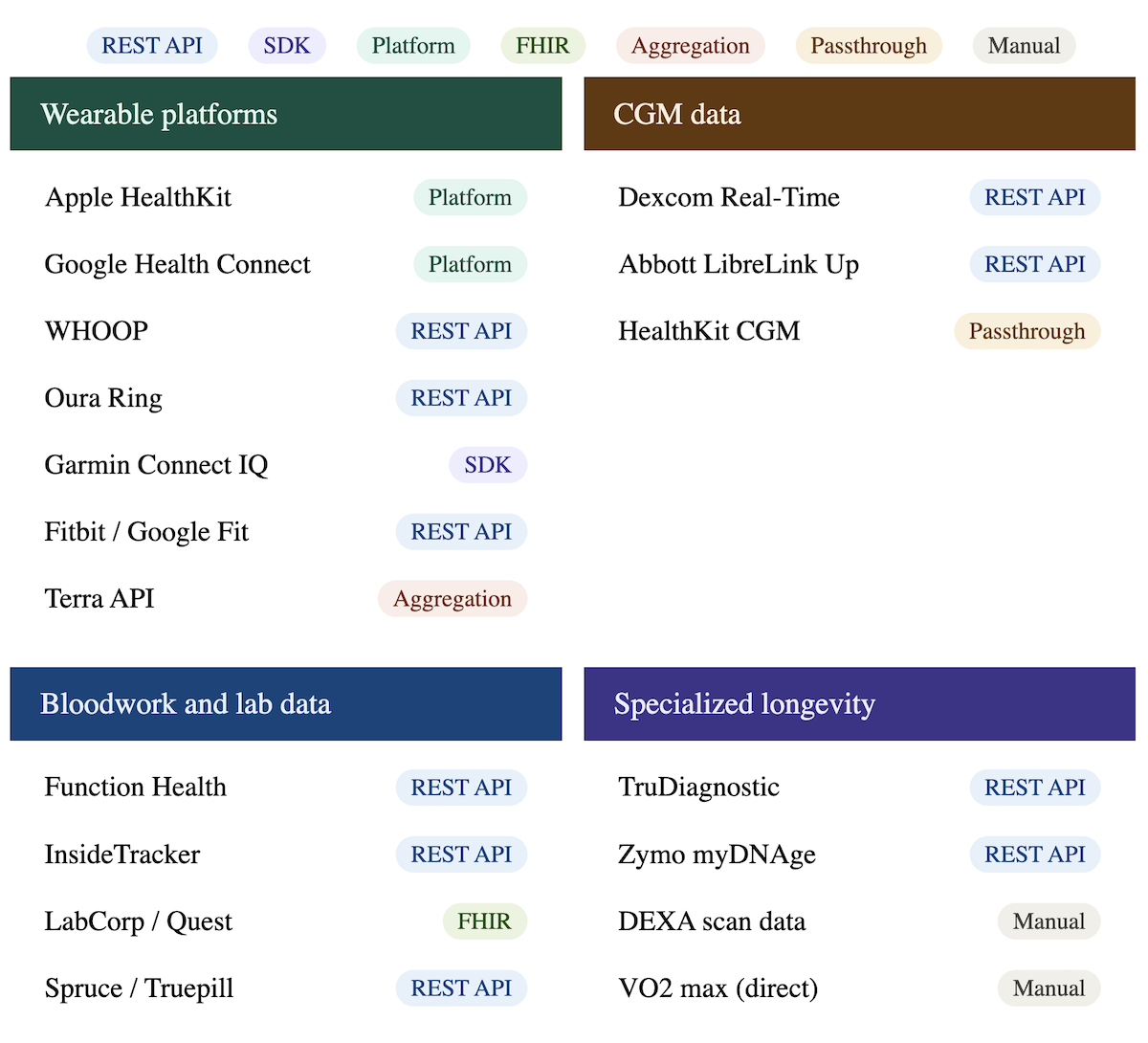
Wearable Platforms
Start with platform health stores, then expand to device-specific APIs for deeper data.
- Apple HealthKit — the most important wearable integration for iOS. Covers heart rate, HRV, sleep stages, VO2 max, SpO2, and ECG data from Apple Watch. Mature API; requires enhanced review for health data apps.
- Google Health Connect — required for comprehensive Android coverage. Data type coverage is expanding and now includes core metrics.
- WHOOP API — recovery score, strain, HRV, sleep data. Business partnership required for production access. Gold standard for HRV and recovery.
- Oura Ring API — readiness, sleep, activity, temperature, SpO2 via OAuth REST API. Dominant in the longevity enthusiast segment.
- Garmin Connect IQ SDK — VO2 max, training load, body battery, stress. The wearable SDK is strong for endurance athletes and performance biohackers.
- Terra API — aggregation layer connecting WHOOP, Oura, Garmin, Polar, and others via a single API. Recommended for most longevity products needing broad device support.
For deeper technical considerations of building for wearable hardware, see our guide to wearable app development.
CGM (Continuous Glucose Monitor) Data
- Dexcom Real-Time API — OAuth 2.0, REST-based; glucose readings with up to 3-minute latency. Partnership agreement required.
- Abbott LibreLink Up API — developer program available. Growing faster than Dexcom internationally.
- HealthKit CGM passthrough — iOS 16+ supports CGM data in HealthKit, the lowest-friction path for iOS-first apps.
⚠ CGM framing risk. Frame glucose data as metabolic performance feedback, not clinical monitoring. Do not use clinical glucose range terminology (hypoglycemia, hyperglycemia) in a wellness context. Levels Health has validated this approach at scale.
Bloodwork and Lab Data
- Function Health API — fastest-growing DTC bloodwork platform, 100+ biomarkers, founder-accessible bloodwork API. Most relevant for longevity-specific apps.
- InsideTracker — bloodwork with optimized reference ranges. Data partnership program available.
- LabCorp and Quest FHIR APIs — FHIR API endpoints (R4) for patient-directed data access under the 21st Century Cures Act.
Specialized Longevity Data Sources
- TruDiagnostic — epigenetic age testing (DunedinPACE, GrimAge clocks) with developer API. The most credible methylation clock partner.
- Zymo Research myDNAge — alternative methylation clock with developer integration.
- DEXA scan data — no standardized API. Requires manual input or PDF parsing.
- VO2 max testing — indirect measurement via wearable platforms; direct measurement has no standardized API.
Many specialized data sources communicate via BLE (Bluetooth Low Energy). For direct device communication beyond platform health stores, our guide to BLE mobile app development covers the architecture.
Data Architecture for a Longevity App — The Decisions That Determine Your Product
Longevity apps are fundamentally data products. Health optimization app development in this space is an architecture problem first and a feature problem second.
The longitudinal data model
Your data model must be designed for time-series storage and retrieval from day one.
- TimescaleDB (PostgreSQL extension) is the best fit for most longevity apps — it handles mixed relational and time-series data in a single system. Health data aggregation across wearables, labs, and manual entries lands naturally in a relational schema with time-indexed hypertables.
- InfluxDB is right for pure time-series at scale (e.g., continuous glucose data at 5-minute intervals for thousands of users).
- A well-structured PostgreSQL schema works for v1 if your data volume is modest. You can migrate to TimescaleDB later.
Two design decisions save significant rework: design for resampling from day one (pre-aggregate at ingestion time so your data visualization layer runs against rollups, not raw readings), and store raw values rather than interpreted flags to preserve interoperability when reference ranges evolve.
The AI and recommendation engine
- Rule-based recommendations — if HRV drops 15%+ from baseline AND training load is high, suggest recovery. Simple, explainable, FDA-safe. Sufficient for v1.
- LLM-powered synthesis — biomarker summaries → personalized narrative insights. Requires wellness framing in the system prompt and a BAA with your LLM provider if health data appears in prompts. See our overview of gen AI in healthcare.
- Trained ML models — correlation discovery across users at scale. A v2+ strategy requiring significant data and data science investment.
The trend analysis capabilities in the recommendation engine separate a data dashboard from a product that changes behavior.
User data ownership and portability
The longevity consumer is privacy-sophisticated. Your architecture must support real data ownership:
- Full data export in standard formats (JSON, CSV) on request
- Account deletion with complete data purge — documented and verified
- Plain-language data use disclosure — what is used for recommendations, product improvement, and what is never shared
Offline sync deserves specific attention. Wearable data is generated continuously whether the user has connectivity or not. Build the sync layer early; retrofitting it is painful.
The User Psychology of the Longevity Consumer — Why Most Biohacking Apps Fail at Retention
The longevity market has a specific user psychology that determines which products survive past 90 days. Understanding this is the difference between a product that retains and one that churns.
The Optimization Trap
The typical biohacking user starts with high engagement — track everything, correlate everything. Within 60–90 days, without meaningful insight, they disengage. Products that fail here confuse data collection with value delivery. Two design principles counter this:
- Design for “aha moments” — “Your HRV recovers 23% faster on days you walk after dinner” is an aha moment. “Your average HRV this week is 48ms” is not.
- Minimum viable tracking — track the highest-signal longevity biomarkers automatically; reduce manual entry aggressively. The user who tracks three metrics and gets one actionable insight retains better than the user who tracks fifteen and gets a dashboard.
The Protocol Adherence Problem
The product that wins personalizes the protocol to the user’s actual data and shows it working in their biomarkers. The core value loop: behavior → data → personalized feedback → refined behavior. The user increases zone 2 training, the app shows VO2 max trending up. The user adds cold exposure, the app shows HRV response on cold days versus non-cold days. The feedback must be specific, personal, and fast.
The quantified self app development challenge is not “how do I collect the data” — it is “how do I close the loop between data and behavior in a way that feels personal.” This is also where heart monitoring app development principles apply — the same feedback loop mechanics translate directly to longevity biomarker tracking.
The Community and Credibility Layers
Products with social or cohort features — even anonymous benchmarking — show meaningfully higher retention than solo-tracking tools. David Sinclair’s research on aging has popularized the idea that biological age is a trackable, improvable metric. Users who believe they can reverse their biological age want to compare notes. Give them a way to do it.
The longevity consumer is also literate and skeptical. They have read Peter Attia. Every recommendation should be traceable to a data source. Every protocol suggestion should cite its basis. The credibility bar is set by the best science communicators in longevity — your product competes with them for user trust.
Monetization Models for Longevity and Biohacking Apps
The longevity consumer is the highest-LTV segment in consumer health — educated, affluent, and willing to pay premium prices. But they churn fast when they do not see value.
Direct-to-Consumer Subscription
The dominant model. The tiered structure proven effective across mobile app development in this space:
- Free tier — basic tracking with limited history, no AI features. Exists to demonstrate the value loop and convert users who have experienced an “aha moment.”
- Pro tier ($15–$25/month) — AI-powered insight synthesis, full trend analysis, protocol tracking with feedback. Where most revenue concentrates.
- Premium tier ($40–$60/month) — expert coaching integration, advanced features like epigenetic age tracking. Serves the deepest biohackers.
Annual pricing is essential. Longevity users who pay annually retain at 3–4x the rate of monthly subscribers. Design annual as the default.
Push notifications play a critical retention role. A well-timed notification — “Your HRV has been trending up for 3 weeks since your new sleep protocol” — reinforces the value loop. A daily “don’t forget to log!” reminder accelerates churn. Tie notifications to insight delivery, not engagement metrics.
For a broader perspective on build costs across iOS and Android, see our breakdown of app development costs.
B2B2C — Employer Benefits
The fastest-growing channel in 2026. Employers are adding longevity programs to competitive benefits packages. A B2B2C model means an enterprise contract with the employer, a consumer-grade app for employees, and an employer-facing analytics dashboard with aggregate, de-identified insights only.
HIPAA applies to the employer-facing data layer. Build the product for consumers first, prove retention, then layer the B2B2C sales motion on top — enterprise sales cycles run 3–9 months.
Additional Revenue Streams
Revenue share on lab tests and specialized testing (epigenetic clocks, DEXA scans) referred through the app works when the test is a natural next step in the user’s protocol. A coaching marketplace or expert access layer generates significant revenue and solves the “what do I do with this data?” churn problem. Note that coaching involving licensed clinicians may trigger HIPAA and telehealth requirements — define scope clearly before launch.
The Compliance Checklist for Longevity and Biohacking Apps
Most longevity apps do not require FDA clearance or HIPAA compliance — but the exceptions matter. For a comprehensive guide, see our resource on HIPAA compliant app development.
FDA Classification
- Intended use statement describes wellness and optimization, not diagnosis or treatment
- All AI recommendation language reviewed — no disease names, no clinical diagnoses
- Biological age and epigenetic clock features framed as performance metrics
- CGM integration copy reviewed — no diabetes terminology in a wellness context
- Provider-connected bloodwork ordering assessed separately with dedicated legal review
Data Privacy (FTC and state law)
- Privacy policy accurately describes all data collected and how it is used
- FTC health breach notification rule compliance confirmed — applies even without HIPAA
- Washington My Health My Data Act compliance confirmed if Washington State users exist
- California CPRA compliance confirmed if California users exist
- No health data sold without explicit, granular data consent — the longevity audience is especially sensitive to health data monetization and will leave products that violate this trust regarding health data privacy
- Data export and deletion workflows built and tested
HIPAA (conditional)
- Provider-connected bloodwork ordering: HIPAA applies. A business associate agreement is required with lab and telehealth partners.
- Employer B2B2C model: assess whether the employer is a HIPAA-covered entity.
- LLM API provider: a BAA is required if health data appears in prompts.
AI and LLM Safeguards
- LLM provider BAA confirmed if user health data appears in prompts
- System prompt reviewed against FDA wellness/SaMD boundary
- Outputs reviewed for hallucination risk — supplement interaction claims are highest-risk
- Supplement interaction logic clearly labeled as informational, not clinical guidance
The Build Roadmap — What to Ship First, Second, and Third
Here is how to build a longevity app in three phases.
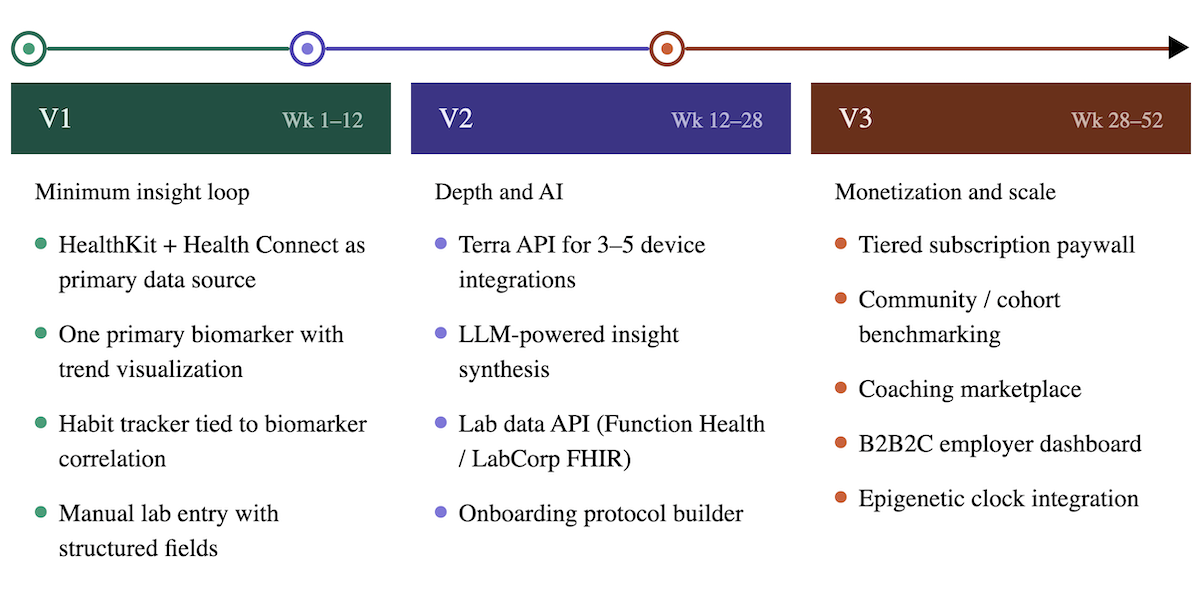
V1 — The minimum insight loop (weeks 1–12)
The goal is one insight that changes one behavior for one user segment.
- One primary data source: HealthKit + Health Connect — covers Apple Watch, Oura, WHOOP via HealthKit write without device-specific API partnerships.
- One primary insight: pick the single biomarker your target user cares most about. Build one genuinely useful visualization and trend — not five mediocre ones.
- One protocol feature: a simple habit tracker tied to the primary biomarker. “You slept 40 minutes more on days you stopped eating by 7pm” is a v1-grade insight.
- Manual lab entry with structured input fields for key bloodwork markers.
The v1 builds the core of what will become a full companion app development ecosystem. Prove the loop before expanding inputs.
V2 — Depth and AI (weeks 12–28)
- Expand to 3–5 data sources via Terra API for broad wearable coverage.
- Add LLM-powered insight synthesis — narrative summaries with protocol suggestions. The feature that transforms a dashboard into a coach.
- Lab data API integration (Function Health or LabCorp FHIR) — replace manual entry.
- Onboarding protocol builder — personalized starting protocol to solve the “I have the app, now what?” dropout.
V3 — Monetization and scale (weeks 28–52)
- Subscription paywall with tiered feature access
- Community and cohort benchmarking — anonymous comparison, protocol challenges
- Coaching marketplace or expert access layer
- B2B2C employer dashboard — de-identified insights for HR teams
- Epigenetic clock integration (TruDiagnostic API) — premium feature for methylation-based biological age tracking
Why Choose Topflight Apps for Longevity and Biohacking App Development
Topflight builds digital health products across the consumer, prosumer, and clinical spectrum. We understand the longevity market’s technical requirements and user expectations because we build in this space.
- Wearable and lab data integrations — HealthKit, Health Connect, Terra API, Dexcom, Oura, WHOOP, Function Health, LabCorp FHIR. We have built the data pipelines that connect these sources into unified biomarker dashboards.
- AI coaching layer development — LLM-powered insight synthesis with wellness framing guardrails.
- Longitudinal data architecture — time-series database design, visualization, and trend analysis for multi-year data horizons.
- Regulatory classification guidance — FDA wellness vs. SaMD boundary analysis specific to longevity features.
- HIPAA-compliant architecture for provider-connected features, B2B2C models, or LLM integrations processing health data.
To understand how AI capabilities factor into the investment, see our analysis of the cost of AI in healthcare.
The Opportunity in Front of You
The longevity and biohacking app market is open. The reference products each own a slice of the stack. The integrated layer that aggregates across all of them and delivers the “aha moment” that changes behavior sustainably has not been built at scale.
The founders who win here will understand that data collection is not the product — insight and protocol change is the product. Build for the aha moment first.
If you are evaluating whether to build a biohacking app, the market timing, regulatory clarity, and available integration infrastructure all point in the same direction. The tools to build the next generation of conversational AI in healthcare — including longevity-specific AI coaching — are mature enough to ship on. The question is no longer whether to build biohacking app products in this space. It is how fast you can close the loop between data and behavior change for users who are ready to pay for it.
Frequently Asked Questions
Does a longevity or biohacking app need FDA clearance?
Most do not. The FDA’s general wellness exemption covers apps that promote healthy behaviors and health maintenance without making disease-specific diagnostic or treatment claims. As long as your product frames biomarker tracking as optimization rather than diagnosis, FDA clearance is not required.
How is a biohacking app different from a regular fitness app?
A fitness app tracks activity and exercise. A biohacking app tracks biological markers — HRV, glucose variability, bloodwork, sleep physiology, biological age — and correlates them with interventions like supplement protocols, fasting schedules, and training programs. The goal is optimization of underlying biology, not just activity logging.
What data does a longevity app track?
Core data categories include wearable biometrics (HRV, sleep stages, SpO2, activity), continuous glucose monitoring, bloodwork and lab results, supplement and protocol adherence, and subjective wellness logs. Advanced products add epigenetic age testing and body composition data from DEXA scans.
Can a longevity app include an AI coach?
Yes, and it is the fastest-growing archetype in the market. The AI coach synthesizes biomarker data and generates personalized protocol recommendations in natural language. The critical requirement is that all outputs must use wellness framing — no clinical condition language, no diagnostic claims, and no treatment recommendations.
Is bloodwork tracking in an app HIPAA compliant?
How do I integrate CGM data into a longevity app without triggering FDA oversight?
Use CGM data for metabolic performance tracking, not clinical glucose monitoring. Avoid diabetes-specific terminology (hypoglycemia, hyperglycemia) and clinical glucose threshold language. Frame all glucose insights as metabolic optimization feedback. Levels Health has validated this approach at scale.
What is the Terra API and should I use it for wearable integrations?
Terra is an aggregation API that connects to WHOOP, Oura, Garmin, Polar, and other wearable platforms through a single integration. It significantly reduces the overhead of supporting multiple devices. For most longevity apps targeting broad device coverage, Terra is the recommended starting point for wearable data ingestion.
How much does it cost to build a longevity tracking app?
A v1 minimum insight loop with one wearable integration and basic tracking typically costs $80K–$150K. A full-featured product with AI coaching, multiple data source integrations, and subscription infrastructure ranges from $250K–$500K+. B2B2C features and HIPAA-compliant architecture add additional cost.