

The phone keeps ringing when a receptionist leaves. In MGMA’s May 26, 2026 poll, 28% of 303 applicable responding practice leaders reported higher staff turnover. For a practice trying to keep reception staffed, an AI medical receptionist is an appealing prospect.
Medical groups are already adopting AI: MGMA Stat’s September 2025 poll found 68% of 351 applicable respondents reported adding or expanding AI tools during 2025. Then comes the moment you give that voice access to your actual appointment calendar. Which calls would you trust it to finish? And when it gets stuck, who picks up the work?
Your first build can start with a call the practice is ready to hand over, using your existing phone system and the scheduling access your site permits. The caller’s request needs a clear ending even when a scheduling action fails. Give unfinished work a staff owner who can pick it up when a transfer fails, and make the agent earn its next responsibility.
How do you build a voice receptionist for your practice?
Start with one call type your practice can authorize and a staff owner for unfinished requests. Connect your phone route and chosen voice components to tools that enforce those permissions. Test task completion and failed handoffs under representative call conditions, and expand only after your practice accepts the results. A focused first release typically goes live in eight to twelve weeks.
Key Takeaways:
- System permissions determine what the agent can promise. Confirm the exact product’s supported operations and the external appointment result before telling a caller the booking is complete.
- A failed call still needs an owner. Agree a staff destination for unfinished work and prove the request reaches it when transfers or services fail.
- Expansion needs evidence of correct work. Review task outcomes and staff corrections alongside access metrics before adding call types.
Table of contents
- What an AI medical receptionist should complete, capture, and route
- Build the voice loop around interruptions and slow systems
- Your scheduling system controls what the agent can book
- Verify callers and give urgent calls a human destination
- A HIPAA compliant AI receptionist needs controls across the call path
- How to build an AI medical receptionist around a narrow first release
- Price the build and the running minutes separately
- Prove the launch with a checklist and call-level results
- AI medical receptionist development with Topflight Apps
What an AI medical receptionist should complete, capture, and route
A custom AI receptionist for healthcare is a phone agent built on your phone system that uses approved practice content and authorized tools to finish permitted administrative work. It captures requests for staff and routes clinical calls under your practice’s approved policy.
MGMA’s May 2026 discussion links front-desk and patient access turnover to disrupted phones and scheduling (MGMA). When we build an AI receptionist, the first thing we map is your call mix. Use this proposed call map to decide what front desk automation can finish, then put a team name against every staff-owned request.
| Call type | Proposed action | Required connection or approval | Completion boundary or staff owner |
|---|---|---|---|
| New appointment booking | Find valid openings and book | Authorized appointment scheduling operation; approved visit/provider rules and caller authority | Confirm final appointment state; staff own unsupported or uncertain writes |
| Reschedule / cancel | Apply supported changes | Confirmed operations for the authorized patient’s booking | Staff recover unavailable writes or partial changes |
| Confirmations and reminders (outbound) | Send approved reminders or SMS confirmations | Supported contact/scheduling tools; outbound permission and opt-out suppression configured | Send only within the approved outbound scope |
| Hours, directions, prep instructions | Answer from current approved content | Practice-approved information | Staff take unresolved requests |
| Insurance and eligibility | Retrieve eligibility and benefits for insurance verification | Authorized clearinghouse or practice-management connection | Staff own unresolved coverage/payment questions |
| New patient intake | Collect approved fields and send approved forms | Supported intake/form systems | Staff resolve ambiguous matches or possible duplicate records |
| Prescription refill requests | Capture the request and create the approved staff task | Approved task destination | Responsible clinical team retains authorization |
| Billing questions and payments | Retrieve authorized balances or send a verified external payment path | System-specific scope and caller verification | Staff handle requests outside that scope |
| Test results | Route to staff | Result-release policy; identity and communication permissions | Staff own disclosure |
| Symptom or urgent calls | Red flags interrupt with a 911 instruction, then route; other urgent requests go to staff | Practice-approved urgent-call route and failed-handoff behavior | Staff take the call; clinical interpretation stays staff work |
CMS’s 2024 guidance describes X12 270/271 eligibility inquiry/response transactions as returning eligibility and benefit information, while warning that the response is preliminary and doesn’t guarantee reimbursement on a submitted claim.
For Section 1557 covered health programs, 45 CFR 92.201 calls for reasonable steps toward meaningful language access, with free, accurate, timely assistance that protects privacy and independent decision-making. HHS’s June 1, 2026 partial-vacatur notice preserves national-origin protections.
Assess your practice’s coverage and provide a workable qualified-interpreter route. Fluent AI speech alone doesn’t establish qualification.
Visit documentation needs its own workflow; our ambient AI scribe app development guide covers that build. For an AI receptionist for clinics, choose a first administrative task your practice can authorize and name who owns the unfinished request.
Build the voice loop around interruptions and slow systems
Here is what we put in place. An AI voice agent for healthcare needs stages you can inspect, with application code controlling the administrative task. Give unfinished work a separate staffed route so an interruption or slow system leaves a recoverable request.
One example is LiveKit, an open-source voice-agent framework and managed cloud platform connecting call audio with AI providers. Pipecat is another option to assess.
| Component | Job | Options to assess | Control/boundary |
|---|---|---|---|
| Phone connection | Connect your existing phone system to the voice session | Existing provider or SIP trunking | Confirm supported audio routes and covered services/configuration under the executed BAA |
| Speech-to-text (STT) | Transcribe the caller | For example, Deepgram | Check BAA coverage for hosting and the STT provider, including direct connections and fallbacks |
| Turn detection | Handle turn endings and interruptions | Proposed voice activity detection (VAD) and turn detection | Tune interruption handling to measured call behavior |
| Reasoning (LLM) | Use a large language model (LLM) to interpret allowed requests and ask for missing information | Chained model or speech-to-speech model | Verify endpoint/account eligibility, BAA coverage and retention for the selected model service |
| Text-to-speech (TTS) | Speak the response | For example, ElevenLabs | Confirm covered service scope and retention for the selected speech endpoint |
| Tool layer | Send validated requests through function calling | Authorized scheduling/practice systems | Application code checks permissions and practice rules; use confirmed external state for spoken completion |
| Escalation: separate human path | Carry unfinished work to staff | Practice-approved destination; call center integration | Assigned owner; qualified-assistance route for multilingual callers |
| Monitoring and QA | Collect stage/task outcomes | Practice-approved monitoring | Apply practice data controls; retain evidence of interruptions, slow tools and unfinished work |
Proposed jobs and controls; assess each service under its current contract and configuration.
Choose between a chained speech pipeline with intermediate text checkpoints and a speech-to-speech model. Decide which stages you need to inspect and replace independently. Our guides to conversational AI in healthcare and gen AI in healthcare cover the broader background.
Measure voice-to-voice latency and test interruption handling on representative calls. Agree response targets for your workflow and check which stages your chosen runtime can measure.
Specify and test the failure behavior of your chosen runtime:
- Slow tool: bound the wait and agree what the caller hears while waiting.
- Partial output: check what happens if speech has played or a model/tool request has started before failure.
- Fallback: verify what task state a replacement service receives and whether its data handling is covered.
When the configured wait/fallback path is exhausted, preserve the task state and send unfinished work to the call map’s assigned human route.
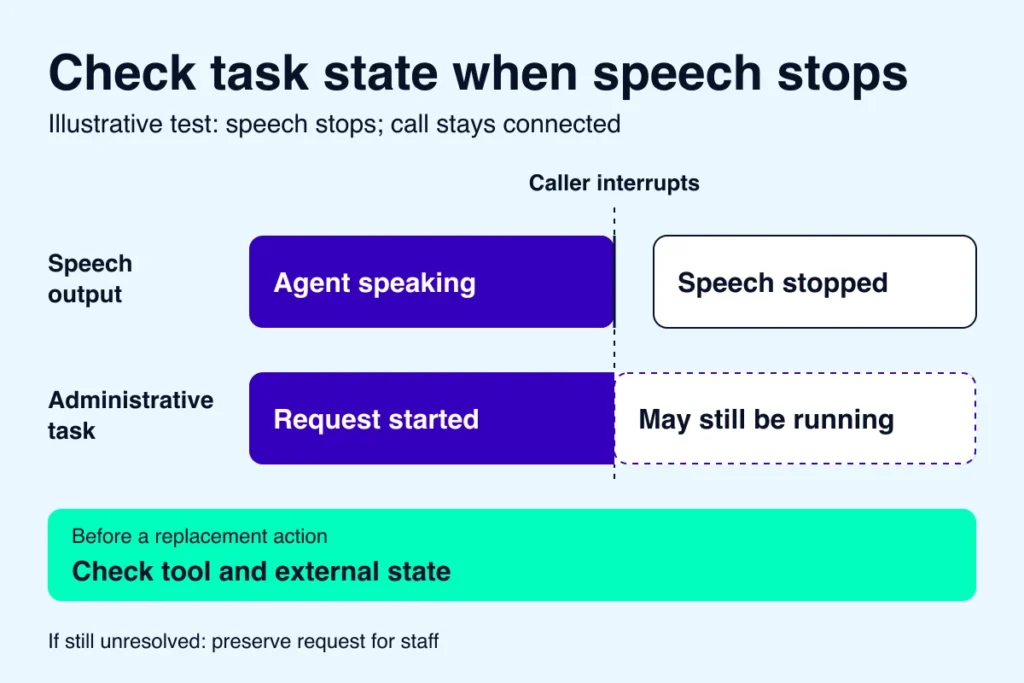
Test speech interruption and task recovery separately; check tool and external state before replacing an action.
Your scheduling system controls what the agent can book
Start with the operation you want the practice to hand over: booking, or rescheduling and cancellations. An AI receptionist for medical practices can claim completion only when the exact scheduling product permits the action and returns a confirmed result. Make those permissions part of discovery before designing the conversation.
Confirm the operations your site permits
Access to appointment data and permission to change appointments need separate checks. Confirm the route for the changes you want and the steps required for production access.
For your EHR integration or practice management system connection, ask:
- Which product/version and site configuration? If the proposed route uses FHIR R4, which reads/writes are supported for FHIR Appointment, FHIR Slot, FHIR Schedule and FHIR Patient?
- Which app/user is authorized, with what production access?
- Which booking/change/cancel operations are permitted?
- What appointment-type rules and failure/confirmation contract apply?
Use these questions when scoping a connection to athenahealth, eClinicalWorks or NextGen.
Have application code check the model’s generated arguments against independently maintained permissions and practice rules, including caller authority.
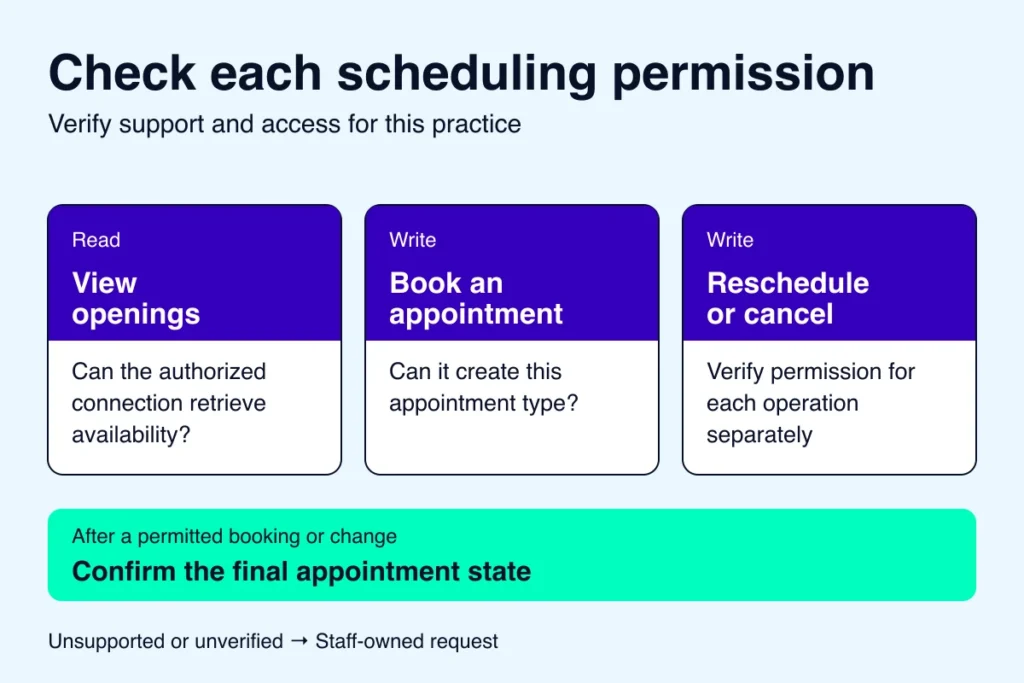
Confirm supported operations and production permissions for your exact scheduling product and site.
For implementation detail, see how to integrate with Epic EHR. Our “how will AI help change EHR?” guide covers broader strategy.
Confirm the booking before you tell the caller
Argonaut’s STU3 scheduling guide puts hold duration under server business rules and requires servers to declare cancellation support. It describes cancel-then-rebook failing partway through, leaving a cancellation without the replacement booking.
Verify which of these interactions your scheduling system supports. For your build, check hold expiry/release and slot competition. Treat an expired hold and a cancelled appointment awaiting replacement as distinct recovery states.
AWS’s Malcolm Featonby explains the retry problem: a timeout can follow a successful change. Apply that principle to scheduling: reconcile external appointment state or use the verified external idempotency contract before retrying.
Your local request ledger can’t guarantee exactly one external write. The request you sent and the result you can verify are separate pieces of evidence. Check the appointment system before deciding whether the change needs another attempt.
Speak completion only from confirmed external state. If reconciliation leaves the appointment outcome uncertain, preserve the request for its staff owner and explain that uncertainty to the caller.
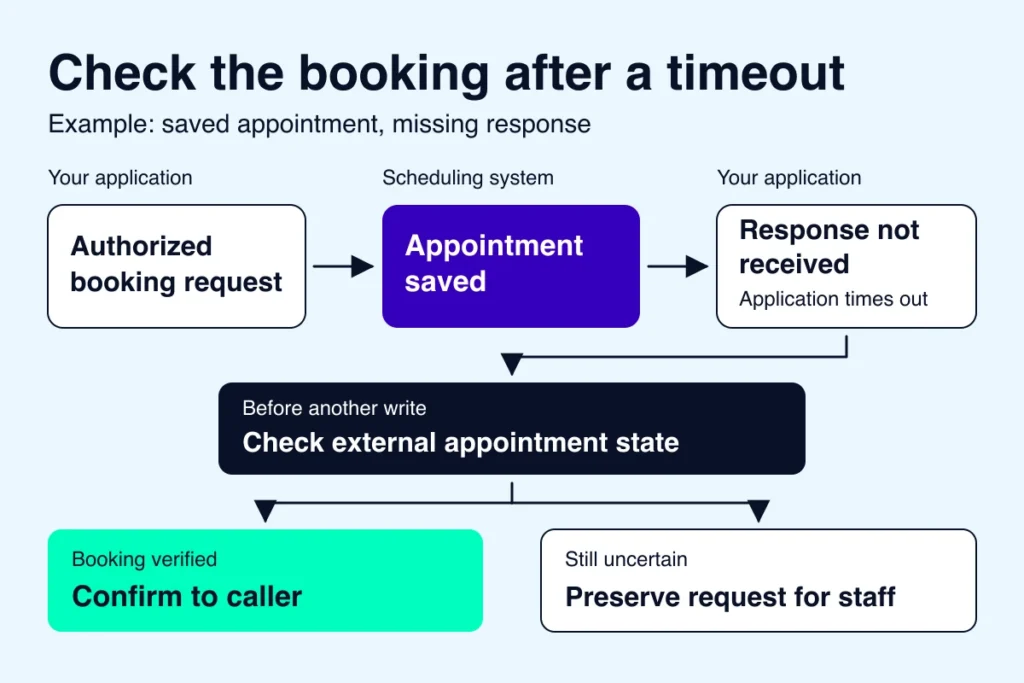
A missing response can leave a completed booking unconfirmed; verify external state before deciding on another write.
Verify callers and give urgent calls a human destination
The outcome for an AI receptionist for doctors should be an authorized disclosure or an accepted human destination. Put caller checks before the protected action, and give unfinished work a staff owner when that path fails.
Check authority before the protected action
Put these checks into the runtime flow:
Identity and authority
HHS/OCR and HIPAA’s verification rule require reasonable identity and authority checks before PHI disclosure when either is unknown. For your build, patient identity verification and authority checks precede the permitted action; unresolved checks go to staff.
Permitted exceptions
Exceptions cover permitted facility-directory, care/payment-involvement, notification and disaster-relief disclosures, including relevant care/payment disclosures after death. Professional judgment can satisfy verification for those disclosures; good-faith belief can do so for serious/imminent threats and defined law-enforcement cases under their legal conditions. Keep exception assessment with approved staff.
Proxy/minor scope
HHS/OCR ties access to applicable law and representation scope, including exceptions for minor-consented services, another authorized decision-maker, agreed confidential care and abuse/endangerment. Have staff assess that authority; a relationship label alone leaves it unresolved.
Messages and callbacks
HHS permits safeguarded appointment messages and requires accommodation of reasonable confidential-contact requests. Set voicemail/callback content to the practice’s approved wording and those preferences, and carry it into failed-callback recovery.
Unresolved checks
Give your human-in-the-loop route a staff owner who can resolve the check and pick up the request. Have that owner approve the disclosure scope before the agent resumes the protected action. Require guardrails that prevent a model’s hallucination from becoming permission to disclose.
A transfer needs an accepted destination
FDA’s defined administrative-support exclusion covers scheduling, admissions and billing functions. Red-flag detection with emergency instructions stays on the routing side of the line: it does not recommend a level of care. Telling a caller whether to come in, wait, or go to the emergency room is triage, and any build that adds that interpretation needs a separate intended-use assessment against FDA clinical decision support guidance.
For your first release, wire red-flag symptom detection for phrases such as chest pain, trouble breathing, stroke signs, suicidal statements or heavy bleeding to an interrupt that runs alongside the model and stops any task. The agent tells the caller to hang up and call 911 or the local emergency number, and immediately transfers a caller who stays on the line to the practice-approved destination. Every other urgent or clinical request is captured and routed to staff. Our health AI FDA clearance guide covers classification.
Agree emergency escalation and destinations for after-hours calls with practice clinical leadership, including whether a nurse triage line can accept the request. For behavioral health practices, agree the crisis path with clinical leaders, including the 988 Suicide and Crisis Lifeline. Every destination needs a decision about acceptance and a recovery owner when it can’t take the work.
Test these outcomes for your warm transfer flow:
- Confirm staff acceptance after answer.
- Recover from refusal or voicemail.
- Resume the caller conversation after timeout where supported.
- Close a departed caller’s pending call attempt as configured.
Test delivery of unfinished work to its assigned staff owner, even when the phone attempt has ended.
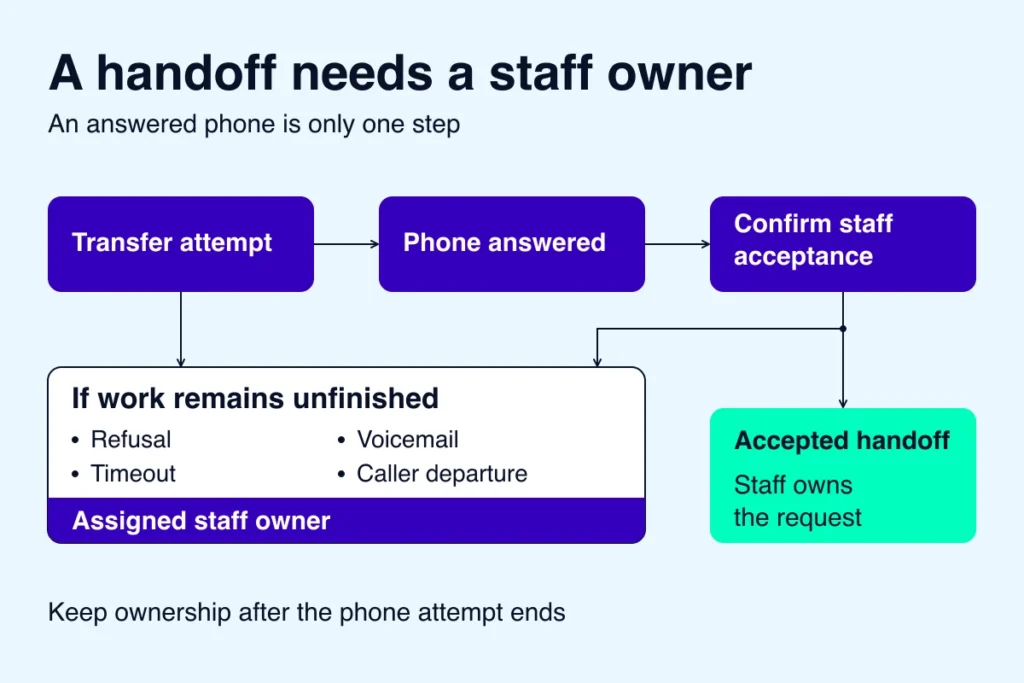
Confirm staff acceptance, and assign unfinished requests to staff when the phone handoff fails.
A HIPAA compliant AI receptionist needs controls across the call path
With a HIPAA compliant AI receptionist, the support console belongs on the same data map as live audio and transcripts. Trace protected health information (PHI) through those routes and match covered services to the applicable business associate agreement (BAA).
Check AI disclosure laws wherever your service will operate. Utah, for example, requires prominent opening disclosure for high-risk verbal interactions in regulated occupational services, including health-data collection.
For this build, make an opening AI notice your practice policy across the service, with approved wording.
Configure the records the call leaves behind
HHS/OCR exempts disclosures to and requests by providers for treatment from minimum necessary; internal access policies still specify roles, information categories and conditions. Scope the agent’s fields and operations to its duties, and review support access separately.
Under 45 CFR 164.312, map these controls onto each audio, transcript and support-data route:
- Access controls and authentication for the agent and support staff
- Audit controls for access to PHI
- Integrity protections for retained call records
- Transmission security along the approved routes
Encryption specifications remain addressable and require assessment under the current rule. For the chosen services, validate permissions and logs against the route they protect.
Separate medical-record retention from the Security Rule’s 6-year compliance-document requirement, under HHS/OCR guidance and 45 CFR 164.316. Set audio, transcript, log and backup schedules from applicable record laws and operational needs, with safeguards through disposal.
Give call recording consent its own jurisdiction review, tied to the exact recording and transcript routes the practice approves. Decide record settings before the team wires up storage.
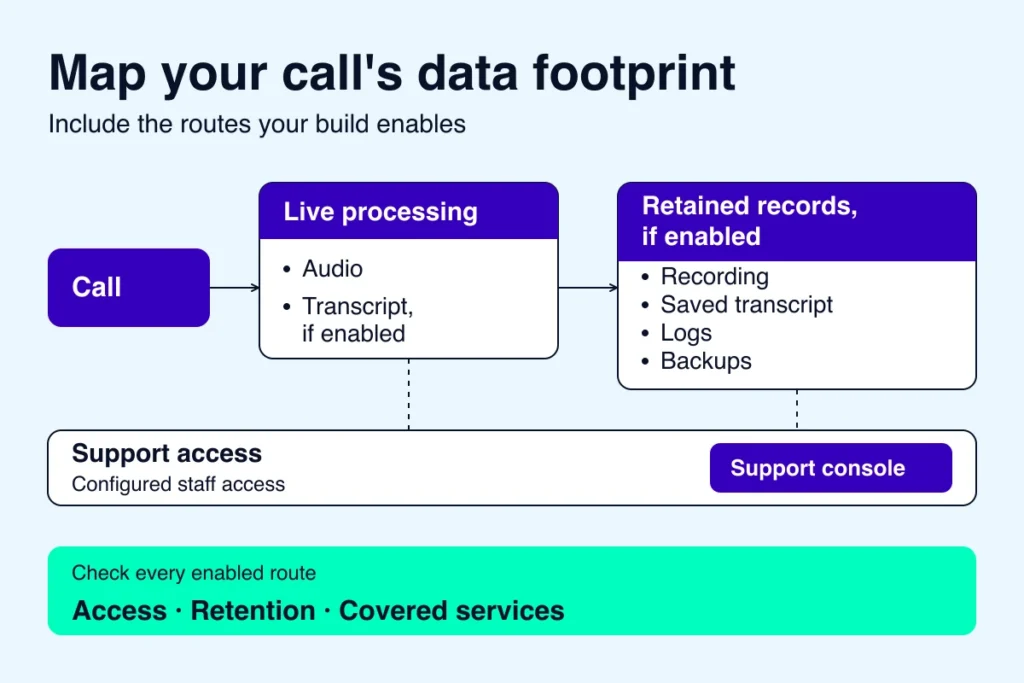
Review support access separately and set retention by record type across the enabled routes.
Use our HIPAA compliant software development guide for implementation detail; our ChatGPT HIPAA compliance guide covers the OpenAI-specific questions.
Outbound reminders need their own consent path
The FCC AI voice ruling (FCC 24-17) applies TCPA artificial/prerecorded-voice rules to initiated calls using AI-generated human voices. Review callbacks and reminders for applicable consent or exemptions separately from inbound answering.
FCC’s wireless healthcare exemption covers appointment/exam confirmations and reminders. Configure:
- A patient-provided number; no recipient charge or plan-allowance use.
- Provider identification and HIPAA compliance.
- No marketing or financial content.
- Generally, calls up to 1 minute and texts up to 160 characters; 1 daily/3 combined weekly messages.
- Immediate opt-out suppression.
Establish applicable permission for workflows outside that exemption.
Keep outbound permissions separate in the build scope, so approving the inbound agent doesn’t also switch on reminders or callbacks. Have the practice approve which outbound workflows the first release can initiate.
Require a verified payment-data bypass that includes recordings/transcripts. PCI SSC calls for system-specific PCI DSS scope assessment covering services that can affect payment security; a payment link or keypad alone establishes no exclusion.
How to build an AI medical receptionist around a narrow first release
To build an AI medical receptionist, start with one call type your practice can authorize. Confirm phone and scheduling access, then name the staff who recover unfinished work. A focused first release on one authorized call type typically goes live in eight to twelve weeks; the exact duration depends on the access you can confirm.
In a MGMA case study, Valley View Hospital in Colorado examined missed calls by hour and day, transfer destinations and call duration. Those findings informed routing and staffing changes.
The clinics identified front-desk transfers for prescription refills, clinical questions, billing or medical records. Use practice-approved call data to choose the first authorized workflow and name the staff who handle the rest.
Use this proposed roadmap:
| Phase | Work/output | Practice input | Exit evidence | Indicative duration |
|---|---|---|---|---|
| 1. Discovery | Map call types/rules; confirm exact phone, scheduling and contact permissions | Approved call samples/logs; system contacts and staff routes | Chosen first workflow; supported operations and named owners | 1-2 weeks |
| 2. Pilot build | Connect the test phone route and selected voice path to the authorized workflow | Test access; approved scripts and tool rules | Calls whose final administrative outcomes and exception tasks staff can inspect | 4-6 weeks |
| 3. Testing | Test uncertain writes and disclosure limits; exercise interruptions, failed handoffs and degraded services | Representative call conditions; practice-defined criteria | Approver-reviewed results; blocking failures resolved | 2 weeks |
| 4. Go-live | Release approved scope with staff coverage and monitoring; enable rollback/manual recovery | Named release owner; staffed destinations | Observable task outcomes; unfinished work has an owner | 1-2 weeks |
| 5. Expansion | Add the next call type, location or language after permissions, recovery and measured results are accepted | Updated rules, including multilingual support scope; receiving staff | Accepted evidence supports the added scope | 3-4 weeks per added call type |
What makes a fast build possible
Speed comes from configuration rather than shortcuts. We reuse a proven voice architecture and components across projects, and prior experience with major EHR and PM integrations shortens the discovery of what each system permits. A narrow first release keeps testing and approvals small, and going live first on after-hours or overflow calls shows results while risk stays low. Compliance is configured from the start instead of added later.
WHO’s guidance for large multimodal models supports defined tasks with appropriate accuracy and reliability, informed early by patients and clinicians alongside other affected users. Put those boundaries in writing and name approvers.
AMA’s AI governance toolkit recommends assigning monitoring responsibility and defining escalation routes. For this pilot, name who reviews failures and owns recovery.
Bring these practice inputs to discovery:
- Approved call samples and scripts
- Phone/scheduling access and technical contacts; available vendor security reports, including SOC 2
- Visit/provider rules and disclosure permissions
- Staffed handoff destinations and release/QA owners
Before you decide how to build an AI medical receptionist, settle the first workflow and access dependencies with the practice. A missing permission or unresolved decision leaves the launch plan open. Request a scoped plan against those inputs; our HIPAA compliant app development guide covers deeper implementation.
Price the build and the running minutes separately
Build costs. For an AI receptionist in healthcare, build effort follows the calls you approve and the access your systems allow. Ask for a scope that names the practice rules and recovery paths the first release must support.
Have the proposal connect that work to its estimate. You should be able to see what changes when you add another approved call type or require a different recovery path.
Running costs. Budget for phone service and platform/hosting, plus inference usage and staff QA. Whether you use Twilio or another phone provider, request itemized numbers and minutes, including any streaming, transfer or recording charges.
Request platform/hosting charges and plan-specific allowances separately from inference usage. Check the selected speech and model services’ actual billing units, such as audio minutes, generated characters and input/output tokens.
State expected usage and included credits. Compare alternative phone routes separately, and itemize integration, EHR access, additional services, taxes and human operations.
Ask for the build total and recurring estimate as separate lines, with their assumptions attached. Make staff review visible alongside service usage so you can budget for the work that continues after launch.
Our healthcare app development cost guide covers broader project budgets. Keep this proposal tied to the receptionist’s authorized scope.
Before signing, ask who owns support and staff QA, what code and licensing rights you receive, who controls the vendor accounts, and how call data will be handled.
Prove the launch with a checklist and call-level results
Agree release criteria for an AI receptionist for healthcare before simulated call testing. NIST’s voluntary Generative AI Profile supports deployment-like evaluation and manual recovery; have a named practice approver review the results.
For call QA, vary accents, noise and interruptions. Inspect actual audio and final system state, including multi-turn corrections and an injected tool error.
Use these proposed outcome checks:
- Confirmed booking: Match the spoken confirmation to the scheduling system’s final appointment state.
- Uncertain write: Simulate a timeout after commit and a repeated request; inspect external state and the unfinished request’s next step.
- Protected disclosure: Test failed identity or proxy checks; inspect disclosed information and the staff route.
- Human handoff: Test accepted and failed transfers; inspect staff acceptance, received context and final callback/task disposition.
- Degraded service: Test slow or unavailable services; inspect the manual recovery record and prove staff can retrieve unfinished work and return calls with necessary context.
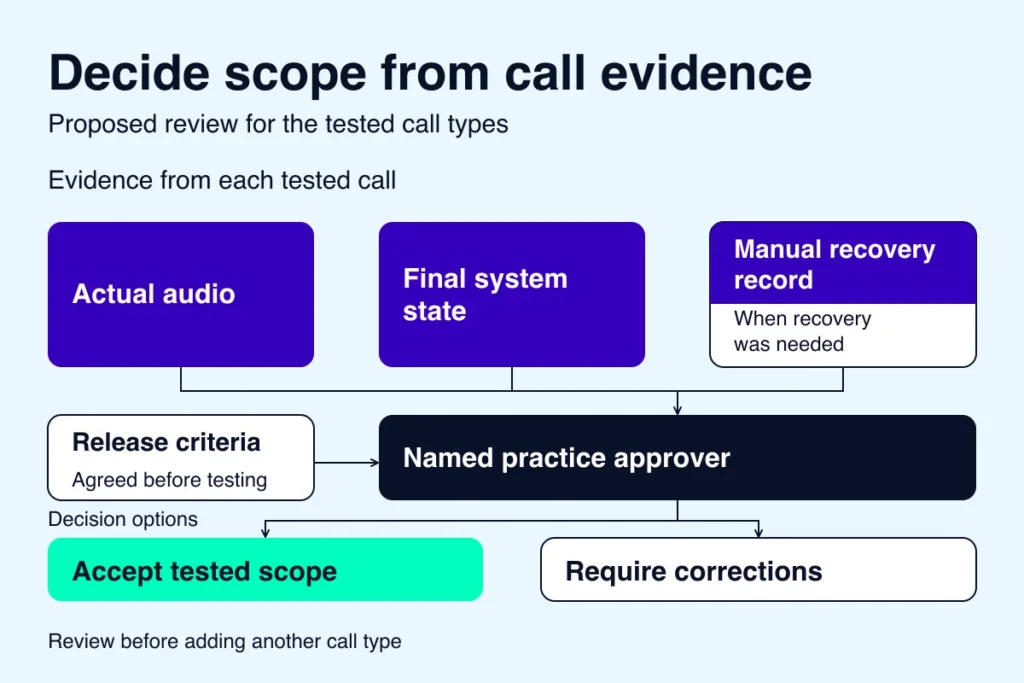
Review call evidence against criteria agreed before testing, and limit approval to the tested scope.
Expand only after the results hold
Compare equivalent periods for inbound volume, answer time/hold time, call abandonment rate, unanswered calls and callback performance. Track completed administrative tasks and staff corrections separately, alongside staff workload. Count calls separately from unique patients; define the no-show rate’s denominator and observation period before judging changes.
The practice approver accepts the tested scope or requires corrections before adding another call type. Our AI in healthcare compliance guide covers review tooling.
AI medical receptionist development with Topflight Apps
We build custom, HIPAA-compliant AI receptionists quickly. Our work covers the real-time voice pipeline and latency tuning, scheduling integrations with Epic, athenahealth and specialty practice management systems, safety and escalation design with clinical leaders, compliance configured from the start, phased launches with measurable results, and ongoing support and improvement.
In adjacent caregiver-support work, our Mi-Life AI chatbot for Goldie Floberg helps caregivers retrieve client-specific information. John Pingo, Goldie Floberg’s President and CEO, says: “The MVP simplifies access to essential info, reducing mental strain for caregivers.”
To scope your AI receptionist for medical practice, bring us your existing phone system, exact scheduling product and site, and the first call types you want it to handle. Those inputs let us define permitted actions and delivery dependencies, with staff handoffs approved by your practice.
Talk to our healthcare app developers about a bounded first release. A focused first call type typically goes live in eight to twelve weeks; we confirm duration, price and ownership in the scoped proposal.
Frequently Asked Questions
What is an AI medical receptionist?
A custom phone agent completes permitted administrative tasks in your practice’s systems. It captures staff-owned requests and routes calls beyond its approved scope.
How long does it take to build and launch an AI medical receptionist?
A focused first release on one authorized call type typically goes live in eight to twelve weeks: one to two weeks of discovery, four to six weeks of pilot build, two weeks of testing, and one to two weeks to go live. Exact durations depend on confirmed phone and scheduling access and are fixed in the scoped proposal.
Can an AI receptionist book directly into Epic, athenahealth, or my practice management system?
Booking requires authorized write access for your exact product and site. Confirm completion only from the appointment system’s successful result.
Is an AI medical receptionist HIPAA compliant?
Yes, it can be, when every service that touches call audio, transcripts or patient data is covered by a BAA and the deployed call path applies appropriate safeguards. That includes the phone service, speech-to-text, the model and text-to-speech, with data access and retention set to the agent’s duties. Review the selected services with us before the first call goes live.
Does an AI receptionist have to tell patients it is AI?
Use an opening AI notice as practice policy. Legal duties vary by jurisdiction and workflow; Utah requires opening disclosure for high-risk verbal interactions in regulated occupational services.
What happens when a patient calls with an emergency?
Red-flag phrases interrupt the call, give the 911 instruction, and transfer callers who stay on the line to the practice-approved destination, including after-hours and failed-transfer recovery. Recommending a level of care stays out of scope.
Can the AI receptionist work with our existing phone numbers and phone system?
Yes, when your number or SIP route and provider configuration can connect the voice workflow to authorized tools and staff handoffs. In discovery we confirm the exact connection path and what the carrier permits. Number changes or porting are only needed when the existing route cannot support the call flow.
Can it handle calls in Spanish and other languages?
Test the chosen language workflow and provide qualified-assistance or interpreter routes where required. Fluent AI speech alone doesn’t establish qualification.
How much does it cost to build and run a custom AI receptionist?
Build cost for a focused first release typically runs $30,000 to $60,000, depending on the approved call types, scheduling access and compliance scope. Running costs are usage-based: phone minutes, speech and model usage, generated speech, hosting and staff QA, typically in the low hundreds of dollars per month at modest call volume. Ask for the build total and the recurring estimate as separate lines with their assumptions.
Does TCPA apply to AI appointment reminder calls?
TCPA rules apply to initiated calls using AI-generated voices (FCC 24-17). Configure applicable consent or qualifying exemption conditions, provider identification and immediate opt-out suppression.
Who owns the system and the call data?
Agree code and licensing rights, vendor-account control, call-data handling and support responsibilities in the contract before signing. Ownership terms are a contract decision, not a platform default, so settle them before the first call goes live.