

Your week runs long: notes after dinner, unscored PHQ-9s and GAD-7s, clients on their own between sessions, and the rest of the desk work that never gets billed. AI for therapists can help with much of it.
An AI assistant for therapists is three products sharing one rulebook: a session-note drafter, a between-session check-in loop, and a compliance layer that decides what may be recorded and what never leaves the therapist’s hands. The therapist owns every output.
Psychologists are experimenting already. According to the APA’s 2025 Practitioner Pulse survey, 56% have used AI in their practice, and 22% use it for note-taking or dictation. Upheal, Mentalyc, and Blueprint are the names that keep coming up.
Measurement-based care is the obvious opening, and it barely happens. The legal side is less forgiving: as of late 2026, six states ban standalone AI-delivered therapy, and your license answers for where you sit on that line.
This piece stays on the clinician-facing assistant. The adjacent guides:
How do you build an assistant for therapists that survives compliance review?
Build three products over one rulebook: a session-note drafter, a deterministic between-session check-in loop, and a compliance layer covering the psychotherapy-notes rule, 42 CFR Part 2, recording consent, and state AI-therapy laws. Buy the transcription and the large language model integrations; build the templates, artifact classification, consent service, and escalation rules; put the therapist’s signature on every output. And the AI never delivers therapy.
Key Takeaways:
- Where each artifact is stored matters more than how well the AI writes. HIPAA splits the signed progress note from the therapist’s privately kept analysis, and a defensible product makes that separation possible without deciding it for the therapist.
- Deterministic scoring and a written escalation policy are the whole check-in game. LLMs cannot score validated instruments, six states ban AI-delivered therapy, and a positive item 9 at 11 p.m. must not sit in an unread queue until Monday.
- Buy the plumbing, build the judgment. Transcription and the LLM are commodities you rent with a BAA; templates, artifact classification, consent, and escalation are the parts no vendor can own for you, and trust gets earned in the review screen.
Table of contents
- What an AI assistant for therapists is, and what it is not
- Buy or build: the two-minute answer
- Module 1: AI session notes for therapists
- Module 2: Between-session check-ins, measurement-based care without an AI therapist
- Module 3: HIPAA-compliant AI for therapists, the compliance map
- Reference architecture: what to own in a therapist assistant
- EHR integration: FHIR where you can, partnership where you can’t
- Therapist trust is built in the review screen
- The therapist assistant build checklist
- Why choose Topflight Apps for AI assistant development for therapists
What an AI assistant for therapists is, and what it is not
A therapist assistant is clinician-facing software that drafts session documentation, collects and summarizes structured client check-ins between sessions, and enforces the consent and data rules specific to behavioral health. Everything it produces waits for your review, and the AI never communicates therapeutically with the client.
The market files these tools under two words, scribe and chatbot. Neither name fits once the tool holds an entire caseload. Six rows separate them:
| General ambient AI scribe | Therapy chatbot | Therapist assistant | |
|---|---|---|---|
| Primary user | Physician | Client or consumer | Therapist |
| Talks to the client therapeutically | No | Yes | No, structured check-ins only |
| Default note format | SOAP or H&P | None | DAP, BIRP, SOAP, GIRP, plus modality templates |
| Longitudinal context | Single visit | Conversation history | Treatment plan, goals, and symptom trajectory across sessions |
| Key compliance layers | HIPAA, BAA chain | HIPAA or FTC, state chatbot and AI-therapy laws | HIPAA psychotherapy-notes rule, 42 CFR Part 2, state AI-therapy laws, recording consent, minors |
| Primary risk | Hallucinated clinical facts | Harmful advice, missed crisis | Mis-stored sensitive content, missed risk language, consent gaps |
The compliance row is where the categories split hardest. A behavioral health AI scribe answers HIPAA through a chain of business associate agreements. The assistant also has to:
- keep psychotherapy notes separate,
- label Part 2 data,
- track consent per session,
- follow the state AI-therapy laws,
- and handle minors.
That list is why you can’t just grow a scribe into an assistant. The compliance work has to be designed in from day one.
No vendor sells notes, check-ins, and compliance as one architecture aimed at builders. Blueprint comes closest on breadth, Eleos on compliance depth, and all of them sell to clinicians rather than to teams building their own.
Money is arriving anyway. According to Rock Health’s H1 2025 market overview, AI-enabled startups took 62% of US digital health venture funding ($3.95 billion of the $6.4 billion total), with clinical and non-clinical workflow tied as the top-funded categories at $1.9 billion each.
The EHR-embedded options most therapists already know are SimplePractice Note Taker and TherapyNotes TherapyFuel.
Related: guide on how to build an AI medical assistant.
A general ambient scribe documents a visit. A therapist assistant documents a relationship over time, under stricter confidentiality rules, with a client who may be in crisis between sessions.
Among AI tools for therapists, the assistant is the one defined by a shared rulebook:
- one consent model,
- one data-classification model,
- one clinician-in-the-loop rule.
An AI scribe for therapists is one module of it, not the whole. The buy-or-build answer comes next, then the three modules in order, each with the decisions you have to make and the questions to put to a vendor.
Buy or build: the two-minute answer
Three doors, and each is a real one. Buy a tool your colleagues already use, like Upheal or Mentalyc. Use the features your EHR already ships, like SimplePractice’s note taker. Or commission a build around your own modality, note style, and check-in routine.
Three questions decide which door fits.
1. First, do your templates need to be yours?
A couples, DBT, or EMDR practice fits generic forms poorly, and template quality is the loudest complaint about off-the-shelf tools.
2. Second, do your compliance answers need to be yours?
A bought tool ships with its own storage, consent, and state-law posture, and your license rides on choices the vendor made.
3. Third, what does a build cost against your caseload?
A custom assistant costs real money and months; it pays back when it saves after-hours work or becomes the product you launch.
You can also buy now and still win, if you know what to demand. The modules below define what a tool must do with your notes, your check-ins, and your compliance obligations, bought or built, and they double as the questions you take to any vendor.
Module 1: AI session notes for therapists
AI session notes turn a recorded or summarized session into a draft progress note in your practice’s format, which you edit and sign. The hard part is deciding what the AI may keep and where each artifact is stored.
Progress notes vs. psychotherapy notes: the classification decision
The market treats AI therapy notes as one thing; HIPAA splits the session into two classes of record.
Under 45 CFR 164.501, psychotherapy notes are the therapist’s notes about counseling content. The definition excludes medication records, session start and stop times, modalities and frequencies, test results, and any summary of diagnosis, functional status, treatment plan, symptoms, prognosis, or progress. Whether something qualifies depends on how it is created and kept. They sit outside the client’s right of access, and payers may not condition payment on them.
Many therapists call the same private analysis process notes. The classification treats AI progress notes like handwritten ones. The product must make the separation possible, not decide it for you.
| Artifact | What it is | Default |
|---|---|---|
| Session audio | PHI | Not stored; deleted within hours of sign-off |
| Raw transcript | PHI | Deleted after sign-off unless the practice opts in |
| Extracted entities and draft note | PHI; part of the designated record once signed | Stored in the EHR as the progress note |
| Therapist’s private reflections | Candidate psychotherapy notes | Separate store and controls, excluded from exports and payer requests |
| Risk-language flags | PHI | Shown for review; never auto-inserted into the note |
Note formats and modality-specific templates
AI for therapy notes starts from your practice’s format: DAP, BIRP, SOAP, or GIRP, with modality-specific templates for CBT thought records, DBT diary card review, and EMDR phases, plus the mental status exam (MSE) where needed.
The intake assessment (CPT 90791) documents differently from ongoing sessions (CPT 90834, 90837). Couples and family sessions capture multiple speakers, and the APA says to clarify the identified client: one record for couples or families, separate records for group.
The CY 2026 Medicare Physician Fee Schedule: $173.35 for intake (CPT 90791), $113.90 for 90834 at 38-52 minutes, $167.00 for 90837 at 53+ minutes, $14.70 for the 90785 interactive complexity add-on.
AI progress notes for therapists live inside an episode, and payer audits read the episode as a whole. Expired or mismatched treatment-plan goals let payers deny later services even when the notes look complete. Every note links its medical necessity language to the treatment plan; that linkage is what the audit tests.
Session capture without overreach
Capture has three modes:
- in-room ambient listening,
- telehealth platform audio (Zoom for Healthcare is the common example),
- post-session dictation or summary, no client audio.
Dictation is a first-class path where clients or states make recording impractical. The two-step extract-then-generate pipeline behind them is the ambient AI scribe app development guide’s subject.
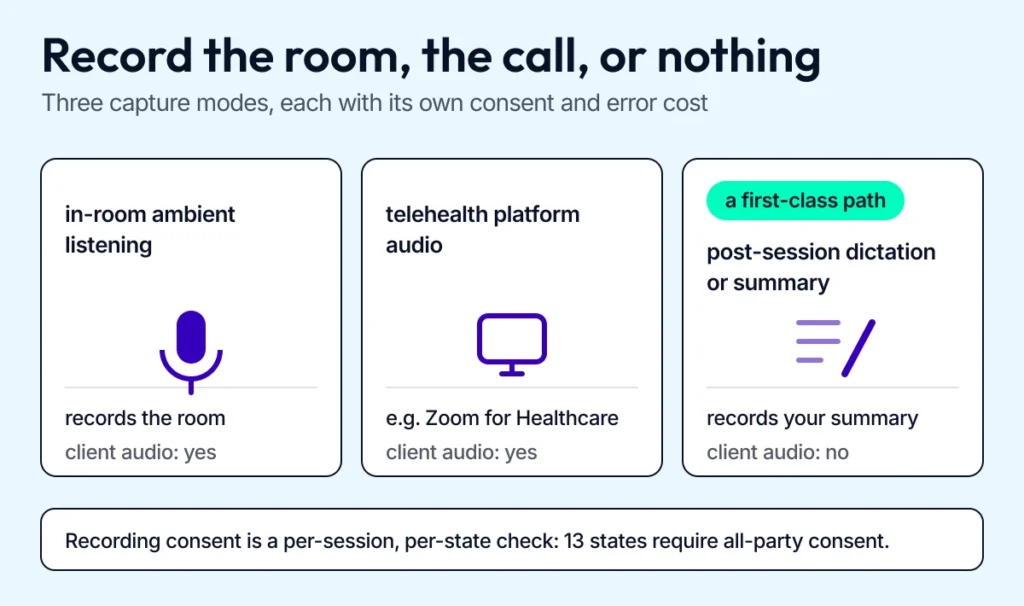
Two of the three modes record the client; the third is why dictation has to be a first-class path.
Recording consent is your per-session, per-state check: 13 states require all-party recording consent, and Michigan’s status is contested.
Therapy notes AI is only as trustworthy as its transcript: Whisper hallucinated phrases or sentences in about 1% of transcriptions, per Koenecke’s ACM FAccT 2024 study; 38% carried explicit harms.
Illinois’ WOPR Act bans AI from detecting emotions or mental states. Do not ship emotion detection or sentiment scoring of your client’s voice as a note feature. Summarize; interpret it yourself.
Risk language is different: suicidal ideation, self-harm, abuse disclosures, and homicidal statements must surface as a flag with the source quote, never silently summarized or omitted. Paraphrasing “I don’t see the point anymore” into “client reports low mood” is a safety failure.
Module 2: Between-session check-ins, measurement-based care without an AI therapist
AI-assisted check-ins send clients validated questionnaires and short structured prompts between sessions, score them deterministically, and hand you a pre-session trend summary. The AI summarizes for you; it does not respond to the client therapeutically.
What a compliant check-in contains
A JAMA Psychiatry review found 18% of psychiatrists, 11% of psychologists, and 14% of master’s-level clinicians practice measurement-based care routinely; the figures are 2007-2018 vintage, and no newer national survey has replaced them.
The instruments are validated and free to embed:
- PHQ-9,
- GAD-7,
- PCL-5.
C-SSRS is the trap: free for clinical use, but a commercial product embedding it needs a license through Clario.
LLMs cannot score these instruments: four open-weight models failed measurement invariance on PHQ-9 and GAD-7 with what the authors called extreme prompt fragility, and LLM-generated versions changed the validated cutoffs.
The rest is yours to set:
- schedules,
- homework adherence and skill-practice logging,
- mood tracking prompts,
- an optional short free-text field.
The patient-reported outcome measures (PROMs) a practice uses are scored with fixed summing rules, in code, never through a model.
Responses, scores, and logs live in the assistant’s check-in store behind the same consent service that covers the notes, away from any vendor’s training set.
The line between support and therapy
Between-session check-ins may send reminders, deliver instruments, acknowledge responses, and share pre-approved content you assigned. They may not generate coping advice, reflective responses, or reframing. The state-law basis sits in the compliance map below, and the line itself is the therapy chatbot compliance guide’s subject, alongside conversational AI in healthcare.
Crisis escalation design
Crisis is why the loop cannot be casual. Suicidal ideation fluctuates hour to hour: in an EMA study of 54 adults with a recent attempt, 29% of ratings shifted more than one standard deviation within hours, and 94% of participants showed at least one such shift.
The trigger is deterministic: PHQ-9 item 9, C-SSRS screens, and risk words in free text fire a pre-written response that names the 988 Suicide & Crisis Lifeline, local emergency services, and after-hours instructions, with the client’s safety plan alongside, plus a therapist notification.
Enrollment says check-ins are not monitored in real time. A positive item 9 at 11 p.m. sits unread until Monday. Write the escalation policy before the feature; get clinical leadership to sign it.
The pre-session brief
The payoff is one screen: the symptom trajectory across score trends, homework completion, flagged items with their source quotes, and the last note’s plan. The brief feeds the next note’s draft, which is where the two modules connect.

Score trends, homework, flags, and the last plan on one screen, so the session starts from evidence instead of memory.
Reimbursement reality
CPT 96127 covers administering and scoring brief standardized instruments, per instrument per encounter, and the 2026 Medicare national average is $5.01.
The digital mental health treatment codes, G0552-G0554, have been live since January 1, 2025, but they require FDA 510(k)-cleared or De Novo-authorized devices, so a typical check-in feature does not qualify.
Cara Lewis, first author of the JAMA Psychiatry review, put it flat: PROs are a data source and do not constitute MBC. A check-in loop counts only when it meets her four-part definition: administer, practitioner reviews, patient reviews, collaborative reevaluation.
That is the reimbursement story for measurement based care software: real, but modest. The 2026 CMS fee schedule guide owns the remote therapeutic monitoring (RTM) and digital mental health treatment (DMHT) reimbursement detail.
Module 3: HIPAA-compliant AI for therapists, the compliance map
HIPAA compliant AI for therapists is six layers deep, and most vendor marketing answers one of the six. Here is the map you hold a vendor to.
| Layer | Applies when | Do |
|---|---|---|
| HIPAA plus the psychotherapy-notes exception | Always, covered entities and their vendors | BAA chain; separate store for psychotherapy notes; minimum-necessary retention for audio and transcripts |
| 42 CFR Part 2 | Federally assisted substance use disorder (SUD) programs, and anyone receiving their records | Label Part 2 data, track consent; segmentation optional, role-based controls prudent; HIPAA-style penalties since February 16, 2026 |
| State AI-in-therapy laws | By the client’s location, often the therapist’s | Geo-aware rules; stand-alone written AI consent where required; no therapeutic AI communication; no emotion detection in Illinois (WOPR Act, HB 1806). Bans as of late 2026: Illinois (HB 1806), Nevada (AB 406), Rhode Island (H 7349A), Maine (LD 2082), Colorado (HB 26-1195), Vermont (H 816); Utah HB 452 regulates disclosure instead |
| Recording consent | Every recorded session | All-party consent captured before recording; per-session revocation; sessions spanning two states follow the stricter rule |
| Minors and families | Clients under 18 and family sessions | Guardian consent; state minor-consent carve-outs; separate visibility for adolescent check-ins |
| FDA | Features that diagnose, predict, or recommend treatment | Keep notes and summaries in documentation territory; check the CDS and general wellness policy guidance, current as of January 2026, before adding risk scores |
The list moves, so re-check it before you sign anything: Tennessee’s law, for example, bans only AI advertising as a mental-health professional.
Related: HIPAA compliant software development guide.
One consent model for all three modules
One consent service covers all three modules. You and your client can revoke each one at any time, and the system checks them at runtime before each action:
- informed consent for AI,
- recording,
- check-in enrollment,
- data sharing.

State-aware rules only hold if the consent service checks them before every action.
For your minor clients: a minor who lawfully consents to their own care generally controls access to those records, which limits what a parent can see.
Related: AI in healthcare compliance guide.
The BAA chain and model-provider settings
You need business associate agreements at every hop:
- cloud,
- transcription,
- LLM,
- telehealth,
- messaging.
Get zero data retention and no-training settings confirmed in writing, and de-identification configured, not promised.
When a vendor waves a SOC 2 Type II report, it attests that controls ran over a period. It is not a BAA, and it proves nothing about HIPAA, Part 2, or state consent.
Make Part 2 obligations flow down into your BAAs, and give the data model a notes-type split so SUD counseling notes stay out of the shared record.
Related: ChatGPT HIPAA compliance guide.
Duty to warn and mandated reporting
Mandated reporting routes the same way: the assistant flags, you decide and file, and no report is ever assistant-authored.
Duty to warn came from Tarasoff II in 1976: protect an identifiable victim. California codified it, Texas rejected it; your escalation rules cannot fit every state at once.
State law follows the client: capture client location at session start. If you are licensed in Texas and your client travels to Illinois, that session runs under Illinois’ consent rule, two-party consent included. Flags route to you; the decision and the documentation stay yours.
Related: health AI FDA clearance guide.
Reference architecture: what to own in a therapist assistant
Buy the commodity infrastructure (transcription, LLM, hosting) and build the parts that carry clinical and legal judgment: note templates, artifact classification, consent, check-in escalation, review UX. That is what separates a defensible AI note taker for therapists from a demo.
Build, embed, or white-label: the question answers itself once you walk the system the three modules define.
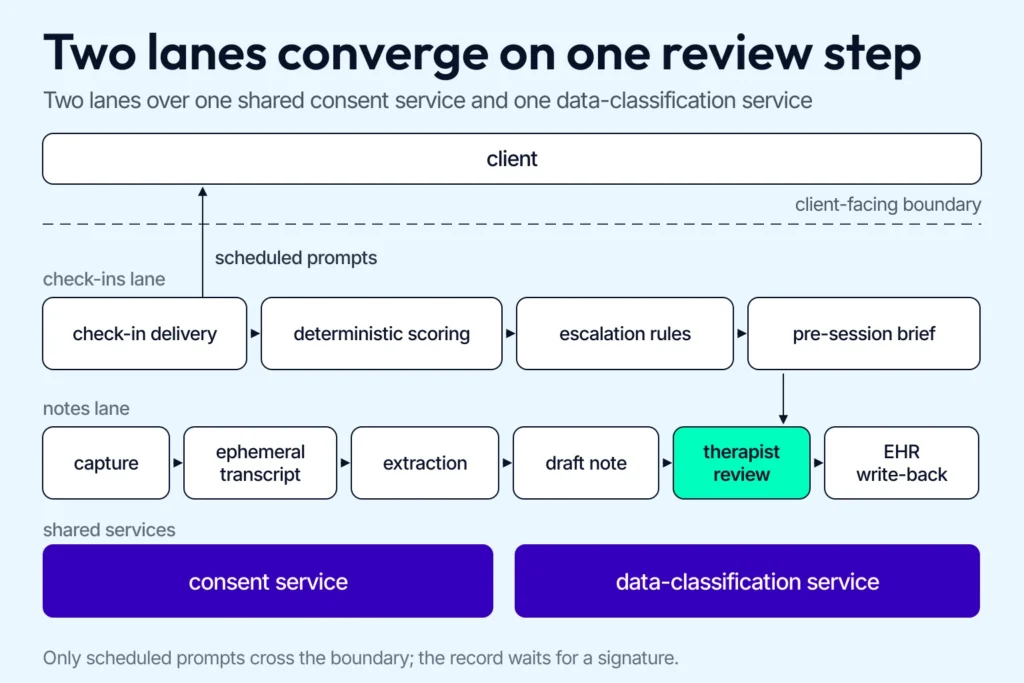
Buy the lanes as two builds if you like; the shared layer and the one review step are what make it one product.
The notes lane runs capture, ephemeral transcript, extraction, draft note, therapist review, EHR write-back. The review step is where the lane earns its defensibility: nothing leaves it without your signature.
The check-ins lane runs delivery, deterministic scoring, escalation rules, pre-session brief. It converges on the same therapist review step, which is what makes the assistant one product instead of two tools bolted together.
Underneath both lanes sit a shared consent service and a data-classification service. The dashed line at the bottom is the client-facing boundary, and only scheduled prompts cross it.
Around the large language model (LLM) sit the surfaces you buy or configure: prompt templates, retrieval-augmented generation (RAG), confidence scoring, and model evaluation. Every one of them is plumbing; the judgment lives in the lanes.
| Component | Buy or build | Why |
|---|---|---|
| Transcription and diarization | Buy, with a BAA | Commodity; test with 3+ speakers for couples and family sessions |
| LLM for extraction and drafting | Buy API, BAA, zero retention | Frontier models beat fine-tuned small models on nuanced session content |
| Note templates (DAP, BIRP, modality) | Build | Your specialty differentiator; generic templates are the top complaint about generalist tools |
| Artifact classification and retention | Build | Encodes your legal posture; no vendor owns this for you |
| Consent service | Build | Must be state-aware and checked before every action |
| Check-in instruments and scoring | Build on open instruments | Scoring must be deterministic and auditable; verify licensing per instrument |
| Crisis escalation | Build with clinical sign-off | Must reflect each practice’s after-hours coverage |
| EHR integration | Depends | FHIR where available; many therapy EHRs have limited write APIs |
| Whole assistant | Embed or white-label | Valid if your differentiation lies elsewhere; diligence the vendor against the compliance map above |
Speaker diarization is the one benchmark worth knowing: best-in-class runs roughly 9-10% error at three speakers, and no therapy benchmark exists, so your own multi-speaker tests are the only evidence that counts.
FHIR, the Fast Healthcare Interoperability Resources standard, is the API format health systems use to exchange clinical records; where it exists, it is the write-back path for your signed notes.
The last row answers the build-versus-buy question: buy the plumbing, build the judgment, and diligence anything you embed.
EHR integration: FHIR where you can, partnership where you can’t
A note draft is only useful if it lands in the record you already use, and the behavioral health EHR market is fragmented: API maturity runs from FHIR write-back to no public API at all.
Saying “we integrate with your EHR” presumes an API. The two biggest therapy platforms have no public write path, so the plan has to match the system the practice actually runs today.
| EHR | Write path |
|---|---|
| SimplePractice | No public API or webhooks; SimpleConnect is enterprise and partner-gated; no FHIR |
| TherapyNotes | No API, no developer program; data leaves only via manual export |
| Valant | Sales-gated “EHR API Management” add-on for patient, charge, appointment data; no public docs, no FHIR |
| Netsmart | Public FHIR R4 API (CareConnect); DocumentReference create documented |
| Qualifacts (CareLogic, Credible) | Registration-gated FHIR R4, read-oriented USCDI patient access; no documented note write-back |
| Epic | FHIR R4 DocumentReference create, Observation writes, QuestionnaireResponse write-back; per-organization approval and scopes |
The matrix is the evidence for the split verdict: write where the API exists, and where it does not, plan partnerships or assisted copy flows to get the note into the record.
Where write-back exists, it rides on FHIR R4: DocumentReference for signed notes, QuestionnaireResponse and Observation for check-in scores, SMART on FHIR launch where the EHR supports it.
For substance use documents, tag the note’s security labels as restricted and SUD-sensitive, so the labels travel with the record wherever it goes.
Related: How to integrate with Epic EHR.
Diligence integration before you choose an assistant, and put it on your vendor questionnaire.
Related: how will AI help change EHR.
Therapist trust is built in the review screen
The adoption numbers are in. The open question is what makes you keep the tool, and the answer sits in the review screen.
The APA’s 2025 ethical guidance puts the weight on you: critically evaluate AI-generated content before you apply it, stay responsible for the final decision, and treat disclosure and informed consent as the floor.
That guidance makes human review the real face of the product. It is where you check the words you are about to own, and responsibility without verifiability feels like liability. If every word falls on you and the screen gives you no way to check them, the tool reads as a threat.
Psychiatrist Mark Komrad, writing in Psychiatric Times, said it out loud: “I found it pretty remarkable, but not a time saver… by the time I was done proofing it, editing it and adding to it… it did not save me any time compared to just writing my own note.” Dinah Miller and Paul Nestadt reached the same verdict in their own trials.
The survey data shows the payoff when the screen works: among AI-using physicians, 68% increased their documentation AI use in athenahealth’s 2025 survey, and the share calling it overhyped fell from 40% to 27%.
Six things earn that trust:
- notes that sound like you, because the tool learns from your edits;
- review in under two minutes;
- source quotes on hover;
- a visible AI-drafted status until you sign;
- one tap to discard everything from a session;
- an audit log of every draft and edit backing that status.

Status, quote, exit: the three things that turn a two-minute review into a reason to keep the tool.
Trust is earned in the two minutes right after the draft appears. Ship that screen, and retention follows.
The therapist assistant build checklist
The checklist compresses the three modules into what you verify before launch, or before you sign a vendor. Nothing here is new; everything here is load-bearing.
Notes:
- format templates per modality;
- artifact classification table implemented;
- transcript auto-deletion;
- risk-language flags with source quotes;
- multi-speaker testing.
Check-ins:
- validated instruments with licensing confirmed;
- deterministic scoring;
- written escalation policy signed by clinical leadership;
- after-hours behavior disclosed to clients.
Compliance:
- BAA chain complete;
- stand-alone AI consent and recording consent, versioned and revocable;
- client-location capture;
- Part 2 labeling and consent tracking;
- minors workflow;
- FDA feature review.
Integration and trust:
- EHR write-back path per target system;
- audit log of every AI draft and edit;
- therapist sign-off before anything reaches the record.
Work the list in order. For the compliance group, the HIPAA compliant app development guide carries the depth.
Why choose Topflight Apps for AI assistant development for therapists
Topflight Apps has shipped each of these layers across behavioral health builds, and the offer below is where every project of ours starts.
The proof, in bullets:
- behavioral health product experience,
- LLM note pipelines with clinician review,
- measurement-based care and check-in flows,
- consent and data-classification architecture for HIPAA, Part 2, and state law,
- EHR and telehealth integration.
We built this same shape for Goldie Floberg’s caregivers: Mi-Life, a HIPAA-compliant assistant they query by voice or text instead of memorizing 1,300 pages of policies, every answer grounded by retrieval-augmented generation. The Mi-Life case study has the build.
The offer: before you write code, map every artifact the assistant creates to its storage and access model, and agree who can see each one. If you’re buying instead, the same map is your questionnaire: walk a vendor through every artifact and its access model before you sign.
We draft the compliance map for every behavioral health build anyway, and you get a working review screen early, because trust is built there.
For the broader mental health app picture, from scope to launch, the mental health app development guide carries it.
Building an AI for mental health professionals means giving your clinicians an assistant that documents a relationship. Building one for your therapists or your behavioral health platform? Talk to Topflight Apps about your notes, check-ins, and compliance requirements, and we will bring this checklist to the first call.
Frequently Asked Questions
Is it legal for therapists to use AI to write session notes?
Legal where consent and state rules are met. What decides it is how artifacts are classified and stored: the signed progress note is ordinary PHI, and separately kept psychotherapy notes stay protected.
Do I need client consent to use an AI note taker in therapy?
In all-party recording states, yes, before any capture. Illinois requires stand-alone written AI consent, named in the map’s state-law row. Disclose AI use and get consent in every state.
Are AI-generated therapy notes considered psychotherapy notes under HIPAA?
Depends on how they are created and kept. A signed draft progress note in the record is not a psychotherapy note. The therapist’s separately kept private analysis is.
What is the difference between an AI scribe and an AI assistant for therapists?
A scribe documents a single visit for a physician. A therapist assistant drafts notes, runs therapist-supervised check-ins, and enforces behavioral health consent and classification rules across sessions.
Can an AI assistant respond to clients between sessions?
Not therapeutically. Six states ban AI-delivered therapy as of late 2026; the map’s state-law row names them. Allowable: reminders, instrument delivery, acknowledgements, and pre-approved content you assigned.
Which states restrict AI in mental health care?
As of late 2026, Illinois, Nevada, Rhode Island, Maine, Colorado, and Vermont ban standalone AI-delivered therapy; the map names them and their bills. The list moves, so re-check at enrollment.
How does 42 CFR Part 2 affect AI tools in substance use treatment?
SUD records get consent tracking, labeling, and separation of SUD counseling notes, and Part 2 obligations flow into BAAs. Enforced with HIPAA-style penalties since February 2026.
Can between-session check-ins be billed to Medicare?
Scoring brief standardized instruments bills under CPT 96127. The digital mental health treatment codes require FDA-cleared devices, so a typical check-in feature does not qualify on its own.
Does an AI assistant for therapists need FDA clearance?
Notes and summaries stay in documentation territory. Risk scores, diagnoses, or treatment recommendations push toward clinical decision support, so review against FDA guidance current as of January 2026.
How do AI therapy notes handle couples and family sessions?
Clarify the identified client first: one record when the couple or family is the client, separate records for group members. Multi-speaker capture needs testing with 3+ speakers.
Should session recordings be stored after the note is written?
No. Audio and raw transcripts are ephemeral PHI. Delete them after note sign-off unless the practice deliberately opts in.